…sometimes hope looks like compost, slow, surprising, quietly transforming what was into what could be. So, maybe the best we can do is let ourselves be changed by love, by grief, by dirt under our fingernails, and by small, ordinary acts of grace. So, wherever you are today, may you remember that your smallness is not insignificance, that love really is fundamentally expressed in potato chips and text messages and a place at the table. It is all still love. And that belonging is not something we earn, it’s something we practice over and over and over again…
~ Kate Bowler, Everything Happens with Kate Bowler, April 2, 2025 ~
Not a poem, but certainly akin to what I often post here on Fridays.
Several years ago, a dear friend grieving the passing of her daughter, told me about Kate Bowler. Admittedly slow on the uptake, to both Kate’s writing and podcasts, I recently subscribed to her weekly Lenten email, The Hardest Part. This week’s description of her recent podcast with long-time friend, Jeff Chu, struck a chord:
We talked about what it means to feel stuck in a life that doesn’t quite fit. About the grief of loving people who may never love us the way we wish. About small, ordinary acts of care—texts, meals, potato chips—that remind us we belong to each other. If you’re in the messy middle, tending what’s dying, planting without guarantees, or quietly rebuilding your hope, this conversation is for you.
And it was. Right on point. A bit of balm for its honesty, vulnerability, and invitation, as I’d been shaming and shunning myself for letting small and petty resentments and disappointments, and bigger betrayals eat away at me.
Their conversation reminded me – as I, we, navigate these bone-jarring and often dispiriting days – that I’m in another “messy middle”… of the Lenten season… of winter giving over to spring… of where I find myself in my own lifespan, soon to cross into the next decade. “May you live in interesting times.” Wasn’t that the greeting?Ahhh, well...
“Anger is always the bodyguard of our woundedness. There’s the trauma, there’s the anger, there’s the rage, but healing is about moving through that. Not distancing, not distracting, but moving through it to that really fundamental sadness and hurt that’s beneath the anger.”
Buddhist teacher Lama Rod Owens in the Harvard Divinity School’s newsletter
A few decades ago, I sat in a week-long workshop with a teacher I’d long admired. Noticing how we were passively note-taking, he suddenly threw down the gauntlet, asked why we’d each spent the considerable time and money to attend a program devoted to authentic leadership when we were, at that moment, like sheep grazing in a pasture?
I knew in my bones this was the invitation I had to accept and so, taking a risk by being the first one to reply as honestly as I could, I said that for several months, I’d been feeling a low-grade anger with so much of what I’d been seeing, experiencing, feeling both at work, and in the world. That I was irritable, quick to judge, hypercritical of myself, and those around me. That I’d lost my spark, my joy, my initiative and creativity. That while I didn’t feel depressed, I wondered if I was.
And he said, looking me straight in the eye, that my anger was my response and in direct proportion to my heart’s deep sadness for the state of the world and my life.
I felt my shoulders drop, my gut relax, and almost wept with relief for this re-framing. Later in the week, he also dropped another belief bomb: that as leaders, we had to learn to keep our hearts open in hell.
Right now, and for the past three months, I have again been feeling anger. Though more the righteous outrage variety. I’m irritable and hypercritical. I’ve lost my spark, feel flat and less inclined to engage in conversation. I haven’t written a poem in ages, and wonder if the fallowness has given over to being stuck in frozen-solid clay, a nearly impossible medium from which any creative seeds might sprout and emerge. Right now, I’ve wondered if I’m depressed.
In quiet moments, when my heart softens and my eyes well with tears, I remember this is truthful protection. The urgency I’ve felt to shake up and ask for action and accountability from those who have helped create this current hell, IS my deep sadness, though its origins are from long ago. The inherited trauma from generations who lived silenced by threats, abuse, and death. The small child in me – who was me – who, sensing things were terribly wrong and seeing no one do anything, felt betrayed and anxiously compelled to do something to fix it.
I’m leaning into the realization that NOW I’m feeling the same betrayal, first felt as a child, at the hands of people who should have known better and done better, and now towards people who are intentionally making it so much worse. Its fear and anxiety have been both driving and distancing me from an almost wordless sadness and hurt. I’ve been acting out from this long ago wounding.
To continue – mindlessly – would be further wounding. To continue – mindfully – is keeping my heart open in hell. “It’s all true,” the mantra I learned from another wise teacher. May it be so.
“As long as the Earth can make a spring every year, I can. I won’t give up until the Earth gives up.” – Alice Walker
“Indeed, to garden — even merely to be in a garden — is nothing less than a triumph of resistance against the merciless race of modern life, so compulsively focused on productivity at the cost of creativity, of lucidity, of sanity; a reminder that we are creatures enmeshed with the great web of being…” – Maria Popova
“Like the seeds, we have to straddle that paradox of not leaving the comforts of our gestational time too quickly, while finding ways to keep moving. Coming out of winter is like waking from hibernation—we need to go slowly, steadily… …As we step into the capacities of our next becoming, we must do two things. The first is to come into a clear conversation with that pulse of vitality and originality which is growing within us, and the other is to meet, name, and respect our resistances to that growth. After all, resistance is what strengthens and protects us in ways we may not yet understand. Sometimes what looks like hesitation is actually wisdom in disguise.” – Toko-pa Turner
“After you have exhausted what there is in business, politics, conviviality, love, and so on — have found that none of these finally satisfy, or permanently wear — what remains? Nature remains; to bring out from their torpid recesses, the affinities of a man or woman with the open air, the trees, fields, the changes of seasons — the sun by day and the stars of heaven by night.” – Walt Whitman
Another snowstorm. A new salvo of political cruelties. A week further into the northern hemisphere’s Spring. A vow made and shared.
It’s 7:00 am Sunday morning. I’m an early riser. Lately, too early as I’ve been plagued with a bout of early morning insomnia, waking around 3. Sometimes I toss a bit, listen to the slow and steady breath of Sig sleeping beside me and try to synch my breath with hopes of falling back to sleep. When my mind overrides that intention, I quietly rise, slip into my robe and slippers and head downstairs to read, or write, or take my place on my cushion, or stare out the window, wondering.
In a couple of hours, I’ll be attending an onsite, in-person writing workshop. Hosted by the Writers’ Guild of Alberta, it’s described as “an all-day retreat designed to nourish your creative process. Writing exercises, inspiring prompts, and focused discussion will get your juices flowing and keep you motivated for days and weeks afterwards.” Goodness, I hope so, for like an Alberta spring, no sooner do my juices start to melt and flow, when they freeze solid and need to be chipped and chopped to get flowing again.
Last week in my monthly online writers’ circle, we each spoke of being in a fallow season, making reference to Katherine May’s memoir Wintering; gave space for our reactions to democracy’s demise in the face of growing fascism; and anticipated Spring’s arrival the next day. A closing offering of a poem which I’ll share here to close today’s short, and “OK enough” post.
This Spring
How can I love this spring when it’s pulling me through my life faster than any time before it? When five separate dooms are promised this decade and here I am, just trying to watch a bumblebee cling to its first purple flower. I cannot save this world. But look how it’s trying, once again, to save me.
Every day I see or hear something that more or less
kills me with delight, that leaves me like a needle
in the haystack of light. It was what I was born for – to look, to listen,
to lose myself inside this soft world – to instruct myself over and over
in joy, and acclamation. Nor am I talking about the exceptional,
the fearful, the dreadful, the very extravagant – but of the ordinary, the common, the very drab,
the daily presentations. Oh, good scholar, I say to myself, how can you help
but grow wise with such teachings as these – the untrimmable light
of the world, the ocean’s shine, the prayers that are made out of grass?
– Mary Oliver –
“How are you?” ask friends who I’ve not seen, nor spoken to for a while. “Terrified,” my response.
Not afraid, but terrified…for my country…the illegal apprehensions, deportations, and denied entry…the constant blatant disregard for law…evil in the guise of leadership.
Not a very mindful response, or is it? Certainly more intense and less palatable than “afraid.” But in the moment, truthful, uncensored. And then it passes. The weight of it lessens for its utterance. But I know, too, that I need those moments of seeing and hearing that kill me with delight.
Thankfully, Walker obliges. Every day. The shine in his eyes, tongue hanging in joyful anticipation as I dress to play with him outside. Chasing him with one of the store of sticks he’s taken from the woodpile in the back. Our backyard scattered with them. Or inside, tugging on the damp-with-drool dishrag nearly shredded, or his blue racquetball, or red kong – each tight in his mouth, until he lets go in false surrender just to keep the game between us going.
Thankful, too, that yesterday’s sunshine and warmth allowed me to sit outside on a cafe’s patio to eat lunch after my 8+km river valley walk. All of it a balm. Nature and good food as co-regulators.
And that exquisite hand-made card sent by a friend who is excelling at paper quilling, her latest fascination. In yesterday’s mail, the envelope with my name and address, written by a hand I didn’t recognize. The note inside, bearing the same beautiful script, thanking me for my words, the tapestry I weave with them, the meaning they bring to her.
Coming through a “wintering” season, again with many more rejections of my writing than acceptances, with words laying fallow, deep underground, her gift like a prayer made out of new, spring-green grass.
Much love and kindest regards, dear friends. And to you, Cate, thank you.
I wondered if last Friday’s photo and poem feature were simply too much for readers, as few opened the post, either here or on social media. Perhaps if I’d titled it, “I Am NOT Happy,” and posted another photo, instead of using the title of Ilya Kaminsky’s poem, “We Lived Happily during the War,” with my photo of an actual Ukrainian door burned in the invasion, it might have evoked more curiosity and less reluctance. Please know this is not a critique, simply an observation AND acknowledgment of so much fatigue, despair, rage and fear, AND the wise self-care choices we each need to make, including what to click and read, and what to pass on. Though I must take a moment to acknowledge, with deep and abiding gratitude, another’s post that cracked open and gave me permission to name what I’d named in mine.
Karen Maezen Miller, an ordained Soto Zen priest, wrote last week, “I Am Not Free,” in which she unabashedly and vulnerably shared the impacts of and her feelings about the current goings on in the USA. I won’t go into detail, but to read a Zen priest – one whose writings have always hit the mark for me, and to whom I have occasionally, naively attributed a well-practiced, placid, equanimity – use the words “terrified,” “furious,” and “hate,” was one of the most reassuring pieces I’d read in weeks. One from which I did feel free.
Last week I attended a session hosted by my library’s new writer-in-residence. “Music and the Practice of Poetry,” it ended up being a wonderfully playful experience in understanding the importance of rhythm to writing and reading aloud poetry. As recommended, I brought something to write on, in this case my black journal of bits and pieces of writing transcribed over the years from my journals, letters, emails, social media posts. A collection of “seeds” that when I reviewed, saw how several had sprouted and blossomed into poems and essays. Like this piece, written in 2014, its essence rooted in last Monday’s post, “Rest.”
“I hear a murmuring of rest, OK, yes and then the air smelling sweet and cool. There are berries to pick and laundry to hang. Groceries to buy and friends to call. This could be enough. For right now is enough. Ease back into life here at home. Give thanks and send blessings to all those suffering.”
Or this one, that I wrote and posted on Facebook exactly six years ago today. Its simple truth and prescience like Kaminsky’s poem.
And how I’ll end this post:
“There are the times when a poem becomes a prayer, an image the beautiful antidote to the day’s atrocities.”
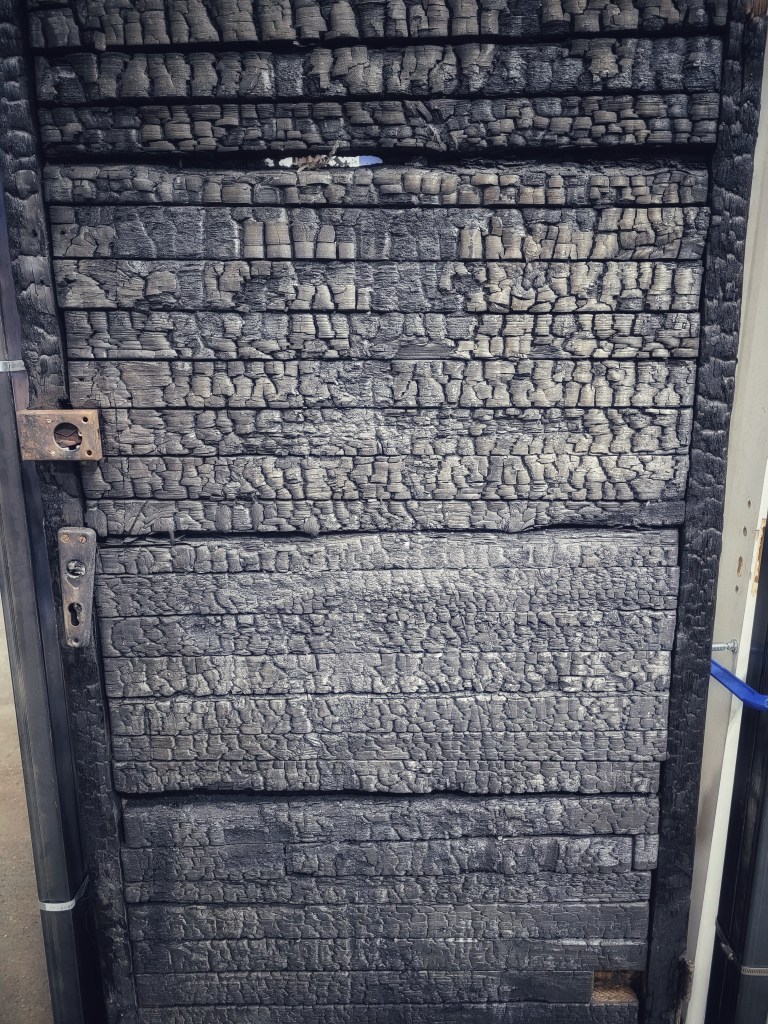
Ukrainian doors burnedand shattered in the war started byRussia February 2022
We Lived Happily during the War
And when they bombed other people’s houses, we
protested but not enough, we opposed them but not
enough. I was in my bed, around my bed America
was falling: invisible house by invisible house by invisible house —
I took a chair outside and watched the sun.
In the sixth month of a disastrous reign in the house of money
in the street of money in the city of money in the country of money, our great country of money, we (forgive us)
lived happily during the war.
~ Ilya Kaminsky, Deaf Republic. 2019 ~
I first heard Kaminsky’s poem in June 2021, read by Padraig O’Tuama in his Poetry Unbound podcast. Written in 2009, its powerful prescience grabbed me then, before hell was unleashed in Ukraine when Russia invaded in February 2022. And it hasn’t let go. Its grip now tighter as the American Republican administration, thinking it is the “great country of money,” backed by men in their “houses of money,” threatens my country, its people, and our livelihoods.Already killing the land, people and livelihoods of Ukraine, Gaza, and beyond.
I am not happy. In all honesty, I feel the rage that comes with such betrayal; fear; sadness; and, in moments, an unsettling hatred towards these men intent on destroying our world. Their acts are evil, committed without empathy and in full consciousness of the consequences of irreparable suffering and death.
Below is my post, written shortly after Russia’s invasion of Ukraine, in which I first included Kaminsky’s poem and the wise words from Canadian elder, Stephan Jenkinson, suggesting “it is no accident that we were born at a time when the culture that gave us life is now failing.“
No one lives happily during war. It is madness to think otherwise, despite the lies and bravado to the contrary. Thankfully, our world is too connected, and blessedly our hearts, to ignore the assaults and violence being perpetrated. Admittedly, it does not make for easy living.
Much love and kindest regards, dear friends.May you keep well. You are needed. We need each other.
In yesterday’s inbox, I received two emails that struck me as contrasting approaches to coping with the current global state of affairs. In one, subject line: Sanity Repair Kit, its author listed thirteen personal strategies to help her stay above despair. The second, the weekly love note from Christine Valters Paintner, abbess of the online contemplative-creative community Abbey of the Arts, opened with the 6th principle of its Monk Manifesto:
“I commit to rhythms of rest and renewal through the regular practice of Sabbath and resist a culture of busyness that measures my worth by what I do.”
Deep, holy breath in and out…I could feel my body relax into the truth of rest being, as Tricia Hersey, founder of The Nap Ministry, writes: an act of resistance in a culture that wants to exploit and deplete our labor so others can profit. Could this be more on point at this time when we’re told that empathy is the fundamental weakness of Western civilization?
While the first email’s list included practices I know I could be doing, should be doing, and am doing – more or less – mostly, I felt overwhelmed and out of breath …except for the invitation to stare off into the sky for several seconds or minutes. Something I do quite regularly, sitting in my living room, often with Walker sleeping there in the sunshine. I understand “different strokes for different folks,” yet I want to uplift here an appreciation for and the wisdom in doing no-thing.
Suddenly, I am remembering with a smile the story I used to read during staff inservices, written by Robert Fulghum of the All I Really Need to Know I Learned in Kindergarten fame. I no longer have that well-marked, tabbed, and dog-eared copy, but it was his experience of taking a pair of favorite leather shoes to the shoemaker for resoling that captures the essence of doing no-thing. He writes:
“The shoe repair guy returned with my shoes in a stapled brown bag. For carrying, I thought. When I opened the bag at home that evening, I found two gifts and a note. In each shoe, a chocolate-chip cookie wrapped in waxed paper. And these words in the note: ‘Anything not worth doing is worth not doing well. Think about it. Elias Schwartz.’”
“Sabbath is not a doing, but a way of being in the world… In those spaces of rest comes renewal, with dreams for new possibilities. As a culture we face so many issues that feel impossible to tackle in meaningful ways. One way to begin is to allow enough space for visions to enter, to step back and see what happens when we slow down our pace first. . . .”
Christine Valters Paintner
Part of my Sabbath often includes cooking a good, ample meal giving us leftovers to get through the beginning of the week. With classical music or relaxing jazz streaming in the background and an occasional glass of wine, I’m in my element. Too, writing my Monday blog, warmly ensconced in my studio, surrounded by my various creative endeavors, inspiring images, vision boards and books, I sink into the wellspring of potential beneath the heartlessly cruel rhetoric filling so much airspace today.
Years ago, before The Abbey of the Arts, or The Nap Ministry, my friend Christina Baldwin penned the exquisite Seven Whispers (2002). “Move at the pace of guidance,” is the second whisper, combining two instructions: to re-humanize our speed of life, and to use a slower pace to actively listen for spiritual guidance.
“The pace of guidance, like peace of mind, begins internally – in me. Even though all my conditioning teaches me to accommodate speed, I am responsible for the pace I bring to the moment, just as I am responsible for the peace I bring to the moment.”
Christina Baldwin
What chocolate chip cookies might we find as we allow and settle into a slower pace and use this overwhelming and despairing time to do no-thing? What visions of possibility and inner wisdom might we access by resting and resetting our overwrought nervous systems? What might be the outcome of such a bold, strategic act of resistance?
“We must hang onto our humanity, it is why we’re in the world.”
Christina Baldwin
Much love, kindest regards, and moments of deep and abiding rest, dear friends.
Each moment of rest, of doing no-thing, of being our own Sabbath matters. Each word, each photograph, each email matters. Each kind word, each warm embrace matters. It’s what we have which I have to believe can turn the tide, perhaps first within the unseen, liminal spaces.
Buds in Spain, March 2020 (we know now the darkness that was soon to fall upon us all)
My gosh…what sweetness to suddenly hear your voice and words singing on the radio this morning.
My heart needed it all.
Such heavy harrowing times. My words are stuck and stuffed like my head cold.
Anyways…this moment a sweet one.
Hope this finds you well.
Much love and kindness.
~ Katharine ~
Re-reading my email, with my friend’s lovely reply, knowing that I am, like many around me, at a loss for words, I knew this was “OK enough” for today’s photo and poem feature. With a line break here and there, formatted into stanzas…yes, it would be “OK enough.”
And how simple a gesture, to respond in the moment to the surge of surprise and joy upon hearing my friend’s name and then her singing, to reach out and connect when it’s darkest… before dawn.
Much love and kindest regards, dear friends. May we all be bearing up well, responding in the moment to those many surges of unexpected joy.
So each word, each photograph, each email matters. Each kind word, each warm embrace matters. It’s what we have which I have to believe can turn the tide, perhaps first within the unseen, liminal spaces.
Last week, I received a lovely anonymous response to this blog, originally written and posted three years ago. An unusual occurrence given the time lapse, it’s lingered. Then, thinking about what to write for today’s post, being tired from another viral infection and wrung out from the aftermath of the latest brutal undoings in the USA, I’ve accepted as gift the right timing of its reappearance and have chosen to repost it now.
Three years later, its essence still fresh, its message more relevant, though the context and circumstances quite different.
I hope this finds you bearing up well, dear friends. We’ve had less than two months of this near incomprehensible, yet strategic dismantling of our world by the Republican administration of the United States. When I take a “holy breath” (thanks, Tenneson) the shock of it all softens into feeling grief and uncertainty (mine, the world’s). Those tears stuffed inside my head cold escape, and the feeling of fear for my country and the world again emerges. This is not “politics as usual,” and while more subtle, nor life. Yet, I must feel lightly…cope lightly…walk ever so lightly.
Much love and kindest regards…
“It’s dark because you are trying too hard. Lightly child, lightly. Learn to do everything lightly. Yes, feel lightly even though you’re feeling deeply. Just lightly let things happen and lightly cope with them. I was so preposterously serious in those days… Lightly, lightly – it’s the best advice ever given me…So throw away your baggage and go forward. There are quicksands all about you, sucking at your feet, trying to suck you down into fear and self-pity and despair. That’s why you must walk so lightly. Lightly my darling…”
Aldous Huxley, Island, 1962
Reading this quote last week it landed, more than lightly. Funny thing is I thought Huxley was advising “slowly my darling.” Musing on that for several days, recalling nearly a decade back, when at a week-long movement intensive – I there quite literally to “sweat my prayers” (Gabrielle Roth) – I met a woman recently retired though pursuing her independent coaching practice. She told me she never scheduled herself before 11 AM, preferring to enter each day slowly. I’m sure I countered with something like me being a morning person, liking to rise early, getting a good start on my workday.
Looking back, I was driven in that first year of “retirement,” striving to make a success of my independent coaching practice, not knowing how it would all work out after the decades’ long security of a pay cheque arriving twice monthly in my bank account. In those early months, I remember saying I needed to “make hay while the sun shone,” and secured contracts with people I enjoyed, doing work I loved. But I was exhausted. I remember falling asleep at a Friday night cooking class a couple of days before we flew to China for what ended up being an intense two-week tour. That whole trip I was cold, with photos showing me bundled in toque, scarf, and coat. I suffered through a couple of migraines, and within weeks of our return, developed Bells Palsy, a condition that left its indelible mark. A mark that to this day reminds me to go slow.
In my experience, while going slow is akin to walking lightly, it’s not the same. Trusting last week’s confusion, when I follow its thread, I see how going slow reveals the extent to which I am not “walking so lightly.” Lately, when I slow down, stop, sit still, or simply pause standing to notice the sky, step outside with Annie and breathe in the new day, sadness suddenly arrives. Nothing too pronounced, so it’s been easy to dismiss as I start moving or shift my attention. Despite its subtlety, it’s a sadness that’s been here for several weeks. I’ve alluded to it in one of my first posts of the new year, and last week’s when I wrote about remembering the light in the darkness.
I’m not one who writes to impart advice. In ten plus years of blogging, I can count on one hand the number of posts wherein I’ve listed, recommended, suggested what someone else can do to make their life better. Nor am I “reveal all” writer. Instead, usually prompted by someone else’s words, I disclose some of my own internal meanderings – messy as they might be. It’s through my way of writing – a process that can take several hours – I begin to catch a glimpse of a thread that shimmers, that when I tug, brings me, and perhaps someone else, a bit more clarity.
beauty in a hard place
I was a child taught to try hard and do well. Taking that lesson to heart, I tried too hard, grew too serious, and in ways, too hard. To “lightly let things happen, and lightly cope with them” was not what I saw, was never my lived experience. Fond of saying “it’s all true,” pithy wisdom from a long time ago therapist, helps me both to remember to hold the paradox of it all, and to lessen my need to try hard to understand, to fix, to make sense of it all. In the matter of my sadness – or perhaps the sadness that belongs to us all, and to the trees and the land and the sky and all the beings that have been holding our collective, unacknowledged, displaced grief of late, or since our beginnings – now to apply its wisdom to “feel lightly even though I’m feeling deeply.” Now to lighten my grip. No need to try hard despite the quicksands all about, especially as I try to fall asleep.
“Lightly my darling.”
Lightly, with much love and kindest regards, dear friends.







 A Wabi Sabi Life