“The truth is — the amount of days we have here is actually not so large. So if you have the opportunity to wake up tomorrow, to let this world age you and weather you and meet you where you are for even just one more golden minute — I hope you show up for it. Do as much as you possibly can with your time here. Risk your heart. Express. Take care of others, leave them better than you found them. Give yourself permission to take up space. Be all that you are. Love the way you hope to love, and love people on purpose, with depth and intention. Keep rescuing those younger parts of yourself. Forgive. Put every ounce of your patchwork soul into this world, crack tenderness into all of its dark corners. Stay soft, stay curious, but most importantly – just hold on to your hope.” Hold on to your hope.
~ Bianca Sparacino ~
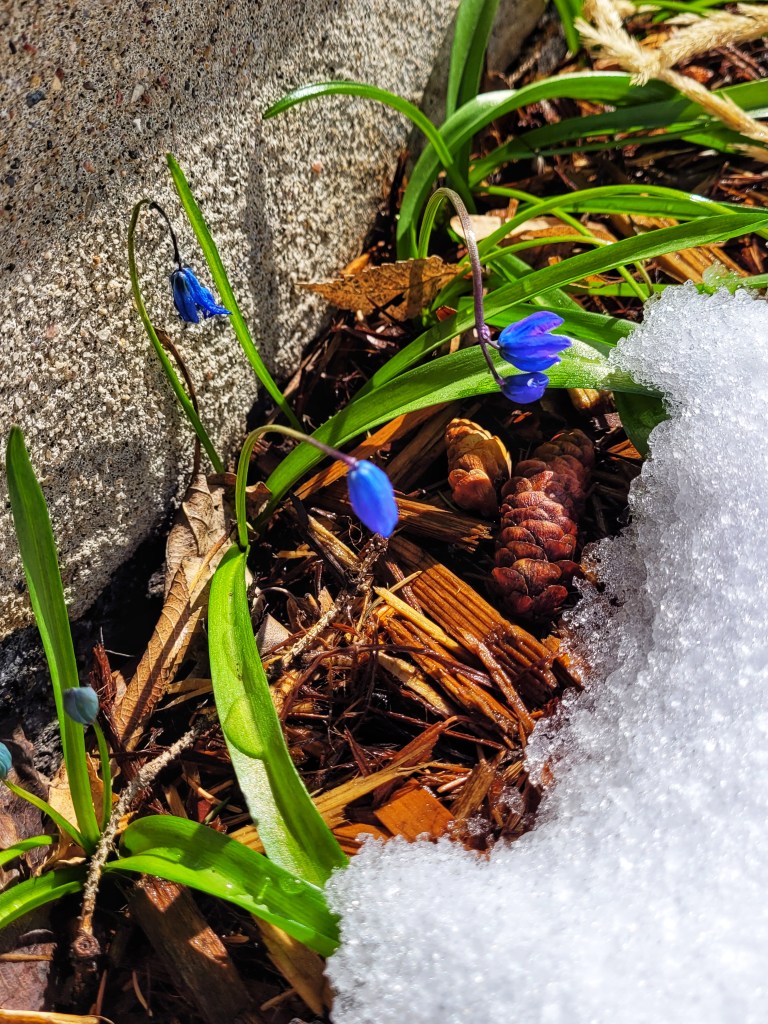
Not yet, but soon those small indigo Siberian squill blossoms, emerging through the snow, sheltered in against our home’s southwestern exposure. Tomorrow, March arrives as a harbinger and holder of Spring. It’s been a very, very long two months into this new year. Despite knowing more snow and a return to bitterly cold weather is likely, standing outside at dawn waiting on Walker, I feel uplifted. Its breeze is making fast work of the snow that, just a week ago, covered our yards and walks. Melts leaving puddles that freeze overnight. That cycle making for treacherouswalks.
Let Sparacino’s words be the tenderness cracked into the world’s dark corners. There can never be enough tenderness, or kindness, or hope. Admittedly, for me, dosed with times of righteous outrage and bewilderment.
During COVID’s then bewildering uncertainties and isolation, I first wrote about the mixed blessing of holy grief, holy gratitude, and holy love. Here I am again, now adding outrage. Holding our hearts open in hell as the tiny and tender indigo flowers find their place alongside the still icy cold snow. A metaphor for trusting that in that space between knowing and not knowing, there exists a realm of infinite possibilities.
“I believe poetry is very old. It’ s very sacred. It wishes for a community. It’s a community, ritual, certainly. And that’s why, when you write a poem, you write it for anybody and everybody…It’s a gift to yourself, but it’s a gift to anybody who has the hunger for it.”
Mary Oliver, as quoted in On Being with Krista Tippett
Four years ago, in January 2020, I designed and published this, my third blog, to serve as a platform for my writing. Little did I know then, that with the sudden arrival two months later of world-stopping Covid-19, I’d need to be leaning into writing and this space to cope with the grief of having lost my career and much of what I had assumed to be certain. I wasn’t alone in any of this, but the resulting systemic social isolation occasionally had me wonder.
By September that year, I’d set my sights on learning how to write poetry. I’d dabbled over the years in my blogs and journals, and for as many, was a devoted listener of The Road Home, a spoken word and music program curated by Bob Chelmick on my local radio station. I discovered Poetry Unbound, a podcast offering from my favourite On Being with Krista Tippett, hosted by Irish poet Pádraig Ó Tuama. With Annie on her leash, I’d plug in my earphones and for fifteen time-stopping minutes, walking familiar neighborhood routes, I’d listen to him read a poem and share his understanding about its structure, meaning, and resonance. An ardent fan, occasionally I’d write about him here, and took advantage of tuning into every free Zoom event around the world, hosted by Padraig reading, talking, teaching poetry. When I learned he’d be coming to Calgary for a retreat in 2023, I made haste months earlier to buy my ticket and reserve my bus ticket – a wise move as we had our first blizzard that weekend.
I joined a couple of Facebook groups for writers and took advantage of many free online readings and workshops to gain exposure to contemporary poets, seeing how they compared with my favourites, helping me find my voice. I was invited by Karen Close, founder and editor of Sage-ing: The Journal of Creative Aging with Creative Spirit, Grace and Gratitude to be her thinking partner and co-editor. Then exactly two years ago, upon the encouragement from one of my public library’s writers-in-residence – another complimentary service of which I have availed myself, I began the work of preparing a manuscript for submission to a well-known Canadian poetry publishing house. With Annie on her cushion by my side, I edited over seventy poems, received feedback from several friends and fellow writers, and emailed the package a week before heading off to walk the Portuguese Coastal Camino. An email in July brought the not so surprising, but none the less disappointing, news that my work had not been selected. It closed with the concise instruction “to persist.”
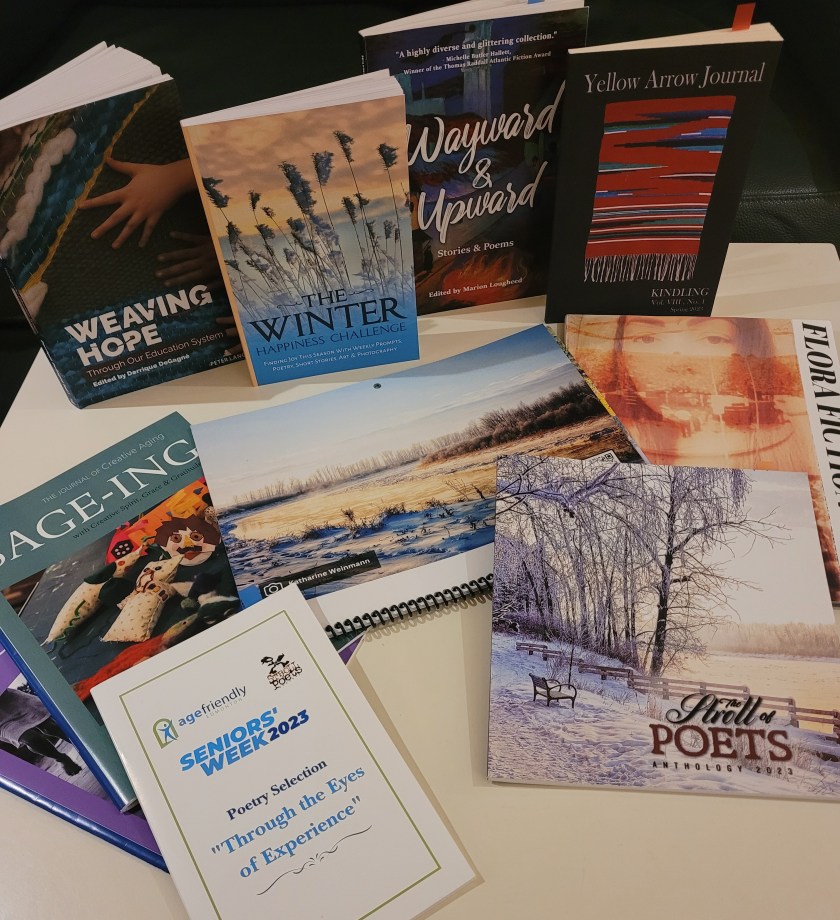
And so, I have. 2023 found me back in the saddle, submitting regularly to literary journals and online magazines around the world. I attended master classes with esteemed poets and prepared a chapbook for a publisher who had previously accepted one of my pieces. Another rejection, but she gave me the gift of feedback I’m using now to move my writing forward. Monitoring my submissions, tracking rejections and successes, with 70 sent last year, over 20% have been published, including several in national and international anthologies. In the meantime, as many journals invite submissions of art and photography, I’ve jumped in and have had several photos published – for money – have been included in a 2024 calendar featuring Edmonton’s river valley and have won the cover contest twice for our local poetry anthology. I feel chuffed.
I think alot about my writing: Why do I do it? What I give to it and what it gives to me? I’m committed to making poetry my writing genre of choice. Or, it has chosen me, being one who has long had a poetic turn of phrase and outlook on life. Like Mary Oliver, I believe poetry is sacred, being one of the ways I bring the sacred into my life, making my life as poem and prayer. However, unlike many writers, I’m not yet confident that writing is my way to, for lack of a better word, salvation…to reconciling what troubles me. I haven’t had enough experience waking during my soul’s dark night to trust that taking pen to paper will see me through to a metaphoric dawn, let alone a literal one. It is a faith that grows.
I am learning about poetry’s inherent nature of ritual, especially in the process of revising. Here I can immerse myself for hours, quietly reading for rhythm and assonance, writing for placement on the page, making space for the breath, embodying the imagery. This gives me pleasure.
I don’t know who proclaims one a poet. Maybe joining a professional group and paying the membership dues legitimizes one’s efforts. I’m leaning more into the empowering wisdom that comes from claiming myself through learning what it means to be a practicing poet. Exploring organically the design of my way of working; developing discipline and technical skill; rolling with rejection and celebrating success; reaching out for support; being vulnerable. Much of it done in isolation. In hindsight, Covid-19 prepared me well.
Four years ago, I began a new career, or rather, a new one found me. Today I am an internationally published poet and photographer. When I waver in my confidence and question the value of my words in a world inundated with others, I have those from my dear friend, author, and first writing mentor, to hold me in its community:
“And the quality of your writing offers me a moment of presence with you, your thoughts and reflections, and the complexities of the road we travel in and through these times at both the very personal and the larger scale. This is alchemy. Please continue. Please imagine me in early morning–still dark, tea and low light, and waking my day with your gift.”
Christina Baldwin
Thank you, too, for yours sent to me, dear friends. Much love and kindest regards.
Over the years I’ve blogged some of my responses to entering the eldering stage of life, with one of my earliest references in 2016, when I cited the transition from ambition to meaning in Angeles Arrien’s The Second Half of Life. Searching this current blog, A Wabi Sabi Life, I again referenced Arrien in February 2020, mere weeks before the world was stopped by covid-19. In Threshold of Uncertainty, my first post of 2022, I described my experience standing on the threshold of a new year. Recently the gift of a question to a friend who has just crossed into his 7th decade – What joys and challenges will wearing the mantle of early eldering bring?… Last week’s wistful musings prompted by my short visit with my parents and to attend my mother-in-law’s funeral…Yesterday, an excerpt from Dr. Sharon Blackie’s Hagitude, cited in her weekly Art of Enchantment Substack…like a bell thrice rung:
In the last part of our life, focus is everything. The years when we imagined we needed to be all things to all people are long gone, along with our dilettante days: the days of experimenting with this and that, of adopting and discarding different personas, of reinventing ourselves for every season of the year. Now, it’s time to get serious. To let the inessential fall away and focus on the essence of who we are. What is it that is left of us when Old Bone Mother comes along and strips that old, decaying flesh from our bones? Who is it that we are; what is it that we feel we are here to do? What do we imagine these final years of our lives are really for?
Dr. Sharon Blackie
Like Blackie, who says she asks herself these questions every year at this time, when the dark grows long, and she grows older, I’m feeling a similar urgency with similar questions. I realize typing now, this is part of the root of that knot I mentioned a couple of weeks ago and wondered what thread I needed to pull to loosen its persistent grip.
For me, the urgency is more in asking the questions with an open heart and mind, rather than anticipating a set of simple answers. As in the old stories of the Grail, the Question That Must Be Asked is always more important than the answer it provokes.
…be patient toward all that is unsolved in your heart and to try to love the questions themselves like locked rooms and like books that are written in a very foreign tongue. Do not now seek the answers, which cannot be given you because you would not be able to live them. And the point is, to live everything. Live the questions now. Perhaps you will then gradually, without noticing it, live along some distant day into the answer.
Who is it that we are, or think we are? What is it that we feel we are here to do? What is the world asking of us now? What do we imagine these final years of our lives are really for? What joys and challenges will wearing the mantle of eldering bring? What thread(s) do I pull in hopes of loosening the interior knot’s persistent grip?
Sitting with, in the growing dark, growing patient with uncertainty. Light a candle in this season of light, advent of a holy reminder, a mystery we learn to trust.
It’s early Sunday night and I’m sitting in my usual space for writing. Hot cup of tea to the side. My radio station playing low in the background. The space heater blowing warm, taking off the foreboding chill. Last week I read that here in Edmonton we were having the longest run of October +20 C degree days since 1944, and today tied the record for the latest first frost. But this weekend, winter made its arrival in other parts of the province and I know it’s simply a matter of time. The wheel turns…
It’s been nearly three months since my last post, one wherein I’d announced the need for a pause…to settle into my breath, body and bones after my month long Camino, to prepare for traveling to Italy with my husband, to re-centre to purpose. Since returning from Spain in early June, I’ve had the felt sense of standing yet again on a cusp. It was an atypical summer, late in coming, the hottest August on record giving us warm, sultry, bug free evenings, and one of illness: my lengthy recovery from Covid; then my husband developing a viral infection – non Covid but with a similar symptom pattern leaving him fatigued and coughing for weeks; and I succumbing to the same a few weeks later. Our Annie dog sustained sprains and pulled muscles. My elderly father’s ever robust and vital presence began to dim.
“I’ve lost my edge,” is how my husband put it, and for the first time I saw glimpses of a wavering frailty that comes with aging. While we’ve both recovered, and are feeling well having enjoyed our unstructured time sauntering in Rome, and then touring the exquisite landscapes of Puglia (albeit in overcast skies and rain), there’s the indelible realization we have entered a new life stage. Grief with facing the endings of ways of living and being, we are staring – starkly, undeniably -at our mortality and that of those we love and cherish.
In readying myself to write tonight and to return to it as my vocation, I spent a couple of hours today catching up on the myriad of e-newsletters in my inbox, a cursory glance telling me they held a pearl or several. Below are some of the more salient bits holding my attention:
“I have this belief that an internal monoculture of peace and clarity and smooth sailing is what normal people experience, so it’s what I should experience. And if I don’t feel peaceful and clear and focused, then there’s something that needs fixing inside me… I want to reframe messiness as holy. I want to slide down and immerse myself in the murky waters of my messy heart.”
Barb Morris, “a messy mind is a healthy mind,” e-letter, September 29, 2022
“I’m curious to know if you have a line you repeat to yourself when you’re trying to sink into that necessary solitude that is at the heart of every human relationship: the relationship of yourself to yourself.”
Padraig O’Tuama, “the solitude at the heart of human relationship,” Poetry Unbound Newsletter, October 2, 2022
“We reach for hope as the antidote to despair, but actually hope is the cause of despair. The problem with hope is that it’s bipolar. Every time we rely on hope, we always bring in fear. Buddhist wisdom teaches that hope and fear are two sides of the same dynamic.”
Margaret Wheatley, “We Have to Talk About Hope,” October 19, 2022
“The rhythms of the seasons play a significant role in my own discernment. Honoring the flowering of spring and the fruitfulness of summer, alongside the release of autumn and the stillness of winter, cultivates a way of being in the world that feels deeply reverential of my body and soul’s own natural cycles. We live in a culture that glorifies spring and summer energies, but autumn and winter are just as essential for rhythms of release, rest, and incubation. When we allow the soul’s slow ripening, we honor that we need to come into the fullness of our own sweetness before we pluck the fruit. This takes time and patience.”
Christine Valters Paintner, Love Notes, Abbey of the Arts newsletter, October 22, 2022
My synthesis, in poem…
the necessary solitude that is my messy heart and mind that I sink into as an antidote to the bipolarity of hope and fear
seasons’ rhythms a discernment where now autumn’s release and soon winter’s stillness allow my soul’s ripening
I took time and patience the needed pause to recover and reveal life’s holy starkly beautiful truths
Much love and kindest regards, dear friends. It’s good to be back.
What if, on the first sunny day, on your way to work, a colorful bird sweeps in front of you down a street you’ve never heard of.
You might pause and smile, a sweet beginning to your day.
Or you might step into that street and realize there are many ways to work.
You might sense the bird knows something you don’t and wander after it.
You might hesitate when the bird turns down an alley. For now there is a tension: Is what the bird knows worth being late?
You might go another block or two, thinking you can have it both ways. But soon you arrive at the edge of all your plans.
The bird circles back for you and you must decide which appointment you were born to keep.
– Mark Nepo –
I have a poetry folder in my SAVED Facebook posts, collecting ones that strike a chord, or ring that inner bell. This wasn’t one I’d saved. Prompted by another, wandering down a short rabbit hole, I discovered it. With so many people leaving their homemade, makeshift offices to return to their worksites and places, I thought this might ring a bell for them.Ironic how now, once again when the world sits poised on a 5th wave of covid, we have to consider which appointments we need, want, or were born to keep.
Of course it’s to be expected: the dim light and early dark and the endless days of rain. And if the week of brutal cold wasn’t what you signed up for, well, it’s what you got, so might as well make the best of it. Other people got blizzards, and friends have flooded basements or days without power or lost everything to wind-whipped wildfire. Of course, there’s nothing less comforting than the notion that others have it worse. Misery doesn’t love company, it just spreads like an oil slick across the dull land, and we have moved on from terror to a cranky ennui. But one day last week, the clouds lifted, and there was the mountain, shining in all its snow-clad glory. My breath caught to remember that what I see is not the sum of what is there.
– Lynn Ungar –
So this is January, 2022. Today, a Facebook cartoon meme showed Lucy complaining to Charlie Brown of the new year, suggesting we had, in fact, been stuck with a used one. Last year, or even the one before that. Where I live, we’ve had weeks of “brutal cold” suddenly broken overnight by above freezing temperatures and rain, making for treacherous travelling, by car or foot. House fires with fatalities. Inflation rates the highest in 30 years. Unprecedented numbers of Covid caseswith friends suddenly succumbing.
And yet the beauty of snow laden trees and brilliant blue skies. Wolf Moon an incandescent marvel illuminating the night. My parents’ 68th anniversary. The birthdays of my husband and niece. Poetry books in the today’s mail. Stories shared and books reviewed on Zoom. Tonight’s easeful meanderings in my women’s circle. An abundance of goodness and gratitude, more than named here. This is my January, 2022.
It’s Sunday evening, the time I usually sit down in my office to tap out Monday’s post, stringing together impressions from the last week, often inspired by something I’ve read or heard. Classical choral music, hosted by one of the stellar announcers on my radio station, CKUA, and the purr of the space heater create an aural ambiance, and some needed warmth.
I’d thought I’d write my more-or-less annual “word for the year” post, wherein I sing the praises of having been introduced to the notion by a dear friend several years ago, then more recently shored up by a twelve-day discernment process hosted by Abbey of the Arts. Last year, in hindsight, I wrote about the prescience of having had HOME “arrive” as my 2020 word, given the onset of COVID which had all of us everywhere staying put for months on end. And that I’d arrived at NATURE as being most apt for 2021, given how much solace and settling I had found being in nature during these past nearly two years of Covid’s continued destabilization. This year FAITH came, inspired by reading something in my friend Shawna Lemay’s recently published wondrous novel, EVERYTHING AFFECTS EVERYONE. Already primed for signs and shimmers, I was alert when one of her characters, quoting Alan Watts, said:
“We must make here a clear distinction between belief and faith, because, in general practice, belief has come to mean a state of mind which is almost the opposite of faith. Belief, as I use the word here, is the insistence that the truth is what one would ‘lief’ or wish it to be. The believer will open his mind to the truth on the condition that it fits in with his preconceived ideas and wishes. Faith, on the other hand, is an unreserved opening of the mind to the truth, whatever it may turn out to be. Faith has no preconceptions; it is a plunge into the unknown. Belief clings, but faith lets go.”
I’m not sure why or how, but reading those words on that brilliantly sunny but brutally cold morning between Christmas and New Year’s Day, while Annie napped beside me on “her” loveseat, grokked my word for 2022. I let go of sense making, meaning making, and trusted the thud of certainty that landed inside, having faith that FAITH it was, and FAITH it would be for 2022.
I have just finished preparing an early dinner for us – veal marsala, pasta with a mixed wild mushroom cream sauce, sautéed carrots, perfectly matched with the Amarone gifted from friends for Christmas – the ingredients purchased and menu heavily influenced by pranzo yesterday at the Italian Centre, where we again enjoyed our vino rosso with porchetta panino only served Saturdays. While sitting in the café sipping and chewing, watching a steady stream of folks order their espressos e dolces, I talked about what I most missed about this, hard to believe nearly two years’ living a covid-curtailed life: travelling abroad. That while I occasionally miss being out and about town with friends, I most deeply yearn for the new impressions that travelling brings me.
“A great traveler…is a kind of introspective; as she covers the ground outwardly, so she advances fresh interpretations of herself inwardly.”
Lawrence Durell describing Freya Stark in Phil Cousineau, The Art of Pilgrimage, 1998
I know I’ve done a pretty good job of keeping fresh those self interpretations here at home – walking with Annie, or during the Saturday Camino walks in the river valley, noticing the ever changing, ever constant beauty around me, and making photos and poetry from what shimmers; chronicling those impressions in my now second photo-journal of Covid life – my pre-determined final volume because at the rate we’re going, this could be another never ending story! Immersing in contemplative online learning programs and engaging in online poetry readings that inspire creative expression. Reading. My recent experiments in needle and hand work. Cooking. My biweekly circle gathering. Yes, through it all, even with grieving the loss of my professional life, and now nurturing a new one, as I reflect, I have navigated this time well. Still, I miss travelling.
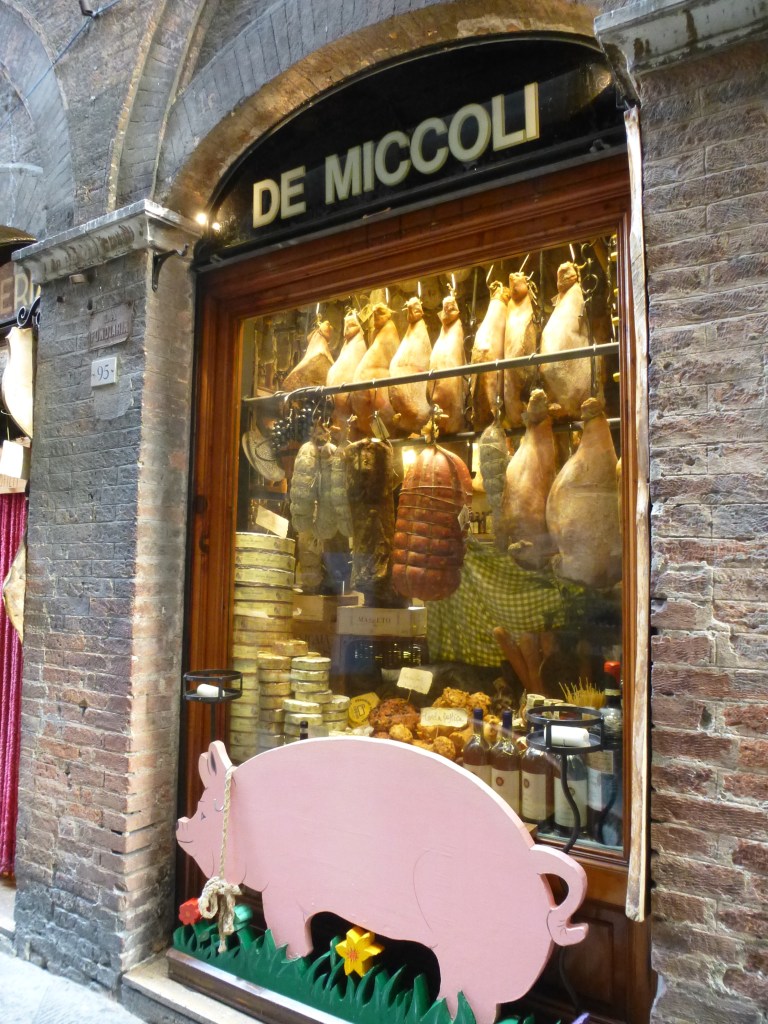
And so I reminisced with him about the first time I ate a porchetta panino, at the little café in the piazzetta around the block from L’Accademia in Florence, as I waited my turn to see Michelangelo’s David. And then in Siena when we toured Tuscany and Rome together. Weaving up and down the cobblestoned streets, we suddenly found ourselves in front of the shop with the tell-tale pig sign and proscuitto legs, and scent of garlic and rosemary beckoning us in. Taking one to go, with a slice of panforte, it became a signature Sienese dinner that night in our room at the villa.
Waxing on, I told him that while there are vistas yet unseen I wished to experience – hopefully some with him, a less enthusiastic traveler – maybe due to my European roots and inexplicable fascination with Moorish design and culture, returning to countries I’ve already visited – Germany, Italy, France, Spain, Morocco – held the most allure, to deepen those already etched impressions.
“the need for sacred beauty…we can only discover the real thing though deep observation, by the slow accretion of details”
Phil Cousineau, The Art of Pilgrimage, 1998
Earlier this week my friend from Germany called, she with whom I lived the three months I travelled solo in Europe in 2011. “Come and stay with me for a few months,” she, recently retired and finding her footing, implored. If only it were that easy. And maybe it is, or soon will be, albeit with safeguards and precautions.
Perhaps that’s where faith comes in. Rings its bell quietly to remind me that one day, I’ll return to and visit anew, those places of my heart’s desire, to delve deeper into myself, by way of the world.
“Pilgrims are poets who create by taking journeys.”
Richard R. Niebuhr in Phil Cousineau, The Art of Pilgrimage, 1998
Child stirring in the web of your mother Do not be afraid Old man turning to walk through the door Do not be afraid
– Joy Harjo – How We Became Human
Every day I receive and read several poems from various sources, including social media. Not too long ago I read a brief musing on poetry by philosopher, author, activist Bayo Akomolafe: “Poetry is the language of the apocalypse. When cracks appear, when tensions materialize and split the familiar open, the least thing you need is precision. The least thing you want is to simply get to the point. Well, the poet casts his eyes beside the point, beneath the surfaces, where the exquisite sprouts.”
As we step into this new year, one where cracks and tensions continue to be evident, continue to split open the familiar, this poem felt right as an offering and evocation of the exquisite. A prayer of sorts to greet the day, to remember the power of thoughts and beauty, to not be afraid.
You could be right. Maybe there is a vast conspiracy, a web of lies wrapped around generations, a fraud so vast and pervasive that only the enlightened catch glimpses in shadowed alleys. Do you want to know? Do you dare to tug on the smallest of those tangled threads? Are you courageous enough to look at the edges of your vision? Begin with these questions: Whose stories have I not been allowed to hear? Who have I placed outside the circle of my concern? If I were to really listen, what might crack open and be born?
– Lynn Ungar – November 29, 2021
With the new covid variant “omicron,” gaining traction and making global headlines, countries are responding, re-heating debate and dissent, protest and polarization. Ungar’s questions are wise reminders to help us hold the centre when there’s heat on the rim, to invite us into curiosity, to remind us of all we do not know.
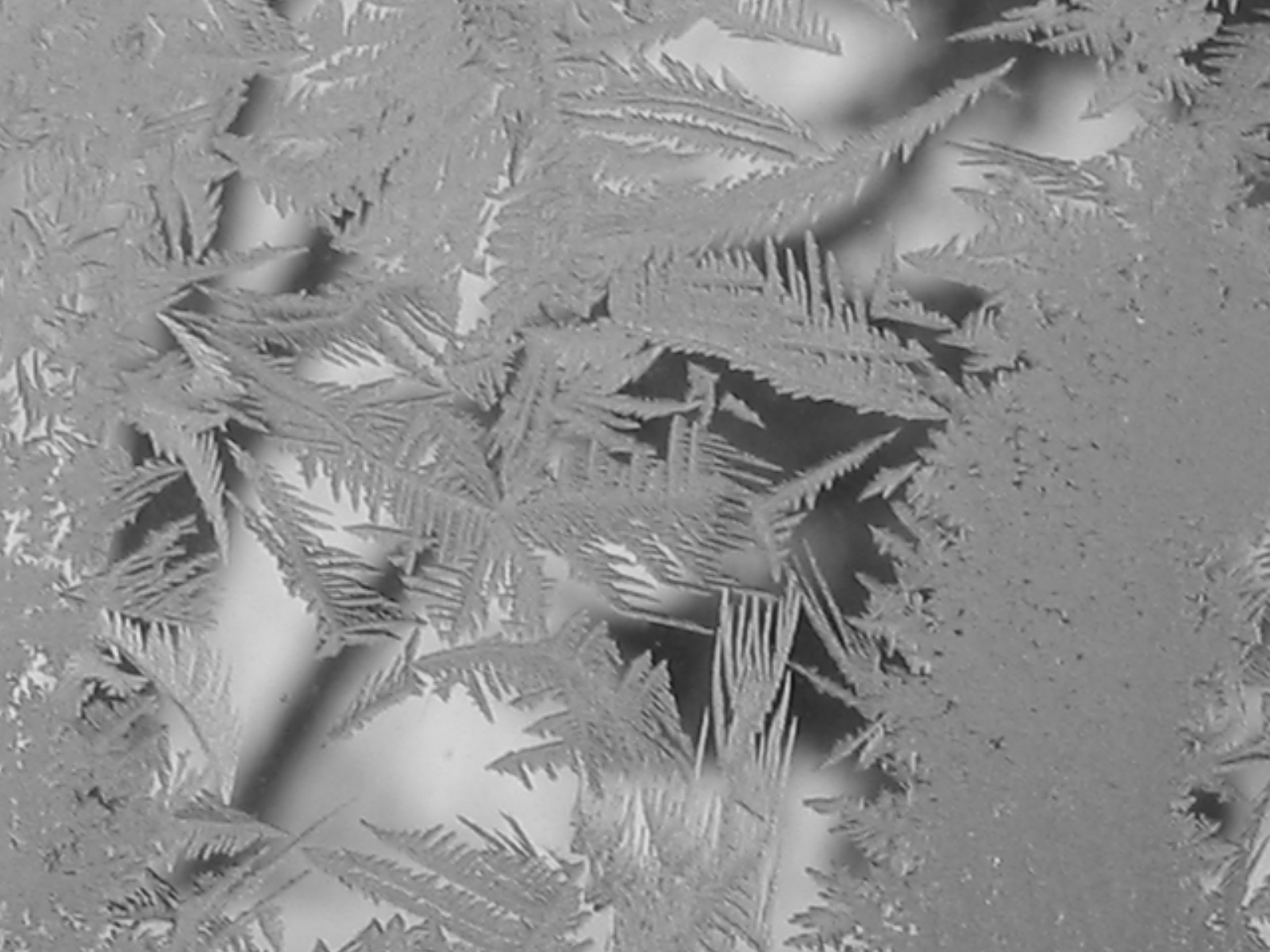
“re-wintering” – what caught my eye as Annie and I walked this week
Every other week I circle up virtually with some dear woman friends. It’s been a way to feel connection and offer support to each other during these continued covid times. We begin, as is our way, following The Circle Way practice, with a reading of some kind to help us land and settle in with each other and ourselves. A bell rung once, twice and we begin to check in with each other, often in response to what has been evoked by the reading, or by whatever is personally stirring and needing to be spoken aloud to the centre.
Last week I as I walked past my bookshelves to fetch my bells, grabbed by the title on the spine, I grabbed “The Wild In You: Voices from the Forest and the Sea” (2015) by Canadian poet, Lorna Crozier. (Lovely synchronicity in that as I’m sitting here tapping away, in the background I hear The Road Home’s Bob Chelmick read from Lorna’s 2018 volume, The God of Shadows.) A beautiful compilation of poetry and Ian McAllister’s photography, I quickly flipped through the pages, arriving at “A Winter’s Sleep,” companioned by a magnificent wolf sleeping on the seaside sand.
A Winter’s Sleep
So much sleeping in this place. Think of all that lies beneath the snow, lake trout below the ice, bears in their dens, their warm snores drifting above the treetops that are sleeping, too, high above your own long sleep.
Even raven, with so much to say and do, closes his eyes, tucks his beak under his wing and sinks into the season’s dream-rich dark where all his stories start.
Lorna Crozier, 2018
As is our way, we meander in a conversation punctuated that evening by long pauses and the shared recognition of how fatigue, grief and the need for Nature’s stillness were embroidering our days of late. One shared another poem, another mentioned a book, Wintering, the title of which evoked a memory that I’d written about it. When I read aloud from the post I’d written last February, I knew it was an idea worth repeating here. That even though my interior state has shifted from what I described then, today, as the winds blew a constant icy cold, the temperature plummeted, and too, the hours of daylight here on the Canadian prairies, it is wintering.
WINTERING, originally posted February 1, 2021
“Dashed and disheartened – again,” I emailed a friend. What with last week’s winds having blown in Arctic cold temperatures and flat light skies, reading up on my country’s vaccination rollout debacle and delays, virus variants that are proving to be highly contagious and perhaps more deadly than the original, and a speculated move to mandated mask wearing outside, this might be an understatement. Certainly enough to have been stalled again in writing here, having missed two of my usual Monday postings. Plumbing a bit deeper, what with my husband having celebrated his first “Covid” birthday two weeks ago, we realized with age, and life as we’ve known it “on hold,” we’re feeling quite wistful. Most apparent for me is missing traveling and all that it gives me, more fully appreciated now in its absence. I’m resigned to the probability that this will be another year, and most likely then some, of staying put. Too, the whisper of a question held this past year, “Will I – we – ever travel again as in the past?”
A few days ago, somewhat warmer with soft snowflakes fluttering down, Annie and I walked, she happy for her full-length coat, and NOT having to wear her fleece boots. I plugged into a recent On Being podcast, curious having read Krista’s weekend letter:
“Katherine May, in her book, Wintering – The Power of Rest and Retreat in Difficult Times (2020), meditatively explores ‘wintering’ as a season of the natural world but also as a place our bodies and psyches need to go, a season that recurs again and again across a life. We cheat and dismiss this in life as we’ve been living it, but it has presented itself insistently in a pandemic year we might reimagine as one long communal wintering.
We can’t move forward without grieving all we’ve lost in the past year. Closer to the ground, this means we have to let in the fact of sadness — a precursor to pain and fear — with some reverence. If happiness is a skill, Katherine May says, so is unhappiness. Winter embodies the strange complexity of reality. It is the bitterest season, we blithely say. And all the while it manages not to be the death of the life cycle, as Katherine May reminds, but its crucible.”
Krista Tippet, The Pause, January 23, 2021
Wintering.
That would be the odd place in which I found myself last spring and summer. Whereas I’d used the words “fallow” and “lost”, as I listened to Katherine May, I recognized in her words a fuller, more accurate description of those several months lying cold and low, when all around me blushed and blossomed.
“…wintering is a metaphor for those phases in our life when we feel frozen out or unable to make the next step, and that that can come at any time, in any season, in any weather; that it has nothing to do with the physical cold…”
Katherine May, On Being podcast, January 21, 2021
Not bound to season as we know it, but a necessary and recurrent place to drop into when we appreciate the cyclical nature of our lives. Thinking back, during an actual winter fifteen years ago, I dropped into depression. Not major, but enough that I and others noticed I was not myself. Little energy and enthusiasm, waning concentration, major exertions of effort to get through a day of work and home chores. Enough that once on the other side that spring, I’d mentioned it to my family doctor, and upon closer examination, recognized its cyclical nature. Perhaps a bit of seasonal affective disorder with some inherited family predisposition towards the winter “blahs.” Never since as severe, though I have a letter I wrote to myself then, upon the suggestion of my doctor, “to be opened in the dark days, to remember.” I’ve never needed to, though I know it’s perched on my desk amidst a collection of mementos. And that brings reassurance enough.
“Plants and animals don’t fight the winter; they don’t pretend it’s not happening and attempt to carry on living the same lives they lived in the summer. They prepare. They adapt. They perform extraordinary acts of metamorphosis to get them through. Wintering is a time of withdrawing from the world, maximizing scant resources, carrying out acts of brutal efficiency and vanishing from sight; but that’s where the transformation occurs. Winter is not the death of the life cycle, but its crucible.”
Katherine May, On Being podcast, January 21, 2021
I wonder if because we are mostly acculturated out of such natural rhythms and rituals, those embedded deep within our DNA and beneath our consciousness, we find ourselves in “winter” out of season? That if we heeded Nature’s signs and stirrings, we’d ready ourselves, with each other, for wintering’s alchemical invitation. I feel a growing love and appreciation for winter, the season, since being unfettered by work’s imposed schedule, demands, and need for driving. And as many of us have felt during the pandemic, in lives slowed and diminished of obligation, its paradoxical gifts.
“It’s a time for reflection and recuperation, for slow replenishment, for putting your house in order. Doing these deeply unfashionable things — slowing down, letting your spare time expand, getting enough sleep, resting — is a radical act now, but it’s essential.”
Katherine May, On Being podcast, January 21, 2021
Recently I came upon these words from Toko-pa Turner’s book, Belonging: Remembering Ourselves Home. They echo the hidden transformative gifts in this crucible of winter and wintering:
“Like the bowl that has yet to be filled, there is an emptiness that precedes creativity that is alive with potential. With ordinary eyes, it’s easy to mistake this emptiness for stagnancy. We may think, “I have nothing of substance to offer! I have no original ideas!” But down at the invisible base of things, there is a holy dance taking place. Though we may want to run from the tension, the polarities are in constant motion, readying themselves into harmony. Far from dormant, this dance is the active receptivity that calls things into form. We are such a vessel. These times of nothingness are actually busy with living into a new capacity.
Originality comes when you stay close to that emptiness, making it a welcoming place, adorning it with your divine longing, learning the shape of it, and filling it with your questions. Every great artist I know is obsessed with a question, and their artworks are less attempts to answer that question than they are exaltations of asking. As Jean Cocteau says, ‘The poet doesn’t invent. He listens.'”
I listened last summer as I wintered, lost and fallow. I remembered it as a familiar season of my life and followed its nudges to find my way through. Walking with Annie. Reading and writing. Photography and painting. Making love notes to friends. Cooking and circling up with women friends. And now in the fullness of its season, I sleep longer, nap more, give myself permission to pause the writing until I feel stirred. I let myself feel, once again, dashed and disheartened, trusting them to be worthy of these times. And I wonder.
“I recognized winter. I saw it coming a mile off, since you ask, and I looked it in the eye. I greeted it and let it in. I had some tricks up my sleeve, you see. I’ve learned them the hard way. When I started to feel the drag of winter, I began to treat myself like a favored child, with kindness and love. I assumed my needs were reasonable and that my feelings were signals of something important. I kept myself well fed, and I made sure I was getting enough sleep. I took myself for walks in the fresh air and spent time doing things that soothed me. I asked myself, what is this winter all about? I asked myself, what change is coming?”
Katherine May, Wintering – The Power of Rest and Retreat in Difficult Times (2020)


















 A Wabi Sabi Life