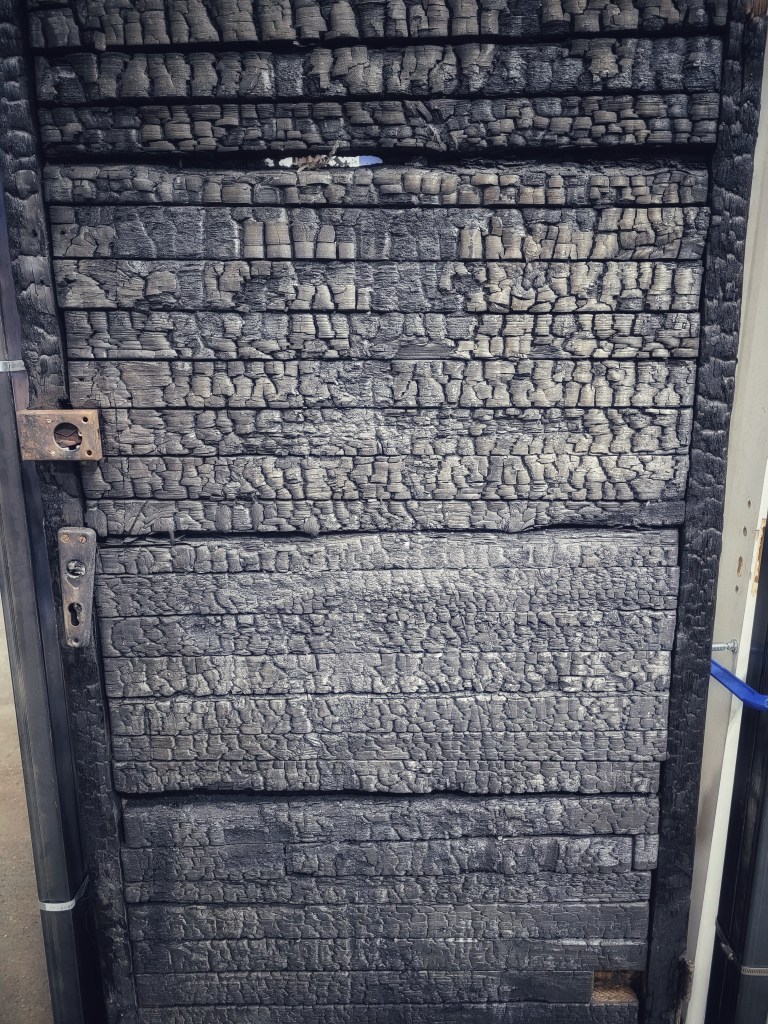
Ukrainian doors burnedand shattered in the war started byRussia February 2022
We Lived Happily during the War
And when they bombed other people’s houses, we
protested but not enough, we opposed them but not
enough. I was in my bed, around my bed America
was falling: invisible house by invisible house by invisible house —
I took a chair outside and watched the sun.
In the sixth month of a disastrous reign in the house of money
in the street of money in the city of money in the country of money, our great country of money, we (forgive us)
lived happily during the war.
~ Ilya Kaminsky, Deaf Republic. 2019 ~
I first heard Kaminsky’s poem in June 2021, read by Padraig O’Tuama in his Poetry Unbound podcast. Written in 2009, its powerful prescience grabbed me then, before hell was unleashed in Ukraine when Russia invaded in February 2022. And it hasn’t let go. Its grip now tighter as the American Republican administration, thinking it is the “great country of money,” backed by men in their “houses of money,” threatens my country, its people, and our livelihoods.Already killing the land, people and livelihoods of Ukraine, Gaza, and beyond.
I am not happy. In all honesty, I feel the rage that comes with such betrayal; fear; sadness; and, in moments, an unsettling hatred towards these men intent on destroying our world. Their acts are evil, committed without empathy and in full consciousness of the consequences of irreparable suffering and death.
Below is my post, written shortly after Russia’s invasion of Ukraine, in which I first included Kaminsky’s poem and the wise words from Canadian elder, Stephan Jenkinson, suggesting “it is no accident that we were born at a time when the culture that gave us life is now failing.“
No one lives happily during war. It is madness to think otherwise, despite the lies and bravado to the contrary. Thankfully, our world is too connected, and blessedly our hearts, to ignore the assaults and violence being perpetrated. Admittedly, it does not make for easy living.
Much love and kindest regards, dear friends.May you keep well. You are needed. We need each other.
“I believe poetry is very old. It’ s very sacred. It wishes for a community. It’s a community, ritual, certainly. And that’s why, when you write a poem, you write it for anybody and everybody…It’s a gift to yourself, but it’s a gift to anybody who has the hunger for it.”
Mary Oliver, as quoted in On Being with Krista Tippett
Four years ago, in January 2020, I designed and published this, my third blog, to serve as a platform for my writing. Little did I know then, that with the sudden arrival two months later of world-stopping Covid-19, I’d need to be leaning into writing and this space to cope with the grief of having lost my career and much of what I had assumed to be certain. I wasn’t alone in any of this, but the resulting systemic social isolation occasionally had me wonder.
By September that year, I’d set my sights on learning how to write poetry. I’d dabbled over the years in my blogs and journals, and for as many, was a devoted listener of The Road Home, a spoken word and music program curated by Bob Chelmick on my local radio station. I discovered Poetry Unbound, a podcast offering from my favourite On Being with Krista Tippett, hosted by Irish poet Pádraig Ó Tuama. With Annie on her leash, I’d plug in my earphones and for fifteen time-stopping minutes, walking familiar neighborhood routes, I’d listen to him read a poem and share his understanding about its structure, meaning, and resonance. An ardent fan, occasionally I’d write about him here, and took advantage of tuning into every free Zoom event around the world, hosted by Padraig reading, talking, teaching poetry. When I learned he’d be coming to Calgary for a retreat in 2023, I made haste months earlier to buy my ticket and reserve my bus ticket – a wise move as we had our first blizzard that weekend.
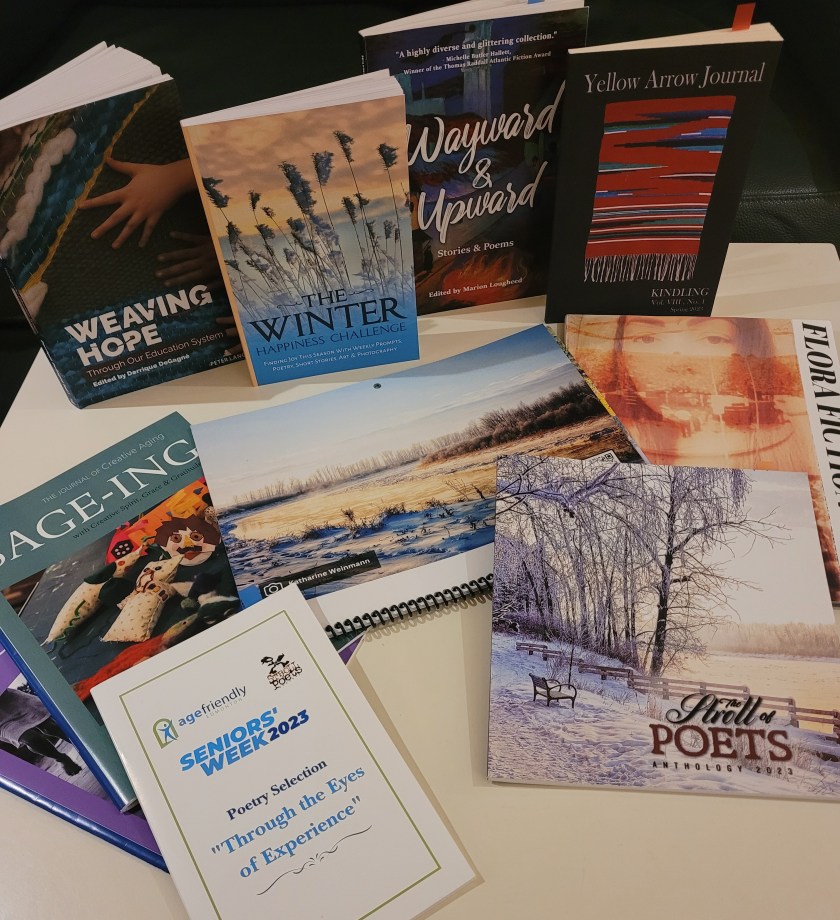
I joined a couple of Facebook groups for writers and took advantage of many free online readings and workshops to gain exposure to contemporary poets, seeing how they compared with my favourites, helping me find my voice. I was invited by Karen Close, founder and editor of Sage-ing: The Journal of Creative Aging with Creative Spirit, Grace and Gratitude to be her thinking partner and co-editor. Then exactly two years ago, upon the encouragement from one of my public library’s writers-in-residence – another complimentary service of which I have availed myself, I began the work of preparing a manuscript for submission to a well-known Canadian poetry publishing house. With Annie on her cushion by my side, I edited over seventy poems, received feedback from several friends and fellow writers, and emailed the package a week before heading off to walk the Portuguese Coastal Camino. An email in July brought the not so surprising, but none the less disappointing, news that my work had not been selected. It closed with the concise instruction “to persist.”
And so, I have. 2023 found me back in the saddle, submitting regularly to literary journals and online magazines around the world. I attended master classes with esteemed poets and prepared a chapbook for a publisher who had previously accepted one of my pieces. Another rejection, but she gave me the gift of feedback I’m using now to move my writing forward. Monitoring my submissions, tracking rejections and successes, with 70 sent last year, over 20% have been published, including several in national and international anthologies. In the meantime, as many journals invite submissions of art and photography, I’ve jumped in and have had several photos published – for money – have been included in a 2024 calendar featuring Edmonton’s river valley and have won the cover contest twice for our local poetry anthology. I feel chuffed.
I think alot about my writing: Why do I do it? What I give to it and what it gives to me? I’m committed to making poetry my writing genre of choice. Or, it has chosen me, being one who has long had a poetic turn of phrase and outlook on life. Like Mary Oliver, I believe poetry is sacred, being one of the ways I bring the sacred into my life, making my life as poem and prayer. However, unlike many writers, I’m not yet confident that writing is my way to, for lack of a better word, salvation…to reconciling what troubles me. I haven’t had enough experience waking during my soul’s dark night to trust that taking pen to paper will see me through to a metaphoric dawn, let alone a literal one. It is a faith that grows.
I am learning about poetry’s inherent nature of ritual, especially in the process of revising. Here I can immerse myself for hours, quietly reading for rhythm and assonance, writing for placement on the page, making space for the breath, embodying the imagery. This gives me pleasure.
I don’t know who proclaims one a poet. Maybe joining a professional group and paying the membership dues legitimizes one’s efforts. I’m leaning more into the empowering wisdom that comes from claiming myself through learning what it means to be a practicing poet. Exploring organically the design of my way of working; developing discipline and technical skill; rolling with rejection and celebrating success; reaching out for support; being vulnerable. Much of it done in isolation. In hindsight, Covid-19 prepared me well.
Four years ago, I began a new career, or rather, a new one found me. Today I am an internationally published poet and photographer. When I waver in my confidence and question the value of my words in a world inundated with others, I have those from my dear friend, author, and first writing mentor, to hold me in its community:
“And the quality of your writing offers me a moment of presence with you, your thoughts and reflections, and the complexities of the road we travel in and through these times at both the very personal and the larger scale. This is alchemy. Please continue. Please imagine me in early morning–still dark, tea and low light, and waking my day with your gift.”
Christina Baldwin
Thank you, too, for yours sent to me, dear friends. Much love and kindest regards.
It’s early Sunday night and I’m sitting in my usual space for writing. Hot cup of tea to the side. My radio station playing low in the background. The space heater blowing warm, taking off the foreboding chill. Last week I read that here in Edmonton we were having the longest run of October +20 C degree days since 1944, and today tied the record for the latest first frost. But this weekend, winter made its arrival in other parts of the province and I know it’s simply a matter of time. The wheel turns…
It’s been nearly three months since my last post, one wherein I’d announced the need for a pause…to settle into my breath, body and bones after my month long Camino, to prepare for traveling to Italy with my husband, to re-centre to purpose. Since returning from Spain in early June, I’ve had the felt sense of standing yet again on a cusp. It was an atypical summer, late in coming, the hottest August on record giving us warm, sultry, bug free evenings, and one of illness: my lengthy recovery from Covid; then my husband developing a viral infection – non Covid but with a similar symptom pattern leaving him fatigued and coughing for weeks; and I succumbing to the same a few weeks later. Our Annie dog sustained sprains and pulled muscles. My elderly father’s ever robust and vital presence began to dim.
“I’ve lost my edge,” is how my husband put it, and for the first time I saw glimpses of a wavering frailty that comes with aging. While we’ve both recovered, and are feeling well having enjoyed our unstructured time sauntering in Rome, and then touring the exquisite landscapes of Puglia (albeit in overcast skies and rain), there’s the indelible realization we have entered a new life stage. Grief with facing the endings of ways of living and being, we are staring – starkly, undeniably -at our mortality and that of those we love and cherish.
In readying myself to write tonight and to return to it as my vocation, I spent a couple of hours today catching up on the myriad of e-newsletters in my inbox, a cursory glance telling me they held a pearl or several. Below are some of the more salient bits holding my attention:
“I have this belief that an internal monoculture of peace and clarity and smooth sailing is what normal people experience, so it’s what I should experience. And if I don’t feel peaceful and clear and focused, then there’s something that needs fixing inside me… I want to reframe messiness as holy. I want to slide down and immerse myself in the murky waters of my messy heart.”
Barb Morris, “a messy mind is a healthy mind,” e-letter, September 29, 2022
“I’m curious to know if you have a line you repeat to yourself when you’re trying to sink into that necessary solitude that is at the heart of every human relationship: the relationship of yourself to yourself.”
Padraig O’Tuama, “the solitude at the heart of human relationship,” Poetry Unbound Newsletter, October 2, 2022
“We reach for hope as the antidote to despair, but actually hope is the cause of despair. The problem with hope is that it’s bipolar. Every time we rely on hope, we always bring in fear. Buddhist wisdom teaches that hope and fear are two sides of the same dynamic.”
Margaret Wheatley, “We Have to Talk About Hope,” October 19, 2022
“The rhythms of the seasons play a significant role in my own discernment. Honoring the flowering of spring and the fruitfulness of summer, alongside the release of autumn and the stillness of winter, cultivates a way of being in the world that feels deeply reverential of my body and soul’s own natural cycles. We live in a culture that glorifies spring and summer energies, but autumn and winter are just as essential for rhythms of release, rest, and incubation. When we allow the soul’s slow ripening, we honor that we need to come into the fullness of our own sweetness before we pluck the fruit. This takes time and patience.”
Christine Valters Paintner, Love Notes, Abbey of the Arts newsletter, October 22, 2022
My synthesis, in poem…
the necessary solitude that is my messy heart and mind that I sink into as an antidote to the bipolarity of hope and fear
seasons’ rhythms a discernment where now autumn’s release and soon winter’s stillness allow my soul’s ripening
I took time and patience the needed pause to recover and reveal life’s holy starkly beautiful truths
Much love and kindest regards, dear friends. It’s good to be back.
For leaving the fridge open last night, I forgive you. For conjuring white curtains instead of living your life.
For the seedlings that wilt, now, in tiny pots, I forgive you. For saying no first but yes as an afterthought.
I forgive you for hideous visions after childbirth, brought on by loss of sleep. And when the baby woke repeatedly, for your silent rebuke
in the dark, “What’s your beef?” I forgive your letting vines overtake the garden. For fearing your own propensity to love.
For losing, again, your bag en route from San Francisco; for the equally heedless drive back on the caffeine-fueled return.
I forgive you for leaving windows open in rain and soaking library books again. For putting forth
only revisions of yourself, with punctuation worked over, instead of the disordered truth, I forgive you. For singing mostly
when the shower drowns your voice. For so admiring the drummer you failed to hear the drum. In forgotten tin cans,
may forgiveness gather. Pooling in gutters. Gushing from pipes. A great steady rain of olives from branches, relieved
of cruelty and petty meanness. With it, a flurry of wings, thirteen gray pigeons. Ointment reserved for healers and prophets. I forgive you.
I forgive you. For feeling awkward and nervous without reason. For bearing Keats’s empty vessel with such calm you worried
you had, perhaps, no moral center at all. For treating your mother with contempt when she deserved compassion. I forgive you. I forgive
you. I forgive you. For growing a capacity for love that is great but matched only, perhaps, by your loneliness. For being unable
to forgive yourself first so you could then forgive others and at last find a way to become the love that you want in this world.
– Dilruba Ahmed –
This is the poem that released a floodgate of words, and tears, about which I wrote in my last blog. To listen to it being wondrously recited and interpreted by Irish poet Pádraig Ó’Tuama, click here.
Human beings suffer They torture one another, They get hurt and get hard. No poem or play or song Can fully right a wrong Inflicted and endured.
The innocent in gaols Beat on their bars together. A hunger-striker’s father Stands in the graveyard dumb. The police widow in veils Faints at the funeral home.
History says, Don’t hope On this side of the grave… But then, once in a lifetime The longed-for tidal wave Of justice can rise up, And hope and history rhyme.
So hope for a great sea-change On the far side of revenge. Believe that a further shore Is reachable from here. Believe in miracles And cures and healing wells.
Call miracle self-healing: The utter, self-revealing Double-take of feeling. If there’s fire on the mountain Or lightning and storm And a god speaks from the sky
That means someone is hearing The outcry and the birth-cry Of new life at its term. It means once in a lifetime That justice can rise up And hope and history rhyme.
– Seamus Heaney –
Earlier this week, I heard Irish poet Pádraig Ó’Tuama read this poem in a live stream and from him learned that Joe Biden has been reciting it in his campaign for president. Once the election results are certified, it would appear that poetry will have once again returned to the White House.










 A Wabi Sabi Life