In yesterday’s inbox, I received two emails that struck me as contrasting approaches to coping with the current global state of affairs. In one, subject line: Sanity Repair Kit, its author listed thirteen personal strategies to help her stay above despair. The second, the weekly love note from Christine Valters Paintner, abbess of the online contemplative-creative community Abbey of the Arts, opened with the 6th principle of its Monk Manifesto:
“I commit to rhythms of rest and renewal through the regular practice of Sabbath and resist a culture of busyness that measures my worth by what I do.”
Deep, holy breath in and out…I could feel my body relax into the truth of rest being, as Tricia Hersey, founder of The Nap Ministry, writes: an act of resistance in a culture that wants to exploit and deplete our labor so others can profit. Could this be more on point at this time when we’re told that empathy is the fundamental weakness of Western civilization?
While the first email’s list included practices I know I could be doing, should be doing, and am doing – more or less – mostly, I felt overwhelmed and out of breath …except for the invitation to stare off into the sky for several seconds or minutes. Something I do quite regularly, sitting in my living room, often with Walker sleeping there in the sunshine. I understand “different strokes for different folks,” yet I want to uplift here an appreciation for and the wisdom in doing no-thing.
Suddenly, I am remembering with a smile the story I used to read during staff inservices, written by Robert Fulghum of the All I Really Need to Know I Learned in Kindergarten fame. I no longer have that well-marked, tabbed, and dog-eared copy, but it was his experience of taking a pair of favorite leather shoes to the shoemaker for resoling that captures the essence of doing no-thing. He writes:
“The shoe repair guy returned with my shoes in a stapled brown bag. For carrying, I thought. When I opened the bag at home that evening, I found two gifts and a note. In each shoe, a chocolate-chip cookie wrapped in waxed paper. And these words in the note: ‘Anything not worth doing is worth not doing well. Think about it. Elias Schwartz.’”
“Sabbath is not a doing, but a way of being in the world… In those spaces of rest comes renewal, with dreams for new possibilities. As a culture we face so many issues that feel impossible to tackle in meaningful ways. One way to begin is to allow enough space for visions to enter, to step back and see what happens when we slow down our pace first. . . .”
Christine Valters Paintner
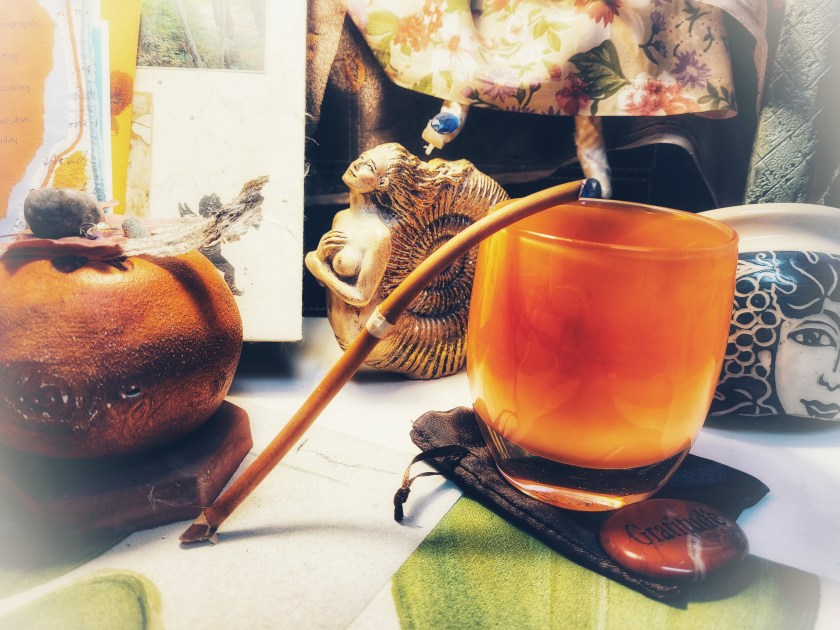
Part of my Sabbath often includes cooking a good, ample meal giving us leftovers to get through the beginning of the week. With classical music or relaxing jazz streaming in the background and an occasional glass of wine, I’m in my element. Too, writing my Monday blog, warmly ensconced in my studio, surrounded by my various creative endeavors, inspiring images, vision boards and books, I sink into the wellspring of potential beneath the heartlessly cruel rhetoric filling so much airspace today.
Years ago, before The Abbey of the Arts, or The Nap Ministry, my friend Christina Baldwin penned the exquisite Seven Whispers (2002). “Move at the pace of guidance,” is the second whisper, combining two instructions: to re-humanize our speed of life, and to use a slower pace to actively listen for spiritual guidance.
“The pace of guidance, like peace of mind, begins internally – in me. Even though all my conditioning teaches me to accommodate speed, I am responsible for the pace I bring to the moment, just as I am responsible for the peace I bring to the moment.”
Christina Baldwin
What chocolate chip cookies might we find as we allow and settle into a slower pace and use this overwhelming and despairing time to do no-thing? What visions of possibility and inner wisdom might we access by resting and resetting our overwrought nervous systems? What might be the outcome of such a bold, strategic act of resistance?
“We must hang onto our humanity, it is why we’re in the world.”
Christina Baldwin
Much love, kindest regards, and moments of deep and abiding rest, dear friends.
Each moment of rest, of doing no-thing, of being our own Sabbath matters. Each word, each photograph, each email matters. Each kind word, each warm embrace matters. It’s what we have which I have to believe can turn the tide, perhaps first within the unseen, liminal spaces.
“I believe poetry is very old. It’ s very sacred. It wishes for a community. It’s a community, ritual, certainly. And that’s why, when you write a poem, you write it for anybody and everybody…It’s a gift to yourself, but it’s a gift to anybody who has the hunger for it.”
Mary Oliver, as quoted in On Being with Krista Tippett
Four years ago, in January 2020, I designed and published this, my third blog, to serve as a platform for my writing. Little did I know then, that with the sudden arrival two months later of world-stopping Covid-19, I’d need to be leaning into writing and this space to cope with the grief of having lost my career and much of what I had assumed to be certain. I wasn’t alone in any of this, but the resulting systemic social isolation occasionally had me wonder.
By September that year, I’d set my sights on learning how to write poetry. I’d dabbled over the years in my blogs and journals, and for as many, was a devoted listener of The Road Home, a spoken word and music program curated by Bob Chelmick on my local radio station. I discovered Poetry Unbound, a podcast offering from my favourite On Being with Krista Tippett, hosted by Irish poet Pádraig Ó Tuama. With Annie on her leash, I’d plug in my earphones and for fifteen time-stopping minutes, walking familiar neighborhood routes, I’d listen to him read a poem and share his understanding about its structure, meaning, and resonance. An ardent fan, occasionally I’d write about him here, and took advantage of tuning into every free Zoom event around the world, hosted by Padraig reading, talking, teaching poetry. When I learned he’d be coming to Calgary for a retreat in 2023, I made haste months earlier to buy my ticket and reserve my bus ticket – a wise move as we had our first blizzard that weekend.
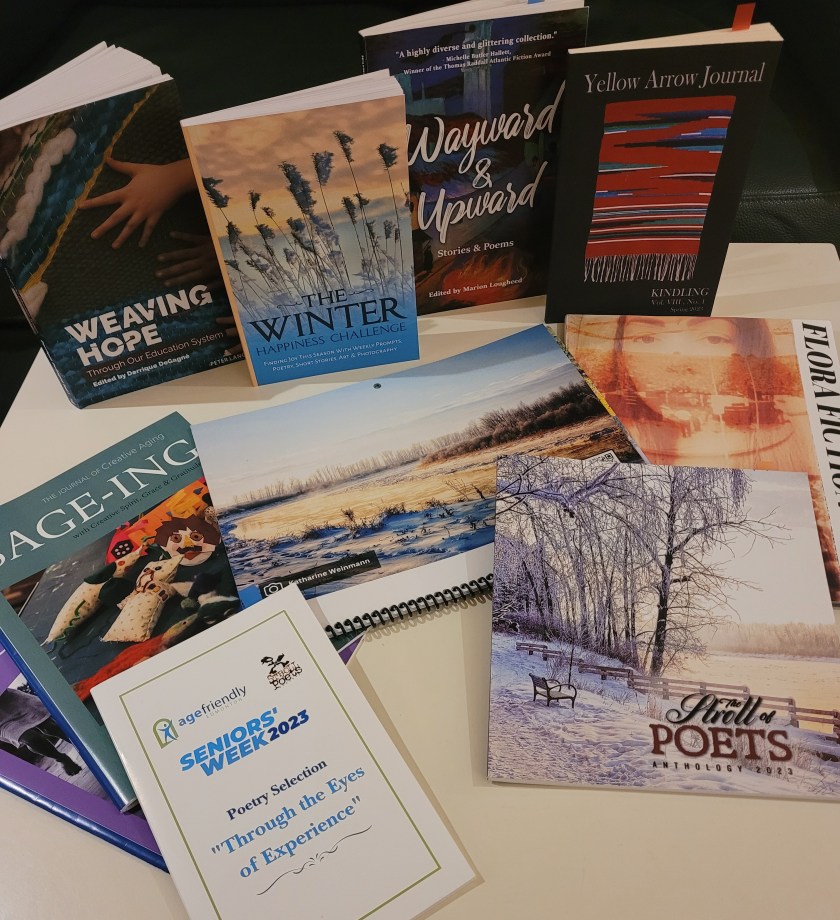
I joined a couple of Facebook groups for writers and took advantage of many free online readings and workshops to gain exposure to contemporary poets, seeing how they compared with my favourites, helping me find my voice. I was invited by Karen Close, founder and editor of Sage-ing: The Journal of Creative Aging with Creative Spirit, Grace and Gratitude to be her thinking partner and co-editor. Then exactly two years ago, upon the encouragement from one of my public library’s writers-in-residence – another complimentary service of which I have availed myself, I began the work of preparing a manuscript for submission to a well-known Canadian poetry publishing house. With Annie on her cushion by my side, I edited over seventy poems, received feedback from several friends and fellow writers, and emailed the package a week before heading off to walk the Portuguese Coastal Camino. An email in July brought the not so surprising, but none the less disappointing, news that my work had not been selected. It closed with the concise instruction “to persist.”
And so, I have. 2023 found me back in the saddle, submitting regularly to literary journals and online magazines around the world. I attended master classes with esteemed poets and prepared a chapbook for a publisher who had previously accepted one of my pieces. Another rejection, but she gave me the gift of feedback I’m using now to move my writing forward. Monitoring my submissions, tracking rejections and successes, with 70 sent last year, over 20% have been published, including several in national and international anthologies. In the meantime, as many journals invite submissions of art and photography, I’ve jumped in and have had several photos published – for money – have been included in a 2024 calendar featuring Edmonton’s river valley and have won the cover contest twice for our local poetry anthology. I feel chuffed.
I think alot about my writing: Why do I do it? What I give to it and what it gives to me? I’m committed to making poetry my writing genre of choice. Or, it has chosen me, being one who has long had a poetic turn of phrase and outlook on life. Like Mary Oliver, I believe poetry is sacred, being one of the ways I bring the sacred into my life, making my life as poem and prayer. However, unlike many writers, I’m not yet confident that writing is my way to, for lack of a better word, salvation…to reconciling what troubles me. I haven’t had enough experience waking during my soul’s dark night to trust that taking pen to paper will see me through to a metaphoric dawn, let alone a literal one. It is a faith that grows.
I am learning about poetry’s inherent nature of ritual, especially in the process of revising. Here I can immerse myself for hours, quietly reading for rhythm and assonance, writing for placement on the page, making space for the breath, embodying the imagery. This gives me pleasure.
I don’t know who proclaims one a poet. Maybe joining a professional group and paying the membership dues legitimizes one’s efforts. I’m leaning more into the empowering wisdom that comes from claiming myself through learning what it means to be a practicing poet. Exploring organically the design of my way of working; developing discipline and technical skill; rolling with rejection and celebrating success; reaching out for support; being vulnerable. Much of it done in isolation. In hindsight, Covid-19 prepared me well.
Four years ago, I began a new career, or rather, a new one found me. Today I am an internationally published poet and photographer. When I waver in my confidence and question the value of my words in a world inundated with others, I have those from my dear friend, author, and first writing mentor, to hold me in its community:
“And the quality of your writing offers me a moment of presence with you, your thoughts and reflections, and the complexities of the road we travel in and through these times at both the very personal and the larger scale. This is alchemy. Please continue. Please imagine me in early morning–still dark, tea and low light, and waking my day with your gift.”
Christina Baldwin
Thank you, too, for yours sent to me, dear friends. Much love and kindest regards.
Finally, enough space to for some words to emerge from that place “before, beneath and beyond” to find their way to the surface and onto this page.
Finally, enough that has been in process for summer’s duration now settling.
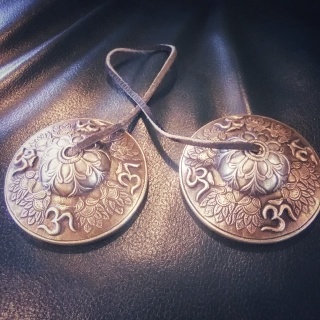
Finally, like my practice’s bell that signals the need for a pause with a breath in between, embodying and enlivening that breath here.
tingshas for ringing in a pause
FRIENDSHIP My last post almost two months ago was an opening into the seldom talked about territory of the distress with broken friendships. As I’d anticipated, my exploration evoked comments from many readers, mostly women. Ranging from encouragement for naming truth, to reframing as peace-making the individual acts of courageously and vulnerably stepping in to invite conversation and clarification, to women sharing related stories of long-standing friendships suddenly going awry, to others feeling the best friendships should be the easiest to maintain (an opinion I countered). If I were to edit that post, I’d clarify that while the opening quote was ample context for both my letter to my friend, and the post, I wouldn’t “walk away in disgust” but rather in sorrow. As has been the case.
Since then, longtime friend Tracy shared a book title that I promptly borrowed from the library. Platonic: How the Science of Attachment Can Help You Make and Keep Friends by Maria Franco (2022) provides an accessible frame for understanding the complexities of early attachment wounding in adult friendships. Suffice to say that John Bowlby’s seminal work on attachment theory, now decades old, is thankfully again seeing the light of day, helping us understand the tricky ground of relationships. Add in the impacts of generational trauma, its impacts on the body-mind, and coping strategies of addiction and we have more than enough reason to find compassion for ourselves and others.
While I’d thought I might have more to write on the subject, my attention has shifted though the questions I hold and the sorrow I feel continue ebb and flow.
MEMORIES At some point during the day, as any of you who store your photos on the cloud know, photo memories appear. Sometimes it’s a past post on social media that I check for relevancy before sharing again. Always it’s the photos I’ve made and stored in the cloud over the years. For the past few days, it’s been photos of my first visit to Morocco in 2019. How utterly poignant to see over and over the beauty of her land, culture and people that captivated me then, that enticed me to return this past March, now in the aftermath of the weekend’s catastrophic earthquake. Writing today to a friend who shares my awe and appreciation for Morocco:“my return to Morocco was most satisfying…my love for her only deepened…my desire to spend more time there was only stoked, not sated.”
To others I acknowledged the bittersweet gift of travel: that with each journey taken, the world becomes smaller, more intimate with each connection made, each friendship forged. So that when such devastating events occur, I cannot help but feel a heart stopping immediacy, a bone resounding impact and meaning. Then anonymous concern gives way to personalized shock and grief.
My dear friend, Omid Safi, an acknowledged scholar of Islamic studies and Rumi, hosts regular “illuminated tours” of Morocco. Evidence of our small world when in March he was with his group in Marrakech as I was with mine in Casablanca. When he saw that I’d attended a cooking class at Marrakesh’s AMAL Women’s Training Center and Moroccan Restaurant, he wrote that its founder was a dear friend. Today he posted their efforts to gather and directly forward donations to families left bereft in the mountain villages hardest hit by the earthquake. I appreciated Omid’s post, resonant with the message I’d heard repeatedly while touring the country, reminding me of those most basic values shared among Abrahamic faith traditions: “send thoughts and prayers, please. Also send aid. Remember that our beloved Prophet says to change things first with your hands, then your tongue, and lastly by the heart. We begin by doing something.”
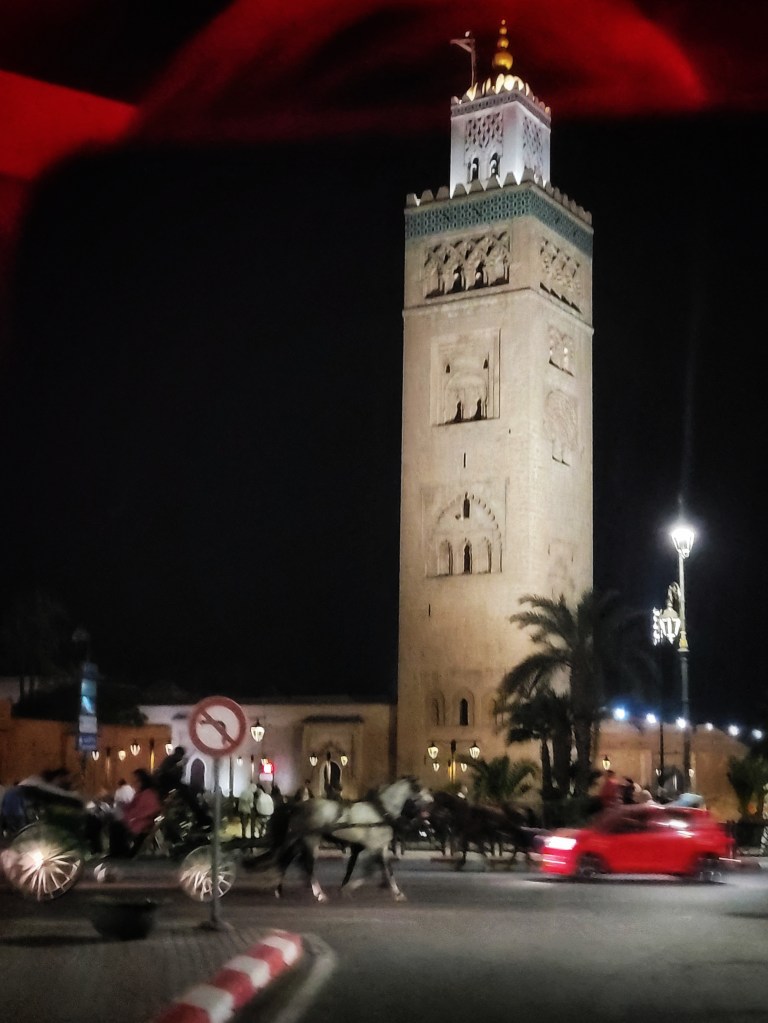
Marrakech’s Koutoubia Mosque, March 2023 September 8, 2023- it shook and swayed, yet stands still erect
ANNIE Among those photo memories are countless ones of Annie. Today a favourite taken a year ago.
It’s been three months since we had to say goodbye to our beloved fur companion. Striking for me has been the coincidence (?) of weather. On both the first- and second-month anniversaries of her passing, the day was exactly as it had been for those initial three days in June: leaden gray skies and steady soaking rain. And like those first three days, each month since I’ve felt held by the sheltering sky, in my grief, my love, my missing, my appreciation for this beautiful being called Annie.
I haven’t yet been able to return to our favourite bench overlooking the pond, nor walk our familiar neighbourhood routes. But in the meantime, I have walked. Close to 320 kms since the end of July. Up and down and through our river valley. Initially with great trepidation, now with confidence that I am as ready as I can be to walk the 16-day, 260 km Via de Francesco from Assisi to Rome. I tended to a collapsed metatarsal of my left foot for most of the spring and summer, the onset of which occurred during that day in March when walking on cobblestone through the labyrinthine medina of Fez. Finally surrendered to giving up pickleball in early June, the activity I’d counted on both to healthfully distract me from grief and to build my cardio fitness, I turned to deep water aqua fitness three times a week. Then my dear friend and former marathoner Thais, created a month-long training program wherein I’d gradually increase the distance and backpack weight to 20+ km and 13+pounds, some of the longest days walked during the highest temperatures of the summer with the greatest weight.
THREE COINS IN THE FOUNTAIN In a week’s time I’ll be settled in Florence for several days, about to meet up with my morning food tour in Otranto. On Tuesday, an early spot at the Uffizi to once again revel in the masters. Another day a city bus up to Fiesole. Then later in the week, a train to Assisi to wander solo and adjust to the first of many hill towns I’ll encounter walking. There I’ll meet with the small group of fellow walkers and pilgrims escorted by our Italian guide, and tour company host, Sandy Brown, writer of several Italian “camino” guidebooks. We’ll conclude our via at the Vatican, giving me several more solo days to decompress in Rome’s Trastevere neighborhood. That coin tossed over my shoulder into the Trevi Fountain last October, now my third, has returned me yet again to another country of my heart.
third coin tossed at the Trevi Fountain, October 2022
“MOVING AT THE PACE OF GUIDANCE” (coined by my friend Christina Baldwin in The Seven Whispers) Walking one day on my own a few weeks ago, I realized how different my preparation for this long-distance trek compared to last year’s Portuguese Coastal Camino. Both then and now booked early in the new year, as I waxed and waned in the early weeks of summer, wondering if I was up to the challenge due to grief and injury, I realized I didn’t know WHY I was making this journey. Last year I had been so clear that I was responding to a decades’ held dream. Such clarity of purpose and my reading of Phil Cousineau’s The Art of Pilgrimage shaped so much of my planning and preparation. Now except for my lists, and clothing and supplies laid out on a bed for weeks, my dedication to my training, I began to wonder about the presence of grace in all of this.
One night trying to sleep after long, hot rugged day of walking, I wept…with exhaustion, with missing Annie, with fear I’d not be up to making the trek, with worry for my husband and a sudden health complication (resolving), and with realizing that with Annie’s passing, my words had died. I did not have the energy to find a word to write. I did manage to polish up a few poems to meet some submission deadlines. And while I trusted this was a temporary state, simply my fallow not a harvest season, I felt sorrow and disappointment that I’d been unable to use my writing to heal my grief, as I’d known other writers to do, published collections being an added result. I felt especially vulnerable as in June I had asked for and received the gift of a weekly writer’s circle with the group of remarkably kind and talented and generous women writers with whom I’d just completed an online course. How could I be in a writer’s circle and not be writing?
Come a week, those four weeks in Italy I will be moving at the pace of guidance. Beyond a food tour and gallery ticket I have nothing booked. Having visited Florence and Rome several times, I feel comfortable wandering, sitting at cafes, watching people, noticing, making photos, and taking a note or many to seed future writing. Walking every day for sixteen, I know from experience there is a simplicity and rhythm that invites heeding guidance, feeling grace.
Realizing the extent to which this summer I have been holding – grief, uncertainty, worry, pain – I feel myself exhaling.
Thank you, dear friends, for your patience as I find my words and my breath. Much love and kindest regards.






 A Wabi Sabi Life