If this is the best you can do, citizens of the world, I resolve to become summer shadow, turtle adrift in a pool. Today a frog waited in a patch of jasmine for drizzles of wet before dawn. The proud way he rose when water touched his skin – his simple joy at another morning – compare this to bombing, shooting, wrecking, in more countries than we can count and ask yourself – human or frog?
– Naomi Shihab Nye, Voices in the Air, 2018 –
Talk about prescience. This poem was published in 2018, though most likely written months, if not years earlier. Given the poet’s Palestinian father, Naomi Shihab Nye has always had her eye on, and heart attuned to the chronic strife in her father’s homeland.
I wrote at the bottom of the poem’s page, after yesterday’s reading and in response to growing tensions and extended involvements, “Are we poised for WW3? And too, Ukraine and Russia since February 2022…” My question as reasonable as the poet’s, but I pray, not prescient.
I’ve been away for a several days, hence the pause. Writing, but not in this space. It’s nice to be back until I set off again in a few weeks. Much love and kindest regards, dear friends.
A girl in Gaza speaks into a table microphone: Do you believe in infinity? If so, what does it look like to you?
Not like a wall Not like a soldier with a gun Not like a ruined house bombed out of being Not like concrete wreckage of a school’s good hope a clinic’s best dream
In fact not like anything imposed upon you and your family thus far in your precious thirteen years.
My infinity would be the never-ending light you deserve every road opening up in front of you.
Soberly she nods her head.
In our time voices cross the sea easily but sense is still difficult to come by.
Next girl’s question: Were you ever shy?
– Naomi Shihab Nye, Voices in the Air, 2018
I’m sitting at a worktable in my public library typing this post for tomorrow’s drop. We’ve been without WIFI in our home office for nearly a week (hence why no Monday post). WOW! How dependent are we on this technology? It’s tax time. My husband does all our investing online. Bills to be paid by the month end. Waiting to print time sensitive return labels. Looming project deadlines. I’ve managed with my phone but wonder how much I’m over the data limit and how much the costs will be. My neck aches from being hunched over…texting and tapping what I can to stay in touch, be responsive. So, in this moment, I’m reminded how much I enjoy and appreciate my library, surrounded by stacks, students plugged in working at other tables, surrounded by full-length windows.
It’s quintessential springtime in Alberta. After several days of sun, warm weather, and melted snow – after getting off really easy with winter – the temperature dropped below freezing and snow fell for most of the day. I took a leisurely start to my day with a coffee date being canceled. Sipping my Americano, in the flat white light of the living room, quiet with snow gently falling outside, I began reading this volume of poetry, waiting on my shelf for just this moment. Needing some shoring up given another week of rejections and trepidation about the manuscript I’m revising, I was not disappointed, as even its epigraph began to set me straight:
“Stay humble, blend, belong to all directions. Fly low, love a shadow. And sing, sing freely, never let anything get in the way of your singing, not darkness, not winter, not the cries of flashier birds, not the silence that finds you steadfast pen ready…”
Naomi Shihab Nye
Then this, the first sentence of her introduction:
“Poet Galway Kinnell said, ‘To me, poetry is someone standing up, so to speak, and saying, with as little concealment as possible, what it is for him or her to be on earth at this moment.'”
And this, to open the first section, “Messages,”:
Broken pencil Broken pen Maybe today I’ll write my best poem
Well maybe not a poem but a post. And maybe not my best, but enough. Enough to be thankful for Palestinian-American poet and educator, Naomi Shihab Nye who first came to my attention when I read her well known “Gate a4” and signature, “Kindness.” Enough to let her cultural perspective and experiences teach me, as she was taught when teaching a poetry workshop in an international high school in Japan, the word Yutori – “life space” – the place and space “in which to stand back to contemplate what we are living and experiencing. More spaciousness in being, more room in which to listen.” (Voices in the Air, xiii) And enough to remember a girl in Gaza, or Ukraine, or Israel, Afghanistan, Haiti, Ethopia, Yemen,Russia…asking profound questions, being deeply heard, and wishing her the infinity of the never-ending light she so deserves.
I Perhaps everything that frightens us is, in its deepest essence, something helpless that wants our love.
So you must not be frightened if a sadness rises in front of you, larger than any you have ever seen; if an anxiety, like light and cloud-shadows, moves over your hands and over everything you do.
You must think that something is happening with you, that life has not forgotten you, that it holds you in its hand; it will not let you fall. – Rainer Maria Rilke
II the places in our heart where the world took bites out of us
may never fully heal and will likely become wide open spaces
~ be careful to not fill them with just anything or anyone
your wounds aren’t supposed to become attics for you to hoard unnecessary junk
these holes in our hearts are holy sites
and we should treat them as such
so when visiting your old wounds make sure to take your shoes off and turn off your cellphone
sit by candlelight and watch how the shadows tell the story how brave you are
~ to survive – John Roedel
III “When a lot of things start going wrong, all at once, it is to protect something big and lovely that is trying to get itself born – and that this something needs for your to be distracted so that it can be born as perfectly as possible.” – Anne Lamott
IV “Even a wounded world is feeding us. Even a wounded world holds us, giving us moments of wonder and joy. I choose joy over despair. Not because I have my head in the sand, but because joy is what the Earth gives me daily and I must return the gift. “ – Robin Wall Kimmerer
I collect poems and quotes for my weekly Friday photo and poem feature. As I scrolled for today’s post, these four came together for me with a curious resonance, echoing from writ small to large, scaling from an individual’s questioning and suffering to Earth’s magnificent mystery.
I offer these selections as a reminder that there are forces seen and unseeen, angels, ancients and ancestors working on our behalf in ways we have little, if any way, of registering. I offer these up to salute the turning of the season, life’s cycles being just one of those vast and wondrous mysteries.
Much love and kindest regards, dear friends, and blessings for the arrival of the Equinox, spring and autumn.
It’s dawn. Still dark, as yesterday’s “spring ahead” time change makes more noticeable the gift of more daylight in the evening.
It’s Monday, when I typically drop a post, or try to. Last night making pizza and watching the Oscars interrupted my typical pattern of getting to my desk at 6 to write. Too, yesterday I sent off to my editor the big writing project I’d been waking early each weekday for the past few weeks to complete. After pressing the “send” button on the email, I took a breather and walked in sunshine warming and snow melting, passing folks enjoying the same. Smelling, hearing, and feeling spring. My breather continuing until bed time.
It’s soon time to join my 7:00 am Zoom weekday writing space, where after exchanging good mornings we all mute and “vanish” ourselves to our keyboards to write for an hour or longer. I’ll finish this post, despite it being late, and begin pieces for several March submission deadlines.
It’s a post without a theme. Simply keeping my promise made to Muse to write. Showing up at my desk, in the space I created to create. Candle lit. Classical music streaming from the station I re-discovered during those recent trips to Niagara (WNED on TuneIn). Radiant heat glowing on my back. Americano cooling in its handmade Italian cup. Borrowing from my Friday pattern, I’ll leave you with what feels like the perfect poem for today, an excerpt from John O’Donohue’s “A Morning Offering,” in To Bless the Space Between Us:
I place on the altar of dawn: The quiet loyalty of breath, The tent of thought where I shelter, Waves of desire I am shore to And all beauty drawn to the eye.
May my mind come alive today To the invisible geography That invites me to new frontiers, To break the dead shell of yesterdays, To risk being disturbed and changed.
May I have the courage today To live the life that I would love, To postpone my dream no longer But do at last what I came here for And waste my heart on fear no more.
There are those who want the world to remain on its current path. This is not only unacceptable, but it is painfully unimaginative. For the beauty of our generation is we are uniquely situated to achieve what so many in this world currently consider impossible. How exquisitely beautiful it will be to watch the current narrative go down in flames, then witness poetics & phoenix rise from the ashes.
Embers, ancestors, and angels await us, loved ones. Forward.
– Mark Gonzales – In Times of Terror, Wage Beauty, 2014
I’d forgotten I had on my poetry shelf this eloquent “collage of visions.” In response to last week’s attempt to find enough words to notice and name one of the current global narratives literally imploding and exploding, a friend, in her comment, referenced the book, one I had gifted her years back. Immediately retrieving it, thumbing through its simple and beautifully designed pages, I knew I wanted to uplift and amplify Mark’s message and intention here today. Quoting from the back cover:
In Times of Terror, Wage Beauty is a meticulously crafted series of ideas in tweet sized digestible prose. It serves as a personal guide to social change makers in the 21st century navigating complex social systems by highlighting advanced approaches to healing and global wellness.
A quick early morning scroll todayon social media and I’m reminded it’s International Women’sDay. Aware of feeling cynical and crusty, perhaps the result of many very early mornings arriving at my desk to write, I’m less inclined to jump on the bandwagon and share any of its memes or create my own. As with so many of these socially-politically designated days, often created, if not co-opted, by the power brokers to highlight and assuage their own interests, or by corporations to make money, I’m tired and disillusioned with the narrative that has become a “painfully unimaginative” rhetoric. I need a narrative like Mark’s. One that insists we not live in a world where any of us needs to shout to be heard, seen, and valued (26).
Instead, a narrative that encourages the simple yet essential acts of creativity – dreams, laughter, love, and imagination (51). One that heals the hearts of those forced from their homelands by centering on their beauty (29). One that remembers stories as ceremony, vessels for ancestors, memories, futures, and the vehicle by which the divine is engaged (41). One that reminds me “now is not the time to be timid” (21).
Good poetry begins with the lightest touch, a breeze arriving from nowhere, a whispered healing arrival, a word in your ear, a settling into things, then like a hand in the dark it arrests your whole body, steeling you for revelation.
In the silence that follows a great line you can feel Lazarus deep inside even the laziest, most deathly afraid part of you, lift up his hands and walk toward the light.
– David Whyte –
Sooooo…in last Monday’s post – one I’d been thinking of writing since the first of the year, in celebration of four years of writing, including 265 posts here – I claimed myself a poet, describing the chronology of my journey to finding my way to a new career, or more aptly, vocation. And, of course, the next day dawned with several rejection emails in my inbox and more that came during the week. A coincidence, but my inner critic has been having a field day ever since.
“Getting too big for your britches, aren’t you?” came her scolding interjection. And for most of the week, despite signing on every morning for a 7:00 am Zoom writing circle, writing and editing poems for submissions, I’ve been hearing her, sotto voce, describe my words and my effort as “trite” and “maudlin”. Ouch.
And, of course. Not only is part of this practice about learning to roll with rejection “out there,” but also, and more significantly, working with (and that can mean ignoring, cajoling, considering…) the rejecting aspect of myself. So, I took us out to play pickleball with my friends. Got into my body and out of my head and was surprised to see both my game improve and my writing.
Too, I received kind feedback from friends, several of whom write and know this terrain well, letting me know their response to how and what I write. The timing of one was nothing short of an answered prayer. Allies who help shore me up to shut down the noise.
And suffice to say, I took several bold and audacious steps toward making a future dream come true, one that utterly delights me, and brings visceral joy whenever I think about it.
Sooooo…I persist. I’m finding my way to a lighter touch. I look forward to the day when my inner critic – who I know arrives to keep me in line because she IS deathly afraid – lifts up her hands, surrenders, and walks toward the light. On the page and in all aspects of my life.
“I believe poetry is very old. It’ s very sacred. It wishes for a community. It’s a community, ritual, certainly. And that’s why, when you write a poem, you write it for anybody and everybody…It’s a gift to yourself, but it’s a gift to anybody who has the hunger for it.”
Mary Oliver, as quoted in On Being with Krista Tippett
Four years ago, in January 2020, I designed and published this, my third blog, to serve as a platform for my writing. Little did I know then, that with the sudden arrival two months later of world-stopping Covid-19, I’d need to be leaning into writing and this space to cope with the grief of having lost my career and much of what I had assumed to be certain. I wasn’t alone in any of this, but the resulting systemic social isolation occasionally had me wonder.
By September that year, I’d set my sights on learning how to write poetry. I’d dabbled over the years in my blogs and journals, and for as many, was a devoted listener of The Road Home, a spoken word and music program curated by Bob Chelmick on my local radio station. I discovered Poetry Unbound, a podcast offering from my favourite On Being with Krista Tippett, hosted by Irish poet Pádraig Ó Tuama. With Annie on her leash, I’d plug in my earphones and for fifteen time-stopping minutes, walking familiar neighborhood routes, I’d listen to him read a poem and share his understanding about its structure, meaning, and resonance. An ardent fan, occasionally I’d write about him here, and took advantage of tuning into every free Zoom event around the world, hosted by Padraig reading, talking, teaching poetry. When I learned he’d be coming to Calgary for a retreat in 2023, I made haste months earlier to buy my ticket and reserve my bus ticket – a wise move as we had our first blizzard that weekend.
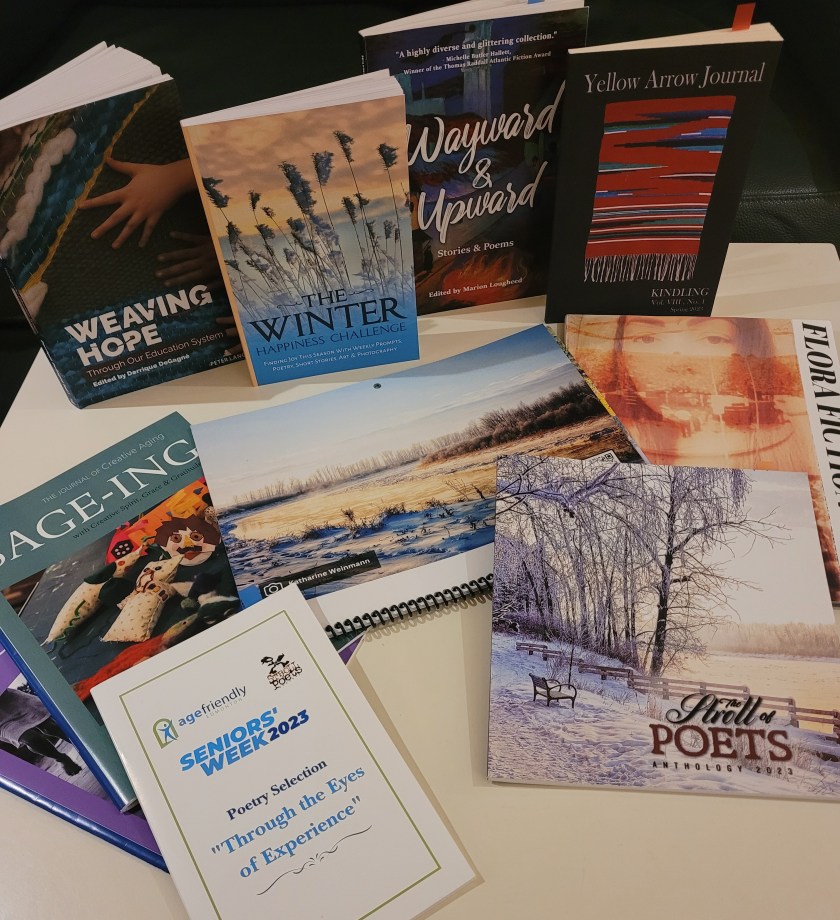
I joined a couple of Facebook groups for writers and took advantage of many free online readings and workshops to gain exposure to contemporary poets, seeing how they compared with my favourites, helping me find my voice. I was invited by Karen Close, founder and editor of Sage-ing: The Journal of Creative Aging with Creative Spirit, Grace and Gratitude to be her thinking partner and co-editor. Then exactly two years ago, upon the encouragement from one of my public library’s writers-in-residence – another complimentary service of which I have availed myself, I began the work of preparing a manuscript for submission to a well-known Canadian poetry publishing house. With Annie on her cushion by my side, I edited over seventy poems, received feedback from several friends and fellow writers, and emailed the package a week before heading off to walk the Portuguese Coastal Camino. An email in July brought the not so surprising, but none the less disappointing, news that my work had not been selected. It closed with the concise instruction “to persist.”
And so, I have. 2023 found me back in the saddle, submitting regularly to literary journals and online magazines around the world. I attended master classes with esteemed poets and prepared a chapbook for a publisher who had previously accepted one of my pieces. Another rejection, but she gave me the gift of feedback I’m using now to move my writing forward. Monitoring my submissions, tracking rejections and successes, with 70 sent last year, over 20% have been published, including several in national and international anthologies. In the meantime, as many journals invite submissions of art and photography, I’ve jumped in and have had several photos published – for money – have been included in a 2024 calendar featuring Edmonton’s river valley and have won the cover contest twice for our local poetry anthology. I feel chuffed.
I think alot about my writing: Why do I do it? What I give to it and what it gives to me? I’m committed to making poetry my writing genre of choice. Or, it has chosen me, being one who has long had a poetic turn of phrase and outlook on life. Like Mary Oliver, I believe poetry is sacred, being one of the ways I bring the sacred into my life, making my life as poem and prayer. However, unlike many writers, I’m not yet confident that writing is my way to, for lack of a better word, salvation…to reconciling what troubles me. I haven’t had enough experience waking during my soul’s dark night to trust that taking pen to paper will see me through to a metaphoric dawn, let alone a literal one. It is a faith that grows.
I am learning about poetry’s inherent nature of ritual, especially in the process of revising. Here I can immerse myself for hours, quietly reading for rhythm and assonance, writing for placement on the page, making space for the breath, embodying the imagery. This gives me pleasure.
I don’t know who proclaims one a poet. Maybe joining a professional group and paying the membership dues legitimizes one’s efforts. I’m leaning more into the empowering wisdom that comes from claiming myself through learning what it means to be a practicing poet. Exploring organically the design of my way of working; developing discipline and technical skill; rolling with rejection and celebrating success; reaching out for support; being vulnerable. Much of it done in isolation. In hindsight, Covid-19 prepared me well.
Four years ago, I began a new career, or rather, a new one found me. Today I am an internationally published poet and photographer. When I waver in my confidence and question the value of my words in a world inundated with others, I have those from my dear friend, author, and first writing mentor, to hold me in its community:
“And the quality of your writing offers me a moment of presence with you, your thoughts and reflections, and the complexities of the road we travel in and through these times at both the very personal and the larger scale. This is alchemy. Please continue. Please imagine me in early morning–still dark, tea and low light, and waking my day with your gift.”
Christina Baldwin
Thank you, too, for yours sent to me, dear friends. Much love and kindest regards.
Day ends, and before sleep when the sky dies down, consider your altered state: has this day changed you? Are the corners sharper or rounded off? Did you live with death? Make decisions that quieted? Find one clear word that fit? At the sun’s midpoint did you notice a pitch of absence, bewilderment that invites the possible? What did you learn from things you dropped and picked up and dropped again? Did you set a straw parallel to the river, let the flow carry you downstream?
– Jeanne Lohmann – (from The Light of Invisible Bodies)
This week, in my “third Wednesday” writers’ circle, I read this poem into the centre. As it had been at least a month since we’d all been together, our check-in was as rich in stories and perspective as each of us and our past month’s involvements. I wanted to create a pause, and to allow for a shift into the business of writing. A poem can do that.
One of our members liked the poem’s permission to learn from what we drop and drop again. Another was struck by “the bewilderment that invites possibilty.” My breath caught at the naming of those days living with death and how its presence in mine over the past months has nudged me to recognize the new life landscape in which I now walk.
But mostly, it was the poem’s presupposition that this day, any day, can change me. And from its conclusion, that I could let the river’s flow carry me downstream. Effortlessy. If I allowed it.
Big sigh…as I let those words, those questions, and their invitations settle in me.
The third breath: that it will come without despair.
And the fourth, without anxiety.
That the fifth breath will come with no bitterness.
That the sixth breath will come for joy.
Breath seven: that it will come for love.
May the eighth breath come for freedom.
And the ninth, for delight.
When the tenth breath comes, may it be for us to breathe together, and the next, and the next,
until our breathing is as one, until our breathing is no more.
– Jan Richardson – The Cure for Sorrow: A Book of Blessings for Times of Grief
Last Saturday I skipped my weekly river valley camino to attend “Into a Sanctuary of Women,” an online retreatwith Jan Richardson. Familiar with her work as a spiritually oriented author, artist and poet, whose words have a particular resonance for women, I welcomed the opportunity to experience herlive. The gifts of her presence and her work are akin to another of my inspirational favourite women, Christine Valters Paintner, the online abbess of Abbey of the Arts, a space for, as she names us, contemplative, creative dancing monks.
Framed by the contents of her book of the same title, Jan used her art to underscore aspects of sanctuary – its components and meanings (refuge, hospitality, making welcome, safety, spaciousness, invitation for transformation), how to make and be sanctuary for ourselves and for others, and its personal gifts and challenges. Her poetry, by form of blessing, became pause and punctuation points. This one, seen earlier in the week on her social media page, was offered to help us settle into the sacred space being created by the hundred plus of us who gathered.
Transcribing it here, now, I imagine reading it quietly as I sit in the morning. I can feel it bringing a solid, soothing start to my day. I envision it reminding me of my life’s inevitable passage, through its eldering landscape to my own passing on. And I know again my kindredness with you, breathing as one, until no more.
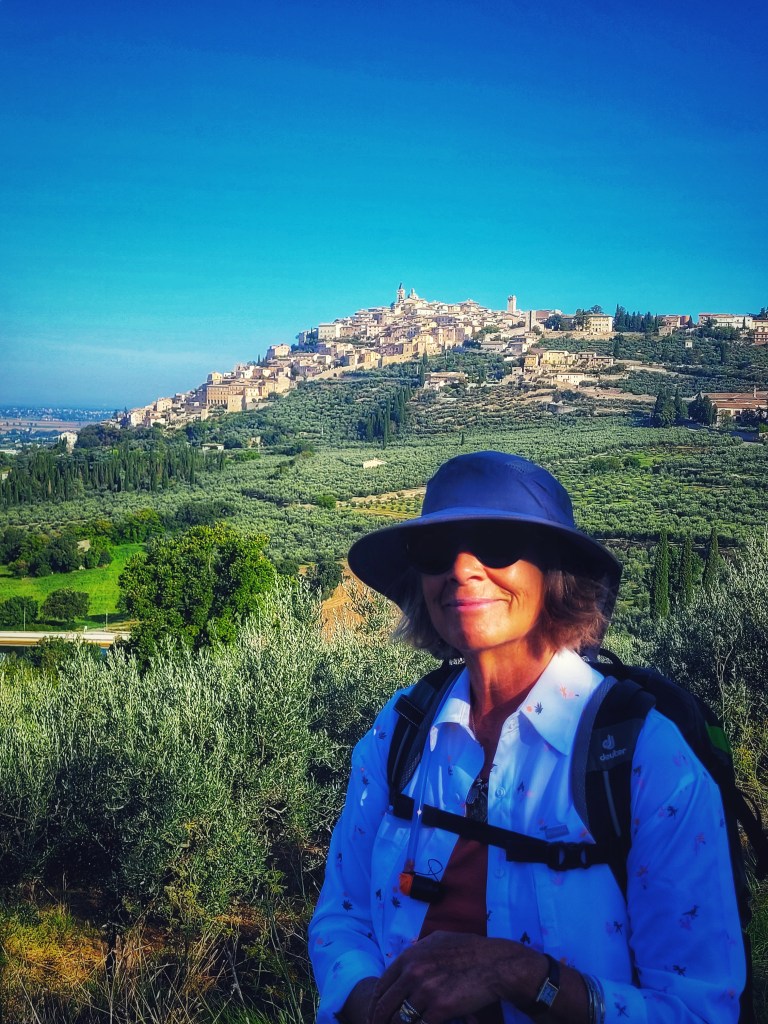
the ridged terraces below Trevi, Umbria – a classic Italian hilltop town la Via di Francesco, September 27, 2023
SILENT BRAVERIES Sometimes it takes looking at your struggles to recognize the depth of your courage. To be in awe of what it takes to face real fears, break old patterns, and climb the steep ridges of your own private mountain. Even the silent braveries carried out over time cover the ground all around you.
– Susan Frybort – Look to the Clearing
From my filed and saved poems, this is one in keeping with my current writing, both here andin recent poetry. The threshold crossed into a new terrain, one I’ve coined “an eldering landscape,” where facing real, albeit old and ancient fears; identifying, breaking and grieving old patterns; challenging roles and rules; initiating courageous conversations; climbing my private steep mountains and traversing barren landscapes – all various way markers to a destination unknown.
Truly my camino, caminho, cammino – the Spanish, Portuguese, and Italian ways. Truly ones that each of us walk, in this and the various stages of our lives. Walks wherein we call upon, become, and cover the ground with our respective silent braveries, revealing the way for each other.







 A Wabi Sabi Life