I Am a Poet

my poems and photos

“I believe poetry is very old.
It’ s very sacred. It wishes for a community.
It’s a community, ritual, certainly. And that’s
why, when you write a poem, you write it
for anybody and everybody…It’s a gift to
yourself, but it’s a gift to anybody who has
the hunger for it.”

Mary Oliver, as quoted in On Being with Krista Tippett

Four years ago, in January 2020, I designed and published this, my third blog, to serve as a platform for my writing. Little did I know then, that with the sudden arrival two months later of world-stopping Covid-19, I’d need to be leaning into writing and this space to cope with the grief of having lost my career and much of what I had assumed to be certain. I wasn’t alone in any of this, but the resulting systemic social isolation occasionally had me wonder.

By September that year, I’d set my sights on learning how to write poetry. I’d dabbled over the years in my blogs and journals, and for as many, was a devoted listener of The Road Home, a spoken word and music program curated by Bob Chelmick on my local radio station. I discovered Poetry Unbound, a podcast offering from my favourite On Being with Krista Tippett, hosted by Irish poet Pádraig Ó Tuama. With Annie on her leash, I’d plug in my earphones and for fifteen time-stopping minutes, walking familiar neighborhood routes, I’d listen to him read a poem and share his understanding about its structure, meaning, and resonance. An ardent fan, occasionally I’d write about him here, and took advantage of tuning into every free Zoom event around the world, hosted by Padraig reading, talking, teaching poetry. When I learned he’d be coming to Calgary for a retreat in 2023, I made haste months earlier to buy my ticket and reserve my bus ticket – a wise move as we had our first blizzard that weekend.

I joined a couple of Facebook groups for writers and took advantage of many free online readings and workshops to gain exposure to contemporary poets, seeing how they compared with my favourites, helping me find my voice. I was invited by Karen Close, founder and editor of Sage-ing: The Journal of Creative Aging with Creative Spirit, Grace and Gratitude to be her thinking partner and co-editor. Then exactly two years ago, upon the encouragement from one of my public library’s writers-in-residence – another complimentary service of which I have availed myself, I began the work of preparing a manuscript for submission to a well-known Canadian poetry publishing house. With Annie on her cushion by my side, I edited over seventy poems, received feedback from several friends and fellow writers, and emailed the package a week before heading off to walk the Portuguese Coastal Camino. An email in July brought the not so surprising, but none the less disappointing, news that my work had not been selected. It closed with the concise instruction “to persist.”

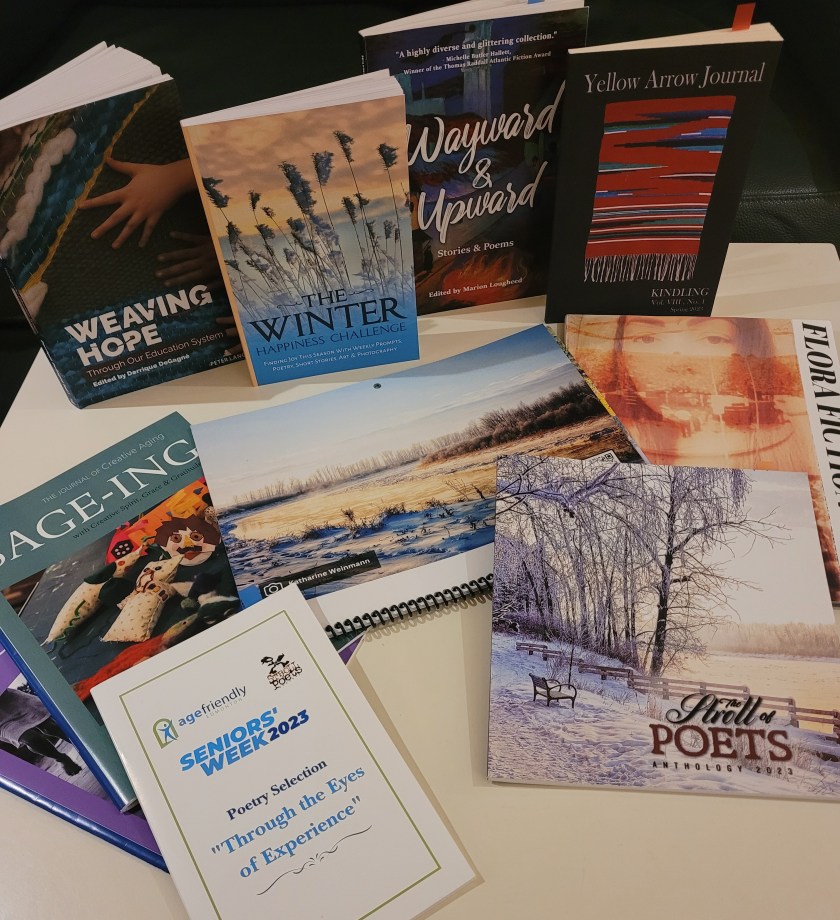
And so, I have. 2023 found me back in the saddle, submitting regularly to literary journals and online magazines around the world. I attended master classes with esteemed poets and prepared a chapbook for a publisher who had previously accepted one of my pieces. Another rejection, but she gave me the gift of feedback I’m using now to move my writing forward. Monitoring my submissions, tracking rejections and successes, with 70 sent last year, over 20% have been published, including several in national and international anthologies. In the meantime, as many journals invite submissions of art and photography, I’ve jumped in and have had several photos published – for money – have been included in a 2024 calendar featuring Edmonton’s river valley and have won the cover contest twice for our local poetry anthology. I feel chuffed.

I think alot about my writing: Why do I do it? What I give to it and what it gives to me? I’m committed to making poetry my writing genre of choice. Or, it has chosen me, being one who has long had a poetic turn of phrase and outlook on life. Like Mary Oliver, I believe poetry is sacred, being one of the ways I bring the sacred into my life, making my life as poem and prayer. However, unlike many writers, I’m not yet confident that writing is my way to, for lack of a better word, salvation…to reconciling what troubles me. I haven’t had enough experience waking during my soul’s dark night to trust that taking pen to paper will see me through to a metaphoric dawn, let alone a literal one. It is a faith that grows.

I am learning about poetry’s inherent nature of ritual, especially in the process of revising. Here I can immerse myself for hours, quietly reading for rhythm and assonance, writing for placement on the page, making space for the breath, embodying the imagery. This gives me pleasure.

I don’t know who proclaims one a poet. Maybe joining a professional group and paying the membership dues legitimizes one’s efforts. I’m leaning more into the empowering wisdom that comes from claiming myself through learning what it means to be a practicing poet. Exploring organically the design of my way of working; developing discipline and technical skill; rolling with rejection and celebrating success; reaching out for support; being vulnerable. Much of it done in isolation. In hindsight, Covid-19 prepared me well.

Four years ago, I began a new career, or rather, a new one found me. Today I am an internationally published poet and photographer. When I waver in my confidence and question the value of my words in a world inundated with others, I have those from my dear friend, author, and first writing mentor, to hold me in its community:

“And the quality of your writing offers me a moment of presence with you, your thoughts and reflections, and the complexities of the road we travel in and through these times at both the very personal and the larger scale. This is alchemy. Please continue. Please imagine me in early morning–still dark, tea and low light, and waking my day with your gift.”

Christina Baldwin

Thank you, too, for yours sent to me, dear friends. Much love and kindest regards.
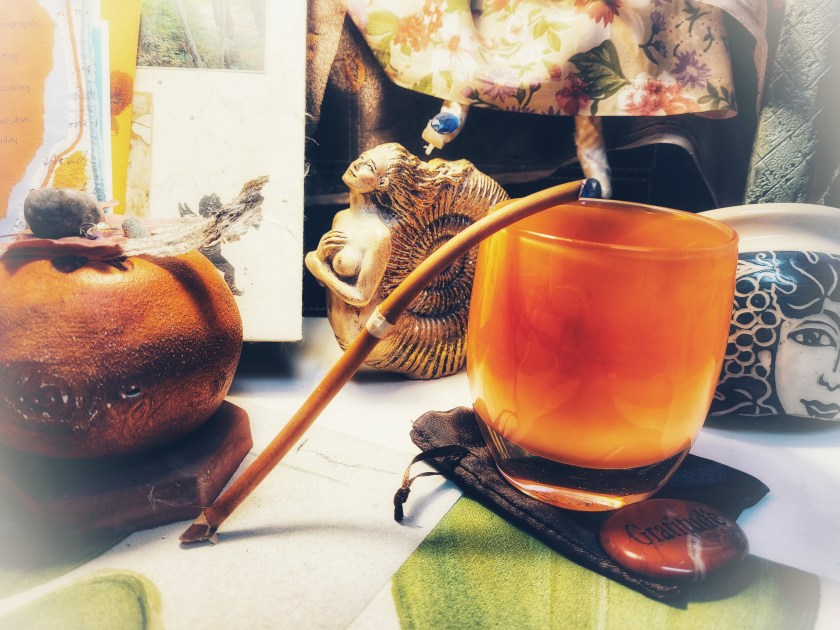
on the corner of my writing table

Blessing of Breathing

BLESSING OF BREATHING

That the first breath
will come without fear.

That the second breath
will come without pain.

The third breath:
that it will come without despair.

And the fourth,
without anxiety.

That the fifth breath
will come with no bitterness.

That the sixth breath
will come for joy.

Breath seven:
that it will come for love.

May the eighth breath
come for freedom.

And the ninth,
for delight.

When the tenth breath comes,
may it be for us
to breathe together,
and the next,
and the next,

until our breathing
is as one,
until our breathing
is no more.

– Jan Richardson –
The Cure for Sorrow: A Book of Blessings for Times of Grief

Last Saturday I skipped my weekly river valley camino to attend “Into a Sanctuary of Women,” an online retreat with Jan Richardson. Familiar with her work as a spiritually oriented author, artist and poet, whose words have a particular resonance for women, I welcomed the opportunity to experience her live. The gifts of her presence and her work are akin to another of my inspirational favourite women, Christine Valters Paintner, the online abbess of Abbey of the Arts, a space for, as she names us, contemplative, creative dancing monks. 

Framed by the contents of her book of the same title, Jan used her art to underscore aspects of sanctuary – its components and meanings (refuge, hospitality, making welcome, safety, spaciousness, invitation for transformation), how to make and be sanctuary for ourselves and for others, and its personal gifts and challenges. Her poetry, by form of blessing, became pause and punctuation points. This one, seen earlier in the week on her social media page, was offered to help us settle into the sacred space being created by the hundred plus of us who gathered.

Transcribing it here, now, I imagine reading it quietly as I sit in the morning. I can feel it bringing a solid, soothing start to my day. I envision it reminding me of my life’s inevitable passage, through its eldering landscape to my own passing on. And I know again my kindredness with you, breathing as one, until no more.

Much love and kindest regards, dear friends.

A Long Slow Walk

“I think that this sense of well-being that comes with timelessness, the sense of being at peace – it must be very, very old. And it must be like a stylus dropping into a groove on the surface of the planet and making this music. And we are, our bodies are, that stylus, and we’re meant to move at this RPM that comes with the movement of our bodies.”

Paul Salopek, “A Path Older Than Memory,” Emergence Magazine

Last week, I took the time to open, click, listen, and read the conversation with Paul Salopek and Emmanuel Vaughan-Lee, founder of Emergence Magazine, an award-winning magazine and creative production studio that explores the threads connecting ecology, culture, and spirituality. An hour later, so intrigued with their conversation, I shared it on Facebook, logged onto their follow up ZOOM conversation live streamed from the UK this past weekend, and recommended it to my local Camino group at the start of our Saturday walk.

Salopek, an award-winning journalist, embarked ten years ago on a winding course retracing the migration pathway of early humans out of Africa, across Asia, eventually to cross the Bering Strait, down the Americas to Patagonia. Both in Emergence and more fully on the National Geographic page hosting this epic photo story, he describes how his personal relationship to time and the sharing of meaningful stories has deepened while moving through the world at three miles (5 km) per hour, or as my friend Christina Baldwin writes, “at the pace of guidance” and story.

“And I thought this would be an interesting experiment in slow storytelling or slow journalism, a way of slowing down my methodology and immersing myself in the lives of the people who inhabit the headlines of our day. So it’s been kind of a giant kind of a planet-sized studio to think about how stories are connected—not just kind of mega stories, say the climate crisis or human conflict, but our individual stories as well. And one way that I’ve found that does it really well is by slowing myself down and walking from person to person. That’s basically the premise of this. It’s a listening project where the destination almost always is another person.”

Paul Salopek, “A Path Older Than Memory,” Emergence Magazine

I love to walk. I have been walking more or less every Saturday morning in Edmonton’s famed river valley with my local chapter of the Canadian Company of Pilgrims, a “yes” I’d said several years ago on a wintry morning in January, and easily the most significant “yes” I’d said that year. What initially started as one member’s quest to train for his first Camino de Santiago trek, where walking was the raison d’etre, has evolved into a time for us to walk, be in community, and enjoy coffee at local cafes. True to my style, some Saturdays find me more extraverted, engaged in a series of edifying conversations along the path, while others, like this past weekend, ask of me to surrender to the silent restorative of its sunny, almost balmy morning. Stopping for a moment near the trail end, I smelled and felt those faint stirrings of spring, in time with this week’s celebration of Imbolc, the first day of spring in Celtic tradition.

I didn’t grow up in a walking family. Though recently it registered that I may have “inherited” an affinity for trekking from my father, who as a young teen at the conclusion of WWII, found himself alone, displaced, and dodging prisoner of war camps in Germany, taking months to walk his way home to the Black Forest where his mother held her breath waiting for his safe return.

Germany’s Black Forest

I used to regularly hike in the Rocky Mountains, though it’s been well over a decade, and I miss those outings with my women friends. Since Covid, I’ve made two long distance walks, the Portuguese Coastal Camino to Santiago de Compostela, Spain in May-June 2022, and most recently, the Via di Francesco, from Assisi to Rome in September-October 2023. I’ve discovered, like Paul, and many of us, my pace is about 3 miles (5 km) per hour…even when sauntering, my preferred way of moving (when I’m not kitchen dancing.)

“You do not have to, you know, make your way to the jungles of northeastern India to experience this thing. I think it’s there for you. And it might be a little tougher to see and experience if it’s part of your daily life, whether you’re living in a small town or a megalopolis or anything in between, because, as usual, if we stay sedentary, we get scales over our eyes, and we stop realizing the wonders of the everyday world around us because they become over familiar. But walking peels those scales off and allows you to rediscover the extraordinariness of so-called ordinary things. And that includes a walk through your town, a stroll out into the fields, or a park near your house—indeed, your backyard, if you choose to go micro, right?

Paul Salopek, “A Path Older Than Memory,” Emergence Magazine

Walking with Annie was an invitation in peeling off the scales. As I wrote in a post during what would be her last days, “Walking Annie is no longer exercise. It’s fresh air, the gift of being outside noticing life around us.” Admittedly, still missing her, it takes a bit more presence and intention to notice life around me, scales off, without her. And yet, more often than not, I experience what Paul Salopek describes as an:

“astonishing internal metronome that’s built inside of us, inside of our body, that distinguishes us from almost every other animal…this goodness that’s kind of humming in our bones, waiting to be let out.”

Listening and reading and looking at Paul’s journey, I’m stoked to envision my next long, slow walk, wondering what memories will be evoked, people encountered, stories conjured, bones set to humming, all waiting to be let out?

Much love and kindest regards, dear friends.

Small Kindnesses

from Facebook, December 22, 2023

I’ve been thinking about the way, when you walk
down a crowded aisle, people pull in their legs
to let you by. Or how strangers still say “bless you”
when someone sneezes, a leftover
from the Bubonic plague. “Don’t die,” we are saying.
And sometimes, when you spill lemons
from your grocery bag, someone else will help you
pick them up. Mostly, we don’t want to harm each other.
We want to be handed our cup of coffee hot,
and to say thank you to the person handing it. To smile
at them and for them to smile back. For the waitress
to call us honey when she sets down the bowl of clam chowder,
and for the driver in the red pick-up truck to let us pass.
We have so little of each other, now. So far
from tribe and fire. Only these brief moments of exchange.
What if they are the true dwelling of the holy, these
fleeting temples we make together when we say, “Here,
have my seat,” “Go ahead—you first,” “I like your hat.”

– Danusha Laméris –

I’m anticipating, weather permitting, that my mother will be discharged from hospital to home today. Like a cat with nine lives, she has made a remarkable recovery from her doctor’s sobering announcement two weeks ago that we prepare for the worst. Relief is mingled with realistic concern that she may not yet be out of the woods, as the crisis – impacted bowel, diverticulitis, pancreatitis, and a pancreatic cyst which is diminishing – the consequence of three years on Ozempic has lingering, if not long-lasting implications. Has she now entered her 9th and final life, having used the rest? Will her bowel and pancreas recover? Is she able to tolerate a gain in weight to return to health? What are the consequences for my father’s well-being? These are pressing, significant questions.

One day during a hospital visit, upon the recommendation of a patient recovering from leg reconstruction after a harrowing motorcycle accident last fall, we walked down the hall to the little tuck shop for homemade egg salad sandwiches on toast with sides of bread and butter pickles. That patient wheeled himself down for a coffee, saying he preferred it to Canada’s caffeine mainstay, Tim Horton’s, stopping regularly for one and to visit staff before his own admission. With a kind word for everyone, a twinkle in his eye, freshly showered, shaved, and dressed, admittedly bored and itching to be released, I sensed and said how he must bring a much-welcomed kindness to the overworked nurses with his amiable nature. Just one of the kindnesses that abound in hospitals, those “true dwellings of the holy.”

We’re home now, having arrived late Wednesday night to still frigid weather. But yesterday, enough warmth mixed with sunshine made that hour walk outside a healing balm. Too, sleeping in our bed. I’ve caught up on correspondence, letting friends know how my family and I are faring. Your small kindnesses – expressed here, on social media, in emails and messages – have most certainly created another “true dwelling of the holy,” for which I am beyond grateful.

Much love and kindest regards, dear friends.

I Saw It Coming

In a week’s time my husband and I were to have been with my family celebrating my parents’ 70th anniversary. A staggering accomplishment given current divorce rates. Instead, after several back-and-forth conversations with my father and sister, wherein the “no choice” choice was made to cancel the family dinner, photographer, and flowers, we’ll stick to the flight plan and hold vigil, virtually and in person, for my mother, whose health and life have been seriously compromised by taking Ozempic. She is the second person in my close circle who has recently suffered a life-threatening bowel obstruction from this much touted, so-called weight loss miracle drug. Here as I type, she is with my sister in a hospital 30 minutes from home, the closest facility able to provide the CT scan needed to determine the impact to her bowels and life, while my father, bearing a week’s weight of worry for his wife, collapses with fatigue at home. (Another story, the sorry state of health care crippled across my country.) Thankfully, my sister is an RN, astute in her holistic perspective, clear and courageous in her advocacy, compassionate in her care.

In the last twenty-four hours I have learned of two friends losing their life partners. Before Christmas, another. And I wonder, will my father be losing his? For an hour today of personal respite, I attended a silent writing circle. After introductions, the host set a 45-minute timer wherein we muted ourselves, turned off our video cameras, and wrote. “January, the first month in a new year…its first days always bring an undercurrent of unease…for decades I’ve stepped across its threshold, yet this time feel days darker with melancholy…a bone deep sadness, its source clearer with each passing day.”

“Epiphanies,” I wrote. “Three wise men bearing gifts; the anniversary of our arrival 43 years ago to the prairie province we call home; the sudden death of my young, never-known grandmother, shrouded in secrecy, and leaving behind her toddler child, my mother, now holding tenuously to her own life. And today, dawning stark cold and bright, like winter’s belated arrival, the realization of how intergenerational trauma has shaped and coloured my stepping into most every new year of my life, tarnishing it with inchoate anxiety and grief.”

I’m as OK with all of this as I can be. Intuitively, instinctively, even presciently, I’ve been naming and writing here about crossing the threshold into this hard next life chapter – the eldering landscape where death and illness, failing health and loss become its “leitmotif;” where unapologetic grief becomes an even deeper expression of my love for my life and this world.

Sustained by those few near and dear kindred friends, my community of walkers, a monthly check-in with my therapist, my beloved and our quiet sanctuary of a home; and the ever-present beauty a step outside my door, I’m OK.

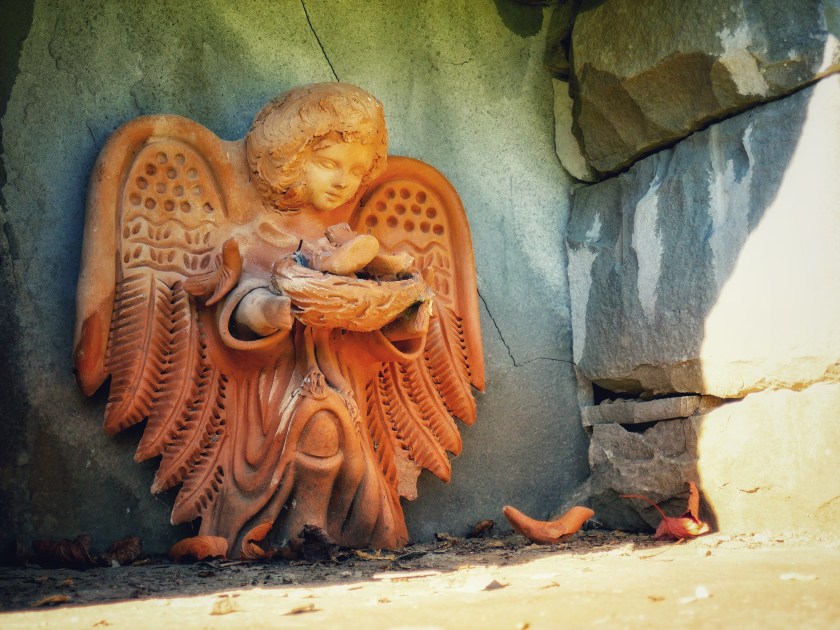
By the time this post drops, I may find we need to shuffle flights to arrive earlier, and I pray my prayers of comfort, grace and gratitude carry me and us through. Too, being held by forces seen and unseen – the angels, ancients, and ancestors.

I’ll borrow a poem from Mary Oliver to sign off:

“You don’t want to hear the story
of my life, and anyway
I don’t want to tell it, I want to listen

to the enormous waterfalls of the sun.

And anyway, it is the same old story
a few people just trying,
one way or another,
to survive.

Mostly, I want to be kind.”

Much love and kindest regards, dear friends, and thank you for yours…

A blessing for living between

a blessing for living between.
Between miracles.
Between answers.
Between formulas.

Blessed are you who live here,
this space between
simple categories and easy answers.

You who wonder why this is your life,
why you got this diagnosis,
or why you still struggle with infertility,
or why you haven’t found your birth parents,
or why you can’t kick the addiction
or why your kids haven’t come home.

Blessed are you who
build a home on uneasy ground,
who, despite your trying,
your asking, you’re searching,
haven’t found the satisfying
feeling of discovery.

And blessed are you who never will.
This is not an easy place to live.
Outside of certainty,
outside of knowing,
outside of the truth.

But blessed are you
who realize that love and beauty
and courage and meaning live here too.
Amid the unease and the frustration
and the sleepless nights.
In the way love and courage
show up through people,
through presence, through laughter.

May you be surprised by
your capacity for ambiguity,
for the way it makes you
a great listener and a good friend,
for you are someone who knows
how to feel your way around
in the dark and squint for the stars.

I wish it were easier, dear one.
I wish I could hand you
the answers you seek.

But for now,
may you find comfort
in the fact that you are not alone.
We are all learning to live
in the uncertainty in the unknowing.
So blessed are we who live here together.

~ Kate Bowler, November 19, 2023 ~

A dear friend, well acquainted with grief, having lost her step-daughter to cancer a few years back, introduced me to Kate Bowler, herself close friends with cancer. I’ve listened to a couple of Kate’s “in your face with honesty” podcasts, and an interview on On Being. This recently posted poem speaks to me of her no holds barred, compassionate experience of living in the liminal – rife with challenge, rich with gifts.

I’m not sure why I felt moved to share this poem today, after many months’ pause in my Friday photo and poem posts. Maybe because right now – again – so many near and far are living “outside of certainty, outside of knowing, outside of the truth.” That our world, human and the more than, is living in the indefinite pauses between miracles, answers, and formulas. That we might each find comfort in knowing we aren’t alone, and in the blessing we all live here together, near and far.

Much love and kindest regards, dear friends.

Solo Traveling

I am home. Met by my husband in sunshine and mild temperatures last Saturday after nearly 24 hours awake, most of those masked in the minority, I arrived safe, sound, very tired and with my checked luggage. It’s taken about a week to recover from jet lag and feel my soul return to my body. I’ve been grateful for another prolonged autumn, warm enough to get back on the pickleball courts and try out my foot after trekking 220/237 km on the Via de Francesco, and close to another 100 km wandering through Florence, Assisi and Rome during the days bookending my walk. I played so-s0 after five months off court, and while my foot felt OK, I realized it’s too much, too soon to resume play daily. Saturday found me in our still colourful river valley walking with my Camino group. It felt wonderful to tie on the boots I’d worn up and down those paths in Italy, now with a much lighter pack, and gloves, toque and a down coat given the sudden shift in temperature…to be reunited with friends who, too, had trekked this past month in Portugal, Spain, Germany, Italy and Eastern Europe

Edmonton’s River Valley – Whitemud Creek towards Snow Valley

“Solitude is one of the most precious things in the human spirit. It is different from loneliness. When you are lonely, you become acutely conscious of your own separation. Solitude can be a homecoming to your own deepest belonging. One of the lovely things about us as individuals is the incommensurable in us. In each person, there is a point of absolute nonconnection with everything else and with everyone. This is fascinating and frightening. It means that we cannot continue to seek outside ourselves for things we need from within. The blessings for which we hunger are not to be found in other places or people. These gifts can only be given to you by yourself. They are at home at the hearth of your soul.”

John O’Donohue

“After this recent month-long journey, bookended by several days of solo wandering, I can assuredly say I am friends with both.”– posted on Facebook, October 20, 2023

Too, I can assuredly say that combining a small group experience with solo time prior, after, or both, is my favourite way to travel. I experienced it most recently in Morocco this past spring when I arrived solo in Casablanca and then extended my stay in Marrakech after the small group excursion. When I think back to having flown into Florence late that Sunday afternoon – finding the tram to take me from the airport to the SMN train station, to then making my way to the monastery I’d booked for the week (all first time experiences) – the combination of trepidation and accomplishment – in this case particularly so as I knew my way better than the local I’d asked – delightfully got me off on the right foot.

Having been to both Florence and Rome several times, I felt confident in my ability to get around. I’m “old school,” preferring paper maps – this trip using a terrific popup version that tucked away in my purse – and I’m quick to ask for help, understanding that in the encounter made, people enjoy knowing they’re needed. I loved wandering early in morning, and suddenly, for example, coming upon the Duomo to be enthralled by the sunlight breaking through the clouds. Countless moments of “moving at the pace of guidance” – going where I wanted, when I wanted – enjoying my own companionship, not missing a soul, the boon of solo travel.

early morning at the Duomo, Florence

That being said, I know, too, what a well-travelled friend had called “low pot” days: when fatigue, feeling overwhelmed, displaced and lonely create inertia, low confidence and anxiety. Its remedy: to acknowledge and either sit with and rest, let be or move through depending on the situation. This crept up on me during my time in Trastevere, when after two weeks of companionship, walking alone together, I was suddenly alone alone. And I was tired… from the exertion, not only of the actual trek in the glorious hot late summer, but too, from the hundreds of kilometers I’d walked in preparation. The inevitable “come down” from the accomplishment and all it took.

So yes, I am intimate friends both with solitude and its gifts of sustenance, renewal, rest and creativity, and too, with loneliness and its sharp edge of separation and self doubt.

A well-established practice of self-care, I’d spend at least an hour daily editing the day’s photos and writing a description to post on Facebook, this time to soothing instrumental Spotify playlists. While it became THE chronicle of my experience (as the very small journal I brought often remained empty for days at a time), in those moments of solitude and occasional loneliness, the comments from friends shored me up to remember the gifts that can only given to me, by me.

at the Trevi Fountain, Rome

Dear friends, if you were among those who followed my journey, and perhaps commented, thank you for the lifeline.

Much love and kindest regards…

Exhaling

Finally, enough space to for some words to emerge from that place “before, beneath and beyond” to find their way to the surface and onto this page.

Finally, enough that has been in process for summer’s duration now settling.

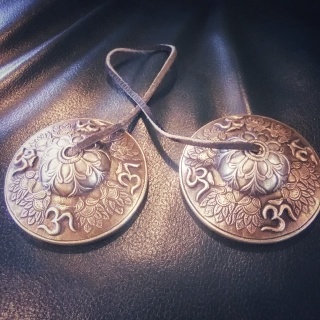
Finally, like my practice’s bell that signals the need for a pause with a breath in between, embodying and enlivening that breath here.

tingshas for ringing in a pause

FRIENDSHIP
My last post almost two months ago was an opening into the seldom talked about territory of the distress with broken friendships. As I’d anticipated, my exploration evoked comments from many readers, mostly women. Ranging from encouragement for naming truth, to reframing as peace-making the individual acts of courageously and vulnerably stepping in to invite conversation and clarification, to women sharing related stories of long-standing friendships suddenly going awry, to others feeling the best friendships should be the easiest to maintain (an opinion I countered). If I were to edit that post, I’d clarify that while the opening quote was ample context for both my letter to my friend, and the post, I wouldn’t “walk away in disgust” but rather in sorrow. As has been the case.

Since then, longtime friend Tracy shared a book title that I promptly borrowed from the library. Platonic: How the Science of Attachment Can Help You Make and Keep Friends by Maria Franco (2022) provides an accessible frame for understanding the complexities of early attachment wounding in adult friendships. Suffice to say that John Bowlby’s seminal work on attachment theory, now decades old, is thankfully again seeing the light of day, helping us understand the tricky ground of relationships. Add in the impacts of generational trauma, its impacts on the body-mind, and coping strategies of addiction and we have more than enough reason to find compassion for ourselves and others.

While I’d thought I might have more to write on the subject, my attention has shifted though the questions I hold and the sorrow I feel continue ebb and flow.

MEMORIES
At some point during the day, as any of you who store your photos on the cloud know, photo memories appear. Sometimes it’s a past post on social media that I check for relevancy before sharing again. Always it’s the photos I’ve made and stored in the cloud over the years. For the past few days, it’s been photos of my first visit to Morocco in 2019. How utterly poignant to see over and over the beauty of her land, culture and people that captivated me then, that enticed me to return this past March, now in the aftermath of the weekend’s catastrophic earthquake. Writing today to a friend who shares my awe and appreciation for Morocco:“my return to Morocco was most satisfying…my love for her only deepened…my desire to spend more time there was only stoked, not sated.”

To others I acknowledged the bittersweet gift of travel: that with each journey taken, the world becomes smaller, more intimate with each connection made, each friendship forged. So that when such devastating events occur, I cannot help but feel a heart stopping immediacy, a bone resounding impact and meaning. Then anonymous concern gives way to personalized shock and grief.

My dear friend, Omid Safi, an acknowledged scholar of Islamic studies and Rumi, hosts regular “illuminated tours” of Morocco. Evidence of our small world when in March he was with his group in Marrakech as I was with mine in Casablanca. When he saw that I’d attended a cooking class at Marrakesh’s AMAL Women’s Training Center and Moroccan Restaurant, he wrote that its founder was a dear friend. Today he posted their efforts to gather and directly forward donations to families left bereft in the mountain villages hardest hit by the earthquake. I appreciated Omid’s post, resonant with the message I’d heard repeatedly while touring the country, reminding me of those most basic values shared among Abrahamic faith traditions: “send thoughts and prayers, please. Also send aid. Remember that our beloved Prophet says to change things first with your hands, then your tongue, and lastly by the heart. We begin by doing something.”

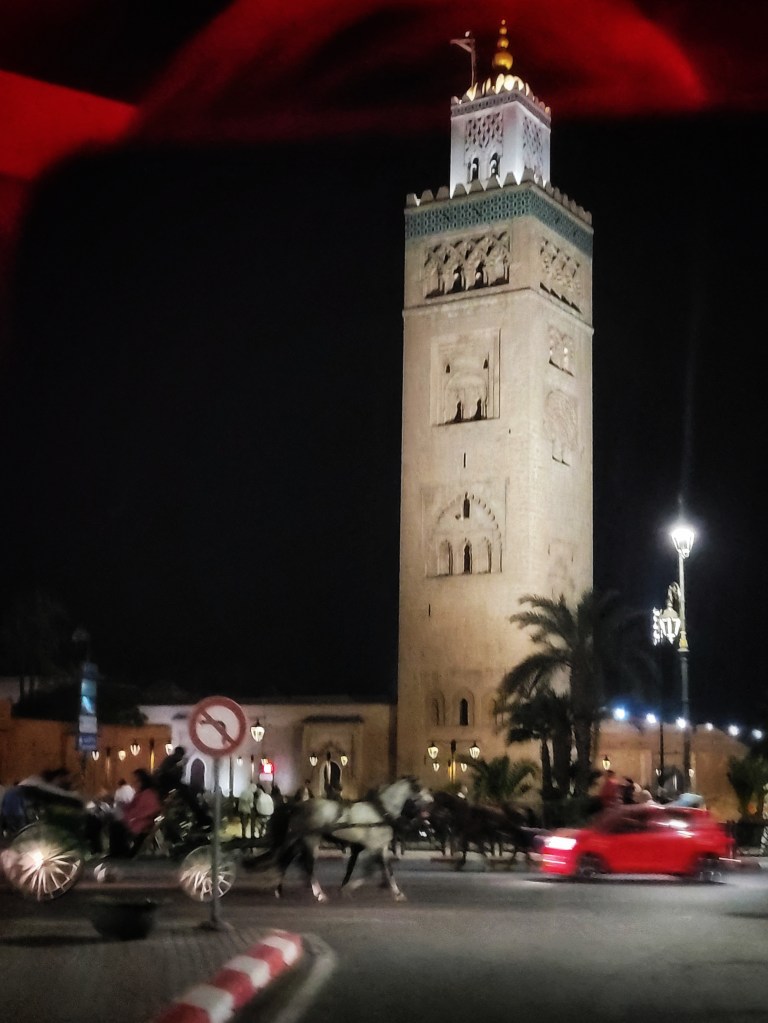
Marrakech’s Koutoubia Mosque, March 2023
September 8, 2023- it shook and swayed, yet stands still erect

ANNIE
Among those photo memories are countless ones of Annie. Today a favourite taken a year ago.

It’s been three months since we had to say goodbye to our beloved fur companion. Striking for me has been the coincidence (?) of weather. On both the first- and second-month anniversaries of her passing, the day was exactly as it had been for those initial three days in June: leaden gray skies and steady soaking rain. And like those first three days, each month since I’ve felt held by the sheltering sky, in my grief, my love, my missing, my appreciation for this beautiful being called Annie.

I haven’t yet been able to return to our favourite bench overlooking the pond, nor walk our familiar neighbourhood routes. But in the meantime, I have walked. Close to 320 kms since the end of July. Up and down and through our river valley. Initially with great trepidation, now with confidence that I am as ready as I can be to walk the 16-day, 260 km Via de Francesco from Assisi to Rome. I tended to a collapsed metatarsal of my left foot for most of the spring and summer, the onset of which occurred during that day in March when walking on cobblestone through the labyrinthine medina of Fez. Finally surrendered to giving up pickleball in early June, the activity I’d counted on both to healthfully distract me from grief and to build my cardio fitness, I turned to deep water aqua fitness three times a week. Then my dear friend and former marathoner Thais, created a month-long training program wherein I’d gradually increase the distance and backpack weight to 20+ km and 13+pounds, some of the longest days walked during the highest temperatures of the summer with the greatest weight.

THREE COINS IN THE FOUNTAIN
In a week’s time I’ll be settled in Florence for several days, about to meet up with my morning food tour in Otranto. On Tuesday, an early spot at the Uffizi to once again revel in the masters. Another day a city bus up to Fiesole. Then later in the week, a train to Assisi to wander solo and adjust to the first of many hill towns I’ll encounter walking. There I’ll meet with the small group of fellow walkers and pilgrims escorted by our Italian guide, and tour company host, Sandy Brown, writer of several Italian “camino” guidebooks. We’ll conclude our via at the Vatican, giving me several more solo days to decompress in Rome’s Trastevere neighborhood. That coin tossed over my shoulder into the Trevi Fountain last October, now my third, has returned me yet again to another country of my heart.

third coin tossed at the Trevi Fountain, October 2022

MOVING AT THE PACE OF GUIDANCE
(coined by my friend Christina Baldwin in The Seven Whispers)
Walking one day on my own a few weeks ago, I realized how different my preparation for this long-distance trek compared to last year’s Portuguese Coastal Camino. Both then and now booked early in the new year, as I waxed and waned in the early weeks of summer, wondering if I was up to the challenge due to grief and injury, I realized I didn’t know WHY I was making this journey. Last year I had been so clear that I was responding to a decades’ held dream. Such clarity of purpose and my reading of Phil Cousineau’s The Art of Pilgrimage shaped so much of my planning and preparation. Now except for my lists, and clothing and supplies laid out on a bed for weeks, my dedication to my training, I began to wonder about the presence of grace in all of this.

One night trying to sleep after long, hot rugged day of walking, I wept…with exhaustion, with missing Annie, with fear I’d not be up to making the trek, with worry for my husband and a sudden health complication (resolving), and with realizing that with Annie’s passing, my words had died. I did not have the energy to find a word to write. I did manage to polish up a few poems to meet some submission deadlines. And while I trusted this was a temporary state, simply my fallow not a harvest season, I felt sorrow and disappointment that I’d been unable to use my writing to heal my grief, as I’d known other writers to do, published collections being an added result. I felt especially vulnerable as in June I had asked for and received the gift of a weekly writer’s circle with the group of remarkably kind and talented and generous women writers with whom I’d just completed an online course. How could I be in a writer’s circle and not be writing?

Come a week, those four weeks in Italy I will be moving at the pace of guidance. Beyond a food tour and gallery ticket I have nothing booked. Having visited Florence and Rome several times, I feel comfortable wandering, sitting at cafes, watching people, noticing, making photos, and taking a note or many to seed future writing. Walking every day for sixteen, I know from experience there is a simplicity and rhythm that invites heeding guidance, feeling grace.

Realizing the extent to which this summer I have been holding – grief, uncertainty, worry, pain – I feel myself exhaling.

Thank you, dear friends, for your patience as I find my words and my breath. Much love and kindest regards.

Friendship

As friendships grow closer, conflict becomes more difficult to avoid. And this is often a good thing. Because the closer we get to each other’s hearts, the more triggers rise into view. Because you can’t fully know someone until you ignite each other’s fire. Because you won’t know if a connection has legs until it has been tested by conflict. And when it is, there is a choice to be made. Walk away in disgust or walk toward it in effort to deepen the connection. Conflict isn’t the adversary of connection. Fear of confrontation is.

Jeff Brown, Hearticulations

This is a deeply vulnerable topic…for me and I’ll presume many of you, particularly my women readers. It’s one of those areas that so deeply affects our lives and yet when friendships go sideways, fall apart, dissolve into thin air, we seldom if ever talk about it. I’m certain I’ve read somewhere from someone whose opinion matters to me, that breakups with friends can be as devastating as divorce, if not more so. And so it is, with the encouragement from a friend, I write this post to begin to illuminate the often shadowed dynamic so essential to our lives and well being.

I included the above quote in a letter I recently sent to a friend. Sensing our relationship was wobbling, for weeks – months even – I pondered reaching out to enquire of her. And then in a bout of insomnia several weeks ago, compelled I sat down in the dark of my writing studio to craft a letter. Several revisions later, coupled with my self doubt and courage that waxed and waned, this quote arrived last week. It both perfectly described my thoughts on friendship in general, and framed the intention and context specific to my letter to her.

It’s not the first time I’ve written such a letter to a friend, or initiated the conversation. And always the self doubt. Always the courage to reveal, to make myself vulnerable by asking, “Are we OK?” I think we’ve all seen how as we grow closer to another – a friend, a partner, a professional colleague – anyone with whom we’ve made an investment of time, care, attention and regard – that conflict is bound to arise. Paradoxically, our differences surface and grow in the very container of similarity and safety provided by the initial attraction and energy of the relationship. This is particularly so of marriage, and why it holds the potential for the healing of its partners, as old wounds come to light. But avoid naming it, fearful of our own vulnerability in the face of it, self doubt and shame grow, projection and denial thrive, and relationship languishes or collapses.

Friendships – like my self doubt, courage and insomnia – wax and wane. As the saying goes, they come for a reason, a season, or a lifetime. This and the analogy I’ve adopted – one of the astrological arrangements of stars and planets moving closer and then apart – help restore perspective. Given my nature, in those periods of waning and moving apart, I’ve found myself wondering “why?” In the absence of clarification, I’ve defaulted, sometimes distressingly, to a habit of mind cultivated in childhood that says, “I’m to blame.” That same childhood source of those triggers that get touched when I get close to another’s heart and they inadvertently say or do, or don’t say or do, and hit the target. When I do the same to another.

…Something in you knew
Exactly how to shape it,
To hit the target,
Slipping into the heart
Through some wound-window
Left open since childhood.

John O’Donohue, “For Someone Who Did You Wrong,” in To Bless The Space Between Us (2008)

With a child’s naiveté and cultivated by societal norms, I’ve believed in the possibility of, even yearned for a “bff” – that one girlfriend who, through thick and thin, over the ups and downs of life, would always be there. (But truthfully, when I consider my own life and its continuous unfolding, I’m not sure about it – except for Oprah and Gayle, perhaps.) Implied is a depth of trust and consistent connection which can be a displacement onto or substitute for what was missing in our earliest relationship with mother. Jungian analyst Marion Woodman writing about the “Death Mother” together with Daniela Sieff and Toko-pa Turner, and contemporary writer Bethany Webster on “The Mother Wound,” are each identifying an archetype arising from patriarchy with its pervasive damaging impacts for girls and women, and their relationships with self and other. I’ve felt deficient and heart broken when friends for whom I cared a great deal, loved even, despite efforts to make amends, broke up with me because I had hit their heart target. Even today, the memory is a tender ache.

…Meanwhile, you forgot,
Went on with things
And never even knew
How that perfect
Shape of hurt
Still continued to work.

John O’Donohue, “For Someone Who Did You Wrong,” in To Bless The Space Between Us (2008)

In relationships that matter to me, where the heart is touched, it’s the absence of clarification I’d find most troubling. It’s why I’d ponder for days and wake at 3:00 am to draft a letter. Muster the courage and allow myself to be vulnerable to enquire. I rest a bit easier now, in a solace knowing it might simply be a change in season, no longer the reason, that the planets have shifted. Why what was once close is not quite so, or any longer.

…Now a new kindness
Seems to have entered time
And I can see how that hurt
Has schooled my heart
In a compassion I would
Otherwise have never learned.

John O’Donohue, “For Someone Who Did You Wrong,” in To Bless The Space Between Us (2008)

I’ve said to friends who have mattered along the way, when you feel something is amiss between us, please don’t waste precious time, energy and sleep trying to figure out if it’s you or me, foolish or worthy of your attention. It’s most likely all true. So please bring it to the friendship so we can work on it together. Walk toward me for clarification, and deepen the connection. Please.

Or don’t. I’m learning to be OK with that choice, too.

…Somehow now
I have begun to glimpse
The unexpected fruit
Your dark gift had planted
And I thank you
For your unknown work.

John O’Donohue, “For Someone Who Did You Wrong,” in To Bless The Space Between Us (2008)

Much love and kindest regards, dear friends.

The Pilgrim

THE PILGRIM

When you return from a long journey
air sweet with lilac and unfurled green
then you fall to your knees
and become gratitude’s pilgrim.
You were given the way at birth.
Given blue fields and loam.
Given an open throat, wild orchids,
a path lit by milky stars.
You were given desire,
sweet darkness of the body,
white hum in the bone.

It’s not the departure you long for,
nor the finish, with its thick incense,
tired feet and weeping.
It is the quiet loneliness in between,
When memory marries wind
and you are pure light. Walking.
One foot in front of the other.
You cannot speak of this place.
The way you cannot speak of grace
or what holds you to this world.
How at this moment you can only stand up
and move toward the light of home.

– Rosemary Griebel –
YES (2011)

Last week, listening to a past episode of The Road Home on my radio station CKUA, I heard my friend Rosemary recite three of her poems from this collection, YES. Her lovely voice, together with the background music selected by host Bob Chelmick made for several minutes of exquisite listening pleasure. I first met Rosemary virtually, and then in person when we both attended last November’s weekend workshop with our beloved Irish poet, Pádraig Ó Tuama. Knowing I’d see her, I brought my copy of her book for her to sign. It was there I learned how we are kin, not only in our shared love of words, but also in our both having walked the Camino de Santiago. It occurred to me while listening to Rosemary read last week, that I needed to feature here, in my Friday photo and poem post, some of the local poets whose love of words I share, to uplift those “prophets in my own land,” so to speak.

I’ve written here how the Camino does its work; on me, from the moment I made my decision and deposit a year ago December to walk, but more so upon my return. This past December I took some time to make the photo journal of my walk. Too, I wrote a short story, A Creative Walks the Portuguese Coastal Camino, drawing on my Camino blog posts, for both the Canadian Company of Pilgrims and Sage-ing: The Journal of Creative Aging. And I had the lovely opportunity to talk about my walk and its impacts, both to support a fellow doing his Master degree in Tourism, exploring the transformative gifts walking a non religious Camino, and on the Ellipsis Thinking podcast, “Paying Attention,” hosted by my dear friend, Greg Dowler-Coltman.

Rosemary’s poem speaks to me of so much that was my Camino. That in the planning, the going and the return, I was “gratitude’s pilgrim”… how the “quiet loneliness” while walking became my necessary and bittersweet companion… my “tired feet and weeping” with relief at our safe arrival…and since home, remembering the light, the grace, the beauty. Thank you, Rosemary.

Much love and kindest regards, dear friends.