Every day I see or hear something that more or less
kills me with delight, that leaves me like a needle
in the haystack of light. It was what I was born for – to look, to listen,
to lose myself inside this soft world – to instruct myself over and over
in joy, and acclamation. Nor am I talking about the exceptional,
the fearful, the dreadful, the very extravagant – but of the ordinary, the common, the very drab,
the daily presentations. Oh, good scholar, I say to myself, how can you help
but grow wise with such teachings as these – the untrimmable light
of the world, the ocean’s shine, the prayers that are made out of grass?
– Mary Oliver –
“How are you?” ask friends who I’ve not seen, nor spoken to for a while. “Terrified,” my response.
Not afraid, but terrified…for my country…the illegal apprehensions, deportations, and denied entry…the constant blatant disregard for law…evil in the guise of leadership.
Not a very mindful response, or is it? Certainly more intense and less palatable than “afraid.” But in the moment, truthful, uncensored. And then it passes. The weight of it lessens for its utterance. But I know, too, that I need those moments of seeing and hearing that kill me with delight.
Thankfully, Walker obliges. Every day. The shine in his eyes, tongue hanging in joyful anticipation as I dress to play with him outside. Chasing him with one of the store of sticks he’s taken from the woodpile in the back. Our backyard scattered with them. Or inside, tugging on the damp-with-drool dishrag nearly shredded, or his blue racquetball, or red kong – each tight in his mouth, until he lets go in false surrender just to keep the game between us going.
Thankful, too, that yesterday’s sunshine and warmth allowed me to sit outside on a cafe’s patio to eat lunch after my 8+km river valley walk. All of it a balm. Nature and good food as co-regulators.
And that exquisite hand-made card sent by a friend who is excelling at paper quilling, her latest fascination. In yesterday’s mail, the envelope with my name and address, written by a hand I didn’t recognize. The note inside, bearing the same beautiful script, thanking me for my words, the tapestry I weave with them, the meaning they bring to her.
Coming through a “wintering” season, again with many more rejections of my writing than acceptances, with words laying fallow, deep underground, her gift like a prayer made out of new, spring-green grass.
Much love and kindest regards, dear friends. And to you, Cate, thank you.
“What can I say that I have not said before? So I’ll say it again. The leaf has a song in it. Stone is the face of patience. Inside the river there is an unfinished story and you are somewhere in it and it will never end until it all ends.”
– Mary Oliver, “What Can I Say”
Finally, feeling 90% better after a wicked chest cold that made for sleepless nights, where once home, I was grateful for the guest room in which to retreat, and the prescribed puffer to lessen the coughing. Almost three weeks’ duration, the symptoms so much like the time I came home with Covid after walking the Portuguese Coastal Camino in 2022, I wondered.
Finally, through the first month of a new year, that has felt particularly dark and heavy with foreboding. While the days are lengthening, noticeable in the late afternoon, the heaviness, experienced by many in my country and beyond, persists. I don’t have to name its source. Suffice to say, I feel a gut deep fear that we are witnessing the intentional takedown of the world as we have known it.
Finally, back here writing. A friend nudged me with an email last week, wondering if I was still sharing my thoughts here, that she missed them. I have been doing the work of writing: revising, editing, and collating poetry for submissions to several chapbook contests and literary journals. I read my poem, “Epiphany,” (my last post) on that day’s Open Mic. But here, in this space, it’s been a long, fallow month.
Since returning home in mid-October from my last long-distance walk, with the most recent variant of Covid as a souvenir, my experience has been one of wandering in the liminal. Vague and restless, moody and melancholic. Missing the rhythm of daily long walks in nature. Sensing inexplicable shifts within me and the world. Seeing more apparent the contours of my “eldering landscape” with the passing of friends, and again the worry as my mother suffered another health crisis just as we headed off to celebrate Sig’s birthday on a hot and sunny Pacific coast beach. (I suspect the aforementioned chest cold a consequence, compounded by the resort’s air conditioning.) Not one typically to write it out here, instead I need to mull, ponder, and give time for subtle impressions to emerge with words.
Re-reading this post, I think I’ve simply been embodying the transition of seasons. I need to say it again to remind myself: hibernating, wintering, keeping low, deep, and quiet. And now, finally, feeling the rising energy and clarity of this new month. Despite human machinations to the contrary, February’s stirrings are an ancient signal to the promise of spring’s rebirth. Its hope echoed by my thanks to the editors who have already this year accepted and published my work… to my friend’s nudge to get back to writing here… to finding my way to my rhythms.
To remembering the world needs us. To placing my faith in the unfinished story that will never end until it all ends, despite the man-made maneuvering and power-play posturing.
We are needed, dear friends. Much love and kindest regards. And to you who have recently subscribed, a warm welcome and heartfelt thanks.
Caretake this moment. Immerse yourself in its particulars. Respond to this person, this challenge, this deed.
Quit the evasions. Stop giving yourself needless trouble. It is time to really live; to fully inhabit the situation you happen to be in now. You are not some disinterested bystander. Exert yourself.
Respect your partnership with providence. Ask yourself often, How may I perform this particular deed such that it would be consistent with and acceptable to the divine will? Heed the answer and get to work.
When your doors are shut and your room is dark you are not alone. The will of nature is within you as your natural genius is within. Listen to its importunings. Follow its directives.
As concerns the art of living, the material is your own life. No great thing is created suddenly. There must be time.
Give your best and always be kind.
~ Epictetus ~
I’m glad to have not only a folder of saved poems for Friday’s photo and poem feature, but ones already crafted and sitting in the draft folder that occasionally fit the mood. Today was my good fortune as after yesterday’s grueling session at the dentist for a root canal (“Hard work,” declared the dentist. “Tell my jaw,” thought I.), all I was up to last night sipping soup, with a side of Tylenol and Advil, was watching the recommended new Netflix series “‘Man on the Inside.”
Epictetus says it. And in a similar vein, John Muth in his classic children’s tale, The Three Questions, a reworking of Leo Tolstoy, here read by Meryl Streep. Too, a verse from Mary Oliver’s poem, Dogfish, that I love:
“…And anyway it’s the same old story – – – a few people just trying, one way or another, to survive.
Mostly, I want to be kind. And nobody, of course, is kind, or mean, for a simple reason.
And nobody gets out of it, having to swim through the fires to stay in this world…”
Better late than never, here it is.
May your Friday be touched by the glow of nature that shines as much from within you as it does from outside. And may we each and all be kindas we caretake the moments of our lives.
CLOUDS All afternoon, Sir, your ambassadors have been turning into lakes and rivers. At first they were just clouds, like any other. Then they broke open. This is, I suppose, just one of the common miracles, a transformation, not a vision, not an answer, not a proof, but I put it there, close against my heart, where the need is, and it serves
the purpose. I go on, soaked through, my hair slicked back; like corn, or wheat, shining and useful.
Mary Oliver, in Why I Wake Early, 2004
Oh, the clouds.
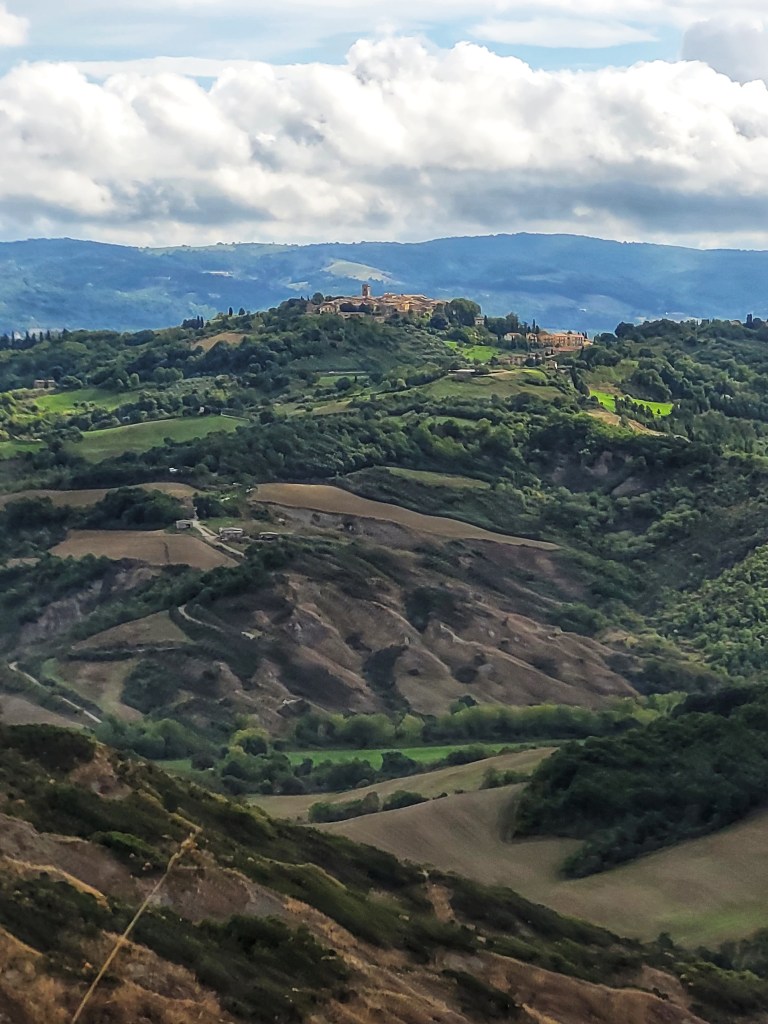
Walking most of the eighteen days in Italy on la Via Francigena – up and down Tuscan hills, across the wide expanses of freshly tilled farmland, in forests dappled with light or dark and sodden with rain – those heavenly ambassadors companioned us, occasionally letting loose their heavy load. A common miracle turned potentially disastrous, depending on the day, the colour of the weather alert (yellow, orange or red) and location in the country, or continent. (In Morocco last week, rain turned years’ dry lakes and rivers into muddy flows.) We were always safe, with our technical guides, Ambra and then Laura, always checking on their various weather and trail apps.
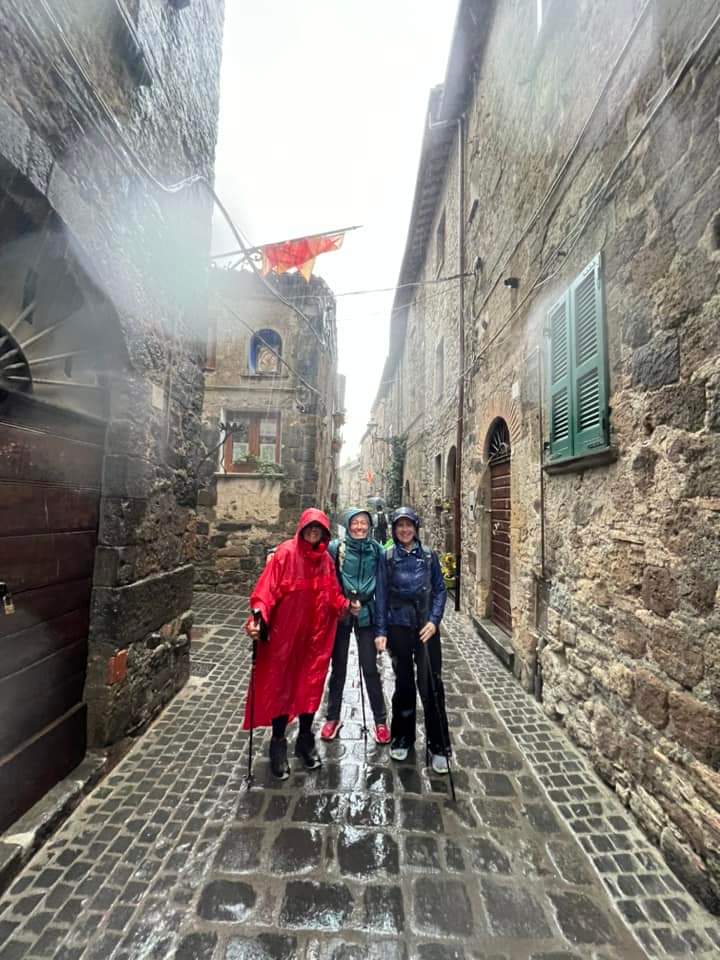
One day, I accepted the invitation to make the memories that come from braving the elements, and walked with three of my companions the distance to Bolsena- every step in the persistent rain and wind. Twenty-six kilometers from early morning to late afternoon through acres of dying sunflowers, village streets, forest paths, up into the medieval town and then down its treacherously steep and slippery cobblestone to the lakeside town’s more contemporary hotels. Clouds so thick the spectacular views obscured until the next day.
Soaked but warm. No waterproofing enough to withstand the deluge. Shining and smiling. Proud of our accomplishment. Memories made.
Much love and kindest regards, dear friends.
memories made in medieval Bolsena, Italy (me in red) photo credit: Laura Harris
I don’t want to live a small life. Open your eyes, open your hands. I have just come from the berry fields, the sun
kissing me with its golden mouth all the way (open your hands) and the wind-winged clouds following along thinking perhaps I might
feed them, but no I carry these heart-shapes only to you. Look how many small but so sweet and maybe the last gift
I will bring to anyone in this world of hope and risk, so do Look at me. Open your life, open your hands.
– Mary Oliver
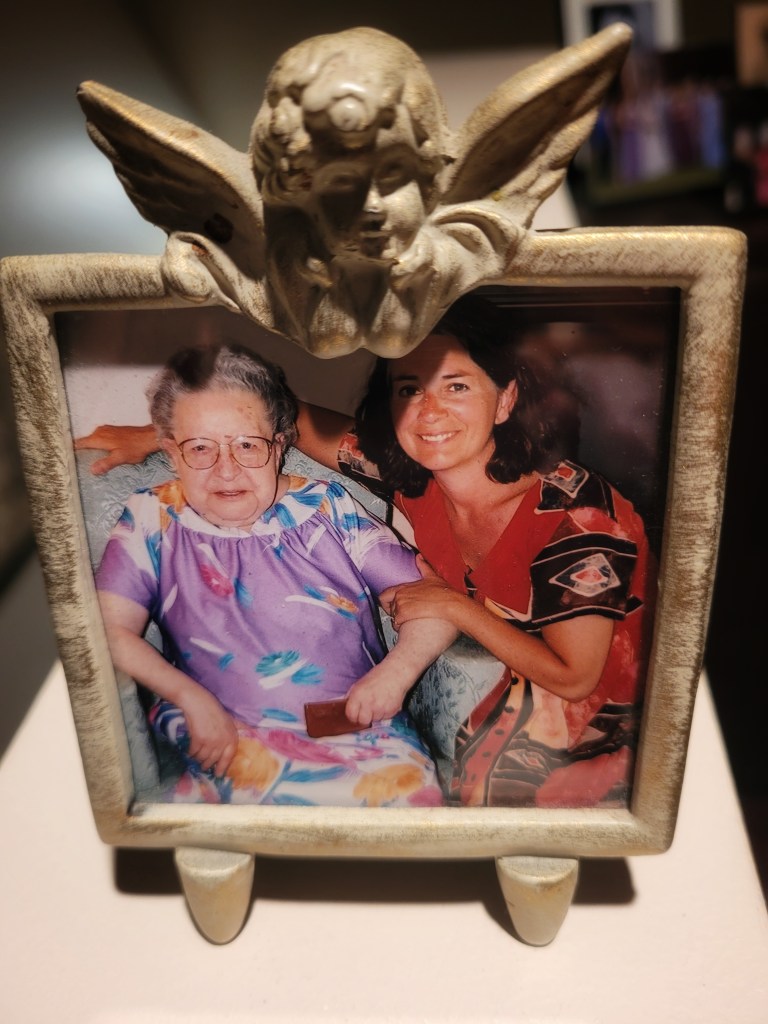
No, it’s not Friday, the day I typically post a poem, a companion photo, and some musings. But because I’ve been thinking a lot about my ancestors, particularly my Oma, this “saved” poem came to mind. As I wrote in last Friday’s photo and poem feature, we had a bumper crop of raspberries from canes we never planted but that found their way under our fence and which, over the years, have waxed and waned in number and in the amount of berries offered. It’s when I’m out picking those berries that my thoughts have turned to Oma as she loved to pick berries, especially the black and red currants from which she’d make the year’s jam and filling for her Christmas Linzer torte, my favourite tradition.
I had moved west by the time I learned in berry season that she, with my sister and her daughter, would go to the numerous “you pick” farms filling buckets and baskets with juicy goodness. From her, my niece learned and elevated the craft to become a gourmet jam and jelly maker, creating concoctions sweet and savory, fragrant and smoking hot. I have several of those jars in my cupboard, as I do one final frozen Linzer torte sent from my Oma in her final famous care package. Given Oma passed in March 2002 and for a few years before lived in a seniors’ residence in a small one room suite without a kitchen, that cherished cake must be three decades old. But like wedding fruitcakes, with a generous splash of brandy and a prayer of thanksgiving and love for my Oma, I know it can be resurrected. In the meantime, I have learned to make a good enough version and do so every Christmas as a tribute to her tradition. Truthfully, I’m in no hurry to eat that last one of hers as it’s a treasured keepsake of her handmade love.
Picking raspberries this summer in the quiet of my backyard, I’d talk to Oma, as I often do when I’m in my kitchen cooking, using one of the many utensils and dish towels she’d packed for me in those care packages, measuring sugar or flour from the avocado green cannister set she gifted me when I moved into my first flat during grad school. She helped me clean and paint that flat. We drove the two hours together in her new hatchback, the car she’d bought herself after learning to drive in her sixties. We slept on the flat’s hardwood floor after she’d worked circles around me, and before falling asleep, surprised me with the grief she felt at the news of Elvis’s death.
My Oma – despite many unspoken hardships as a single mother in WWII Germany; emigrating to Canada on her own after my father had sponsored her; then marrying a German widower and moving several hours away from us to start a new life in a new country alone; working on the assembly line of Bausch & Lomb stitching glass cases for piecemeal wages – did not live a small life. Fiercely independent and always up for a new flavor experience, determined, courageous and curious, in so many ways she inspires me. I attribute my intrepid, solo-traveling nature to having been “seeded” by her.
Flying home two weeks ago, with no foreknowledge, simply intrigued by the two-line description, I watched Perfect Days, a 2023 Japanese film written and directed by Wim Wenders. After three weeks of slow travel, designed with time to stay put and settle into the experiences of southern Italy, it was a soothing transition back into our quiet life at home. Clocking in at two hours, the film is described by The Criterion Collection as:
“A perfect song that hits at just the right moment, the play of sunlight through leaves, a fleeting moment of human connection in a vast metropolis: the wonders of everyday life come into breathtaking focus in this profoundly moving film by Wim Wenders. In a radiant, Cannes-award-winning performance of few words but extraordinary expressiveness, Koji Yakusho plays a public-toilet cleaner in Tokyo whose rich inner world is gradually revealed through his small exchanges with those around him and with the city itself. Channeling his idol Yasujiro Ozu, Wenders crafts a serenely minimalist ode to the miracle that is the here and now.“
The main character seldom speaks. Day in, day out, his routine is the same – thoughtful, simple, purposeful marked with moments of gratitude for the sky, trees, and the light shimmering among the leaves.
The film’s final frame, shown above, defines the central principle grounding the story, and served as its working title. Reading, I smiled with recognition and appreciation, and sighed knowing its essence, as I am one whose first memory is of komorebi.
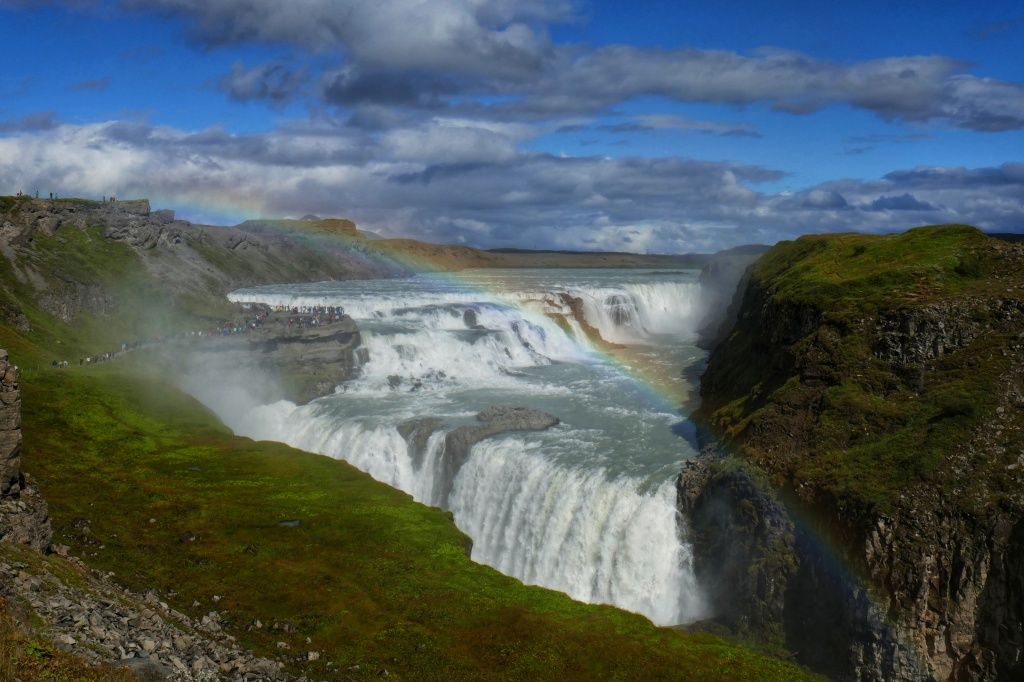
A few years ago, I wrote here about my love affair with trees, then inspired by a Sunday reading of The Marginalian and quote by Maria Popova, “A tree is a light-catcher that grows life from air.” My love affair with skies became conscious when I travelled to Iceland in 2018. While I fully anticipated the landscapes would tug on my heart, I had no idea how indelible the impact of those skies.
Reykjavik HarborGulfoss, Golden Circle, Iceland
But back to trees and some of those that caught my attention in Italy last month. Some captured with komorebi:
Taormina’s “Duca di Cesaro” public gardensRome’s Largo di Torre ArgentinaHerculaneumSorrento’s Piazza Lauro
Borrowing from my earlier post on trees, I’ll conclude in the same way, with a poem by Mary Oliver, in gratitude for the trees I gaze upon in my yard, and in vistas miles and oceans away, and for my friends who share a special kinship with them:
WHEN I AM AMONG THE TREES When I am among the trees, especially the willows and the honey locust, equally the beech, the oaks and the pines, they give off such hints of gladness. I would almost say that they save me, and daily. I am so distant from the hope of myself, in which I have goodness, and discernment, and never hurry through the world but walk slowly, and bow often. Around me the trees stir in their leaves and call out, “Stay awhile.” The light flows from their branches. And they call again, “It’s simple,” they say, “and you too have come into the world to do this, to go easy, to be filled with light, and to shine.”
“I believe poetry is very old. It’ s very sacred. It wishes for a community. It’s a community, ritual, certainly. And that’s why, when you write a poem, you write it for anybody and everybody…It’s a gift to yourself, but it’s a gift to anybody who has the hunger for it.”
Mary Oliver, as quoted in On Being with Krista Tippett
Four years ago, in January 2020, I designed and published this, my third blog, to serve as a platform for my writing. Little did I know then, that with the sudden arrival two months later of world-stopping Covid-19, I’d need to be leaning into writing and this space to cope with the grief of having lost my career and much of what I had assumed to be certain. I wasn’t alone in any of this, but the resulting systemic social isolation occasionally had me wonder.
By September that year, I’d set my sights on learning how to write poetry. I’d dabbled over the years in my blogs and journals, and for as many, was a devoted listener of The Road Home, a spoken word and music program curated by Bob Chelmick on my local radio station. I discovered Poetry Unbound, a podcast offering from my favourite On Being with Krista Tippett, hosted by Irish poet Pádraig Ó Tuama. With Annie on her leash, I’d plug in my earphones and for fifteen time-stopping minutes, walking familiar neighborhood routes, I’d listen to him read a poem and share his understanding about its structure, meaning, and resonance. An ardent fan, occasionally I’d write about him here, and took advantage of tuning into every free Zoom event around the world, hosted by Padraig reading, talking, teaching poetry. When I learned he’d be coming to Calgary for a retreat in 2023, I made haste months earlier to buy my ticket and reserve my bus ticket – a wise move as we had our first blizzard that weekend.
I joined a couple of Facebook groups for writers and took advantage of many free online readings and workshops to gain exposure to contemporary poets, seeing how they compared with my favourites, helping me find my voice. I was invited by Karen Close, founder and editor of Sage-ing: The Journal of Creative Aging with Creative Spirit, Grace and Gratitude to be her thinking partner and co-editor. Then exactly two years ago, upon the encouragement from one of my public library’s writers-in-residence – another complimentary service of which I have availed myself, I began the work of preparing a manuscript for submission to a well-known Canadian poetry publishing house. With Annie on her cushion by my side, I edited over seventy poems, received feedback from several friends and fellow writers, and emailed the package a week before heading off to walk the Portuguese Coastal Camino. An email in July brought the not so surprising, but none the less disappointing, news that my work had not been selected. It closed with the concise instruction “to persist.”
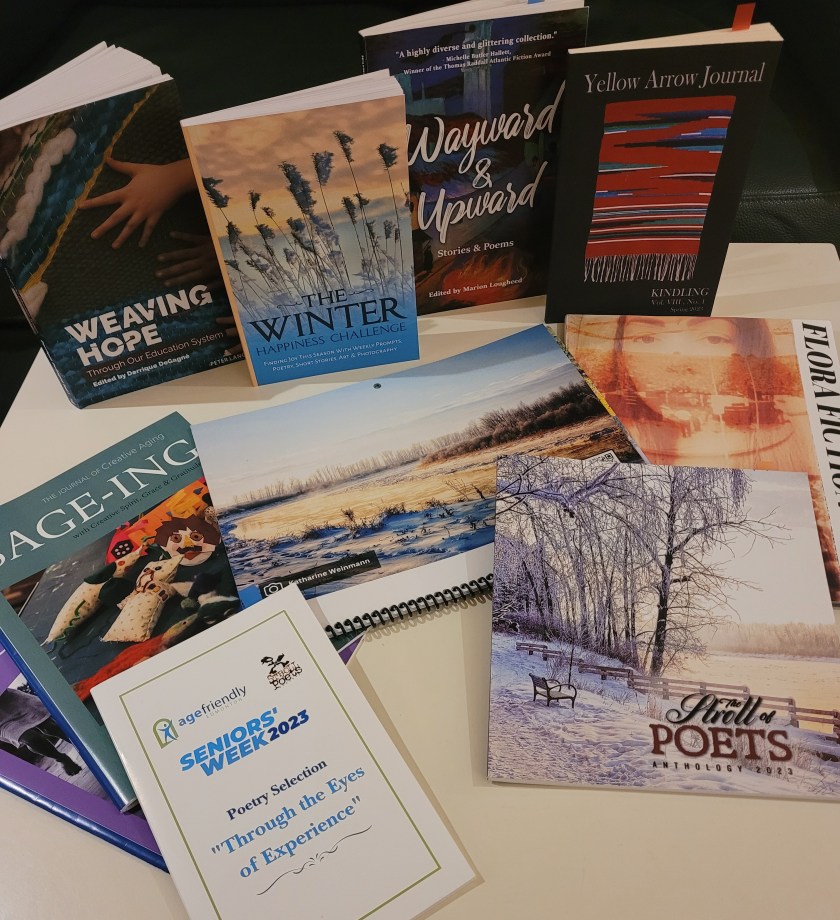
And so, I have. 2023 found me back in the saddle, submitting regularly to literary journals and online magazines around the world. I attended master classes with esteemed poets and prepared a chapbook for a publisher who had previously accepted one of my pieces. Another rejection, but she gave me the gift of feedback I’m using now to move my writing forward. Monitoring my submissions, tracking rejections and successes, with 70 sent last year, over 20% have been published, including several in national and international anthologies. In the meantime, as many journals invite submissions of art and photography, I’ve jumped in and have had several photos published – for money – have been included in a 2024 calendar featuring Edmonton’s river valley and have won the cover contest twice for our local poetry anthology. I feel chuffed.
I think alot about my writing: Why do I do it? What I give to it and what it gives to me? I’m committed to making poetry my writing genre of choice. Or, it has chosen me, being one who has long had a poetic turn of phrase and outlook on life. Like Mary Oliver, I believe poetry is sacred, being one of the ways I bring the sacred into my life, making my life as poem and prayer. However, unlike many writers, I’m not yet confident that writing is my way to, for lack of a better word, salvation…to reconciling what troubles me. I haven’t had enough experience waking during my soul’s dark night to trust that taking pen to paper will see me through to a metaphoric dawn, let alone a literal one. It is a faith that grows.
I am learning about poetry’s inherent nature of ritual, especially in the process of revising. Here I can immerse myself for hours, quietly reading for rhythm and assonance, writing for placement on the page, making space for the breath, embodying the imagery. This gives me pleasure.
I don’t know who proclaims one a poet. Maybe joining a professional group and paying the membership dues legitimizes one’s efforts. I’m leaning more into the empowering wisdom that comes from claiming myself through learning what it means to be a practicing poet. Exploring organically the design of my way of working; developing discipline and technical skill; rolling with rejection and celebrating success; reaching out for support; being vulnerable. Much of it done in isolation. In hindsight, Covid-19 prepared me well.
Four years ago, I began a new career, or rather, a new one found me. Today I am an internationally published poet and photographer. When I waver in my confidence and question the value of my words in a world inundated with others, I have those from my dear friend, author, and first writing mentor, to hold me in its community:
“And the quality of your writing offers me a moment of presence with you, your thoughts and reflections, and the complexities of the road we travel in and through these times at both the very personal and the larger scale. This is alchemy. Please continue. Please imagine me in early morning–still dark, tea and low light, and waking my day with your gift.”
Christina Baldwin
Thank you, too, for yours sent to me, dear friends. Much love and kindest regards.
In a week’s time my husband and I were to have been with my family celebrating my parents’ 70th anniversary. A staggering accomplishment given current divorce rates. Instead, after several back-and-forth conversations with my father and sister, wherein the “no choice” choice was made to cancel the family dinner, photographer, and flowers, we’ll stick to the flight plan and hold vigil, virtually and in person, for my mother, whose health and life have been seriously compromised by taking Ozempic. She is the second person in my close circle who has recently suffered a life-threatening bowel obstruction from this much touted, so-called weight loss miracle drug. Here as I type, she is with my sister in a hospital 30 minutes from home, the closest facility able to provide the CT scan needed to determine the impact to her bowels and life, while my father, bearing a week’s weight of worry for his wife, collapses with fatigue at home. (Another story, the sorry state of health care crippled across my country.) Thankfully, my sister is an RN, astute in her holistic perspective, clear and courageous in her advocacy, compassionate in her care.
In the last twenty-four hours I have learned of two friends losing their life partners. Before Christmas, another. And I wonder, will my father be losing his? For an hour today of personal respite, I attended a silent writing circle. After introductions, the host set a 45-minute timer wherein we muted ourselves, turned off our video cameras, and wrote. “January, the first month in a new year…its first days always bring an undercurrent of unease…for decades I’ve stepped across its threshold, yet this time feel days darker with melancholy…a bone deep sadness, its source clearer with each passing day.”
“Epiphanies,”I wrote.“Three wise men bearing gifts; the anniversary of our arrival 43 years ago to the prairie province we call home; the sudden death of my young, never-known grandmother, shrouded in secrecy, and leaving behind her toddler child, my mother, now holding tenuously to her own life. And today, dawning stark cold and bright, like winter’s belated arrival, the realization of how intergenerational trauma has shaped and coloured my stepping into most every new year ofmy life, tarnishing it with inchoate anxiety and grief.”
I’m as OK with all of this as I can be. Intuitively, instinctively, even presciently, I’ve been naming and writing here about crossing the threshold into this hard next life chapter – the eldering landscape where death and illness, failing health and loss become its “leitmotif;” where unapologetic grief becomes an even deeper expression of my love for my life and this world.
Sustained by those few near and dear kindred friends, my community of walkers, a monthly check-in with my therapist, my beloved and our quiet sanctuary of a home; and the ever-present beauty a step outside my door, I’m OK.
By the time this post drops, I may find we need to shuffle flights to arrive earlier, and I pray my prayers of comfort, grace and gratitude carry me and us through. Too, being held by forces seen and unseen – the angels, ancients, and ancestors.
I’ll borrow a poem from Mary Oliver to sign off:
“You don’t want to hear the story of my life, and anyway I don’t want to tell it, I want to listen
to the enormous waterfalls of the sun.
And anyway, it is the same old story– a few people just trying, one way or another, to survive.
Mostly, I want to be kind.”
Much love and kindest regards, dear friends, and thank you for yours…
It seems you love this world very much. “Yes, I said. “This beautiful world.”
And you don’t mind the mind, that keeps you busy all the time with its dark and bright wonderings? “No, I’m quite used to it. Busy, busy, all the time.”
And you don’t mind living with those questions, I mean the hard ones, that no one can answer? “Actually, they’re the most interesting.”
And you have a person in your life whose hand you like to hold? “Yes, I do.”
It must surely, then, be very happy down there in your heart. “Yes,” I said. “It is.”
– Mary Oliver in Felicity, 2015 –
This wasn’t my original selection for my first Friday photo and poem for this new year. Initially, I was moved by Gregory Orr’s “Aftermath Inventory,” a short, unflinchingly exquisite poem from his collection, The Last Love Letter I Will Ever Write (2019), one posted this week on another poet’s site. It was the final line “My scars?/Someday/They might shine/Brighter than stars.” that stirred because of how I and many are feeling about this cusp of ending and beginning.
I chose not to write my “irregular” regular Monday post which would have dropped on New Year’s Day. Enough inspiring, heartful, hopeful, earnest prayers, blessings, quotes, and memes that I had nothing to offer to the mix, not wanting to dilute those kind and loving intentions. Though can there ever be too many prayers and blessings? Considering Orr’s poem, I thought of it as a humble gesture of my acknowledgment of the suffering of others, close and far, in war, illness, climate disaster, bereavement, poverty, homelessness, addiction. To stand in that unflinchingly, sorrowfully. Grateful for the hands I have to hold, for this world I still find utterly beautiful, loving it very much.
Many times, I start the year with a word. Choosing to forego the practice this year, life had other plans. Sitting one morning having my conversation with God, an Anne Lamott kind of help, thanks, wow conversation, I found myself inhaling to the word “comfort,” exhaling to “gratitude.” Over the days, it’s morphed to asking for grace on the in breath and giving gratitude on the out breath.Words, a mantra, a grounding for my being, body, and breath whispered many times a day. A voice from I don’t know where, or I do, having asked and been heard.
Much love and kindest regards, dear friends.
May this new year bring you all that is good and true and beautiful, with grace and gratitude aplenty, and the courage and compassion to withstand its inevitable heartache and challenge.
We will be known as a culture that feared death and adored power, that tried to vanquish insecurity for the few and cared little for the penury of the many. We will be known as a culture that taught and rewarded the amassing of things, that spoke little if at all about the quality of life for people (other people), for dogs, for rivers. All the world, in our eyes, they will say, was a commodity. And they will say that this structure was held together politically, which it was, and they will say also that our politics was no more than an apparatus to accommodate the feelings of the heart, and that the heart, in those days, was small, and hard, and full of meanness.
Mary Oliver Red Bird (2008)
I collect poems that appear in my inbox or on social media. This is one posted by wise elder Parker Palmer in mid March of this year. Is it prescience? Or simply another rendering of Mary Oliver’s astute skills in observation already so evident in her poetry situated in the natural world. I imagine is was cited often in the months following the 2016 American presidential election. It continues to have remarkable resonance there as states swing to vote in politicians and legislation undermining and undoing so much of what we have considered the hard won, inviolable rights of the historically vulnerable, marginalized and disenfranchised.
Today, I think it apropos for my province, mere days after the election that gave to the woman who took over her party’s leadership on a no confidence vote, the mandate to proceed with her view of things. A woman who, just days before, was found guilty of violating the province’s conflict of interest act. A woman who, in the first months of assuming leadership, was publicly apologizing for every verbal gaffe she’d made speaking, apparently without thinking. Or was she revealing a heart that was “small, and hard, and full of meanness.” A heart that regrettably becomes so shaped by empire. A heart that beats in my own chest unless I chose to cultivate otherwise.















 A Wabi Sabi Life