THESE DAYS Anyone who tells you not to be afraid should have their head examined. Cities are burning, hillsides are ablaze. and the dumpster fire of our common life is out of control. I wish I could tell you when it was going to get better. I wish I could promise that better was anywhere down this road. I miss dancing, bodies in something between conversation and flight. I miss singing, the way we trusted the air that moved between us. I miss the casual assumption that everything would be alright in the morning. These days I am trying to be buoyed by the smallest things – a ripe tomato, a smattering of rain. These days I am trying to remember that songs of lamentation are still songs.
Lynn Ungar, These Days: Poetry of the Pandemic Age, 2020
There is so much about this poem – found searching my bookshelf for one to frame my day, this week, my life, LIFE – that is in perfect alignment, despite it being written four years ago with its context the pandemic.
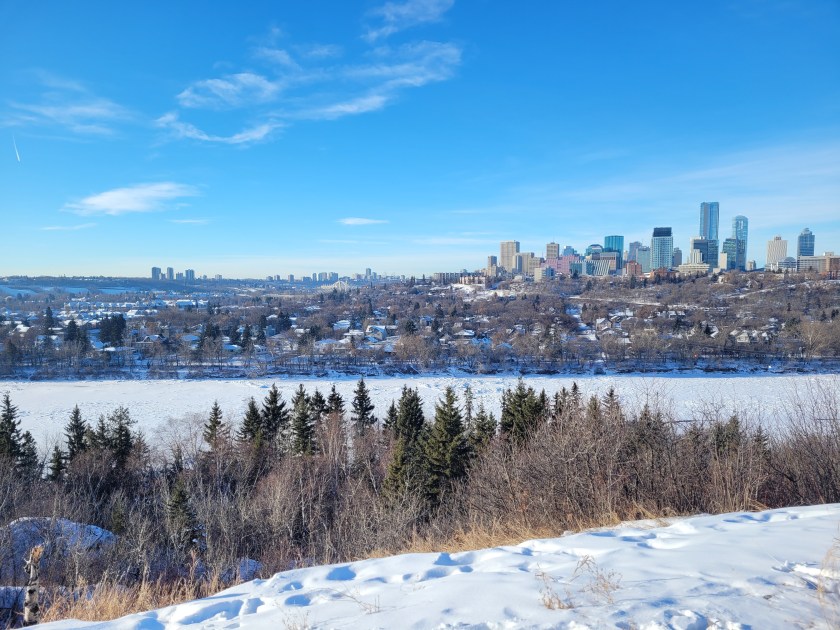
Today, I did a Medicine Walk along my favourite river valley route. Despite training for my long walk in September, this walk was not about distance, elevation, or pace. In honor of the feast day of Saint James – Sant Iago, as in Santiago, as in the Camino – it would be a walking prayer for the health and well-being, for a miracle, for a friend… for several friends… each besieged by life-threatening illness. Itbecame, too, a prayer for all beings displaced,distraught, and destroyed by the wildfires.
Despite an almost twenty-degree drop in temperature, with the morning overcast, thick with smoke from wildfires that last night ravaged one of Alberta’s beloved treasures, Jasper National Park, and its century old townsite, and heavy with rain that eventually, blessedly fell, I dressed for weather and set out. I chose as my audio companion the exquisitely composed “Camino” by the late Canadian violinist, Oliver Schroer. The first notes of the first track, “Field of Stars,” are a haunting homage to Santiago de Compostela (field of stars). The ambient tracks blended with birdsong on my path such that I felt surrounded and held by the morning’s poignant beauty. A perfect reflection of my interior landscape and the devastated one to the west.
Where a few weeks ago pink wild roses bloomed thick and heady with perfume, today’s bushes were laden with ripe purple saskatoon berries and blood-red wild raspberries.Golden yarrow and wild sage filled river banks. To my way of thinking, tasting those berries was my holy communion, the real “body of Christ.”
As steam rose from the placid river, a lone pelican glided above on its huge, outstretched wings. I lost sight of it, and then looking up, there he was again, effortless in his flight. I wondered about the significance of his appearance as I’d never seen one before on this stretch. Once home, I consulted Ted Andrews’ classic Animal Speak to learn they represent renewed buoyancy, unselfishness, and the need to not be weighed down by emotion. Wise medicine for these days.
“I think that this sense of well-being that comes with timelessness, the sense of being at peace – it must be very, very old. And it must be like a stylus dropping into a groove on the surface of the planet and making this music. And we are, our bodies are, that stylus, and we’re meant to move at this RPM that comes with the movement of our bodies.”
Last week, I took the time to open, click, listen, and read the conversation with Paul Salopek and Emmanuel Vaughan-Lee, founder of Emergence Magazine, an award-winning magazine and creative production studio that explores the threads connecting ecology, culture, and spirituality. An hour later, so intrigued with their conversation, I shared it on Facebook, logged onto their follow up ZOOM conversation live streamed from the UK this past weekend, and recommended it to my local Camino group at the start of our Saturday walk.
Salopek, an award-winning journalist, embarked ten years ago on a winding course retracing the migration pathway of early humans out of Africa, across Asia, eventually to cross the Bering Strait, down the Americas to Patagonia. Both in Emergence and more fully on the National Geographic page hosting this epic photo story, he describes how his personal relationship to time and the sharing of meaningful stories has deepened while moving through the world at three miles (5 km) per hour, or as my friend Christina Baldwin writes, “at the pace of guidance” and story.
“And I thought this would be an interesting experiment in slow storytelling or slow journalism, a way of slowing down my methodology and immersing myself in the lives of the people who inhabit the headlines of our day. So it’s been kind of a giant kind of a planet-sized studio to think about how stories are connected—not just kind of mega stories, say the climate crisis or human conflict, but our individual stories as well. And one way that I’ve found that does it really well is by slowing myself down and walking from person to person. That’s basically the premise of this. It’s a listening project where the destination almost always is another person.”
I love to walk. I have been walking more or less every Saturday morning in Edmonton’s famed river valley with my local chapter of the Canadian Company of Pilgrims, a “yes” I’d said several years ago on a wintry morning in January, and easily the most significant “yes” I’d said that year. What initially started as one member’s quest to train for his first Camino de Santiago trek, where walking was the raison d’etre, has evolved into a time for us to walk, be in community, and enjoy coffee at local cafes. True to my style, some Saturdays find me more extraverted, engaged in a series of edifying conversations along the path, while others, like this past weekend, ask of me to surrender to the silent restorative of its sunny, almost balmy morning. Stopping for a moment near the trail end, I smelled and felt those faint stirrings of spring, in time with this week’s celebration of Imbolc, the first day of spring in Celtic tradition.
I didn’t grow up in a walking family. Though recently it registered that I may have “inherited” an affinity for trekking from my father, who as a young teen at the conclusion of WWII, found himself alone, displaced, and dodging prisoner of war camps in Germany, taking months to walk his way home to the Black Forest where his mother held her breath waiting for his safe return.
Germany’s Black Forest
I used to regularly hike in the Rocky Mountains, though it’s been well over a decade, and I miss those outings with my women friends. Since Covid, I’ve made two long distance walks, the Portuguese Coastal Camino to Santiago de Compostela, Spain in May-June 2022, and most recently, the Via di Francesco, from Assisi to Rome in September-October 2023. I’ve discovered, like Paul, and many of us, my pace is about 3 miles (5 km) per hour…even when sauntering, my preferred way of moving (when I’m not kitchen dancing.)
“You do not have to, you know, make your way to the jungles of northeastern India to experience this thing. I think it’s there for you. And it might be a little tougher to see and experience if it’s part of your daily life, whether you’re living in a small town or a megalopolis or anything in between, because, as usual, if we stay sedentary, we get scales over our eyes, and we stop realizing the wonders of the everyday world around us because they become over familiar. But walking peels those scales off and allows you to rediscover the extraordinariness of so-called ordinary things. And that includes a walk through your town, a stroll out into the fields, or a park near your house—indeed, your backyard, if you choose to go micro, right?“
Walking with Annie was an invitation in peeling off the scales. As I wrote in a post during what would be her last days, “Walking Annie is no longer exercise. It’s fresh air, the gift of being outside noticing life around us.” Admittedly, still missing her, it takes a bit more presence and intention to notice life around me, scales off, without her. And yet, more often than not, I experience what Paul Salopek describes as an:
“astonishing internal metronome that’s built inside of us, inside of our body, that distinguishes us from almost every other animal…this goodness that’s kind of humming in our bones, waiting to be let out.”
Listening and reading and looking at Paul’s journey, I’m stoked to envision my next long, slow walk, wondering what memories will be evoked, people encountered, stories conjured, bones set to humming, all waiting to be let out?
“And the road is plenty wide and welcoming, speaking out to all, This is the perfect place, this is the right time, this is where wish becomes possible.”
Susan Frybort, “On the Road of Great Wonder,” in Hope is a Traveler, 2015
This is the opening quote to a story I wrote about walking my Camino last year. Always intent to write more about that month long experience, one over twenty years in the making, but having felt stuck for months, I enrolled in an eight-week online course beautifully taught by local author and scholar Jenna Butler and hosted by Calgary’s Alexandra Writers’ Centre. I’d reached out to Jenna with hope that by using the sensory explorations and writing prompts in “Chronicling Our Personal Relationship with Place,” I’d be inspired to write. I took as kismet – “the perfect place… the right time… where wish becomes possible” – the course’s starting date as it coincided with the evening before I began walking my Camino a year ago. To deepen into the course’s invitation, I posted on social media a few select Camino photos and salient recollections from each day I had walked last year, May 10-30. Too, I’ve been drawn to learn about some literary forms that I thought would lend themselves to my vision of combining the reworked lyric essays from last year’s Portuguese Coastal Camino blog, my journal entries, and those from the guide book provided by Portugal Green Walks, and my newly emerging poetry.
Half way through the course and my hesitation to begin has persisted. I’ve felt afraid to take the first step, not knowing what I’m getting myself into, or where this is going to take me, despite having reached Santiago a year ago. I’ve wondered if Camino doesn’t want, or isn’t yet ready for me to walk on or with him again. Yes, I am animating Camino, doing so out of reverence and regard for its centuries of history, people and their traditions, cultures and stories, and the more than human elements continuously making for its beauty and its challenges. And yes, I admit, maybe it’s simply me who hasn’t been ready, with it simply being a matter of not yet the right time. Then, after a few hours over the past month preparing – compiling my blog posts into a single document and adding my recent Instagram posts; propping up on my writing table my photo journal with its cover photo of me standing in front of the cathedral the day I arrived; stacking beside me my travel journal, course notes, and Portugal Green Walks’ self guided program notes – this week I finally lifted open my laptop and began. While I’d thought I’d use for incentive the June 30th chapbook submission deadline with a literary journal who recently published one of my poems, given the experimental nature of this undertaking, braiding together from several sources, and wanting to embody in my writing now how I walked then – sauntering to enjoy the vistas – I’ve decided wisely let that go.
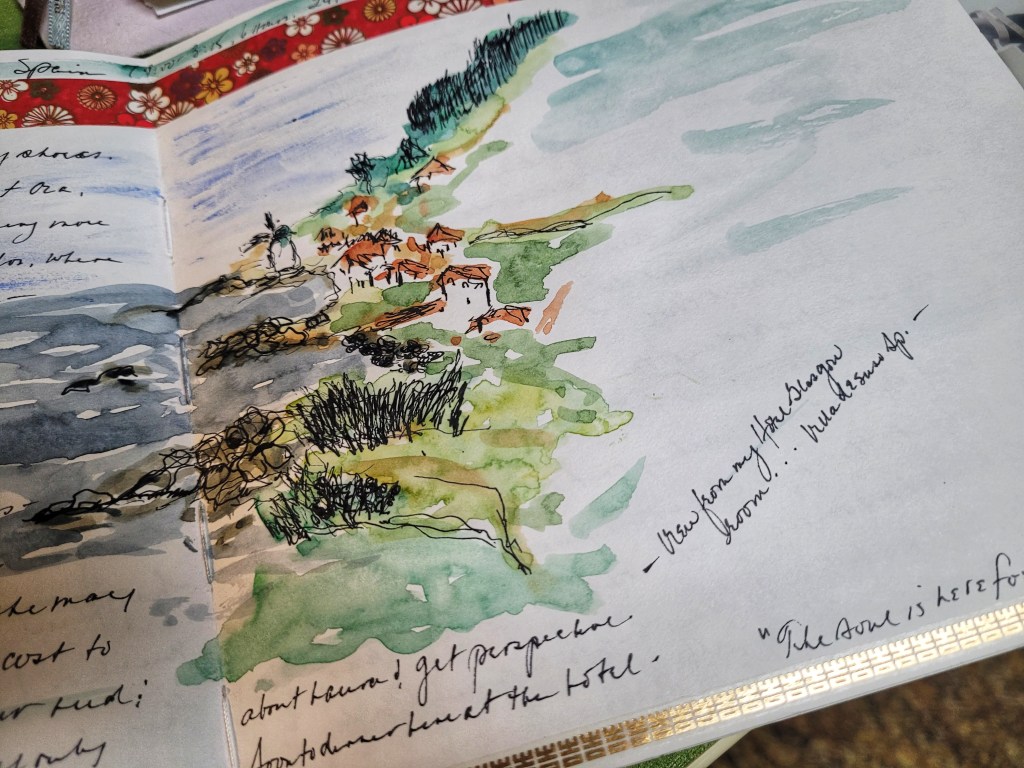
Viana do Casteloview from VilladesusoPontevedra
Albeit reluctantly and with regret, I’m using the gift of time received by finally having conceded a week ago that I must step away from playing pickleball. A game I enjoy for its physicality and camaraderie with women, who like me, love being fully engaged in life. A game my chiropractor has suggested I may need to sit out as for the past three months I’ve been nursing an injured metatarsal. Despite regular appointments, taking a few days off from the game here and there, icing, and copious applications of extra strength Volartin, it’s been one healing step forward and several back. Compounding this is the pressure, with worry enough to wake me, of needing to seriously train for another long walk in September. This one not a saunter. This one strenuous with nearly double the daily kilometers over sixteen days, and steady ascents and descents. All a natural consequence of aging, this has brought its own grief as I face such realities. My foot and body as whole are feeling better, and I’m hoping this, too, will become “the perfect place… the right time… where wish becomes possible.”
***
As I’ve written here before, the writerly life is a lonely one, rife with rejection. Just this morning I received two. On the up side, I finally received a print copy of the local poetry anthology featuring both my photo as cover and poem inside, and in the past month, several other photos have been accepted by literary journals making me wonder if I should shift my genre!
As it’s been several weeks since I posted a Monday morning blog, by way of update, our dear Annie dog has had a remarkable recovery from the stroke she suffered the end of April. So much so, I call her our “Lazarus,” as it truly feels she rose from a near death listlessness during those early days. Today, she has returned to all the ways in which she is uniquely Annie to and with us, including interrupting my work at noon by persistently placing her big right front paw on my lap or keyboard. Now I kiss it and her in ever welcome gratitude.
walking with Annie “Bright Eyes”, June 5, 2023
Much love and kindest regards, dear friends. May this post find you on roads plenty wide and welcoming.
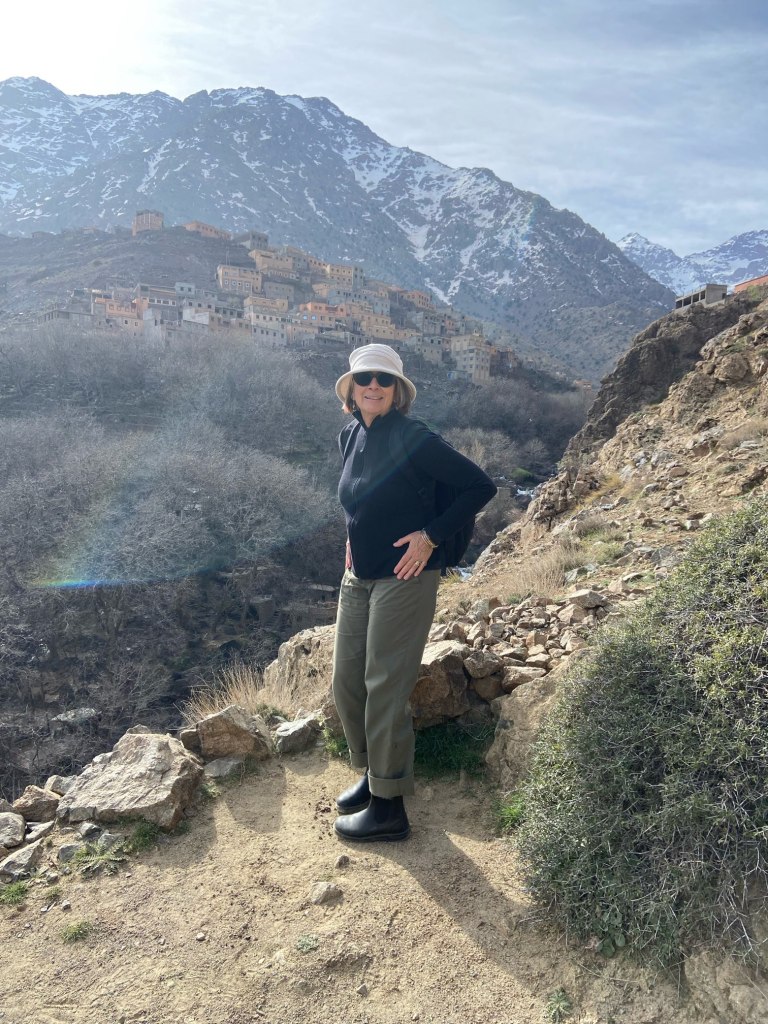
“trekking in Morocco’s High Atlas Mountains” – photo credit: Sharon Gilbert
“To journey and to be transformed by the journeying is to be a pilgrim.“
Mark Nepo
A week from now I’ll be a year older and closer to closing in on a new decade, my 8th. THIS IS A STAGGERING REALIZATION. One I only came to several weeks ago when anticipating the women with whom I’d be traveling through Morocco. With the exception of one and our tour leader, we were all in our 6th, 7th, and 8th decades… fit, active, engaged in life, mostly retired or pursuing encore careers, well traveled, even if that simply meant in our own neighborhoods. So yes, I’m in my sixties and still will be next week, but this actually does translate to my 7th decade. Obvious for you, but a reframing that had escaped me.
Home a week, I’ve observed how this journey – traveling alone both to and from Morocco, arriving a day early in Casablanca without knowing anyone, and extending my stay in Marrakech several days once the tour had concluded and everyone else was homeward bound or extending their travels to other countries – with some of its requisite and complex inner and outer navigations – strengthened my confidence to discern and clarify boundaries, speak my truth, and not give away carefully considered intentions and plans. Embodied and illuminated by the act of solo traveling, these capacities are, too, the boon of aging, arriving at the solid ground of greater self acceptance – warts, quirks, idiosyncrasies, contradictions, and all. Able to name and claim:
“I’m not here to fix anyone. I’m ready to honor my sensitive nature. Taking care of my energy is my priority. Saying no is a healthy way to set boundaries. Self-care is my path to attracting amazing people. I’m a super feeler, therefore I have a big heart. I don’t owe anyone explanations why I feel this way. My sensitivity is my strength and a source of intuition.”
Jane_lightworker, Empath Mantras at The Soul Journey with Sarah Moussa
Too, how I am showing up is a deepening clarification, a further consolidation and integration of the gifts and challenges from my Camino, now approaching its first anniversary. That journey is never far from my thoughts, living daily into the truth that the Camino continues to cook one long after having reached the destination in Santiago…paradoxically, the destination that never arrives.
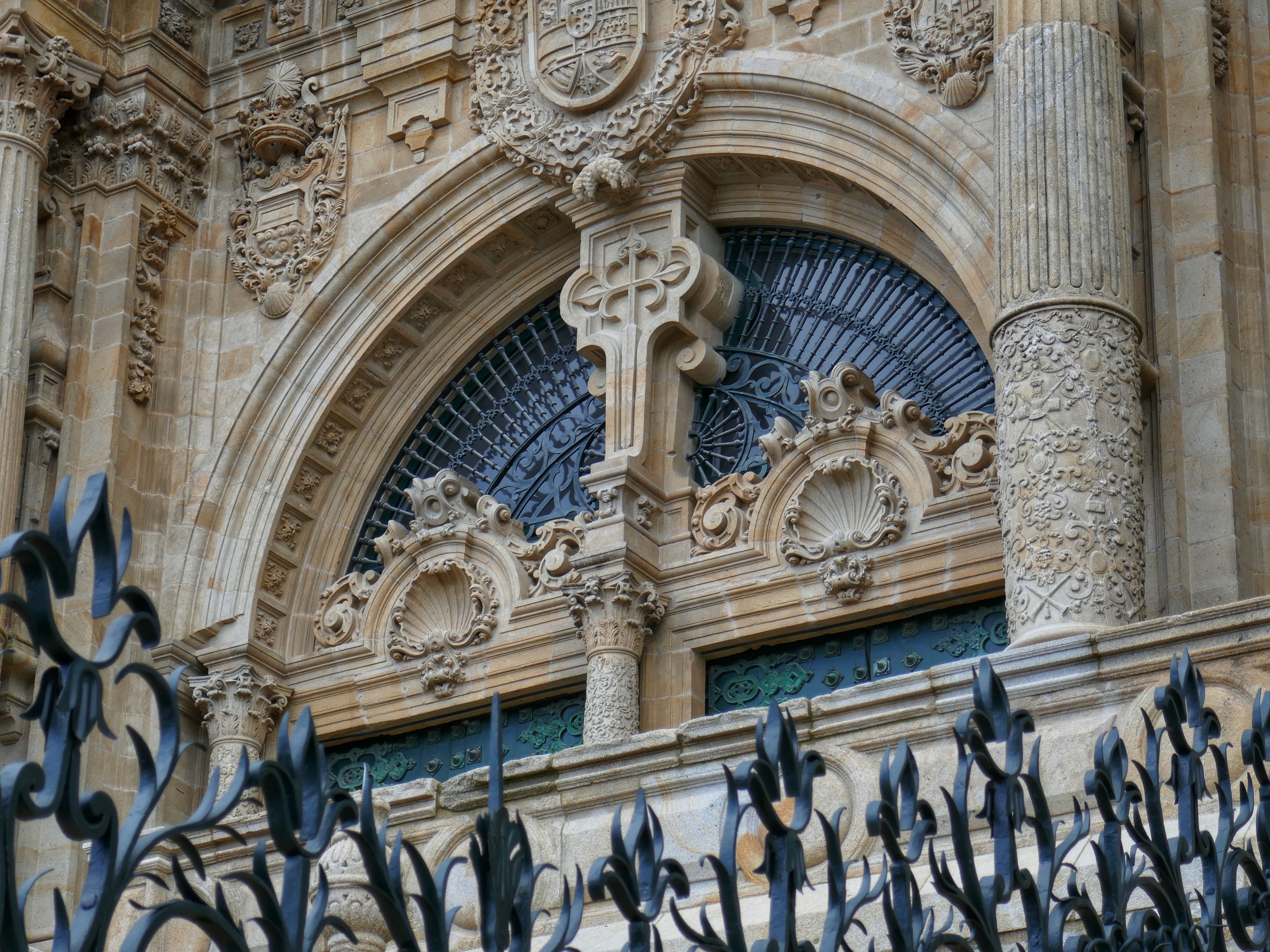
Cathedral de Santiago de Compostela
Today is my first time posting a Monday blog in months. When I signed off in mid January, I only knew I needed to tend to the nuances of an emerging, inner, imaginary conversation:
Once again, it’s apparent to me that the stuff of my wabi sabi life is swirling inside, needing its time to sort and settle. After my new year’s post wherein I realized – the result of another episode of early morning insomnia – that I simply didn’t know much about how I stood on this threshold, I didn’t post my Monday blog last week, and am not inclined to push myself to produce one for this Monday, or beyond. For the time being, it’s my own inner “imaginary conversation” to which I will pay my attention, not yet to be mined for here.
I rest easier knowing I’m not one to procrastinate, but rather am becoming more familiar, in an embodied way, with living in the messy inchoate middle. That place I have named “before, beneath and beyond words.” That place where I become a conscious partner engaged with Life living itself.
Yet during those months I found myself well engaged with words. While not posting longer pieces, my regular Friday photo and poem posts invited shorter reflections as I shared why I’d chosen the poem and-or what it evoked. Then I surprised myself by submitting multiple poems to over twenty literary journals, entering several poetry competitions, and refining my collection for publication. As I wrote here days before departing for Morocco, in a post titled “True to Path,” I won a contest, had a photo chosen for a poetry anthology cover, will be published in several journals, and the anthology for which I wrote the foreward and chapter section poems has been accepted by an international publisher. Now April, National Poetry Month around the world, I’ll return to my desk to write words, maybe the ones that describe travel’s gift of new impressions, acknowledge a simple noticing and attention paid, heal a wound, light a fire, bring joy.
Staying true to path. The destination that never arrives. Naming and claiming the birthday to be celebrated. A new dance around the sun begun.
Much love and kindest regards, dear friends.
“embracing the boon” on the terrace of Morocco’s Kasbah du Toubkal – photo credit: Sharon Gilbert
When you return from a long journey air sweet with lilac and unfurled green then you fall to your knees and become gratitude’s pilgrim. You were given the way at birth. Given blue fields and loam. Given an open throat, wild orchids, a path lit by milky stars. You were given desire, sweet darkness of the body, white hum in the bone.
It’s not the departure you long for, nor the finish, with its thick incense, tired feet and weeping. It is the quiet loneliness in between, When memory marries wind and you are pure light. Walking. One foot in front of the other. You cannot speak of this place. The way you cannot speak of grace or what holds you to this world. How at this moment you can only stand up and move toward the light of home.
– Rosemary Griebel – YES (2011)
Last week, listening to a past episode of The Road Home on my radio station CKUA, I heard my friend Rosemary recite three of her poems from this collection, YES. Her lovely voice, together with the background music selected by host Bob Chelmick made for several minutes of exquisite listening pleasure. I first met Rosemary virtually, and then in person when we both attended last November’s weekend workshop with our beloved Irish poet, Pádraig Ó Tuama. Knowing I’d see her, I brought my copy of her book for her to sign. It was there I learned how we are kin, not only in our shared love of words, but also in our both having walked the Camino de Santiago. It occurred to me while listening to Rosemary read last week, that I needed to feature here, in my Friday photo and poem post, some of the local poets whose love of words I share, to uplift those “prophets in my own land,” so to speak.
I’ve written here how the Camino does its work; on me, from the moment I made my decision and deposit a year ago December to walk, but more so upon my return. This past December I took some time to make the photo journal of my walk. Too, I wrote a short story, A Creative Walks the Portuguese Coastal Camino, drawing on my Camino blog posts, for both the Canadian Company of Pilgrims and Sage-ing: The Journal of Creative Aging. And I had the lovely opportunity to talk about my walk and its impacts, both to support a fellow doing his Master degree in Tourism, exploring the transformative gifts walking a non religious Camino, and on the Ellipsis Thinking podcast, “Paying Attention,” hosted by my dear friend, Greg Dowler-Coltman.
Rosemary’s poem speaks to me of so much that was my Camino. That in the planning, the going and the return, I was “gratitude’s pilgrim”… how the “quiet loneliness” while walking became my necessary and bittersweet companion… my “tired feet and weeping” with relief at our safe arrival…and since home, remembering the light, the grace, the beauty. Thank you, Rosemary.
“When you reach a stage when you can have a very dark and difficult experience, without having to look on the “bright side,” then you know that you have made progress on your healing journey. Because one significant measure of our emotional health, is our capacity to tolerate all of our experiences without jumping to reactive reframes. You reach a stage where you can stretch to accommodate the truth of your lived experience. You have enough light inside, to own the shadow. And enough shadow inside, to own the light.”
Jeff Brown, Hearticulations: on friendship, love and healing, 2020
Taking a step sideways from my usual posting of a Friday poem, I found this quote scrolling on my Facebook feed this week, something I’m doing only occasionally these days (that might be a story for another time). Posted on a friend’s timeline, after reading the comments I was reminded that decades ago I had read something Shakti Gawain of creative visualization fame, wrote about positively thinking herself into a psychosis. At a time when a heavy theme within the new age thought movement was espousing “think positive and manifest thus,” her words left an indelible mark. In that same era, I read Ken Wilber in an issue of the New Age Journal calling out this same tendency, particularly with reference to blaming those suffering with life threatening illness, as his wife at the time was dying of cancer. (Wilber, having created the brilliantly deep and expansive Intergral Theory, is who Fr. Richard Rohr describes in a recent podcast with Brene Brown, “the wisest philosopher of religion on the American scene.”)
I received the gift of insight a few weeks ago, during an interview with a fellow doing a Masters degree in Tourism, studying the transformations experienced by we who walk “secular,” non-religious inspired caminos. In response to his final question, “What in 3 or 4 sentences would I describe as the main lessons learned from my camino?” and as I wrote here last week, after several moments of quiet consideration, searching for the most accurate words, I said that I am developing an embodied, visceral familiarity with what it means to live in Life’s messy, inchoate middle, engaging with, partnering with, Life living itself.
Bravo to we who are so fiercely tender and tenderly fierce in our refusal to only live on the bright side of life, ignoring its necessary, organic, abundant mess. Life needs us to be so.
THE PILGRIM When you return from a long journey air sweet with lilac and unfurled green then you fall to your knees and become gratitude’s pilgrim. You were given the way at birth. Given blue fields and loam. Given an open throat, wild orchids, a path lit by milky stars. You were given desire, sweet darkness of the body, white hum in the bone.
It’s not the departure you long for, nor the finish, with its thick incense, tired feet and weeping. It is the quiet loneliness in between. When memory marries the wind and you are pure light. Walking. One foot in front of the other. You cannot speak of this place. The way you cannot speak of grace or what holds you to this world. How at this moment you can only stand up and move toward the light of home.
– Rosemary Griebel –
In Monday’s post I mentioned meeting in person Calgary poet, Rosemary Griebel. All week, during my morning ritual of sitting with Annie sipping my americano (now laced with a half pump of eggnog syrup, tis the season and all), I’ve been re-reading her poetry collection YES. Last night I texted to her:
“Rosemary, it truly is a beautiful collection…so grounded in your intimate, lived experience of the prairies, one I came to know only a bit when my husband, Sig, and I moved here from ON in 1981 and when I learned to appreciate them accompanying him many weekends in the spring and late summer on field trials – horses with bird dogs like Annie, our English setter. The Pilgrim…yes, what an evocative and deeply resonant beauty…and the several I heard you recite on The Road Home, how I first learned of it, you. And some “hard” ones…all so beautifully, deftly composed. Hard but light filled…”
And so to share here one of hers with you, together with my photo walking one rainy day from Viana do Castelo to Vila Praia de Ancora along the Portuguese Coastal Camino. “A day of quiet loneliness in between. A day when memory marrie[d] the wind and [I felt like] pure light. Walking. One foot in front of the other.”
I’ve written several times of the lesson shared with me in 2011, when walking along the path, high on the cliffs of Italy’s Ligurian coast, from the Cinque Terre town of Vernazza to its Corniglia, with a couple who had walked the Camino Frances a year earlier: the Camino is what happens once home. After preparing for last week’s presentation on my walk; talking this week with a friend about curiosity, creativity, and wisdom for his podcast; and lunching with a friend who, having walked the Camino Frances several years ago, wanted to hear some of my story; once again I feel Camino making its presence known deep within as I prepare for my next writing project.
I feel myself hesitate. Find myself distracted. Yet I know it’s simply a matter of placing my stake in the ground, and saying YES. Then Camino begins once again to work with me.
In circle work, as taught by my teachers and elder “heart sisters,” Christina Baldwin and Ann Linnea in The Circle Way, knowing when to call for a pause is a practice tenet. To regather one’s thoughts or focus, to recentre to purpose, taking a deep breath or several in silence supports the moving through and forward.
my sky at sunset
So it is that after a month of walking, and another two reflecting and writing about it here, I am pausing from writing my Monday posts. I may return to posting my Friday feature photo and poems, and in fact, have one lined up for Friday. But I’ll see how it rolls. Needing my attention this month are a few projects: writing the foreward and composing poetry for an anthology of women’s leadership in education, fine-tuning my poetry manuscript for the next round of submissions to publishers, and preparing the next issue of SAGE-ING for our September 21 online publication date.
In signing off for now, and “tucking in” my reflections on the Camino, here are beautiful words that affirm who I am and how I show up in the world, evident in my recent Camino photostories. Again, one of those timely Facebook finds:
“Are you happy? In all honesty? No. But I am curious – I am curious in my sadness and I am curious in my joy. I am everseeking, everfeeling. I am in awe of the beautiful moments life gives us, and I am in awe of the difficult ones. I am transfixed by grief, by growth. It is all so stunning, so rich, and I will never convince myself that I cannot be somber, cannot be hurt, cannot be overjoyed. I want to feel it all – I don’t want to over it up or numb it. So no, I am not happy. I am open, and I wouldn’t have it any other way.”
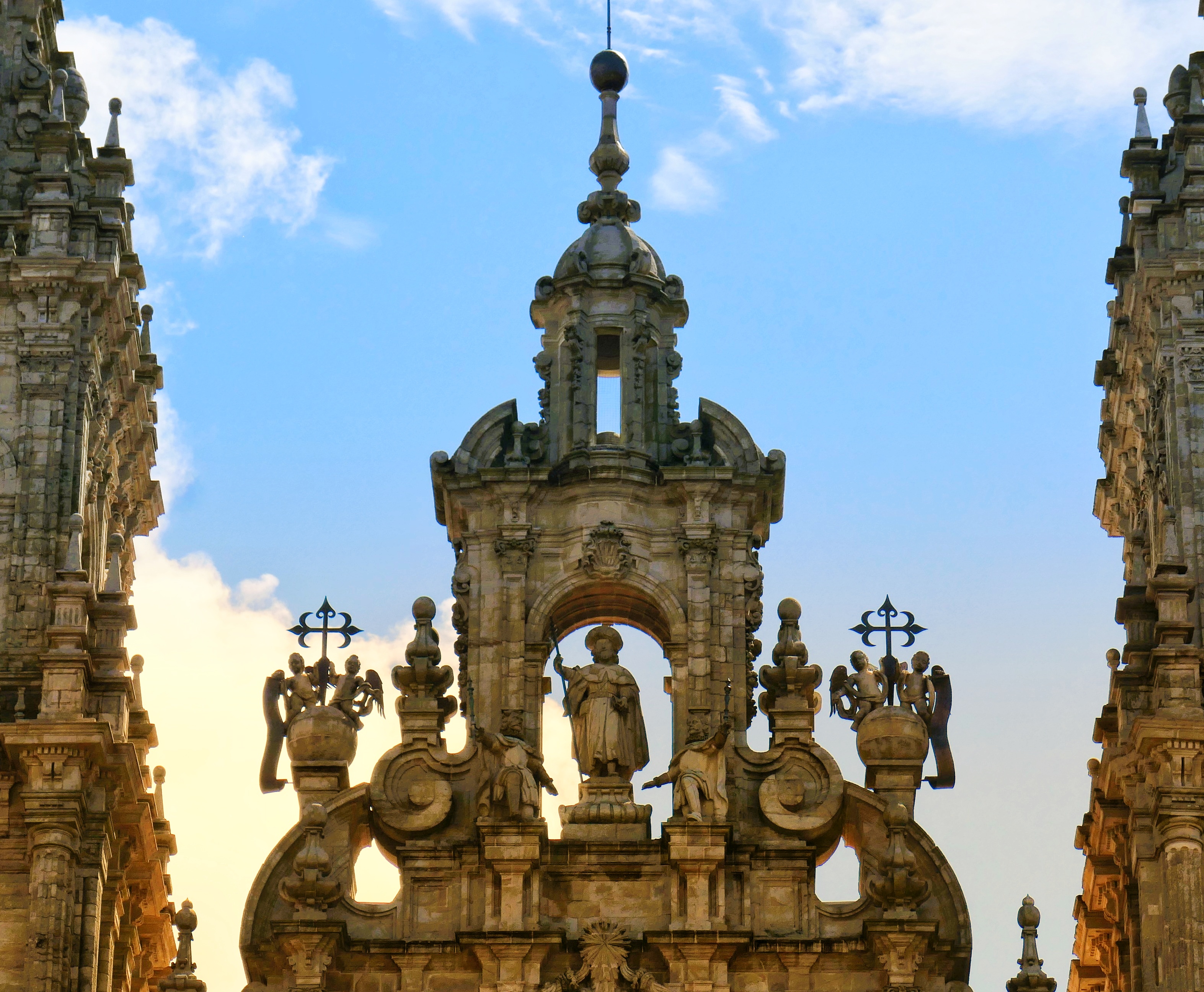
my first glimpse of the Cathedral de Santiagospire
“There is a great moment, when you see, however distant, the goal of your wandering. The thing which has been living in your imagination suddenly becomes a part of the tangible world.”
Freya Stark in The Art of Pilgrimage, 1998
Waking at dawn to the sound of pilgrims’ footsteps passing by my open window, I’d prayed to the Fair Weather Goddess to hold off on the forecasted rain until our arrival in Santiago. I would, but knew walking in more rain, given my fatigue and cough would take more out of me. Despite heavy clouds during this three hour final stage, she had heard and thankfully granted my request.
It was a curious stage, through parkland and woods, meanderng into the thick urban commercial centre of the Santiago suburb, Milladoiro, where we stopped for coffee at the crowded cultural centre, then back into more eucalyptus groves. Climbing and descending, we finally reached the proverbial fork in the road with two Camino markers, each pointing the way to Santiago. Conferring in broken English with another walker, consulting the GPS and guidebook, we opted for the one pointing right. Described as the new “official” route via another suburb, A Conxo, it would be less congested and longer, but avoided a steep climb. We continued to walk in relative solitude. Crossing motorways, moving now into a consistent urban vibe, with markers few and far between, and only the occasional peregrino, identifiable with backpack and scallop shell, I was surprised by the lack of Camino energy and convergence of pilgrims I’d read about as the hard-earned destination drew nearer.
Nuestra Señora De La Merced De Conxo
“Things are always different from what they might be.”
Henry James in The Art of Pilgrimage, 1998
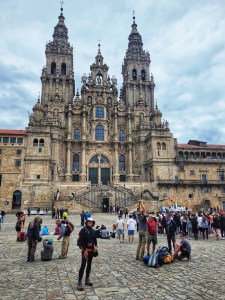
From my journal: “Three hours of walking, not many pilgrims on the Way. At the crossroads we headed right to AConxo and saw no one. Arrived at Prazo do Obradoiro in time to hear the cathedral’s 12:00 pm bells and struck by how few people were gathered here in front of the cathedral. As we stood side by side, I wasn’t overtaken with feeling…instead I felt subdued, relieved to have arrived safely, and tired. Observing myself, I was surprised at my response…perhaps because I had realized a 20 year dream and now is the time to lay it down. I walk my Camino every day and now I have the stamp and certificate, so be it. But when I called home after settling in at the Parador, I cried deeply…”
It would take several weeks to unpack those tears.
this is, in part, whyan iconic photo of arrival
that sky
At the outset of planning this walk, and for long before, I had been clear within myself about the importance of holding both the deep value of the journey, walking every day, and the significance of the destination, arriving at the plaza in front of that magnificent structure, as had thousands of pilgrims for the thousand years before me. A few years ago, when I had last given serious thought to walking, I suddenly cancelled, heeding one of those hardly articulated hunches. A few months later, it would be confirmed when I discovered that the cathedral would be closed and hidden by extensive scaffolding to undergo a multi-year restoration. I knew that if and when I ever walked, I would need, as Bettina Selby describes in The Art of Pilgrimage (1998), “what the newly arrived pilgrims see, exalted as they are at the end of the trek, and by all the magnificence and beauty they have already seen in the approach to their goal, the pool of warm golden light drawing them on.”
altar and botofumeiroSt. James’ crypt – la raison d’etre for somethatwarm golden light
So yes, as I observed myself standing in front of the cathedral, taking in the final stage of arriving at my long held dream, I was surprised with my response. Where was the feeling of exaltation? Where the feeling of jubilation and accomplishment I had seen in the hundreds of photos posted by women on the Facebook site I’d followed for years? Was I subdued because I’d already been here, albeit virtually in several livestream tours a couple of years ago? Or was it a visitation by “the dragons of disappointment”? Citing from The Art of Pilgrimage (1998) archeology scholar Michael Guillen’s experience at the palace of Knossos on Crete: “I felt very little at the site itself because of all the crowds and the meddling that had been done with the restoration; the only real power I felt was in the surrounding land. I felt that the site had been transmogrified, and that the only spirits left were in the objects in the museum. I suppose this is the danger of mass pilgrimage, the loss of spirit at the site, especially when the gods flee to higher and higher places.”
In a recent chance reading of a blog by a fellow who, walking the Portuguese route had taken the right turn at the fork, passing by the historic building at A Conxo, providing the name for my photo above, he, too, wrote about being struck by his own “let down” anti-climatic response to arriving. Not at all what he had anticipated. Hmmm, I wasn’t alone, and imagine there are countless others who have felt similarly.
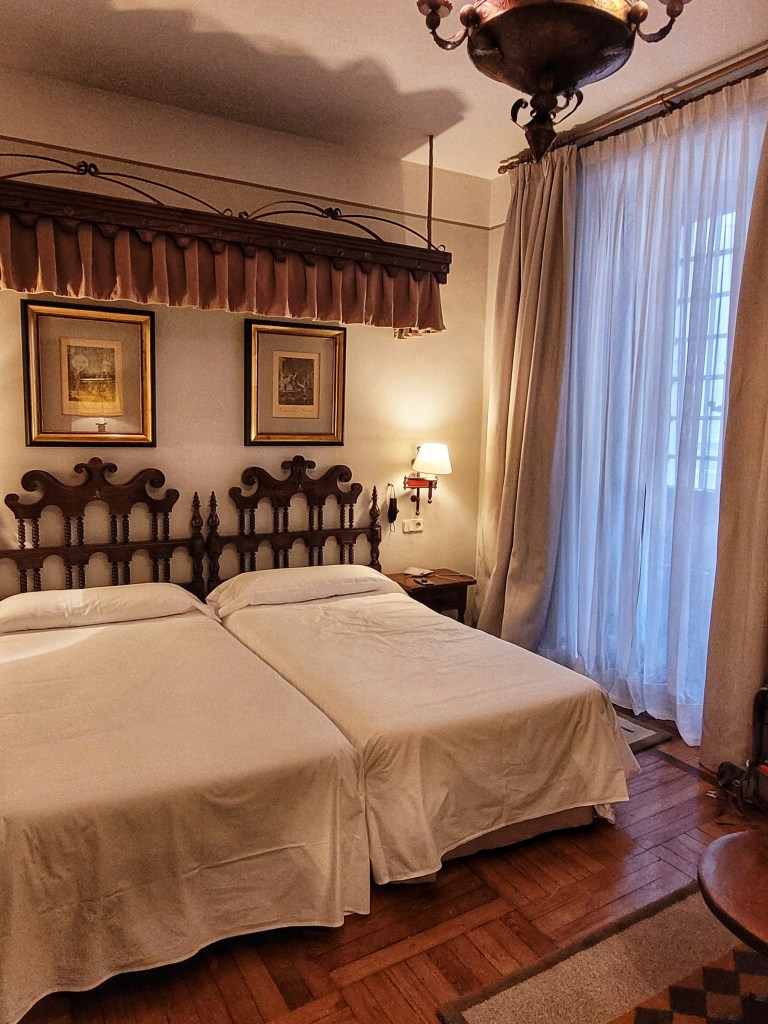
When I designed this walk with Paola at Portugal Green Walks, I determined it would be prudent to stay 72 hours in Santiago in compliance with the then known Covid-19 travel requirements, something that would become moot when we actually departed Canada. The same friend who had recommended PGW said in hindsight, she wished she’d stayed at the Parador in Santiago, the beautiful hotel bordering the plaza, beside the cathedral. “In for a penny, in for a pound, ” my companion agreed and so we partook of its sumptuous surroundings and the best breakfasts.
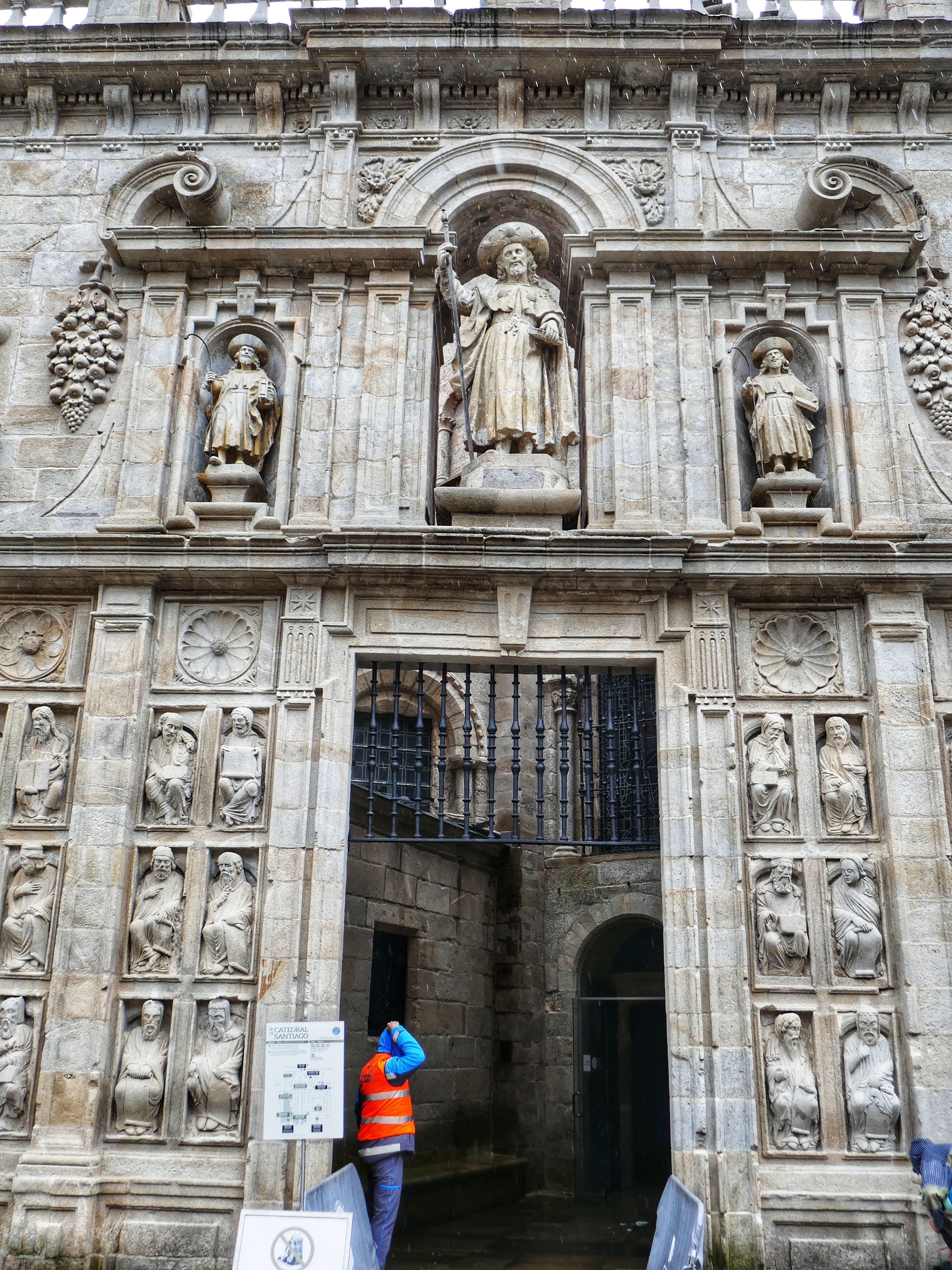
Rain finally came later that afternoon, and poured the next day, making for a perfect time to explore the historic centre, the Cathedral museum, and as luck would have it, attend the daily pilgrims’ mass. As it was Tuesday, and no one had paid the required 400 Euros, we didn’t have the experience of witnessing the famous swinging of the incense filled botofumeiro, so a view of it from the cathedral and its solid silver counterpart in the museum would have to suffice.
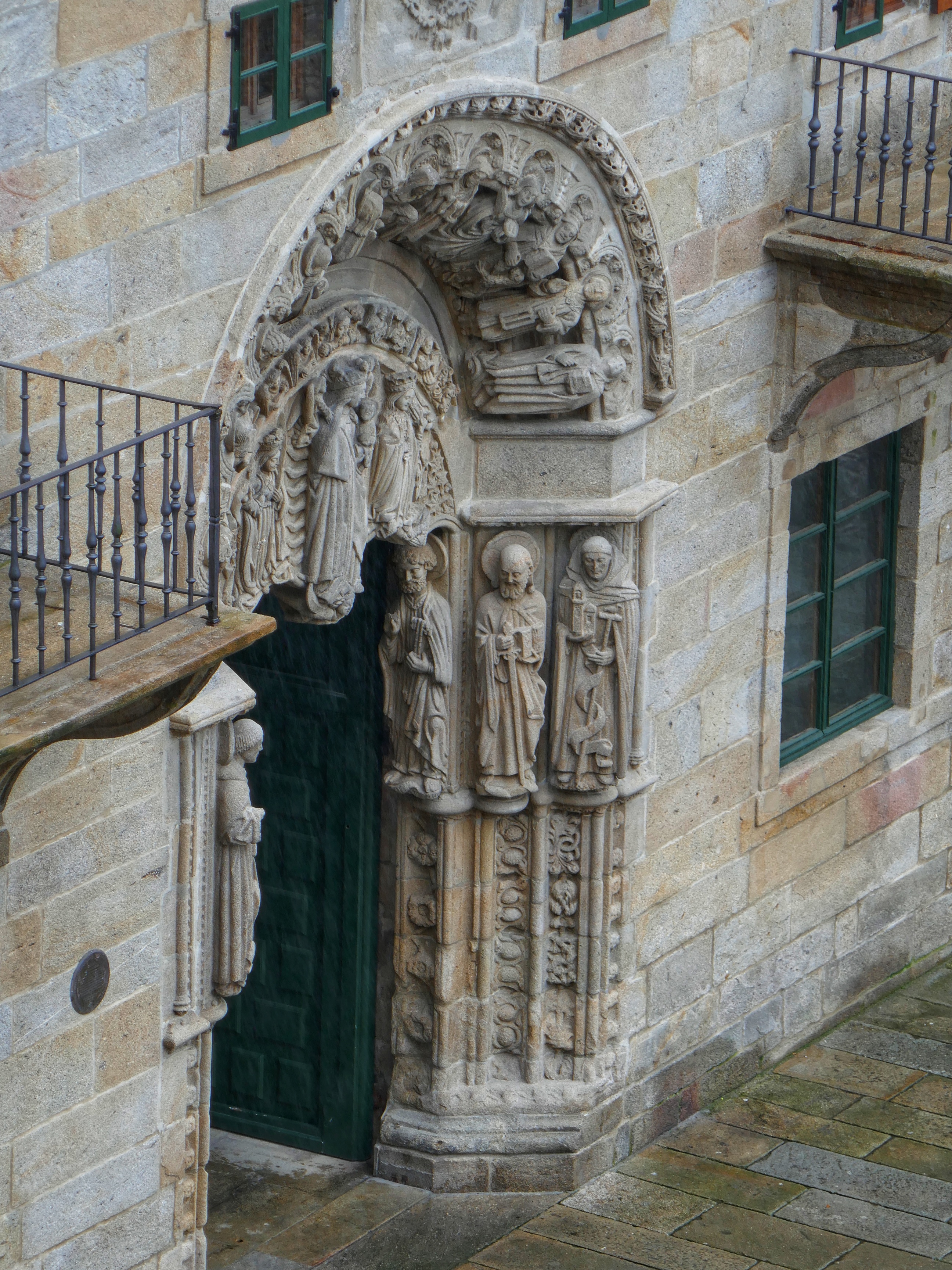
Despite my initial “flat” response – let’s mark it down to being sick and tired and relieved – I was enthralled with the cathedral, catching it from different perspectives at different times of day during my time in Santiago. As if to confirm and assure myself that yes, I had arrived.
That despite it having been a dream to walk the Camino, it was now very much part of my lived and waking reality, of who I now am, in the cells and fibre of my being.
That upon returning home, and devoting these past two months to its reliving, reflecting, re-imagining, and writing, I bring back the boon of some insight and self awareness, and much gratitude.
“The story that we bring back from our journeys is the boon. It is the gift of grace that was passed to us in the heart of our journey. Perhaps it was in the form of an insight into our spiritual life, a glimpse of the wisdom traditions of a radically different culture, a shiver of compassion, an increment of knowledge. All these must now be passed on. The boon…is a presence in the soul of the world that can be sensed and honored and carried home in your heart.”
Phil Cousineau, The Art of Pilgrimage, 1998
Dear readers, thank you for walking with me these several weeks. I’ve appreciated hearing from those of you who commented here and on social media, helping me to remember that while we are often walking alone together, ultimately we are all, as Ram Dass famously said, walking each other home.
Much love and kindest regards, dear friends. And to read about my walk in sequence, I’ve created a new page with all the posts titled and stages named. Buen Camino!
I am tired. I feel a heaviness in my chest, a bit of a sore throat, and some sinus congestion. I’m coughing. Today we’re having our hottest day of summer here in Edmonton. I feel much as I did that day in May walking to Padron, where the temperature there had reached 32 C, just as here today (Thursday, July 28). Here and there, now and then, the same cloudless blue sky and dry hot breeze blowing. Coincidently that was exactly two months ago to the day.
I am weary. Remembering, reliving, reflecting on nearly twenty consecutive days and over 240 kilometers walked, with its insights and lessons, joys and griefs, blessings and ordeals… through the elements, immersed in beauty. I am in as much need of completing this written journey, as I was then of finishing the physical one. Careful though, both then and now, to not “snatch defeat from the jaws of victory” – a wise instruction received many years ago from a wise woman – describing our human propensity for distraction and derailment from realizing our intentions. I did then and will here continue, complete, and arrive.
From my journal: “Our decision to leave at 7 am without breakfast was a wise one given how hot it became by noon. Many did the same as the Way was crowded. Again a lovely route thru hamlets, forests, with several cafes along the way. An early stop for coffee and juice as I didn’t have enough energy to eat breakfast before departing. Later at 11 am, another café stop where I finally satisfied my hankering for a fresh salad…few and far to come by.
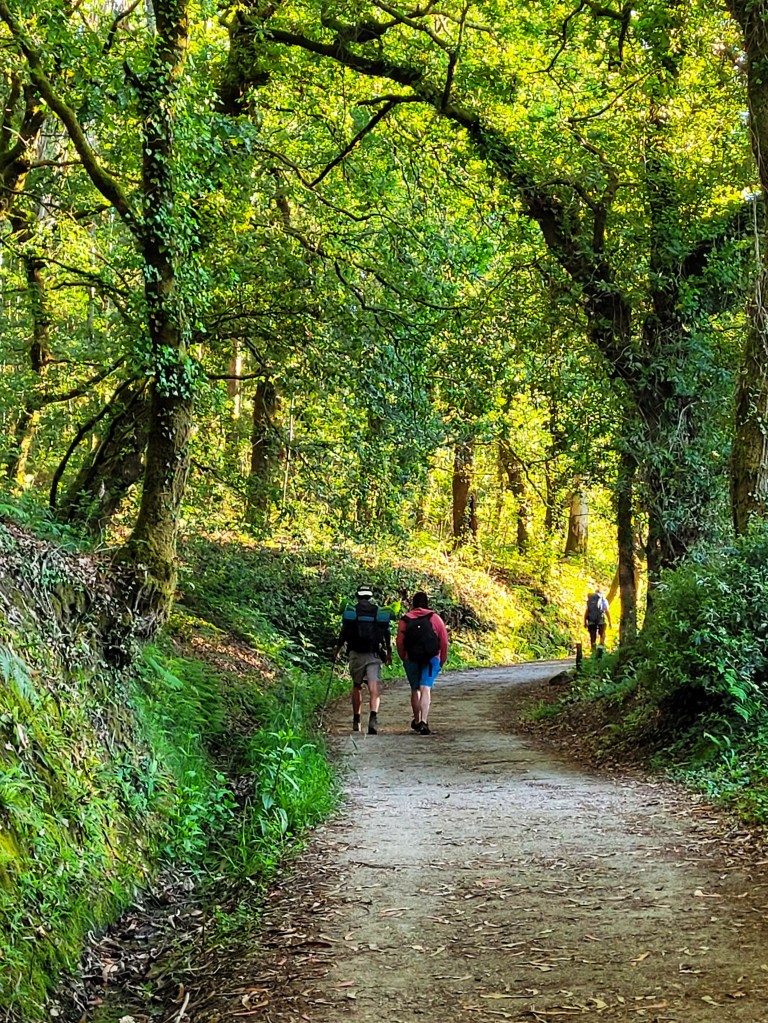
reminding us of the Way leaving Caldas de Reisthose sun dappled forest pathsIngrexa de Santa Marina, Carracedoa stone wall glorious in clover cover
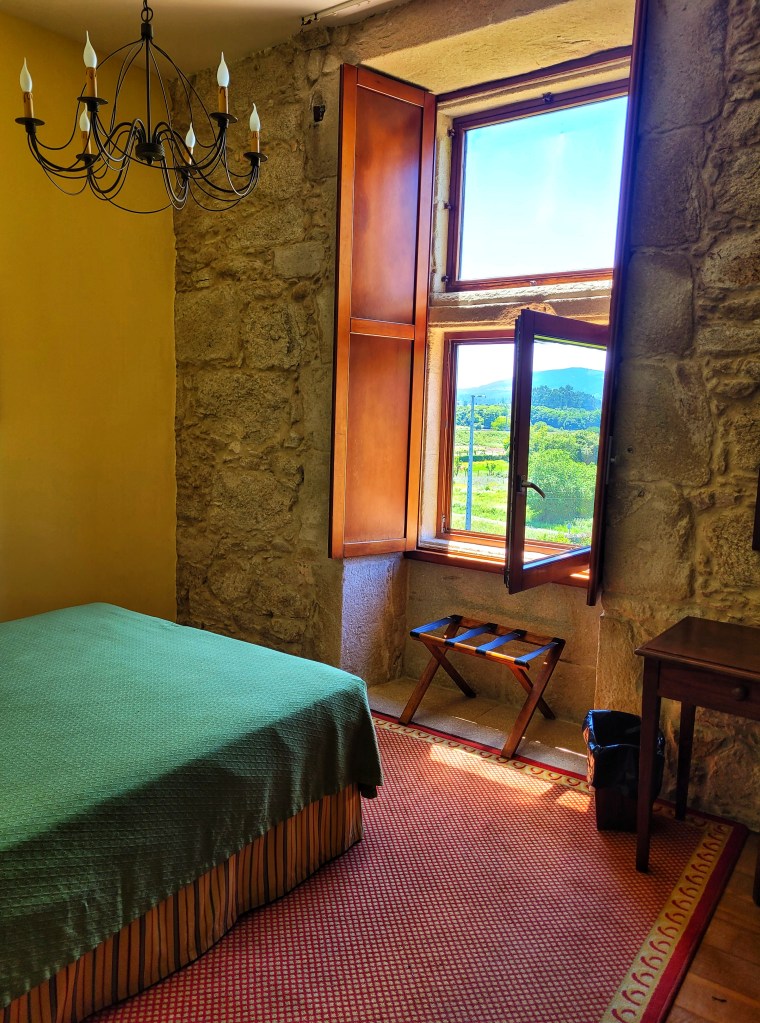
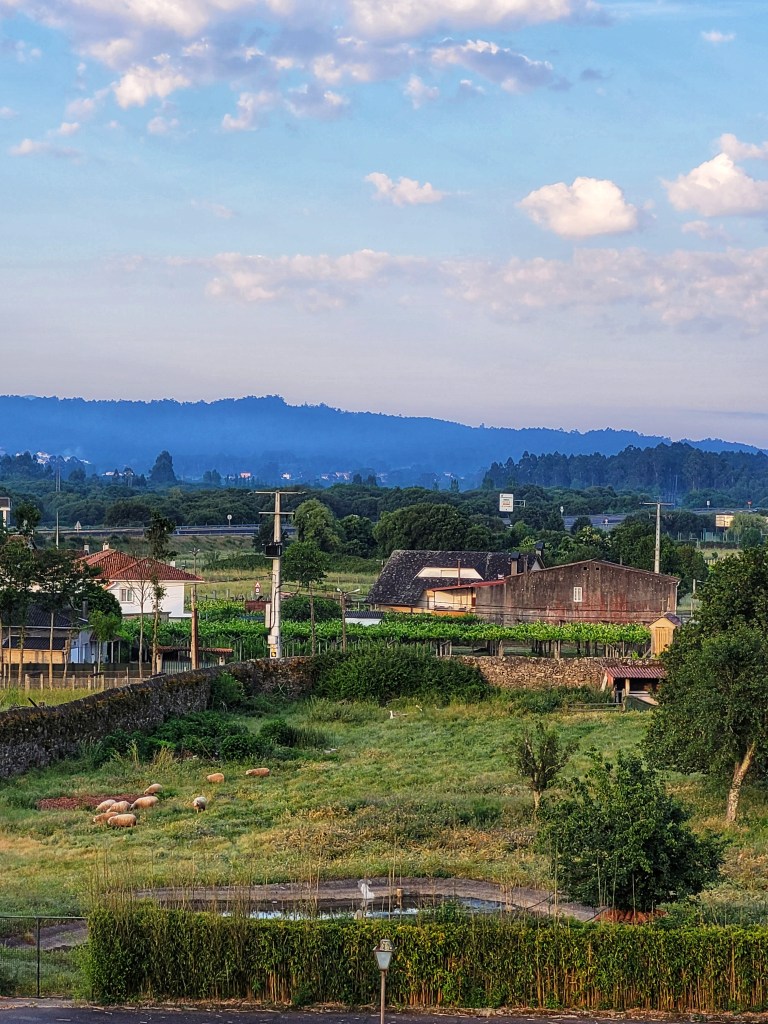
…Opted for going directly to the hotel – Pazo de Lestrove described as ‘an emblematic 16th c recreational mansion that belonged to the Compostela’s archbishops’ – now a luxury “parador” where weddings and large receptions are held. Waiting for luggage and our rooms, I sipped another icy vermut in the shaded corner of the stone terrace – again that Italian Martinibrand, but learned I’d be able to get the famous Petroni – made from Albarino grapes harvested here in the Padron valley – in Santiago…Laundry dried fast in the heat and huge open window overlooking the grounds and hillside. Slept for a few hours and given the heat and fatigue, opted for dinner in the attractive dining room…”
Pazo de Lestove, Padronroom with a morning view
Legend has it that Padron is the town where the boat carrying from Jerusalem the remains of Jesus’s disciple, St. James the Greater, anchored after his crucifixion. The stone to which the boat was moored, called a pedron, gave the town its name, and rests within the Santiago church in Padron. (Photo of lawn art depicting the legend of the boat and stone.)
From my journal: “I continue to be happy with my planning and knowing myself. While the heat made it difficult to take in Padron and its historic sites, staying here in this old Galatian manor house is another facet in the rich cultural experiences provided by PGW.”
Igrexa de Santiago (background) leaving Padron
Sunday, May 29, 2022 – STAGE 18: Padron to Teo-Al Farma
“Imagine the moment when you ‘hit the wall’ on your journey. You’re tired, you’ve lost track of your original purpose of taking the pilgrimage. Your feet hurt, your eyes smart, you are feeling angry with other travelers in your group or toward the local people you are encountering. What do you do?
Try taking a day to brood. Take your good old time, by yourself, and sit on it. Time and patience are the most natural therapists in the world…
Think of the darkness as potentially healing…the appearance of what Spanish poet Frederico Garcia Lorca called ‘duende’ – the dark sounds in music, dancing, poetry, the ritual of the bullfight, the roots of all arts…the dark and quivering companion to the muse and the angel…”
Phil Cousineau, The Art of Pilgrimage, 1998
St. James- Sant Iago en route to Teo
And there we have it. I hit my wall on that penultimate stage. Yes, I was tired. No hurting feet, but my eyes smarted with tears. I hadn’t lost my purpose but was questioning it and myself. And yes, I had been feeling angry, and a range of other emotions off and on. From my journal: “So if a chest cold is helping me feel the weight of what I have been carrying – the need to get it off my chest – today’s head cold feels like sadness and the tears I need to shed…Walking alone I wondered about my Camino, what it had all meant. Thinking about others I knew who had had epiphanies, profound insights, almost mystical realizations. Talking softly to myself, and God, through the silent Sunday village lanes, I said knew I hadn’t come in search of a miracle. I came to say ‘thank you’ … that every step had been a kiss on Earth, every step a prayer to Earth. I began to cry and could have sobbed were it not for my fear of waking the village from its Sunday slumber…For the weight on my chest, in my heart, on my back, since the beginning…the judgement, worry, disappointment…I cried. For the near relief we are almost at Santiago, not without its challenges…I cried. For the ‘letting down’ of all I had been holding in the months prior, in preparation and planning…I cried. For the fears I’ve carried…I cried.”
And then I remembered…
The night dream I had had many months earlier of me with my elder “heart sister,” she who had guided me on my vision quest a couple of years ago. We were standing apart but facing each other, folding a large cloth item, like a sail or a sheet, something that goes better with two people folding together. Each of us holding the edges, she said, giving me guidance as elder sisters do, “You know, Katharine, every step matters.”
Every step matters. Every step I had made walking this Camino – kiss or curse, prayer or pain, joy or judgement – it mattered. None were better nor worse. Let it go. Walk it out. Every step matters.
“It’s the fourth Sunday here. I am so tired and wonder, will I remember… the roses of every color imaginable, stumbling through fences, cascading over stone walls, standing erect against ancient chapels, guarding secrets, holding scents?…Will I remember the abundance of beauty, from simple to sublime? I feel so full, yet I’m unable to discern anything. I am tired. I weep and pray I will remember. My photos will help me, and too, these words on these pages.”
And then I remembered…
I had walked with wonder as my companion. That in heeding the advice of theologian-poet John O’Donohue -to make a journey a sacred thing by ensuring to bless my going forth – I had emailed my three elder “heart sisters” to ask for their blessing. One, practiced in shamanic arts, gave me the gift of journeying for an “elemental” who would accompany me throughout. Named “Wonder,” and embodying the form of a young speckled fawn, “she” attracted that essence in the poetry I had serendipitously found and scribed in my journal before leaving, and in the myriad experiences along the Way, where each day was an unfolding of magnificent beauty: alleyways abundant with roses; stone walls covered in fragrant clover and jasmine; eucalyptus forests dappled with sunlight, their scent wafting in the rising heat; sea and surf in every shade of blue pounding on golden beaches, and rocky shores; skies heavy with sodden grey clouds rolling down mountains bringing veils of rain; fresh briny sweet seafood, simply prepared, drenched in olive oil and smoky paprika; local wines that complemented the local cuisine; and innumerable cups of ubiquitous cafe con leche.
That, as I had written in my first post about this Camino, when I left Canada in May to realize my twenty-year dream, I, like Peter Coffman wrote in Camino (2017) , would be walking “because I knew others who had gone, and the experience filled them with wonder.”
My epiphanies.
wonder on the Way
Much love and kindest regards, dear friends. One more day.































 A Wabi Sabi Life