I thought the earth remembered me, she took me back so tenderly, arranging her dark skirts, her pockets full of lichens and seeds. I slept as never before, a stone on the riverbed, nothing between me and the white fire of the stars but my thoughts, and they floated light as moths among the branches of the perfect trees. All night I heard the small kingdoms breathing around me, the insects, and the birds who do their work in the darkness. All night I rose and fell, as if in water, grappling with a luminous doom. By morning I had vanished at least a dozen times into something better.
– Mary Oliver –
This poem arrived shortly after I had posted Monday’s blog, Love Letters to Life. Its imagery brings to life what I could only hope to have conveyed. That by walking alone along the same river routes for weeks, I began to know and feel my relationship with earth, with life, and its relationship with me. That as I re-remembered this, so, too, was I being remembered, taken in, and held by earth.
A few minutes ago, I wished my friend “buona notte” as we concluded our monthly Zoom call. Held within our mutual love and respect for each other, our conversations always bring gifts – an insight, deeper clarity, more to ponder. Knowing that in a week’s time I’ll be in Italy, feeling its imminent “realness” and growing excitement and curiosity, with her invitation I was able to speak my intention for walking, alone-together with women, currently strangers, but soon to be walking mates.
May we feel remembered by the earth. May we “sleep as never before,” rising each morning rested, refreshed, and ready for the day’s stage. May our thoughts “float as light as moths among the branches of perfect trees,” and not weigh heavy as stones in our packs. May we feel the presence, support, and joy of being with each other, inviting each other and ourselves into “something better.”
This will be my last Friday photo and poem feature until my return in mid-October. I expect to post “love letters” on Facebook if you’d like to follow along. Until then, much love and kindest regards, dear friends.
“We were lovers who … decided to make the world a better place by slowing down long enough to pay for its improvement—by paying attention, the reverent, even holy attention of love.”
Brian McLaren, The Galápagos Islands
My understanding of “paying attention” as a form of gratitude and reciprocity for the abundance we receive from the natural world first came to my awareness when I read Robin Wall Kimmerer’s Braiding Sweetgrass. A couple of years ago, I wrote here about its impact on me. Now, reading last week’s daily meditations from Father Richard Rohr’s Center for Action and Contemplation, with the theme “Befriending Nature,” and listening to podcasts wherein the notion of “anima mundi” had been mentioned, I re-remembered a gift of walking alone, or with another but silently: the slowing down to notice… to really take in… to pay with my attention.
Since July, I have walked over 400 km solo, accompanied by the soft tapping of my poles on dirt and pavement paths; voices heard through my earbuds narrating novels and poetry, or in podcast conversations; urban infrastructure; people and their dogs and babies. During every outing, along routes that have become like familiar friends, I’d stop several times to simply breathe deeper and take in my surroundings: the unusual birdsong; the season’s changing colours; temperatures warmed or cooled by a sudden breeze; the river’s surface. During every outing, always an image or several made with my phone to reflect some essence of that day’s beauty. And after every walk, I’d record the steps, kilometers, and time walked and post it together with my photos and a brief description of my experience. The longer I did this, the more I realized that what I was really doing was composing love letters to life. By showing up on those paths every other day for weeks and noticing and recording, I was saying:
I am here to be with you, to walk in, and among, and on you. I am here to notice you, to be in relation withyou, to be moved, and changed by you. I am here to say thank you for always, unfailingly, uplifting me – turning my fatigue into curiosity, my sour mood into a smile or a tear.
When I walked the Portuguese Coastal Camino, most of that distance solo and unplugged, I composed a chant from words I’d read by Thich Nhat Hahn and Rumi, to help maintain my rhythm and bring some ease and pleasure to the long distances:
With every step I kiss the Earth. With every step I make a prayer. The Soul comes for its own joy. Dance on, dance on, dance on.
This time, while I’d only remembered the first line, whisper-singing it in a new iteration as I walked, I was mindful of making prayers for friends unwell and suffering. This summer, and in a few weeks’ time in a country I deeply love, walking a section of the Via Francigena, I slow down long enough to pay my attention…my reverent, holy attention of love.
Much love, kindest regards, and many thanks for your support and encouragement during my preparation.
It is difficult to know what to do with so much happiness. With sadness there is something to rub against, A wound to tend with lotion and cloth. When the world falls in around you, you have pieces to pick up, Something to hold in your hands, like ticket stubs or change.
But happiness floats. It doesn’t need you to hold it down. It doesn’t need anything. Happiness lands on the roof of the next house, singing, And disappears when it wants to. You are happy either way. Even the fact that you once lived in a peaceful tree house And now live over a quarry of noise and dust Cannot make you unhappy. Everything has a life of its own, It too could wake up filled with possibilities Of coffee cake and ripe peaches, And love even the floor which needs to be swept, The soiled linens and scratched records….
Since there is no place large enough To contain so much happiness, You shrug, you raise your hands, and it flows out of you Into everything you touch. You are not responsible. You take no credit, as the night sky takes no credit For the moon, but continues to hold it, and to share it, And in that way, be known.
~ Naomi Shihab Nye ~
I’ve been absent from this space for a few weeks. I’ve been preoccupied with walking in preparation for another long walk in Italy. This time, a section of the Via Francigena, one of the oldest of Europe’s many pilgrimages. In three weeks, I’ll be bound for Rome where, the Fairweather and Travel gods willing, I’ll land, secure my train ticket at the airport, and continue to one of Tuscany’s famous hill towns, San Miniato. There, I’ll stay in a bright, spacious apartment with a view onto vineyards and hills, to rest, recalibrate and meet my walking mates four days later.
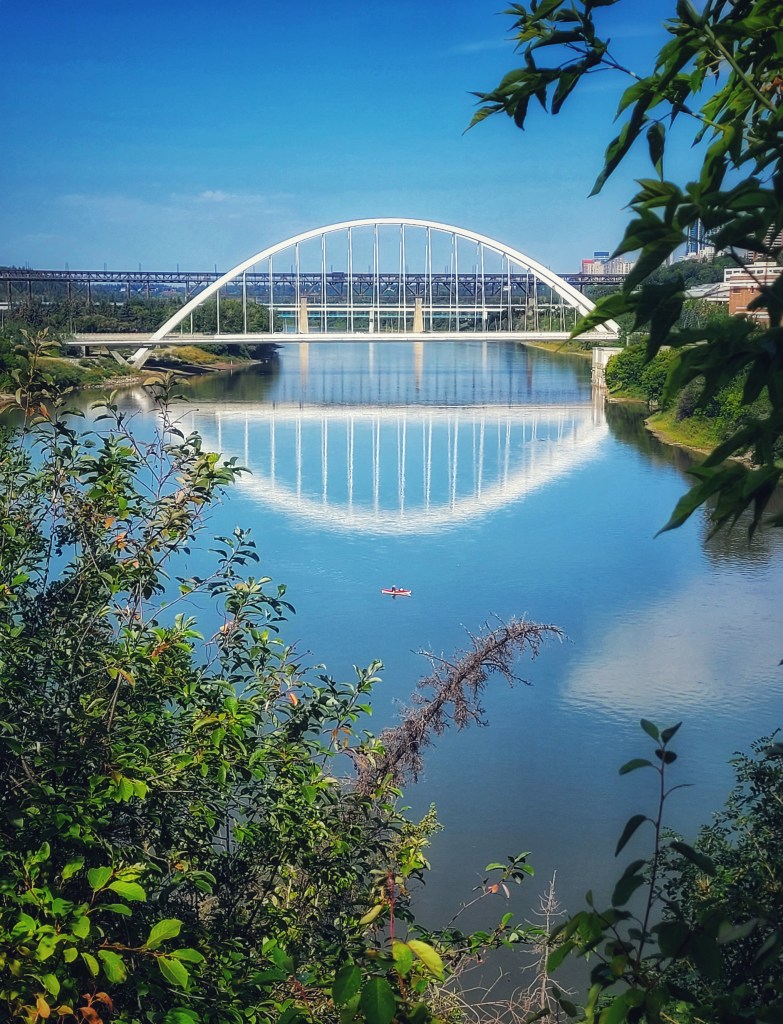
This summer, I’ve walked close to four hundred kilometers in our river valley, rain or mostly shine, and mostly alone. When I’m not listening to podcasts or audio books, I’m aware of my shifting moods. Those uninvited guests – the sadness or irritation, self-doubt, and even anger – most often at the beginning of a walk when fatigue and loneliness weigh, when I’ve yet to find my stride, or my place within the nature that is surrounding me. When I stop to notice the beauty holding me, to breathe, to give myself a few words of encouragement for persevering, then happiness and gratitude arrive.
While this wasn’t the year for peaches here – cold froze the Okanagan orchards – we did have a bumper crop of raspberries with many eaten fresh and many more frozen for winter muffins, galettes, and smoothies. And that errant red currant seed dropped by a bird a couple of years ago bore just enough berries to make my first ever two small jars of glistening garnet-coloured jelly. So much happiness in a spoon, spread on sourdough seedy rye toast.
“Returning is a wonderful thing when great friends are involved. Years dissolve and time is irrelevant in the light of true reunion. It means to become one again. It means to be joined. It means to be one in spirit, one energy, one song. It means to be returned to the balance you find when friendships are struck – and the entryway is a hug.”
Richard Wagamese, Embers, 2016
This quote, neatly printed, matted, and framed, hung in the guest room where I stayed last week, visiting my friends. A recent addition, it struck me as both new and the perfect description of the way my friends host theirs. Now my second summer in their beautiful home, with an outdoor living space only possible in their temperate island climes, I experienced the reunion, the song, the return to balance with both our entryway and departure marked by big, warm, heart to heart hugs…and donuts!
Yesterday, I wrote the quote in a card I’d created in celebration of another dear friend’s 60th birthday. It had been a couple of years since we had last connected, and our friendship, like the planets that had for a time, swung out of alignment. I was touched to have received an invitation to her party, and felt the years’ gap dissolve and time irrelevant as we embraced, said how much we had missed each other, and I stepped in comfortably to help her with food prep. This returning was an answered prayer, I’d said, as I hugged her goodbye with the promise to see each other soon.
“We approach our lives on different trajectories, each of us spinning in our own separate, shining orbits. What gives this life its resonance is when those trajectories cross and we become engaged with each other, for as long or as fleetingly as we do. There’s a shared energy then, and it can feel as though the whole universe is in the process of coming together. I live for those times. No one is truly ever ‘just passing through.’ Every encounter has within it the power of enchantment, if we’re willing to look for it.”
Richard Wagamese, Embers, 2016
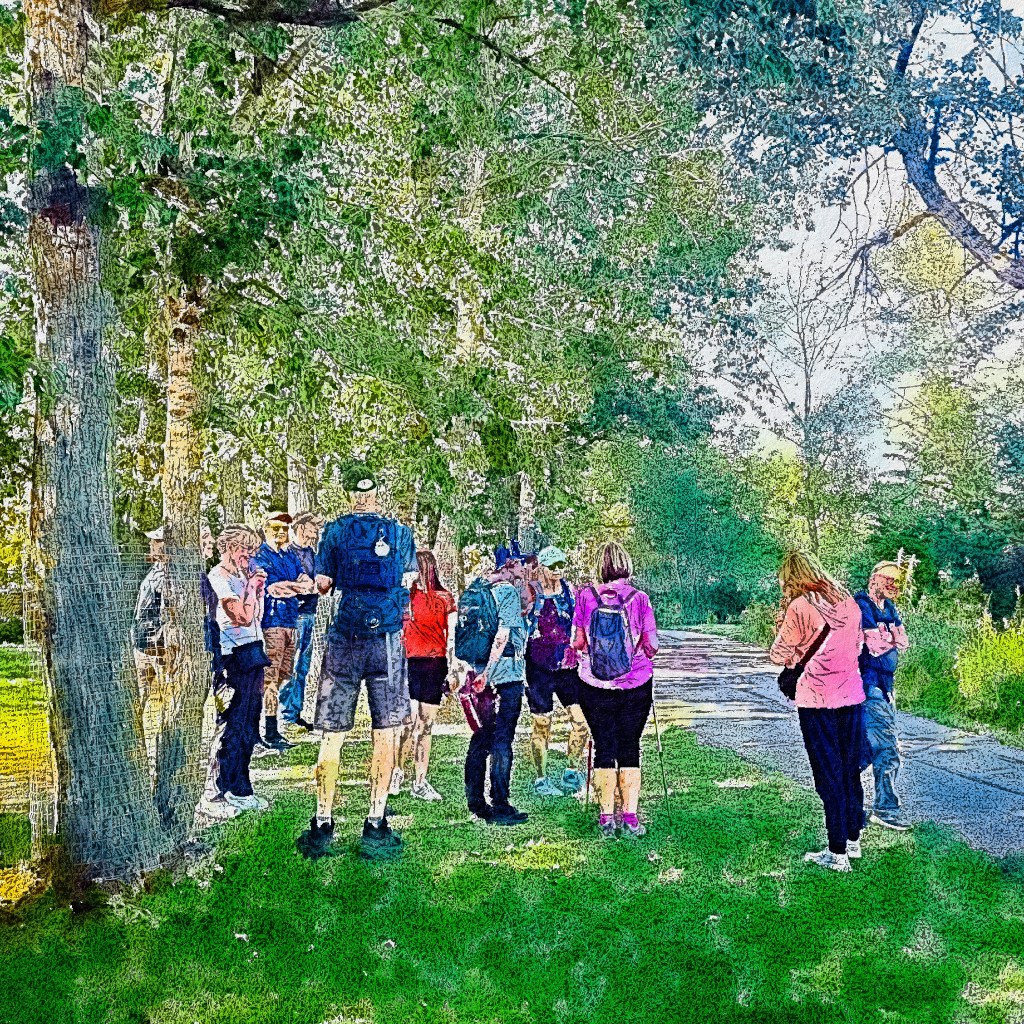
Last Saturday marked my return to walking with my Camino group. Seeing the sandwich sign marking our start brought joy to be reunited with friends who love to walk. We share an enthusiasm and energy as we support those readying for their late summer and early fall Caminos. This weekend we ventured out for the first time to St. Albert, a community north of Edmonton, with its own river, park trails, botanical garden, and splendid outdoor farmers’ market. More than twenty plus folks enjoyed a summer morning engaged in convivial conversation. I was so engrossed with a dear friend that little attention was paid to the route, and both of us were bewildered on our return to see sights totally missed. Such was our deep, connected returning.
It’s a short post, dear friends, sent, as always, with much love and kindest regards.
THESE DAYS Anyone who tells you not to be afraid should have their head examined. Cities are burning, hillsides are ablaze. and the dumpster fire of our common life is out of control. I wish I could tell you when it was going to get better. I wish I could promise that better was anywhere down this road. I miss dancing, bodies in something between conversation and flight. I miss singing, the way we trusted the air that moved between us. I miss the casual assumption that everything would be alright in the morning. These days I am trying to be buoyed by the smallest things – a ripe tomato, a smattering of rain. These days I am trying to remember that songs of lamentation are still songs.
Lynn Ungar, These Days: Poetry of the Pandemic Age, 2020
There is so much about this poem – found searching my bookshelf for one to frame my day, this week, my life, LIFE – that is in perfect alignment, despite it being written four years ago with its context the pandemic.
Today, I did a Medicine Walk along my favourite river valley route. Despite training for my long walk in September, this walk was not about distance, elevation, or pace. In honor of the feast day of Saint James – Sant Iago, as in Santiago, as in the Camino – it would be a walking prayer for the health and well-being, for a miracle, for a friend… for several friends… each besieged by life-threatening illness. Itbecame, too, a prayer for all beings displaced,distraught, and destroyed by the wildfires.
Despite an almost twenty-degree drop in temperature, with the morning overcast, thick with smoke from wildfires that last night ravaged one of Alberta’s beloved treasures, Jasper National Park, and its century old townsite, and heavy with rain that eventually, blessedly fell, I dressed for weather and set out. I chose as my audio companion the exquisitely composed “Camino” by the late Canadian violinist, Oliver Schroer. The first notes of the first track, “Field of Stars,” are a haunting homage to Santiago de Compostela (field of stars). The ambient tracks blended with birdsong on my path such that I felt surrounded and held by the morning’s poignant beauty. A perfect reflection of my interior landscape and the devastated one to the west.
Where a few weeks ago pink wild roses bloomed thick and heady with perfume, today’s bushes were laden with ripe purple saskatoon berries and blood-red wild raspberries.Golden yarrow and wild sage filled river banks. To my way of thinking, tasting those berries was my holy communion, the real “body of Christ.”
As steam rose from the placid river, a lone pelican glided above on its huge, outstretched wings. I lost sight of it, and then looking up, there he was again, effortless in his flight. I wondered about the significance of his appearance as I’d never seen one before on this stretch. Once home, I consulted Ted Andrews’ classic Animal Speak to learn they represent renewed buoyancy, unselfishness, and the need to not be weighed down by emotion. Wise medicine for these days.
“Morning!” we call out in passing – the dog walkers, the bicyclists, the ambitious lady with her water bottles and her sports bra, all out unfortunately early to avoid the heat. “Morning!” Not even “Good morning,” which could be an overstatement, given the hour and the fact that the world is on fire. It’s what we have to offer. We have the gift of a couple fresh hours, the fact that we are out moving through it, a whiff of possibility, the reality that our lives keep on touching one another’s in the tiniest of ways. Morning is as good as word for it as any.
Lynn Ungar, July 8, 2024
…Morgen…Dia…Giornata… On a German markplatz filling with farmers’ stalls for market day…mumbled by an elderly man in the small coastal fishing village on the Portuguese Camino…nodding to locals and those few fellow tourists at dawn on Florentine cobblestone streets.
This week a heat dome descended on my province. Sig was up early training Walker to become his name through neighborhood streets, quiet yet surprisingly busy with others intent to spare their dogs from the rising heat. I’d set out early one morning to climb stairs and hills in preparation for September’s long walk (sports bra left at home, water bladder instead of bottles in my pack). Cyclists early for the workouts or commutes. Our lives touching each other with a nod, a smile, a mumbled “morning,” and then each of us on our respective ways into days that held possibility and for some, or many, grief.
LANGUAGE OF LIGHT Next to the garden beds I wait while summer’s profusion wanes
the sycamores stand in unity rows guarding a path for the recently dead
arboreal complexion of limbs and trunk sentient camouflage in pale olive and tan
trees older than first-born stars leaves shimmering in the language of light.
Diana Hayes, Language of Light, 2023
I’ve started my preparation for another autumn long walk in Italy. This time, a small women’s group walking a small portion of the ancient Via Francigena from San Miniato, Tuscany to Rome. No doubt obvious to you who follow me here and on social media, I am smitten with Italy, and am borrowing a page from a once friend who said there was something about returning repeatedly to the same place, to venture deeper in.
I feel good going into this summer’s training. Last year’s foot injury has healed. So, too, my heart – mostly – from Annie’s year-ago passing. Following the same program developed by my friend, I’m starting a month earlier and so feel an ease and confidence I didn’t last summer. Every other day, alternating with pickleball, and a rest day, my chiropractor approves.
Today it rained. I opted for a slow start hoping for the forecasted three-hour break in the showers. Eventually I decided to dress for the weather and set out with my new floral knee-length rain poncho. I “ruck,” meaning when I walk, I carry at least ten pounds of weight in my pack, use my poles and wear my hiking boots, and made of today an experiment in waterproofing and breathability. Better to test here than thousands of miles and another continent away.
Last year, my friend accompanied me on many walks. This year, plagued by her own chronic foot injury, I’ll be walking alone most days. And I’m quite OK with that, given my proven way, even in groups, ofoften walking solo, in silence, with my camera ever ready. And so it was, Tuesday and today (Thursday), I resumed my lapsed practice of listening to podcasts. SeveralOn Being with Krista Tippett episodes, the last one featuring a conversation with poet, essayist, teacher, and community gardenerRoss Gay on The Insistence of Joy. His closing words struck deep:
Is sorrow the true wild? And if it is — and if we join them — your wild to mine — what’s that? For joining, too, is a kind of annihilation. What if we joined our sorrows, I’m saying. I’m saying: What if that is joy?
Step by step, mulling his concluding words, that powerful question, as light showers grew heavier, I switched over to another of my favourite podcasts, Ellipsis Thinking, created and hosted by my dear friend, Greg Dowler-Coltman. In this episode a conversation with Saltspring Island poet Diana Hayes, the author of today’s chosen poem. Greg had gifted me with Diana’s chapbook, Language of Light, an exquisite collection borne of her near inconsolable grief for her mother’s too-soon death from breast cancer, the same cancer she suffered at the same time. As I listened, struck again by Greg’s talent for deep listening and thoughtful questions emerging from his innate and kind curiosity, I felt a kindredness with Diana’s way of being in the world and as a poet.
Bittersweet is what comes to mind. Knowing oneself and another when we are vulnerable in disclosing and joining our sorrows. The poignant, piercing joy that can result when we do.
Driving this past week, I don’t know where, I noticed the nascent greening of trees in the river valley. After a few much-needed days of precipitation – sloppy snow that turned to thick rain, and in the mountains, heavy snow accumulations, though hardly making a dent in snowpack levels needed to offset the province’s extreme risk for fires and drought – buds are popping, tiny indigo scilla and daffodils are blooming, the raspberry canes are reviving. Absorbed in the beauty of one of my favorite seasons, I suddenly realized this was how it looked the day I took Annie to the vet after what we thought had been a case of THC poisoning. Checking with Sig and my 2023 calendar, yes, it had been April 27th when she suddenly took ill. For several days, she was listless, frightened, eating little, and very unsteady on her feet. Our vet, Deb, and I wept as she laid out options, and Annie lay under the chair.
And then Annie’s miraculous recovery…of biblical proportions, a spring resurrection, to our way of thinking.
our seven miraculous weeks
And then her sudden demise seven weeks later, just days before Solstice. In hindsight, it had been a stroke that felled her then, and now.
There’s not a day goes by that I don’t think of Annie…that I don’t continue to feel the tender ache in my heart for missing her.
Yet in a month’s time, we’ll welcome into our home Walker, our sixth English Setter. I’m ready. Watching people dog-walking and IG reels featuring the antics of dogs, I’m excited with what this young teenager will bring to our lives, assured of being enriched by his presence.
Driving home yesterday from my first solo Saturday Camino, nothing planned but feeling the stirrings to train for another long distance walk this fall, I heard on the radio Sinead O’Connor’s iconic rendering of Prince’s song, “Nothing Compares 2 U.” Tears stung as I whispered along, “yes, nothing compares to you, Annie.”
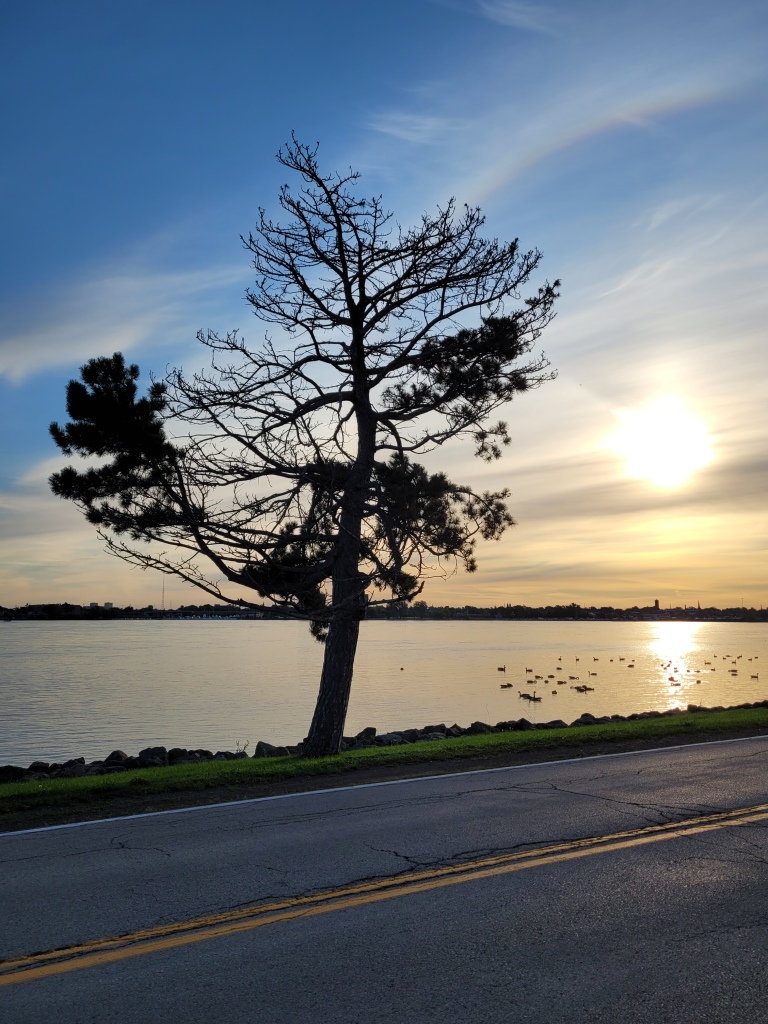
Walking along the river path, enamored seeing more signs of the wheel’s turning, I took a photo that perfectly captured not only the going and coming of seasons, but also the truth of this threshold moment in my life: the endings and beginnings, the grieving and the welcoming.
endings and beginnings
Come Wednesday, we’ll be off exploring more of our beloved Italy…always an easy sell for the man who “eats well and travels seldomly.” I’m acquainting him with regions I first visited in 2011 – Sicily, Sorrento, and the Amalfi Coast – a tour I designed when, lost in translation, the tour company I thought we’d booked with, didn’t. Allora…
A presto! Much love and kindest regards, dear friends.
“I believe poetry is very old. It’ s very sacred. It wishes for a community. It’s a community, ritual, certainly. And that’s why, when you write a poem, you write it for anybody and everybody…It’s a gift to yourself, but it’s a gift to anybody who has the hunger for it.”
Mary Oliver, as quoted in On Being with Krista Tippett
Four years ago, in January 2020, I designed and published this, my third blog, to serve as a platform for my writing. Little did I know then, that with the sudden arrival two months later of world-stopping Covid-19, I’d need to be leaning into writing and this space to cope with the grief of having lost my career and much of what I had assumed to be certain. I wasn’t alone in any of this, but the resulting systemic social isolation occasionally had me wonder.
By September that year, I’d set my sights on learning how to write poetry. I’d dabbled over the years in my blogs and journals, and for as many, was a devoted listener of The Road Home, a spoken word and music program curated by Bob Chelmick on my local radio station. I discovered Poetry Unbound, a podcast offering from my favourite On Being with Krista Tippett, hosted by Irish poet Pádraig Ó Tuama. With Annie on her leash, I’d plug in my earphones and for fifteen time-stopping minutes, walking familiar neighborhood routes, I’d listen to him read a poem and share his understanding about its structure, meaning, and resonance. An ardent fan, occasionally I’d write about him here, and took advantage of tuning into every free Zoom event around the world, hosted by Padraig reading, talking, teaching poetry. When I learned he’d be coming to Calgary for a retreat in 2023, I made haste months earlier to buy my ticket and reserve my bus ticket – a wise move as we had our first blizzard that weekend.
I joined a couple of Facebook groups for writers and took advantage of many free online readings and workshops to gain exposure to contemporary poets, seeing how they compared with my favourites, helping me find my voice. I was invited by Karen Close, founder and editor of Sage-ing: The Journal of Creative Aging with Creative Spirit, Grace and Gratitude to be her thinking partner and co-editor. Then exactly two years ago, upon the encouragement from one of my public library’s writers-in-residence – another complimentary service of which I have availed myself, I began the work of preparing a manuscript for submission to a well-known Canadian poetry publishing house. With Annie on her cushion by my side, I edited over seventy poems, received feedback from several friends and fellow writers, and emailed the package a week before heading off to walk the Portuguese Coastal Camino. An email in July brought the not so surprising, but none the less disappointing, news that my work had not been selected. It closed with the concise instruction “to persist.”
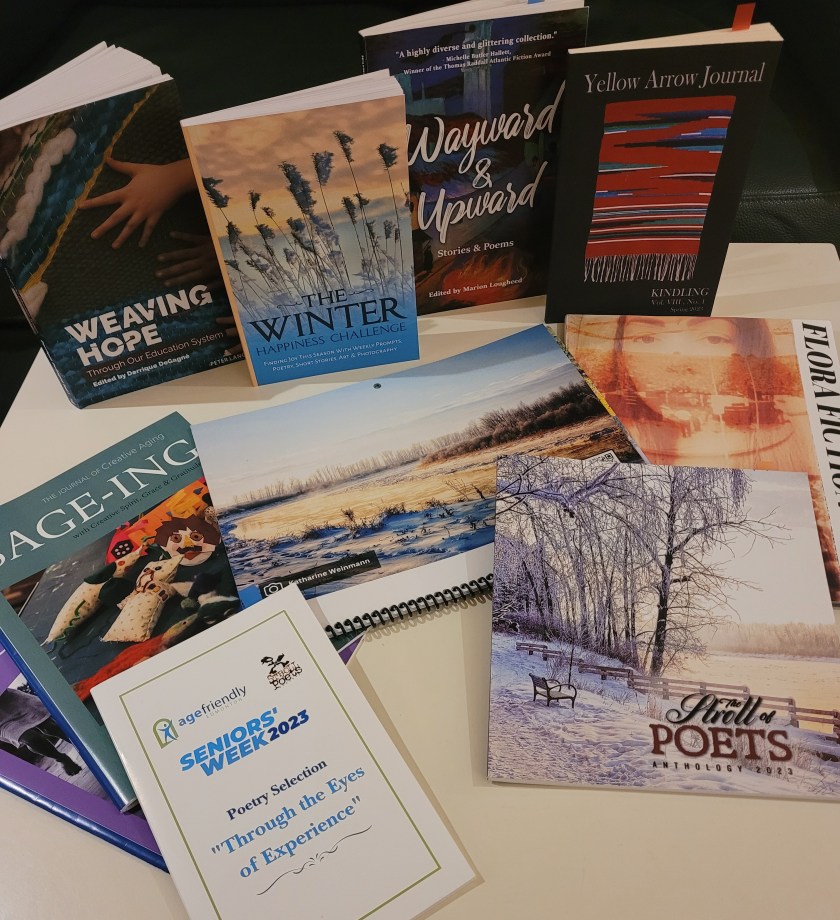
And so, I have. 2023 found me back in the saddle, submitting regularly to literary journals and online magazines around the world. I attended master classes with esteemed poets and prepared a chapbook for a publisher who had previously accepted one of my pieces. Another rejection, but she gave me the gift of feedback I’m using now to move my writing forward. Monitoring my submissions, tracking rejections and successes, with 70 sent last year, over 20% have been published, including several in national and international anthologies. In the meantime, as many journals invite submissions of art and photography, I’ve jumped in and have had several photos published – for money – have been included in a 2024 calendar featuring Edmonton’s river valley and have won the cover contest twice for our local poetry anthology. I feel chuffed.
I think alot about my writing: Why do I do it? What I give to it and what it gives to me? I’m committed to making poetry my writing genre of choice. Or, it has chosen me, being one who has long had a poetic turn of phrase and outlook on life. Like Mary Oliver, I believe poetry is sacred, being one of the ways I bring the sacred into my life, making my life as poem and prayer. However, unlike many writers, I’m not yet confident that writing is my way to, for lack of a better word, salvation…to reconciling what troubles me. I haven’t had enough experience waking during my soul’s dark night to trust that taking pen to paper will see me through to a metaphoric dawn, let alone a literal one. It is a faith that grows.
I am learning about poetry’s inherent nature of ritual, especially in the process of revising. Here I can immerse myself for hours, quietly reading for rhythm and assonance, writing for placement on the page, making space for the breath, embodying the imagery. This gives me pleasure.
I don’t know who proclaims one a poet. Maybe joining a professional group and paying the membership dues legitimizes one’s efforts. I’m leaning more into the empowering wisdom that comes from claiming myself through learning what it means to be a practicing poet. Exploring organically the design of my way of working; developing discipline and technical skill; rolling with rejection and celebrating success; reaching out for support; being vulnerable. Much of it done in isolation. In hindsight, Covid-19 prepared me well.
Four years ago, I began a new career, or rather, a new one found me. Today I am an internationally published poet and photographer. When I waver in my confidence and question the value of my words in a world inundated with others, I have those from my dear friend, author, and first writing mentor, to hold me in its community:
“And the quality of your writing offers me a moment of presence with you, your thoughts and reflections, and the complexities of the road we travel in and through these times at both the very personal and the larger scale. This is alchemy. Please continue. Please imagine me in early morning–still dark, tea and low light, and waking my day with your gift.”
Christina Baldwin
Thank you, too, for yours sent to me, dear friends. Much love and kindest regards.
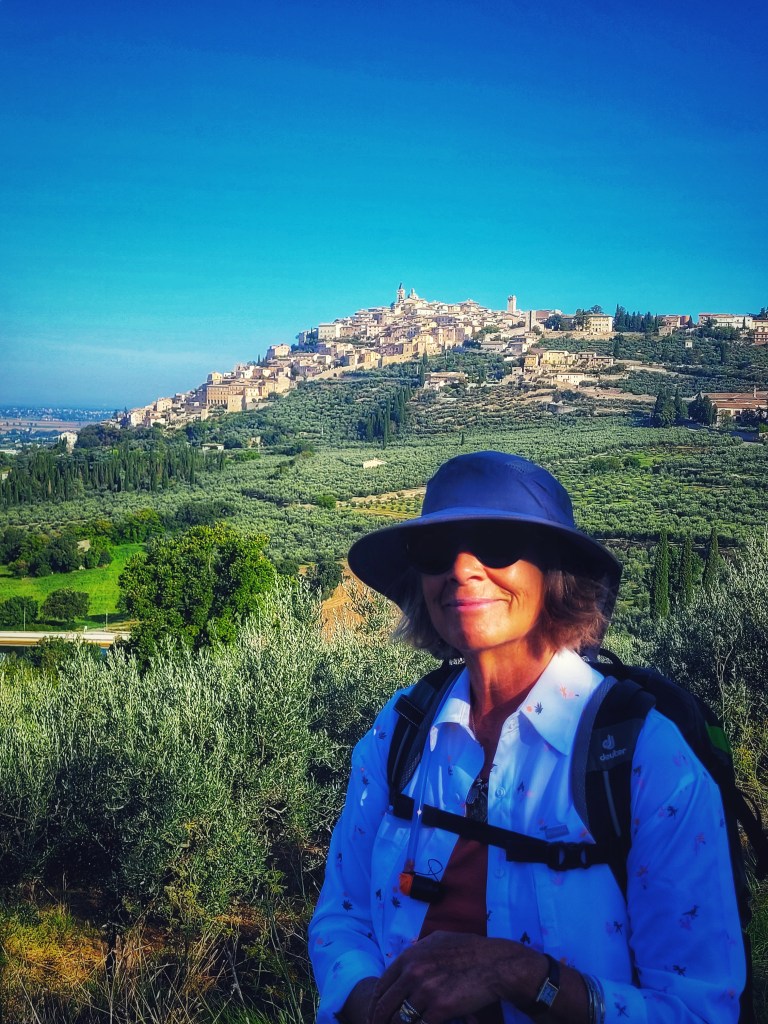
the ridged terraces below Trevi, Umbria – a classic Italian hilltop town la Via di Francesco, September 27, 2023
SILENT BRAVERIES Sometimes it takes looking at your struggles to recognize the depth of your courage. To be in awe of what it takes to face real fears, break old patterns, and climb the steep ridges of your own private mountain. Even the silent braveries carried out over time cover the ground all around you.
– Susan Frybort – Look to the Clearing
From my filed and saved poems, this is one in keeping with my current writing, both here andin recent poetry. The threshold crossed into a new terrain, one I’ve coined “an eldering landscape,” where facing real, albeit old and ancient fears; identifying, breaking and grieving old patterns; challenging roles and rules; initiating courageous conversations; climbing my private steep mountains and traversing barren landscapes – all various way markers to a destination unknown.
Truly my camino, caminho, cammino – the Spanish, Portuguese, and Italian ways. Truly ones that each of us walk, in this and the various stages of our lives. Walks wherein we call upon, become, and cover the ground with our respective silent braveries, revealing the way for each other.













 A Wabi Sabi Life