It is difficult to know what to do with so much happiness. With sadness there is something to rub against, A wound to tend with lotion and cloth. When the world falls in around you, you have pieces to pick up, Something to hold in your hands, like ticket stubs or change.
But happiness floats. It doesn’t need you to hold it down. It doesn’t need anything. Happiness lands on the roof of the next house, singing, And disappears when it wants to. You are happy either way. Even the fact that you once lived in a peaceful tree house And now live over a quarry of noise and dust Cannot make you unhappy. Everything has a life of its own, It too could wake up filled with possibilities Of coffee cake and ripe peaches, And love even the floor which needs to be swept, The soiled linens and scratched records….
Since there is no place large enough To contain so much happiness, You shrug, you raise your hands, and it flows out of you Into everything you touch. You are not responsible. You take no credit, as the night sky takes no credit For the moon, but continues to hold it, and to share it, And in that way, be known.
~ Naomi Shihab Nye ~
I’ve been absent from this space for a few weeks. I’ve been preoccupied with walking in preparation for another long walk in Italy. This time, a section of the Via Francigena, one of the oldest of Europe’s many pilgrimages. In three weeks, I’ll be bound for Rome where, the Fairweather and Travel gods willing, I’ll land, secure my train ticket at the airport, and continue to one of Tuscany’s famous hill towns, San Miniato. There, I’ll stay in a bright, spacious apartment with a view onto vineyards and hills, to rest, recalibrate and meet my walking mates four days later.
This summer, I’ve walked close to four hundred kilometers in our river valley, rain or mostly shine, and mostly alone. When I’m not listening to podcasts or audio books, I’m aware of my shifting moods. Those uninvited guests – the sadness or irritation, self-doubt, and even anger – most often at the beginning of a walk when fatigue and loneliness weigh, when I’ve yet to find my stride, or my place within the nature that is surrounding me. When I stop to notice the beauty holding me, to breathe, to give myself a few words of encouragement for persevering, then happiness and gratitude arrive.
While this wasn’t the year for peaches here – cold froze the Okanagan orchards – we did have a bumper crop of raspberries with many eaten fresh and many more frozen for winter muffins, galettes, and smoothies. And that errant red currant seed dropped by a bird a couple of years ago bore just enough berries to make my first ever two small jars of glistening garnet-coloured jelly. So much happiness in a spoon, spread on sourdough seedy rye toast.
“Returning is a wonderful thing when great friends are involved. Years dissolve and time is irrelevant in the light of true reunion. It means to become one again. It means to be joined. It means to be one in spirit, one energy, one song. It means to be returned to the balance you find when friendships are struck – and the entryway is a hug.”
Richard Wagamese, Embers, 2016
This quote, neatly printed, matted, and framed, hung in the guest room where I stayed last week, visiting my friends. A recent addition, it struck me as both new and the perfect description of the way my friends host theirs. Now my second summer in their beautiful home, with an outdoor living space only possible in their temperate island climes, I experienced the reunion, the song, the return to balance with both our entryway and departure marked by big, warm, heart to heart hugs…and donuts!
Yesterday, I wrote the quote in a card I’d created in celebration of another dear friend’s 60th birthday. It had been a couple of years since we had last connected, and our friendship, like the planets that had for a time, swung out of alignment. I was touched to have received an invitation to her party, and felt the years’ gap dissolve and time irrelevant as we embraced, said how much we had missed each other, and I stepped in comfortably to help her with food prep. This returning was an answered prayer, I’d said, as I hugged her goodbye with the promise to see each other soon.
“We approach our lives on different trajectories, each of us spinning in our own separate, shining orbits. What gives this life its resonance is when those trajectories cross and we become engaged with each other, for as long or as fleetingly as we do. There’s a shared energy then, and it can feel as though the whole universe is in the process of coming together. I live for those times. No one is truly ever ‘just passing through.’ Every encounter has within it the power of enchantment, if we’re willing to look for it.”
Richard Wagamese, Embers, 2016
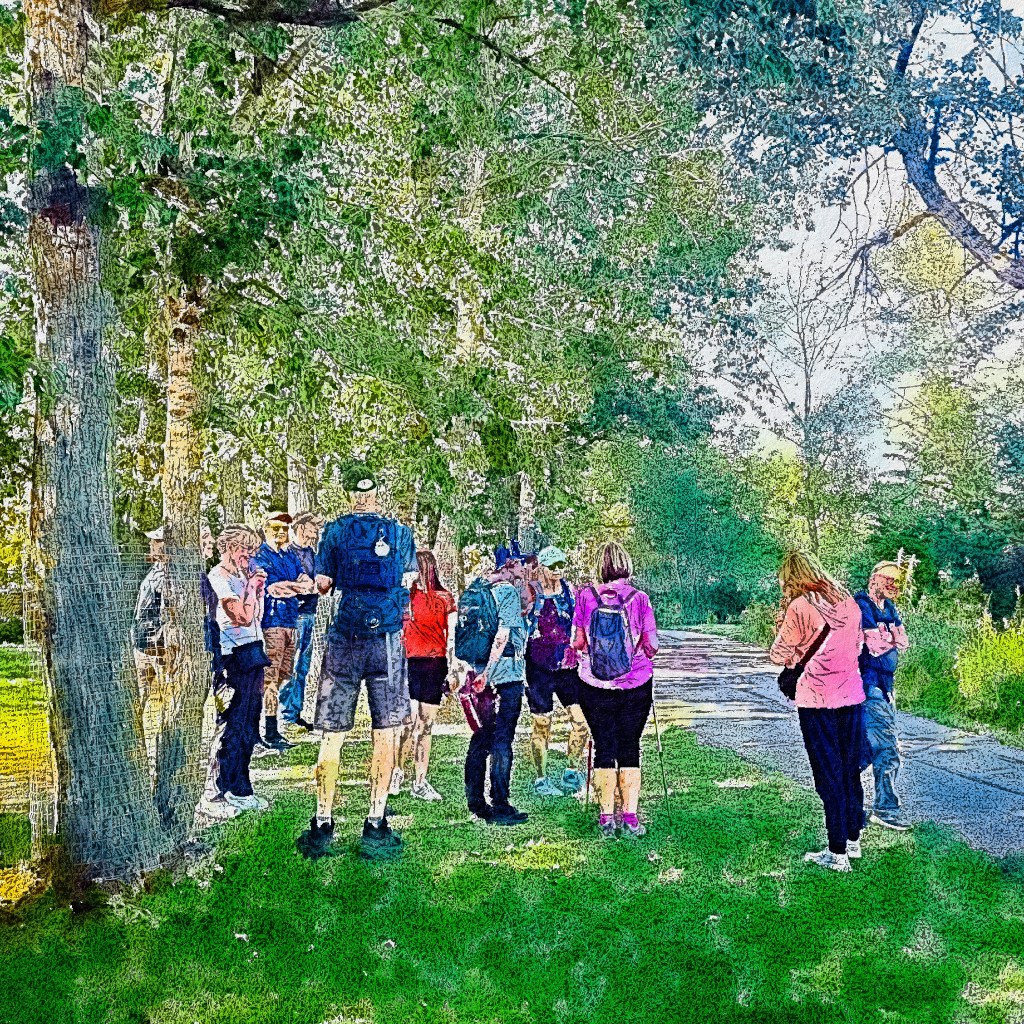
Last Saturday marked my return to walking with my Camino group. Seeing the sandwich sign marking our start brought joy to be reunited with friends who love to walk. We share an enthusiasm and energy as we support those readying for their late summer and early fall Caminos. This weekend we ventured out for the first time to St. Albert, a community north of Edmonton, with its own river, park trails, botanical garden, and splendid outdoor farmers’ market. More than twenty plus folks enjoyed a summer morning engaged in convivial conversation. I was so engrossed with a dear friend that little attention was paid to the route, and both of us were bewildered on our return to see sights totally missed. Such was our deep, connected returning.
It’s a short post, dear friends, sent, as always, with much love and kindest regards.
Consider the life of trees. Aside from the axe, what trees acquire from man is inconsiderable. From their mute forms there flows a poise, in silence; a lovely sound and motion in response to wind. What peace comes to those aware of the voice and bearing of trees! Trees do not scream for attention. A tree, a rock, has no pretense, only a real growth out of itself in close communion with the universal spirit. A tree remains in deep serenity. It establishes in the earth not only its root system but also those roots of its beauty and its unknown consciousness. Sometimes one may sense a glisten of that consciousness, and with such perspective, feel that man is not necessarily the highest form of life.
Cedric Wright in Earth Prayers From Around the World, 1991
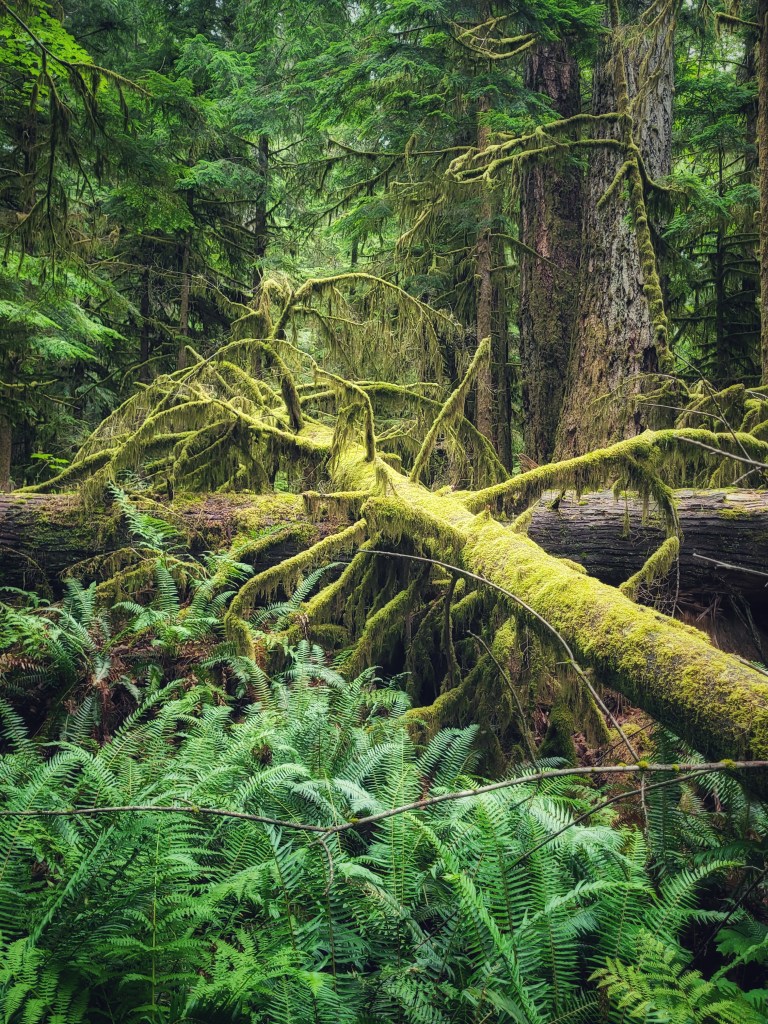
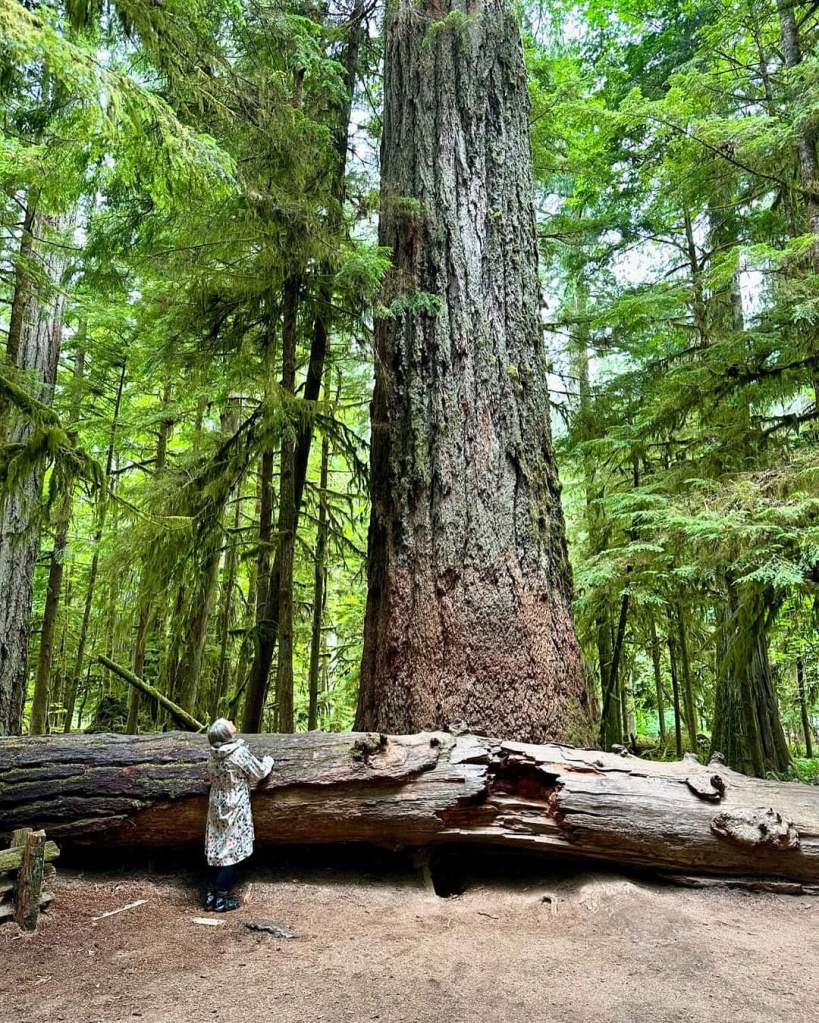
I returned home last night from four days on Vancouver Island, visiting dear friends whose home and hospitality make for a soul-restoring haven. They graciously show me their favourite sights, trusting I’ll delight in what they’ve discovered since relocating there a few years ago. This year, the weather was more in keeping with a Pacific Northwest autumn: cool, overcast, misty with showers, giving us plenty of conversation time in the warm glow of their indoor and outdoor fireplaces. Tuesday, we drove to Cathedral Grove, a popular tourist site along the Tofino highway, graced by a stand of giant, ancient Douglas Firs. It was my first time encountering these enormous stately sentinels. I was rendered awestruck and silent in their presence, taken to the place I have named “before, beneath and beyond words.” One hundred photos later, my friend’s one of me standing in that awe in front of the grove’s largest tree, one estimated to be over 800 years old, and taller than Italy’s Leaning Tower of Pisa, confirmed the perspective that neither man nor woman are the highest form of life.
perspective
Much love and kindest regards, dear friends. And a heart full of gratitude to my friends for the unforgettable experience.
“Morning!” we call out in passing – the dog walkers, the bicyclists, the ambitious lady with her water bottles and her sports bra, all out unfortunately early to avoid the heat. “Morning!” Not even “Good morning,” which could be an overstatement, given the hour and the fact that the world is on fire. It’s what we have to offer. We have the gift of a couple fresh hours, the fact that we are out moving through it, a whiff of possibility, the reality that our lives keep on touching one another’s in the tiniest of ways. Morning is as good as word for it as any.
Lynn Ungar, July 8, 2024
…Morgen…Dia…Giornata… On a German markplatz filling with farmers’ stalls for market day…mumbled by an elderly man in the small coastal fishing village on the Portuguese Camino…nodding to locals and those few fellow tourists at dawn on Florentine cobblestone streets.
This week a heat dome descended on my province. Sig was up early training Walker to become his name through neighborhood streets, quiet yet surprisingly busy with others intent to spare their dogs from the rising heat. I’d set out early one morning to climb stairs and hills in preparation for September’s long walk (sports bra left at home, water bladder instead of bottles in my pack). Cyclists early for the workouts or commutes. Our lives touching each other with a nod, a smile, a mumbled “morning,” and then each of us on our respective ways into days that held possibility and for some, or many, grief.
famed Polish sculptor Igor Mitoraj’s winged Ikaria on exhibition at il Castello Maniace, Siracusa, Sicilia May 2024
Aftermath Inventory
Shattered? Of course, That matters. But What comes next Is all I can hope to master.
Knowing, deep in my Bones, Not all hurt harms.
My wounds? If Somehow, I Grow through them, Aren’t they also a boon?
My scars? Someday, They might shine Brighter than stars.
Gregory Orr, The Last Love Poem I Will Ever Write, W.W. Norton & Co., 2019
One from the draft folder. For a morning when the night before, after my monthly Zoom with a friend, I opted for time with Walker rather than sitting at my desk, searching for a poem that might fit the week.
Maybe not exactly relevant, but eventually it comes around to this. The shattering. The reflection on hurts – given and received. Remembering that not all hurt harms. That it could be an invitation to lean in. Get real. Remember who and what matters most in the moment. At the time. Take the step, say the word to let them know.
My wounds. Your wounds. Our wounds. That when we grow through them, use them as compost for this day and the next, we might discover we’ve grown a well-lived and much-loved life.
My scars. Your scars. Our scars. Inevitable, too. Mark us among the living. The loving. Hearts broken by griefs shared, untold. Filled with gold, may they shine brighter than stars.
Flying home two weeks ago, with no foreknowledge, simply intrigued by the two-line description, I watched Perfect Days, a 2023 Japanese film written and directed by Wim Wenders. After three weeks of slow travel, designed with time to stay put and settle into the experiences of southern Italy, it was a soothing transition back into our quiet life at home. Clocking in at two hours, the film is described by The Criterion Collection as:
“A perfect song that hits at just the right moment, the play of sunlight through leaves, a fleeting moment of human connection in a vast metropolis: the wonders of everyday life come into breathtaking focus in this profoundly moving film by Wim Wenders. In a radiant, Cannes-award-winning performance of few words but extraordinary expressiveness, Koji Yakusho plays a public-toilet cleaner in Tokyo whose rich inner world is gradually revealed through his small exchanges with those around him and with the city itself. Channeling his idol Yasujiro Ozu, Wenders crafts a serenely minimalist ode to the miracle that is the here and now.“
The main character seldom speaks. Day in, day out, his routine is the same – thoughtful, simple, purposeful marked with moments of gratitude for the sky, trees, and the light shimmering among the leaves.
The film’s final frame, shown above, defines the central principle grounding the story, and served as its working title. Reading, I smiled with recognition and appreciation, and sighed knowing its essence, as I am one whose first memory is of komorebi.
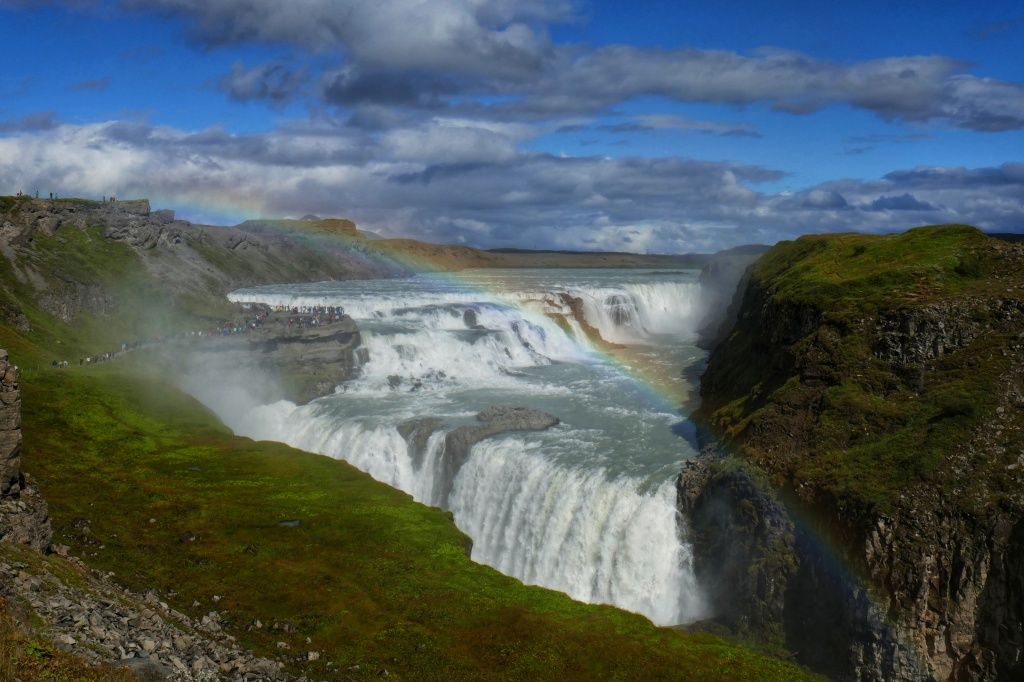
A few years ago, I wrote here about my love affair with trees, then inspired by a Sunday reading of The Marginalian and quote by Maria Popova, “A tree is a light-catcher that grows life from air.” My love affair with skies became conscious when I travelled to Iceland in 2018. While I fully anticipated the landscapes would tug on my heart, I had no idea how indelible the impact of those skies.
Reykjavik HarborGulfoss, Golden Circle, Iceland
But back to trees and some of those that caught my attention in Italy last month. Some captured with komorebi:
Taormina’s “Duca di Cesaro” public gardensRome’s Largo di Torre ArgentinaHerculaneumSorrento’s Piazza Lauro
Borrowing from my earlier post on trees, I’ll conclude in the same way, with a poem by Mary Oliver, in gratitude for the trees I gaze upon in my yard, and in vistas miles and oceans away, and for my friends who share a special kinship with them:
WHEN I AM AMONG THE TREES When I am among the trees, especially the willows and the honey locust, equally the beech, the oaks and the pines, they give off such hints of gladness. I would almost say that they save me, and daily. I am so distant from the hope of myself, in which I have goodness, and discernment, and never hurry through the world but walk slowly, and bow often. Around me the trees stir in their leaves and call out, “Stay awhile.” The light flows from their branches. And they call again, “It’s simple,” they say, “and you too have come into the world to do this, to go easy, to be filled with light, and to shine.”
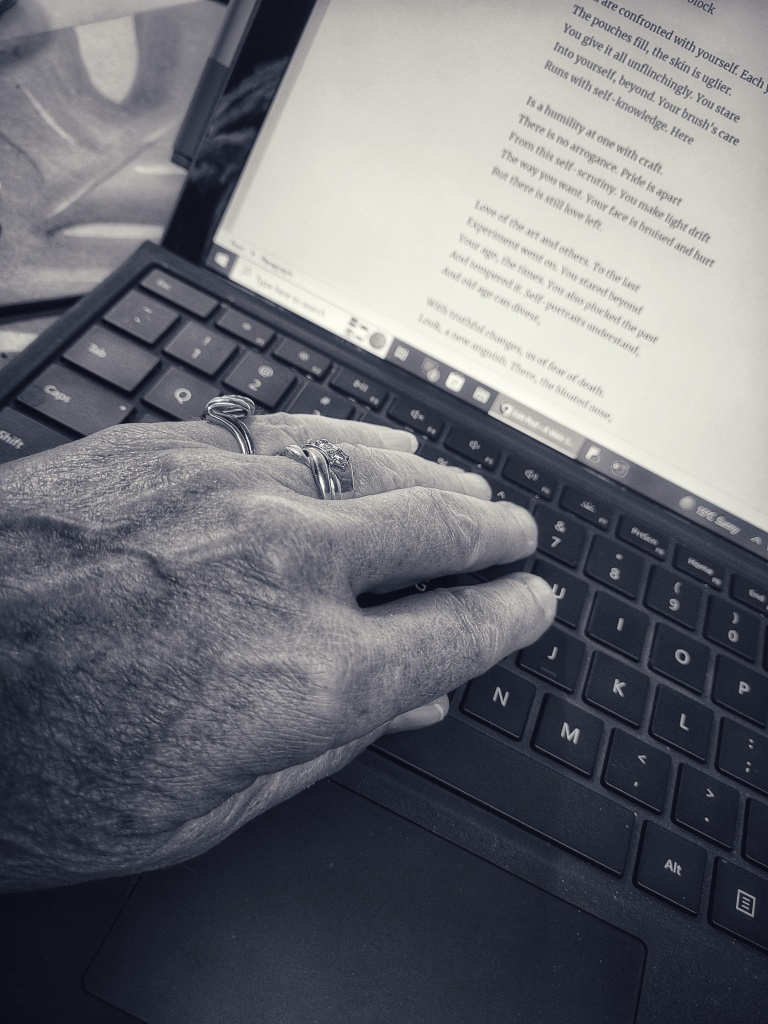
You are confronted with yourself. Each year The pouches fill, the skin is uglier. You give it all unflinchingly. You stare Into yourself, beyond. Your brush’s care Runs with self-knowledge. Here
Is a humility at one with craft. There is no arrogance. Pride is apart From this self-scrutiny. You make light drift The way you want. Your face is bruised and hurt But there is still love left.
Love of the art and others. To the last Experiment went on. You stared beyond Your age, the times. You also plucked the past And tempered it. Self-portraits understand, And old age can divest,
With truthful changes, us of fear of death. Look, a new anguish. There, the bloated nose, The sadness and the joy. To paints, to breathe, And all the darknesses are dared. You chose What each must reckon with.
– Elizabeth Jennings, ‘Collected Poems’ Carcanet, 1987
First post in a month, and this poem fits the bill. To be confronted with one’s aging self – the fatigue that lingers from almost two weeks of jetlag; stiff and aching knees upon waking, and after playing pickleball; vision that increasingly, more often than not, needs the assistance of my glasses; hearing that fades in noisy spaces; crepey skin and protruding veins on my suntanned hands – I could go on, but suffice to say, with truthful changes and a new anguish, there is still love left.
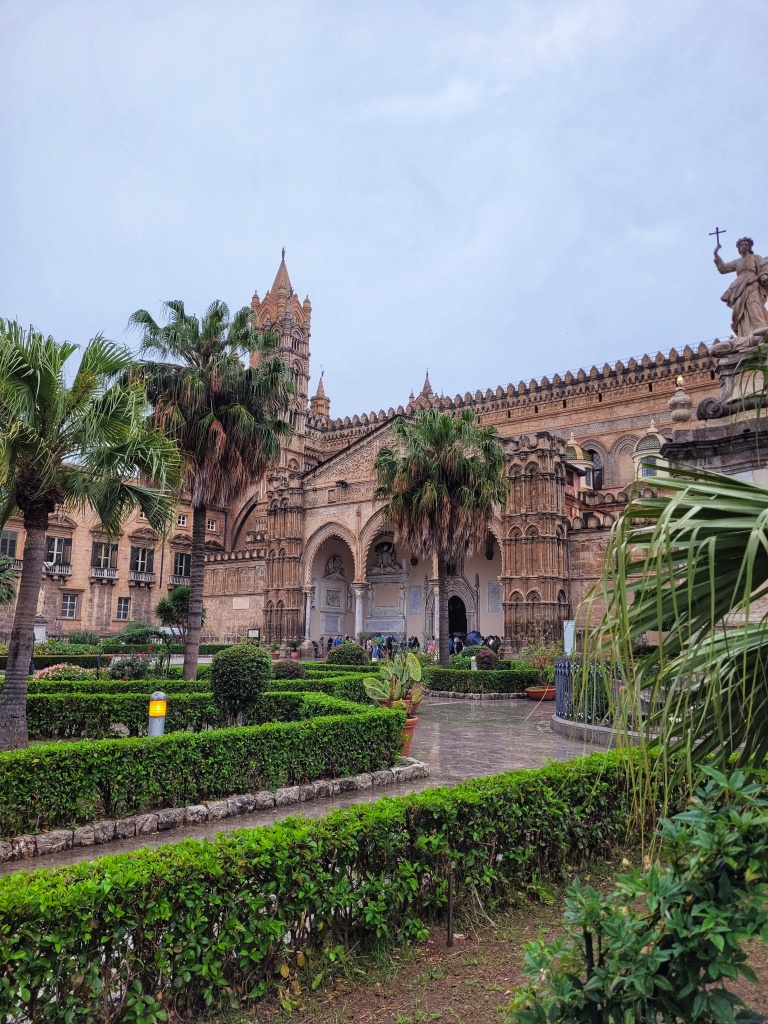
Italy was terrific. She never disappoints, even though it was quite cool for a few days in Taormina, Sicily. The Fairweather Goddess made her presence known, only giving us showers when indoors at a cooking class, touring Palermo, driving in a small touring to a vineyard luncheon on Mount Vesuvius, and full out sunshine when it mattered most – during our drive along the Amalfi Coast on, what locals call, the “Via Mama Mia.” Having arranged this trip, I was pleased that all our plans came together, with the only travel delay back in Canada, where we sat for over an hour on the tarmac during our final leg home from Calgary. I had no idea, as I was sound asleep.
rain in Palermosunshine on the Amalfi Coast, looking down onto Positano
Home less than a week, Sig drove to Kamloops to fetch Walker, our sixth English Setter. Not a year old, he’s playful, eager to please, a quick learner and from one side, looks so much like Annie that I occasionally lapse and call him by her name. It will be quite some time before he becomes the walking companion I had in her, but we’re both amazed at how much he’s settled in six days. Too, we’ve concluded, given our fatigue with the full-out attention required (managed in part by putting a bell on his collar, silence signaling we might need to check out what he’s up to), this will be our last dog, a reckoning as we stare beyond our age, the times.
Walker… we all fall into bed after a full day
At the beginning of this year, I wrote here about “an eldering landscape,” that inevitable next threshold that defines this age and stage of life. Balancing the sadness and the joy, in this stage, in this poem, I think back to one of our seven touring companions in Sicily. Patricia, an eighty-five-year-old American who, with her sixty something daughter, climbed every stair, walked every cobblestone path, sipped every taste of Sicilian wine, cooked with us savoring every morsel. Late self-portrait, hardly! I’ll take a page from her album any day.
I’m happy to be home, and back here on the page with you, dear friends. Much love and kindest regards.
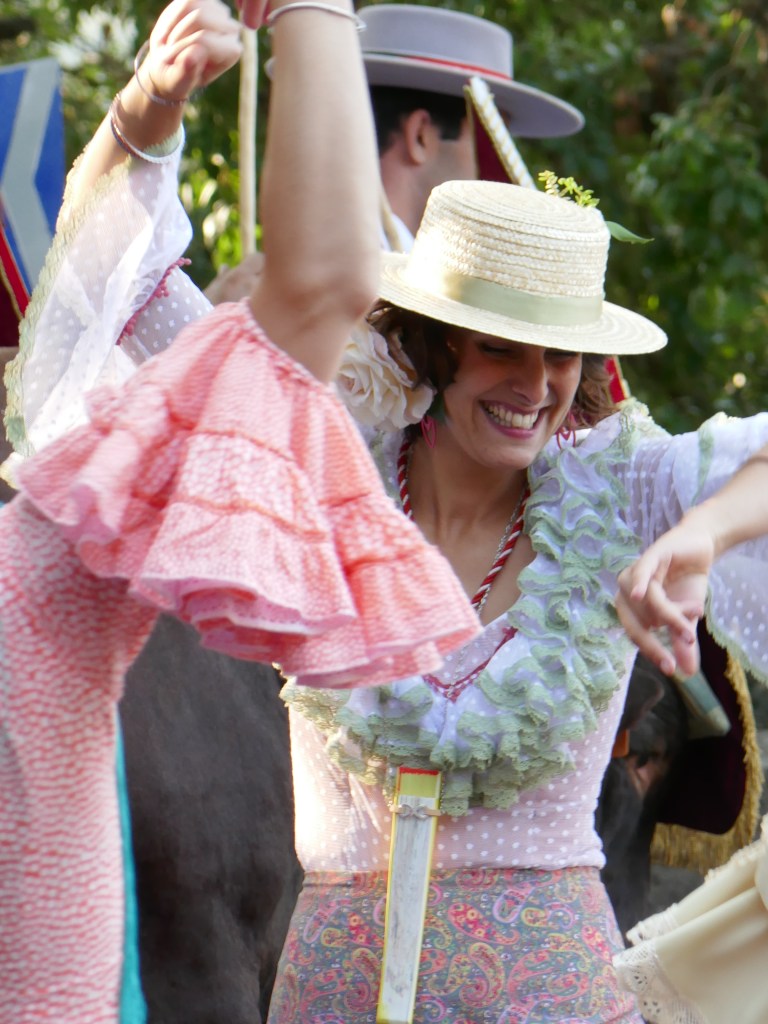
One winter night in 2015, we attended a concert at our local theatre. Conceived and produced by local musician Cam Neufeld,“The Road to Django”celebrates the music of Django Reinhardt, founder of “gypsy jazz,” made famous with violinist Stephane Grappelli in Parisian hotclubs during the 1930s and 40s. Tracing its origins musically, following the migratory path of the Roma people from northern India to Spain, through Turkey and the Balkans to France, Cam and his ensemble educated and entertained us splendidly. But it was when their “journey” brought them to Andalusia with a “vignette” of Flamenco, its origins attributed to the impoverished Romani, a form initially despised but now a UNESCO recognized part of the World’s Intangible Cultural Heritage, that I became enthralled. Arriving at home, I immediately went in search of lessons and a teacher. Two days later, I was in class.
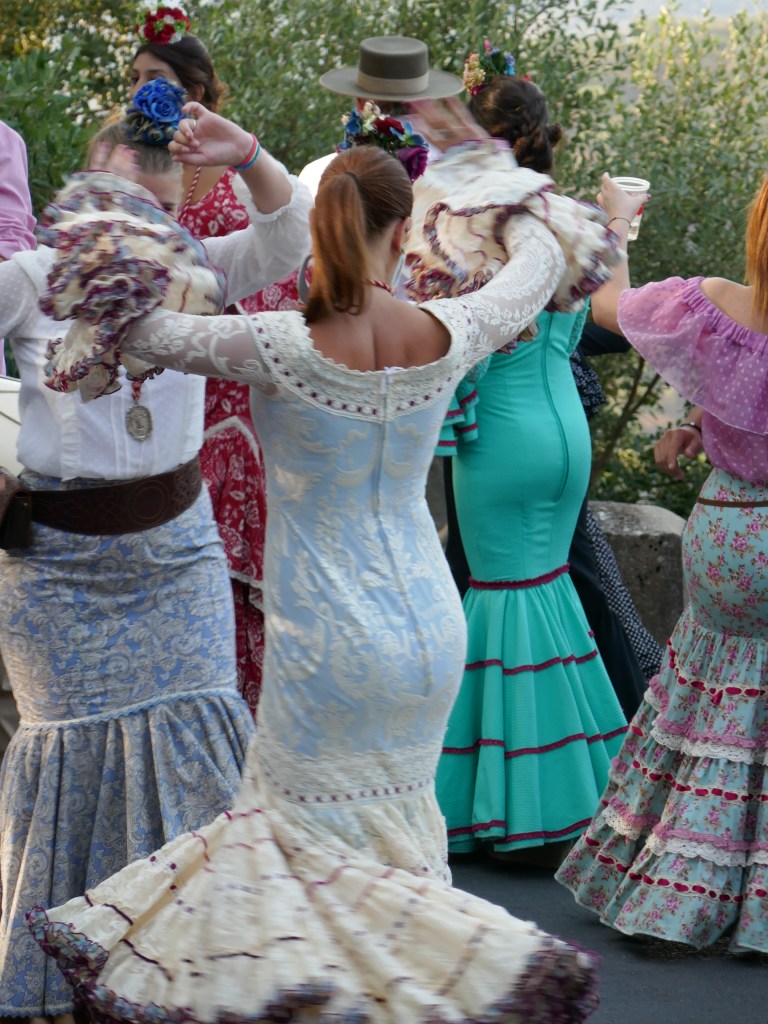
Fast forward to 2017 and my first visit to Andalusia en route to a weeklong writing retreat in a hill town northwest of Sevilla. While the “raison d’etre” left much to be desired, its location – a pink stucco villa built by long time British expats to raise their family and open a cooking school – was a culinary dream come true, the daily treks through the forests into different villages worth the price of admission. And the once in a lifetime opportunity to join the annual pilgrimage, la Romeria Reina de Los Angeles, where the Flamenco tradition was on show at every turn, became a most memorable feast for the eyes and ears. (I wrote about this experience in my earlier blog site.)
Returning to Sevilla after a week of writing, I witnessed a street performance of Flamenco dance and guitar the morning I visited the Plaza de España and later that evening, first in line for front row seats, I saw a live show at one of the local Flamenco cafes.
Returning home, and to classes, I realized this was a dance form I needed to have begun as a child, in another life, in another world if I were to ever realize the dream I had in my head, the feeling held in my heart. Yet, I persisted and finally felt I was making some progress when I switched to a teacher whose approach was organized, coherent, and aligned with my learning style. Jane was a devotee, studying every summer in Sevilla’s blistering heat, coming home to teach and produce annual Flamenco festivals featuring those same masters from Andalusia. I regretted not finding my way to her sooner and losing those precious years.
In 2020, I designed a winter sojourn in southern Spain to introduce my husband to another country of my heart (Italy and Morocco each taking chambers). Arriving in Sevilla, we quickly made our way to the pink stucco villa in the hill town to enjoy its remarkable hospitality and meals. Stops in Cordoba, Granada, Malaga (all described in past posts here) followed, with enough time in each to mosey around, take in the galleries and sights, taste the tapas and sip the icy vermuts. Returning to Sevilla, we took in a Flamenco show at the same cafe I’d visited in 2017. Again, first in line for front row seats, I recognized the male dancer and the singer. It was a performance not to be forgotten. The male dancer knew it. We knew it. He knew we knew it, as the energy in that cafe and on that stage soared and his footwork almost made sparks. Did he know what was to come? Winter 2020. Spain, then Italy, then Portugal, then the rest of the world falling to Covid-19. Was that performance, one where all was put on the stage, nothing held back, imbued with prescience?
Fast forward to this month when I met my teacher for coffee. We’d met earlier in the summer as she was returning to Sevilla for the first time since Covid. I would be soon traveling to Italy to embark on my 250+ km Via di Francesco. I’d told her of my healing foot and wondered if I’d be able to return to her classes. During coffee this time, she confirmed my hunch that dancing again might seriously compromise my foot.
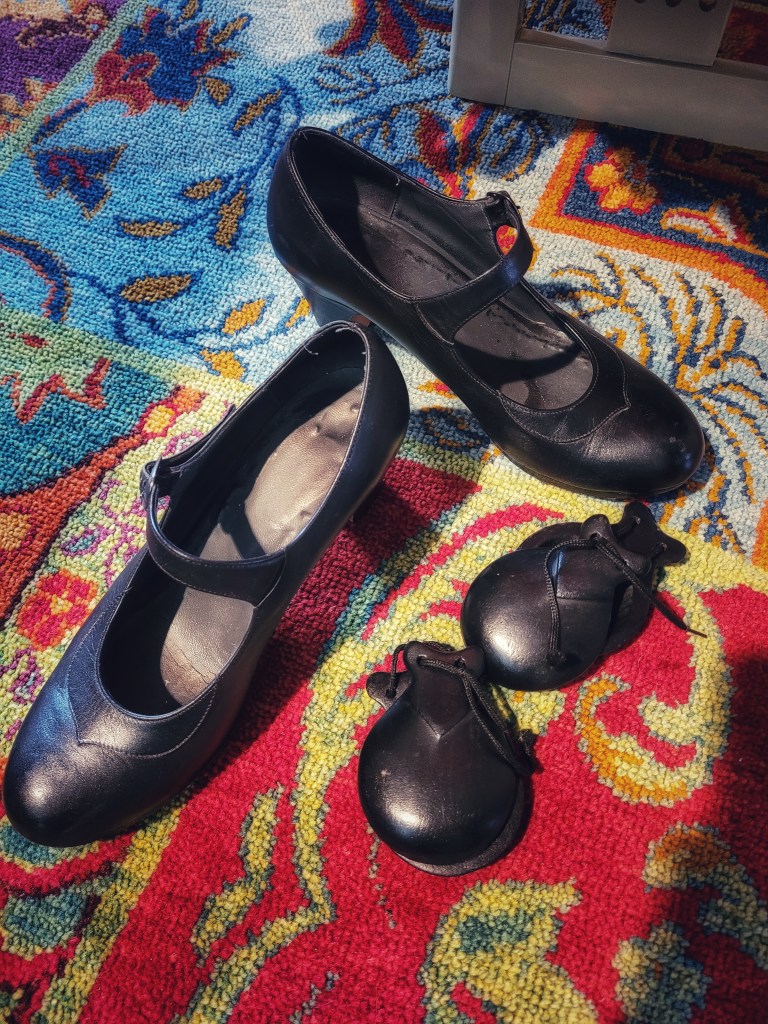
Last week, moved by spring’s enlivening energies and the age-old tradition of spring cleaning, I reached into the closet for the bag containing my nearly new hammered toe shoes, and to my surprise, the castanets I’d purchased while studying with my first teacher. In another closet, I gathered the long black trimmed red ruffled skirt. I took some photos and posted them on the local flamenco page and shared to mine. Within an hour an inquiry. By the next morning, all were sold to a local dance teacher.
We agreed to a day and time for her to pick them up and all day long, very atypical of me, it kept slipping my mind. Come the day of, I totally forgot our appointment. Apologetic, I offered to deliver the package to her. And that day, again atypical, I was running late. My husband, noticing all of this, together with my abrupt shunning of his attempts to help me get going, suggested I might be having a tough time parting with my skirt and shoes. Yes, I was, I conceded.
And then I cried…for the dream not to be…for the memory of that last time I danced…wearing my black shoes and my red skirt with a black ruffled sleeved shirt, looking very much the Flamenco dancer in my mind, on those stages…standing in a row with other dancers, each of us being watched by the teacher from Sevilla as he counted and clapped the beat…our feet tapping, hands held on hips, erect, looking straight ahead into the mirror…reflecting my focus, my precision… even when he stood directly in front of me.
It was a performance not to be forgotten. I knew it. He knew it. I knew he knew it, as the energy soared, and my footwork almost made sparks. Did I know what was to come? Winter 2020. Covid-19. Time passing. My final Flamenco class.
This is my homage to Flamenco, my dream of dancing it, the time I did.
“I think that this sense of well-being that comes with timelessness, the sense of being at peace – it must be very, very old. And it must be like a stylus dropping into a groove on the surface of the planet and making this music. And we are, our bodies are, that stylus, and we’re meant to move at this RPM that comes with the movement of our bodies.”
Last week, I took the time to open, click, listen, and read the conversation with Paul Salopek and Emmanuel Vaughan-Lee, founder of Emergence Magazine, an award-winning magazine and creative production studio that explores the threads connecting ecology, culture, and spirituality. An hour later, so intrigued with their conversation, I shared it on Facebook, logged onto their follow up ZOOM conversation live streamed from the UK this past weekend, and recommended it to my local Camino group at the start of our Saturday walk.
Salopek, an award-winning journalist, embarked ten years ago on a winding course retracing the migration pathway of early humans out of Africa, across Asia, eventually to cross the Bering Strait, down the Americas to Patagonia. Both in Emergence and more fully on the National Geographic page hosting this epic photo story, he describes how his personal relationship to time and the sharing of meaningful stories has deepened while moving through the world at three miles (5 km) per hour, or as my friend Christina Baldwin writes, “at the pace of guidance” and story.
“And I thought this would be an interesting experiment in slow storytelling or slow journalism, a way of slowing down my methodology and immersing myself in the lives of the people who inhabit the headlines of our day. So it’s been kind of a giant kind of a planet-sized studio to think about how stories are connected—not just kind of mega stories, say the climate crisis or human conflict, but our individual stories as well. And one way that I’ve found that does it really well is by slowing myself down and walking from person to person. That’s basically the premise of this. It’s a listening project where the destination almost always is another person.”
I love to walk. I have been walking more or less every Saturday morning in Edmonton’s famed river valley with my local chapter of the Canadian Company of Pilgrims, a “yes” I’d said several years ago on a wintry morning in January, and easily the most significant “yes” I’d said that year. What initially started as one member’s quest to train for his first Camino de Santiago trek, where walking was the raison d’etre, has evolved into a time for us to walk, be in community, and enjoy coffee at local cafes. True to my style, some Saturdays find me more extraverted, engaged in a series of edifying conversations along the path, while others, like this past weekend, ask of me to surrender to the silent restorative of its sunny, almost balmy morning. Stopping for a moment near the trail end, I smelled and felt those faint stirrings of spring, in time with this week’s celebration of Imbolc, the first day of spring in Celtic tradition.
I didn’t grow up in a walking family. Though recently it registered that I may have “inherited” an affinity for trekking from my father, who as a young teen at the conclusion of WWII, found himself alone, displaced, and dodging prisoner of war camps in Germany, taking months to walk his way home to the Black Forest where his mother held her breath waiting for his safe return.
Germany’s Black Forest
I used to regularly hike in the Rocky Mountains, though it’s been well over a decade, and I miss those outings with my women friends. Since Covid, I’ve made two long distance walks, the Portuguese Coastal Camino to Santiago de Compostela, Spain in May-June 2022, and most recently, the Via di Francesco, from Assisi to Rome in September-October 2023. I’ve discovered, like Paul, and many of us, my pace is about 3 miles (5 km) per hour…even when sauntering, my preferred way of moving (when I’m not kitchen dancing.)
“You do not have to, you know, make your way to the jungles of northeastern India to experience this thing. I think it’s there for you. And it might be a little tougher to see and experience if it’s part of your daily life, whether you’re living in a small town or a megalopolis or anything in between, because, as usual, if we stay sedentary, we get scales over our eyes, and we stop realizing the wonders of the everyday world around us because they become over familiar. But walking peels those scales off and allows you to rediscover the extraordinariness of so-called ordinary things. And that includes a walk through your town, a stroll out into the fields, or a park near your house—indeed, your backyard, if you choose to go micro, right?“
Walking with Annie was an invitation in peeling off the scales. As I wrote in a post during what would be her last days, “Walking Annie is no longer exercise. It’s fresh air, the gift of being outside noticing life around us.” Admittedly, still missing her, it takes a bit more presence and intention to notice life around me, scales off, without her. And yet, more often than not, I experience what Paul Salopek describes as an:
“astonishing internal metronome that’s built inside of us, inside of our body, that distinguishes us from almost every other animal…this goodness that’s kind of humming in our bones, waiting to be let out.”
Listening and reading and looking at Paul’s journey, I’m stoked to envision my next long, slow walk, wondering what memories will be evoked, people encountered, stories conjured, bones set to humming, all waiting to be let out?
Dr. Clarissa Pinkola Estes, Women Who Run with the Wolves”
“I haven’t seen anything from A Wabi Sabi Life lately,” remarked my friend in our long overdue, much awaited Zoom call. A myriad of reasons, excuses even, offered. And as I sit down in my studio Sunday night after dinner, my typical time to craft a post, what thread to pull from the dark interior knot in hopes of loosening its vague, inarticulate, persistent grip?
“A brave woman, a wisening woman, will develop the poorest psychic land, for if she builds only on the best land of her psyche, she will have for a view the least of what she is.”
Dr. Clarissa Pinkola Estes, Women Who Run with the Wolves”
Do I write again about friendship? How my initial post rang true for so many women, coincidentally finding several at the time questioning their own friendships? How its precipitant, a letter written to a friend, sank like a stone? Its “no response” response – a risk I weighed yet chose to take – now a knot in my heart tied tight with other friendships that have waned or ended this year.
“So do not be afraid to investigate the worst. It only guarantees increase of soul power through fresh insights and opportunities for re-visioning one’s life and self anew.”
Dr. Clarissa Pinkola Estes, Women Who Run with the Wolves”
Do I wonder how I’ll work with feedback given to me from a publisher considering my chapbook submission and why it was refused? Feedback that when taken into consultation with a writer I hold in high regard, she immediately understood and pointed to numerous examples where I hadn’t written myself into my poems. Another risk I had to take: to submit those poems and then to ask for help to understand. Profound and vulnerable, I sense this is as much about my poetry as it is about allowing myself to fully show up – on the page, in my poems, in my life.
“It is in this psychic kind of land development that Wild Woman shines.”
Dr. Clarissa Pinkola Estes, Women Who Run with the Wolves”
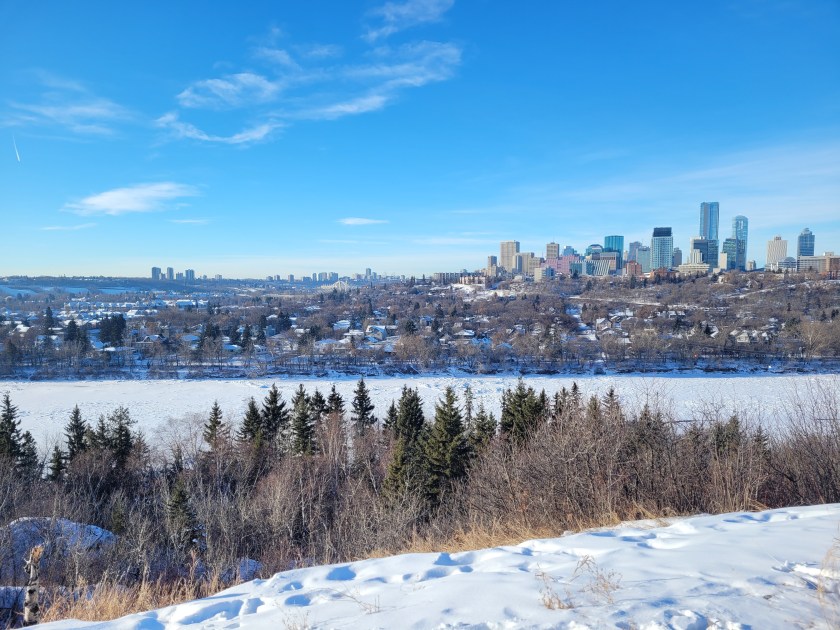
Do I wax majestic on the memories of my solo month in Italy, fresh with every step I take walking, especially on Saturdays with my Camino group? Poles in hand, boots on feet, pack on back. Or every Italian inspired meal made, Moka pot Americano sipped? It all comes back viscerally even though the skyline is urban, there’s ice in the river, and I don’t hear much Italian spoken anywhere. I finished my photo journal last week, reveling in my photos and extracting from the posts I’d fortuitously written every day on Facebook. And just today I returned to the pages of my Morocco photo journal. Reading my travel diary and selecting photos, I felt a much-needed surge in love for my intrepid self. And now considering my writing, with several poems the result of my journeys, there’s a question I hold even closer, “How far do I have to travel to find myself?”
women on the wild edge
There’s the ever present, though softened ache in missing Annie, five months passed. Woven in now with the passing last week of my mother-in-law. Anticipated at ninety-eight years, to her family she had been lost twice due to Alzheimer’s attacking her memory and ability to communicate over the past several years, and now finally her body. I’ll make the trip this week to attend her funeral as Sig is tending to health issues that, while thankfully being resolved, have wearied, and episodically worried us since August. Grief weighs. I feel its silent tension in my body.
And then there’s the grief and trauma in the world “writ large,” unleashed again with manmade and natural upheaval and destruction (maybe they are one in the same?) taking up a lot of my “mind space,” to quote a friend. To quote another, in the title of a talk he gave last week, “What does love have to say at a time of war?”, I ponder this deeply. With beloved Muslim friends with Arabic backgrounds, and beloved Jewish friends, all of whom are reeling with the daily horrors of it all…and too, in my city with its significant Ukrainian demographic, again dear friends, people who now feel they are being forgotten by the world while their own horrors persist, I try to find and walk the middle way. I think of Rumi – “beyond right doing and wrongdoing there is a field and I will meet you there.” Or as my friend recommends, a higher field to see with depth and breadth a way through the entrenched complexities. It feels like the only way, and yet how? Who takes the first step walking into that dark field? Does it matter who, simply that it be?
“She is not afraid of the darkest dark, in fact, she can see in the dark.”
Dr. Clarissa Pinkola Estes, Women Who Run with the Wolves”





















 A Wabi Sabi Life