There is a word in Portuguese that has no direct equivalent in any other language: “saudade.” It is not just longing. It is more. It is longing mixed with melancholy, with expectation, with tenderness and with a gentle sadness.
It is longing for something that was. . . or maybe never was. It is absence with the scent of memory. It is love that did not have time to end, but neither to continue. It is music that echoes in the void left by someone.
In fado they sing saudade. In our long silences, saudade is hidden. In lonely walks, in lost glances out the window, in letters never sent.
Saudade does not want to leave. It doesn’t heal, because it doesn’t hurt completely. It doesn’t break you, but it doesn’t leave you whole either. It’s the sweet wound of souls that feel deeply, beyond words.
Carrying saudade within you is proof that you loved, that you lived, that you dreamed… even if for a moment.
~ Waves of Life, Facebook, May 4, 2025 ~
singingfado on the steps in Lisbon, May 2022
Exactly three years ago I was walking the Portuguese Coastal Camino to Santiago. During my first evening in Lisbon, I encountered the essence of “saudade” in a young street musician strumming her guitar, perched on stone steps across from our hotel, singing “fado,” the Portuguese equivalent of the “blues.“
Once home, in preparation for writing about my experiences, I heard a Portuguese guide refer to fado as “the presence of absence.” This inspired a poem which was published later that year in 100 Caminos, an annual Chilean anthology celebrating Camino poetry:
. . . now my memory mends and fills those cracked and empty places with jasmine perfume and birdsong blistered heels and sun kissed faces
Saudade captures much of how I’ve been feeling this year. Tired from the moral outrage I’ve felt in response to the incessant displays of blatant evil. . . disappointed with life events that didn’t quite become as I’d imagined. . . I feel “the longing for something that was . . . or maybe never was.”
Disillusionment giving way to letting go. Discernment that comes with age. The proof that I have loved and lived and dreamed. The presence of the absence acknowledged and allowed. And what is asking to emerge next.
Life’s unfolding along its silver thread, invisible until it’s not.
Much love and kindest regards, dear friends. It’s nice to be back after several weeks’ absence.
“But I don’t look like a sun,” a young star still wrapped in swaddling veils said.
To which I replied, “But you will, my dear. You will, mashuq. So don’t worry. Don’t fret.”
Daniel Ladinsky, A Year with Hafiz (2011), December 22
My day began before dawn, quiet and dark, lighting the final candle of the Advent wreath. Curious, Walker stood close, watched the flare of the match, the flickering of the four candles, and then left to keep silent vigil sleeping in his bed. I thought of family and friends, the passing of time, the moments of melancholy with the missing…thresholds crossed and yet to be.
It’s now Sunday evening, quiet and dark. I have just listened to poet Elizabeth Alexander read the final chapters from her memoir, The Light of the World. Recommended in Allison Wearing’s online memoir writing course, it’s the lyrical account of the sudden death of her beloved husband…beautiful, poignant, poetic.
A deep breath, a pause to reflect, and to register the sanctity of her story and the liminality of these holy days.
Then, I turned to the book beside me: The Dreaming Way, Toko-pa Turner’s brilliant invitation to the practice of dreamwork. The chapter, “Wisdom of Sophia.” Its essence, as the embodiment of paradox and the continuous chaotic cycle of creation and destruction, leads us to a refinement of our life force aligned with nature.
“Not only is there more to your story beyond this anguish, but one day you story will be the starlight for another to follow out of their own darkness.”
Toko-pa Turner, The Dreaming Way (2024)
Another deep breath and pause to let Toko-pa’s words land. And just before I turned off the floor lamp, I fetched from my box of sacred books and journals, Hafiz by way of Ladinksy to read today’s contemplation.
There’s a thread running through this day…revealed in the elements described here. And a blessing for you, dear friends, that you may trust in your own, perhaps still wrapped, starlight.
Arriving at my desk to write this blog, I opened an email to learn of the sudden passing of my first professional friend. With his wife and young son, they became our first “couple-family” friends when Sig and I made our first home together in small town Ontario. They hosted us for our final nights in Ontario nearly forty-four years ago before we packed up our first dog, Beckey, a few plants (a hosta that still blooms in our dining room window), and some luggage to make the trek across Canada in our little white VW Scirocco sportscar to our new home in Alberta. The vague sadness that has hovered around me for much of this grey, cold and damp day has now found a foothold.
Earlier today, I attended the 4th annual Poets Corner “Reading Rilke,” with Rilke translator-poet Mark S. Burrows in conversation with Padraig O’Tuama and Krista Tippett. Among my notes, the following bore my highlighted underlining:
“I believe in everything that has never been said.” – Rilke
“We are here to listen the world into being and then to share its stories.” – Mark S. Burrows
Consistent among each of them was that much of Rilke’s writing was an embodiment of his famous directive to live into the questions.
Despite my cup feeling full, I don’t have much to write this evening. Questions tinged with sadness. So much that has never been said. Listening into silences. Trusting the infinite possibilities to be found in the unknown.
Remembering how my friend tempered my youthful naievety with his experience and wisdom. For years, throughout every career move, I pinned his handwritten note in front of me to remember: “The world is perfect, including my efforts to change it.” A bit like Rilke.
…”the greatest gift you could give a child — or the eternal child in you — is ‘a sense of wonder so indestructible that it would last throughout life, as an unfailing antidote against the boredom and disenchantments… the sterile preoccupation with things that are artificial, the alienation from the sources of our strength.'”
Musing on what I’d write for today’s post, my direction shifted after reading Sunday’s issue of The Marginalian. The above quote and story that followed stirred a memory of responses I’d had during recent walks, during these past weeks fraught with global disenchantments. The unmistakeable sound of Canada geese – flying overhead, landing in the nearby pond, or in formation ready to make their annual southern migration, honking to announce their presence. Whatever I had been thinking up until that point quickly gave way to awe as I gazed up in admiration and remembered the once popular story I’d often read to groups I’d facilitated.
The Sense of a Goose described the group and leadership dynamics of a flock of geese flying south, and how their innate wisdom could be applied to us building teams and making communities. Reading aloud that story, how many times I’d almost be moved to tears. Even recalling it during my recent walks, watching those geese overhead, I had the same visceral, poignant response.
Delving into its edges and source, I realized I had been feeling the longing – that often barely acknowledged human condition – for the deeply rooted sense of wonder as an indefatiguable source of strength; for the feeling of inner safety and outer belonging; for trusting in the reliable support of others. In that story, among the people with whom I worked, and watching overhead now, I felt what the geese and their flying physics illustrated:
…”the physics of any healthy community, any healthy relationship — the physics of vulnerability and trust. Because life always exerts different pressures on each person at different times, internal or external, thriving together is not a matter of always pulling equal weight but of accommodating the ebb and flow of one another’s vulnerability, each trusting the other to shield them in times of depletion, then doing the shielding when replenished. One measure of love may be the willingness to be the lead bird shielding someone dear in their time of struggle, lifting up their wings with your stubborn presence.”
I’ve long known that eldest daughters and big sisters might need big sisters in their lives. Being both, I am beyond blessed to have three – Ann, Christina and Sarah. Teachers, mentors, wise women, and friends, each in her way, over the years, has supported and encouraged me to live boldly, courageously, unequivocally committed to my knowing, my voice, and my writing.
A leap of faith…my response to the voice through the door calling me…turning toward what I deeply love…saving myself. (Rumi) An answered prayer, as during one of the Pacific Northwest’s infamous storms, waking with a bellyful of doubt before dawn, I received word I’d won a story writing contest, and later during the week, writing for thirty-six hours in silence, a series of prose-poems, tentatively titled “Love Letters to Timeless Poets,” emerged.
That time with Christina, and her subsequent inspiration and emboldening, together with that of Ann and Sarah, continue to nurture me as writer and poet. And so it is that I use this space now to thank Christina, and Ann and Sarah, and to describe Christina’s most recent literary accomplishment.
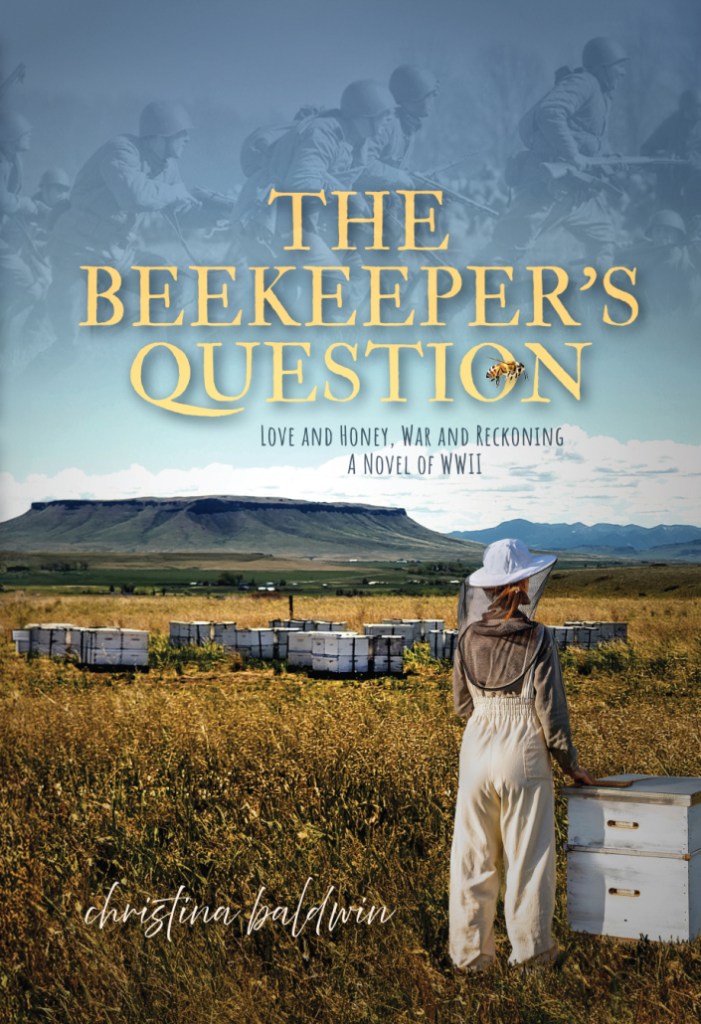
The Beekeeper’s Question, Christina’s decade long labor of love, and response to the voice through the door calling, is a work of historical fiction resonant with today’s struggles. Described as –
“Young lovers, old friends, a mountain valley and a North African battlefield: two Montana families face loss, prejudice, violence, and redemption in the uncertainty of 1940s America.”
Christina Baldwin
– it was perfect reading when I returned home from my long-distance walk. One of those “couldn’t put down,” beautifully written books that broached the hard stuff in the lives of its characters and unflinchingly illuminated the settler history of intentional devastation to the indigenous peoples. I was deeply moved by the subtle weaving in of animism and the mysteries and wisdom of the deep feminine. I felt as did one of Christina’s reviewers:
“So richly written that the characters feel like friends and it’s bittersweet when the story ends.”
Molly Guptill Manning, Author When Books Went to War, NYT Bestseller
As darkness and cold begin to envelop you, and looking ahead to the season of gift-giving, The Beekeeper’s Question might be one for your list, and for yourself.
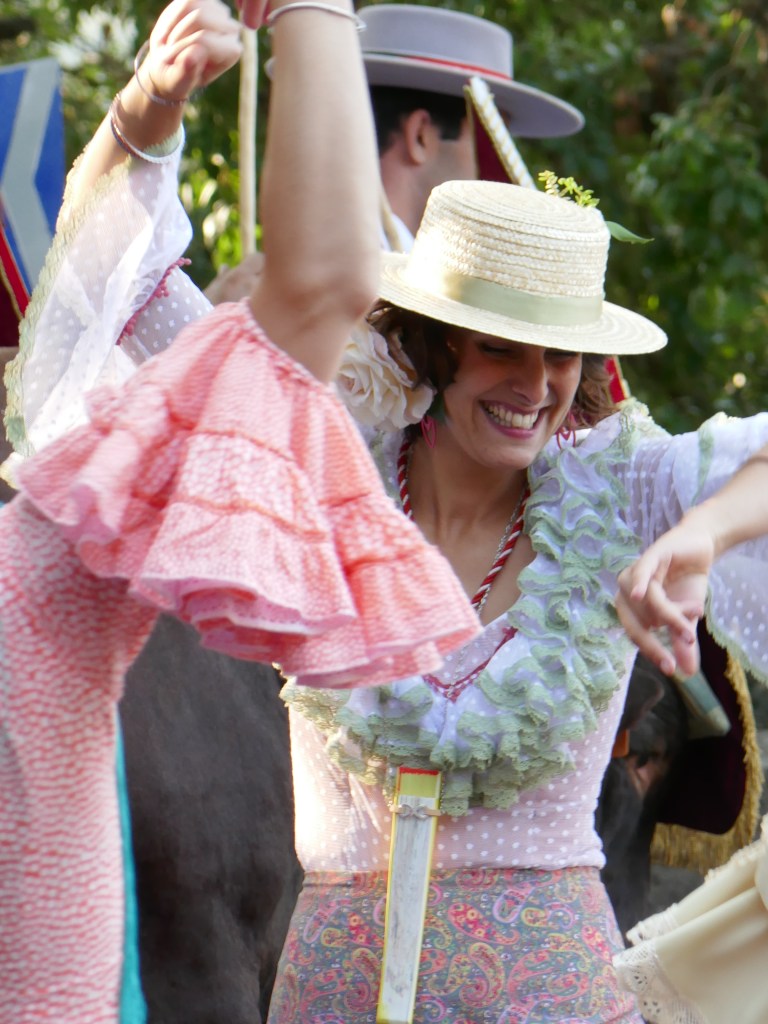
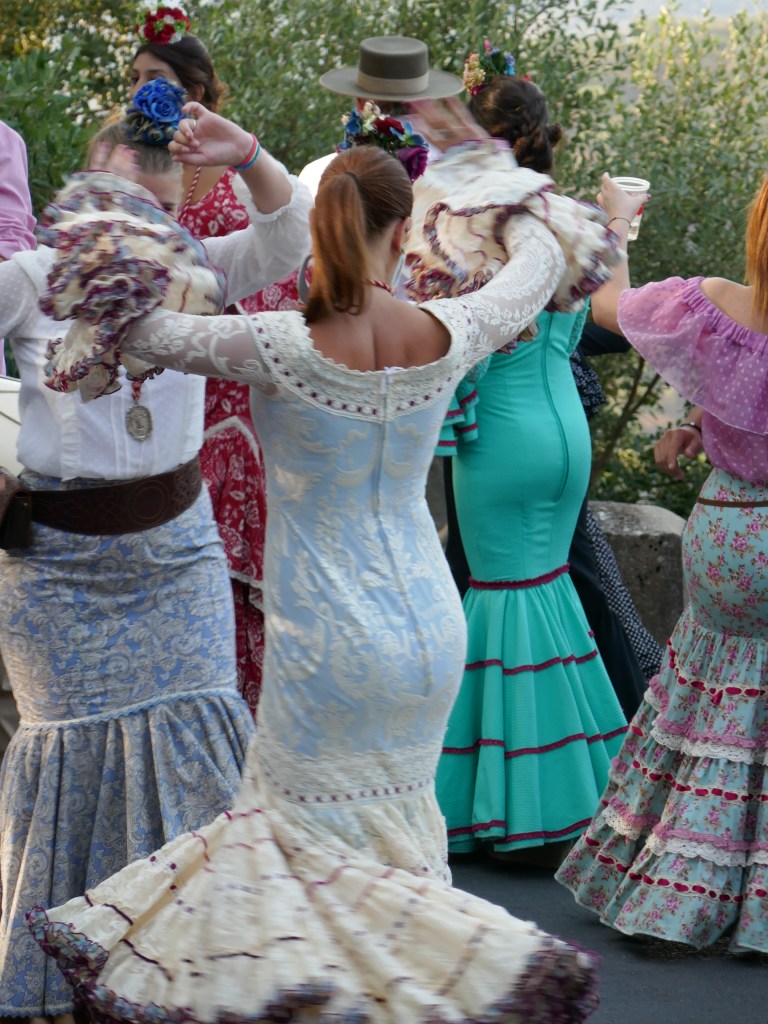
One winter night in 2015, we attended a concert at our local theatre. Conceived and produced by local musician Cam Neufeld,“The Road to Django”celebrates the music of Django Reinhardt, founder of “gypsy jazz,” made famous with violinist Stephane Grappelli in Parisian hotclubs during the 1930s and 40s. Tracing its origins musically, following the migratory path of the Roma people from northern India to Spain, through Turkey and the Balkans to France, Cam and his ensemble educated and entertained us splendidly. But it was when their “journey” brought them to Andalusia with a “vignette” of Flamenco, its origins attributed to the impoverished Romani, a form initially despised but now a UNESCO recognized part of the World’s Intangible Cultural Heritage, that I became enthralled. Arriving at home, I immediately went in search of lessons and a teacher. Two days later, I was in class.
Fast forward to 2017 and my first visit to Andalusia en route to a weeklong writing retreat in a hill town northwest of Sevilla. While the “raison d’etre” left much to be desired, its location – a pink stucco villa built by long time British expats to raise their family and open a cooking school – was a culinary dream come true, the daily treks through the forests into different villages worth the price of admission. And the once in a lifetime opportunity to join the annual pilgrimage, la Romeria Reina de Los Angeles, where the Flamenco tradition was on show at every turn, became a most memorable feast for the eyes and ears. (I wrote about this experience in my earlier blog site.)
Returning to Sevilla after a week of writing, I witnessed a street performance of Flamenco dance and guitar the morning I visited the Plaza de España and later that evening, first in line for front row seats, I saw a live show at one of the local Flamenco cafes.
Returning home, and to classes, I realized this was a dance form I needed to have begun as a child, in another life, in another world if I were to ever realize the dream I had in my head, the feeling held in my heart. Yet, I persisted and finally felt I was making some progress when I switched to a teacher whose approach was organized, coherent, and aligned with my learning style. Jane was a devotee, studying every summer in Sevilla’s blistering heat, coming home to teach and produce annual Flamenco festivals featuring those same masters from Andalusia. I regretted not finding my way to her sooner and losing those precious years.
In 2020, I designed a winter sojourn in southern Spain to introduce my husband to another country of my heart (Italy and Morocco each taking chambers). Arriving in Sevilla, we quickly made our way to the pink stucco villa in the hill town to enjoy its remarkable hospitality and meals. Stops in Cordoba, Granada, Malaga (all described in past posts here) followed, with enough time in each to mosey around, take in the galleries and sights, taste the tapas and sip the icy vermuts. Returning to Sevilla, we took in a Flamenco show at the same cafe I’d visited in 2017. Again, first in line for front row seats, I recognized the male dancer and the singer. It was a performance not to be forgotten. The male dancer knew it. We knew it. He knew we knew it, as the energy in that cafe and on that stage soared and his footwork almost made sparks. Did he know what was to come? Winter 2020. Spain, then Italy, then Portugal, then the rest of the world falling to Covid-19. Was that performance, one where all was put on the stage, nothing held back, imbued with prescience?
Fast forward to this month when I met my teacher for coffee. We’d met earlier in the summer as she was returning to Sevilla for the first time since Covid. I would be soon traveling to Italy to embark on my 250+ km Via di Francesco. I’d told her of my healing foot and wondered if I’d be able to return to her classes. During coffee this time, she confirmed my hunch that dancing again might seriously compromise my foot.
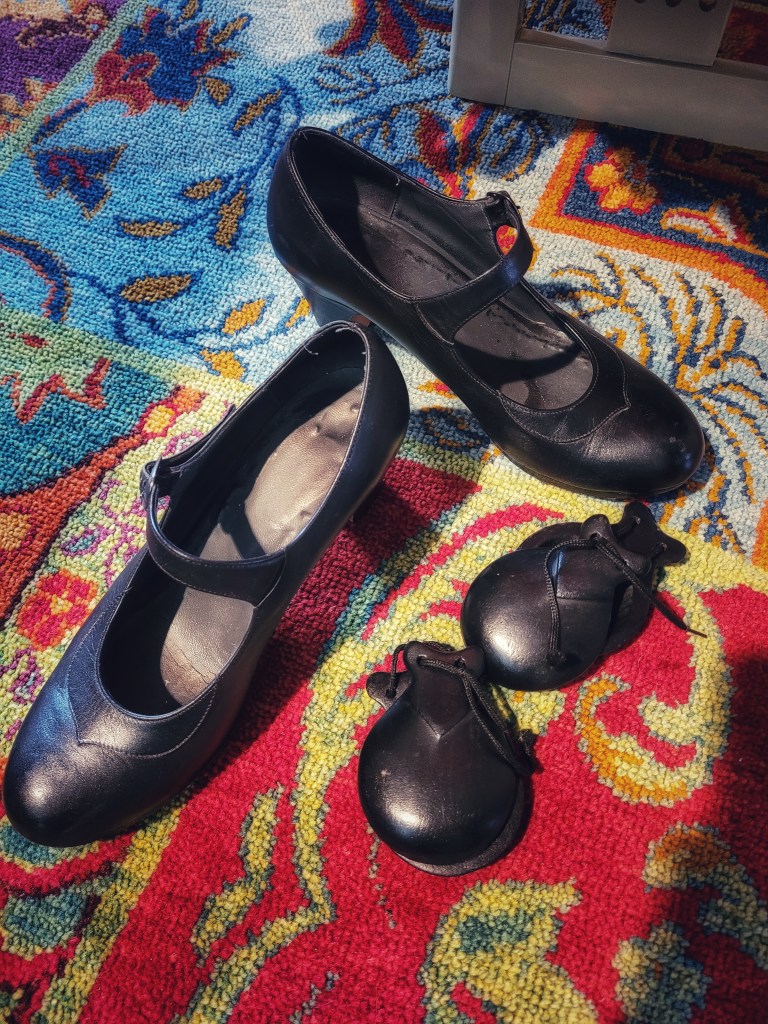
Last week, moved by spring’s enlivening energies and the age-old tradition of spring cleaning, I reached into the closet for the bag containing my nearly new hammered toe shoes, and to my surprise, the castanets I’d purchased while studying with my first teacher. In another closet, I gathered the long black trimmed red ruffled skirt. I took some photos and posted them on the local flamenco page and shared to mine. Within an hour an inquiry. By the next morning, all were sold to a local dance teacher.
We agreed to a day and time for her to pick them up and all day long, very atypical of me, it kept slipping my mind. Come the day of, I totally forgot our appointment. Apologetic, I offered to deliver the package to her. And that day, again atypical, I was running late. My husband, noticing all of this, together with my abrupt shunning of his attempts to help me get going, suggested I might be having a tough time parting with my skirt and shoes. Yes, I was, I conceded.
And then I cried…for the dream not to be…for the memory of that last time I danced…wearing my black shoes and my red skirt with a black ruffled sleeved shirt, looking very much the Flamenco dancer in my mind, on those stages…standing in a row with other dancers, each of us being watched by the teacher from Sevilla as he counted and clapped the beat…our feet tapping, hands held on hips, erect, looking straight ahead into the mirror…reflecting my focus, my precision… even when he stood directly in front of me.
It was a performance not to be forgotten. I knew it. He knew it. I knew he knew it, as the energy soared, and my footwork almost made sparks. Did I know what was to come? Winter 2020. Covid-19. Time passing. My final Flamenco class.
This is my homage to Flamenco, my dream of dancing it, the time I did.
A girl in Gaza speaks into a table microphone: Do you believe in infinity? If so, what does it look like to you?
Not like a wall Not like a soldier with a gun Not like a ruined house bombed out of being Not like concrete wreckage of a school’s good hope a clinic’s best dream
In fact not like anything imposed upon you and your family thus far in your precious thirteen years.
My infinity would be the never-ending light you deserve every road opening up in front of you.
Soberly she nods her head.
In our time voices cross the sea easily but sense is still difficult to come by.
Next girl’s question: Were you ever shy?
– Naomi Shihab Nye, Voices in the Air, 2018
I’m sitting at a worktable in my public library typing this post for tomorrow’s drop. We’ve been without WIFI in our home office for nearly a week (hence why no Monday post). WOW! How dependent are we on this technology? It’s tax time. My husband does all our investing online. Bills to be paid by the month end. Waiting to print time sensitive return labels. Looming project deadlines. I’ve managed with my phone but wonder how much I’m over the data limit and how much the costs will be. My neck aches from being hunched over…texting and tapping what I can to stay in touch, be responsive. So, in this moment, I’m reminded how much I enjoy and appreciate my library, surrounded by stacks, students plugged in working at other tables, surrounded by full-length windows.
It’s quintessential springtime in Alberta. After several days of sun, warm weather, and melted snow – after getting off really easy with winter – the temperature dropped below freezing and snow fell for most of the day. I took a leisurely start to my day with a coffee date being canceled. Sipping my Americano, in the flat white light of the living room, quiet with snow gently falling outside, I began reading this volume of poetry, waiting on my shelf for just this moment. Needing some shoring up given another week of rejections and trepidation about the manuscript I’m revising, I was not disappointed, as even its epigraph began to set me straight:
“Stay humble, blend, belong to all directions. Fly low, love a shadow. And sing, sing freely, never let anything get in the way of your singing, not darkness, not winter, not the cries of flashier birds, not the silence that finds you steadfast pen ready…”
Naomi Shihab Nye
Then this, the first sentence of her introduction:
“Poet Galway Kinnell said, ‘To me, poetry is someone standing up, so to speak, and saying, with as little concealment as possible, what it is for him or her to be on earth at this moment.'”
And this, to open the first section, “Messages,”:
Broken pencil Broken pen Maybe today I’ll write my best poem
Well maybe not a poem but a post. And maybe not my best, but enough. Enough to be thankful for Palestinian-American poet and educator, Naomi Shihab Nye who first came to my attention when I read her well known “Gate a4” and signature, “Kindness.” Enough to let her cultural perspective and experiences teach me, as she was taught when teaching a poetry workshop in an international high school in Japan, the word Yutori – “life space” – the place and space “in which to stand back to contemplate what we are living and experiencing. More spaciousness in being, more room in which to listen.” (Voices in the Air, xiii) And enough to remember a girl in Gaza, or Ukraine, or Israel, Afghanistan, Haiti, Ethopia, Yemen,Russia…asking profound questions, being deeply heard, and wishing her the infinity of the never-ending light she so deserves.
There are those who want the world to remain on its current path. This is not only unacceptable, but it is painfully unimaginative. For the beauty of our generation is we are uniquely situated to achieve what so many in this world currently consider impossible. How exquisitely beautiful it will be to watch the current narrative go down in flames, then witness poetics & phoenix rise from the ashes.
Embers, ancestors, and angels await us, loved ones. Forward.
– Mark Gonzales – In Times of Terror, Wage Beauty, 2014
I’d forgotten I had on my poetry shelf this eloquent “collage of visions.” In response to last week’s attempt to find enough words to notice and name one of the current global narratives literally imploding and exploding, a friend, in her comment, referenced the book, one I had gifted her years back. Immediately retrieving it, thumbing through its simple and beautifully designed pages, I knew I wanted to uplift and amplify Mark’s message and intention here today. Quoting from the back cover:
In Times of Terror, Wage Beauty is a meticulously crafted series of ideas in tweet sized digestible prose. It serves as a personal guide to social change makers in the 21st century navigating complex social systems by highlighting advanced approaches to healing and global wellness.
A quick early morning scroll todayon social media and I’m reminded it’s International Women’sDay. Aware of feeling cynical and crusty, perhaps the result of many very early mornings arriving at my desk to write, I’m less inclined to jump on the bandwagon and share any of its memes or create my own. As with so many of these socially-politically designated days, often created, if not co-opted, by the power brokers to highlight and assuage their own interests, or by corporations to make money, I’m tired and disillusioned with the narrative that has become a “painfully unimaginative” rhetoric. I need a narrative like Mark’s. One that insists we not live in a world where any of us needs to shout to be heard, seen, and valued (26).
Instead, a narrative that encourages the simple yet essential acts of creativity – dreams, laughter, love, and imagination (51). One that heals the hearts of those forced from their homelands by centering on their beauty (29). One that remembers stories as ceremony, vessels for ancestors, memories, futures, and the vehicle by which the divine is engaged (41). One that reminds me “now is not the time to be timid” (21).
“And the road is plenty wide and welcoming, speaking out to all, This is the perfect place, this is the right time, this is where wish becomes possible.”
Susan Frybort, “On the Road of Great Wonder,” in Hope is a Traveler, 2015
This is the opening quote to a story I wrote about walking my Camino last year. Always intent to write more about that month long experience, one over twenty years in the making, but having felt stuck for months, I enrolled in an eight-week online course beautifully taught by local author and scholar Jenna Butler and hosted by Calgary’s Alexandra Writers’ Centre. I’d reached out to Jenna with hope that by using the sensory explorations and writing prompts in “Chronicling Our Personal Relationship with Place,” I’d be inspired to write. I took as kismet – “the perfect place… the right time… where wish becomes possible” – the course’s starting date as it coincided with the evening before I began walking my Camino a year ago. To deepen into the course’s invitation, I posted on social media a few select Camino photos and salient recollections from each day I had walked last year, May 10-30. Too, I’ve been drawn to learn about some literary forms that I thought would lend themselves to my vision of combining the reworked lyric essays from last year’s Portuguese Coastal Camino blog, my journal entries, and those from the guide book provided by Portugal Green Walks, and my newly emerging poetry.
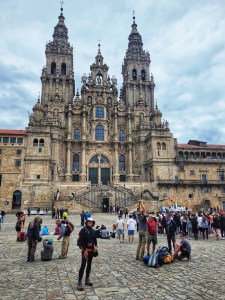
Half way through the course and my hesitation to begin has persisted. I’ve felt afraid to take the first step, not knowing what I’m getting myself into, or where this is going to take me, despite having reached Santiago a year ago. I’ve wondered if Camino doesn’t want, or isn’t yet ready for me to walk on or with him again. Yes, I am animating Camino, doing so out of reverence and regard for its centuries of history, people and their traditions, cultures and stories, and the more than human elements continuously making for its beauty and its challenges. And yes, I admit, maybe it’s simply me who hasn’t been ready, with it simply being a matter of not yet the right time. Then, after a few hours over the past month preparing – compiling my blog posts into a single document and adding my recent Instagram posts; propping up on my writing table my photo journal with its cover photo of me standing in front of the cathedral the day I arrived; stacking beside me my travel journal, course notes, and Portugal Green Walks’ self guided program notes – this week I finally lifted open my laptop and began. While I’d thought I’d use for incentive the June 30th chapbook submission deadline with a literary journal who recently published one of my poems, given the experimental nature of this undertaking, braiding together from several sources, and wanting to embody in my writing now how I walked then – sauntering to enjoy the vistas – I’ve decided wisely let that go.
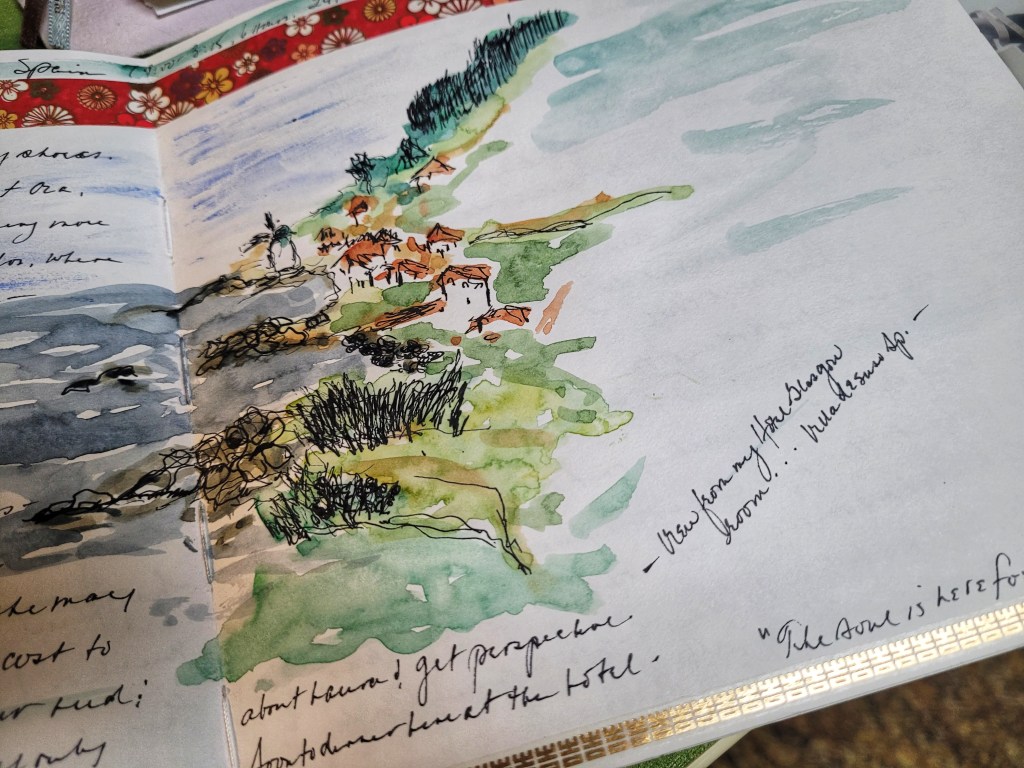
Viana do Casteloview from VilladesusoPontevedra
Albeit reluctantly and with regret, I’m using the gift of time received by finally having conceded a week ago that I must step away from playing pickleball. A game I enjoy for its physicality and camaraderie with women, who like me, love being fully engaged in life. A game my chiropractor has suggested I may need to sit out as for the past three months I’ve been nursing an injured metatarsal. Despite regular appointments, taking a few days off from the game here and there, icing, and copious applications of extra strength Volartin, it’s been one healing step forward and several back. Compounding this is the pressure, with worry enough to wake me, of needing to seriously train for another long walk in September. This one not a saunter. This one strenuous with nearly double the daily kilometers over sixteen days, and steady ascents and descents. All a natural consequence of aging, this has brought its own grief as I face such realities. My foot and body as whole are feeling better, and I’m hoping this, too, will become “the perfect place… the right time… where wish becomes possible.”
***
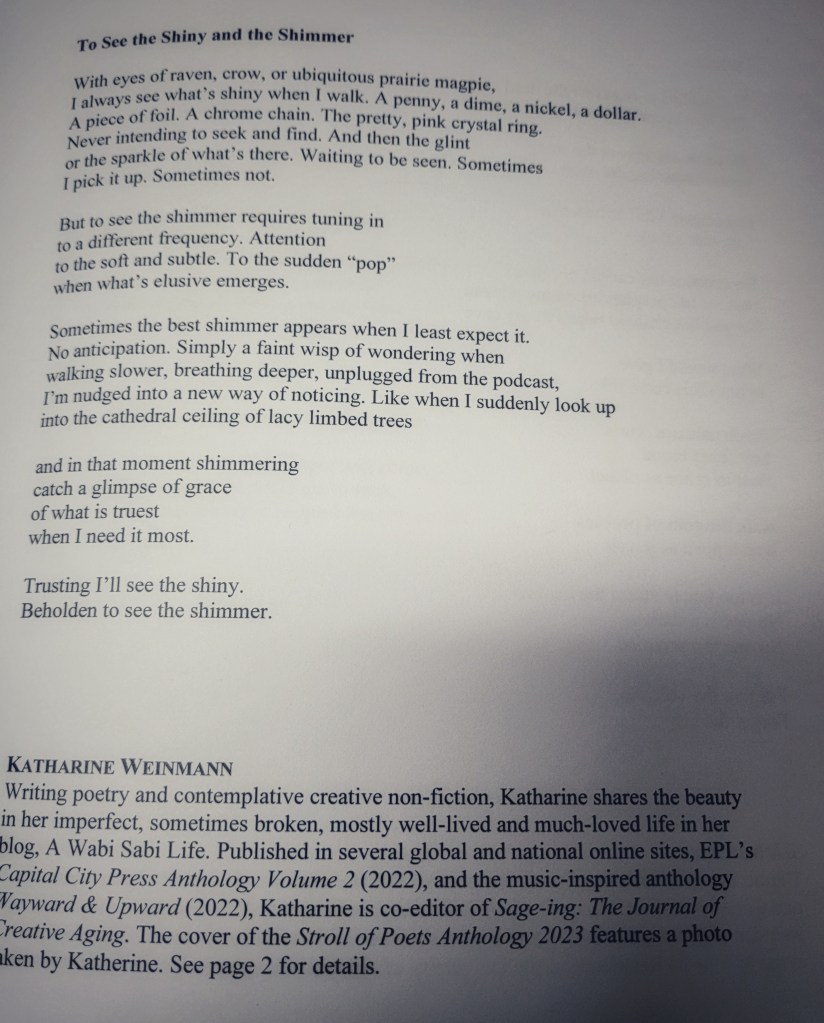
As I’ve written here before, the writerly life is a lonely one, rife with rejection. Just this morning I received two. On the up side, I finally received a print copy of the local poetry anthology featuring both my photo as cover and poem inside, and in the past month, several other photos have been accepted by literary journals making me wonder if I should shift my genre!
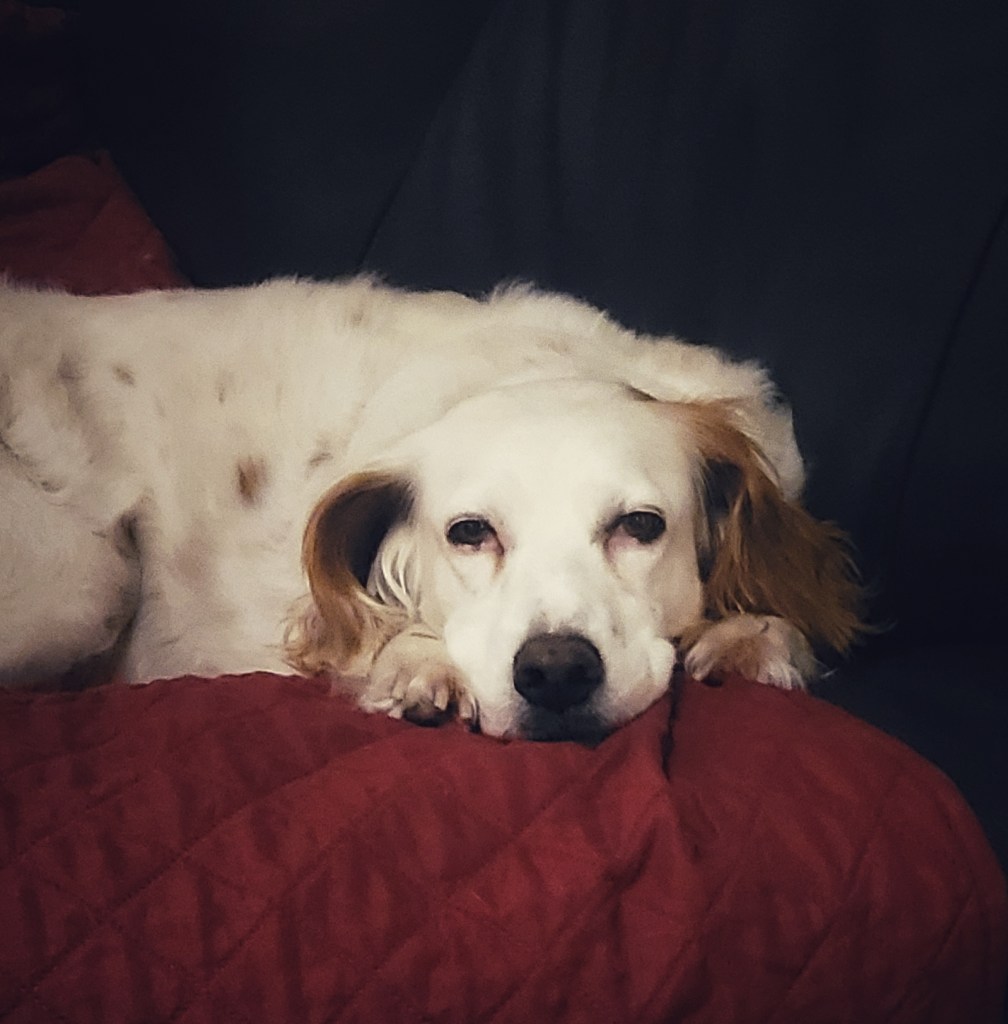
As it’s been several weeks since I posted a Monday morning blog, by way of update, our dear Annie dog has had a remarkable recovery from the stroke she suffered the end of April. So much so, I call her our “Lazarus,” as it truly feels she rose from a near death listlessness during those early days. Today, she has returned to all the ways in which she is uniquely Annie to and with us, including interrupting my work at noon by persistently placing her big right front paw on my lap or keyboard. Now I kiss it and her in ever welcome gratitude.
walking with Annie “Bright Eyes”, June 5, 2023
Much love and kindest regards, dear friends. May this post find you on roads plenty wide and welcoming.
Give up on your agenda – this is exploration, not exercise. She can’t hear you calling her on, but then, you can’t smell whatever is so intriguing about that clump of grass, so maybe just relax. Stop counting steps. Don’t even count birds, or minutes or the things you have left to do on your pressing and eternal list. Move gently into the immeasurable. Stop to greet children. Consider that the most fascinating thing in the world could be your neighbor’s garbage can. Observe without judgement what is near to hand – even if what you see is the halt in her step, the way her spine has begun to show. Walk just long enough to remember that love is not an antidote to death, but loss is not the opposite of life.
– Lynn Ungar, May 2, 2023 –
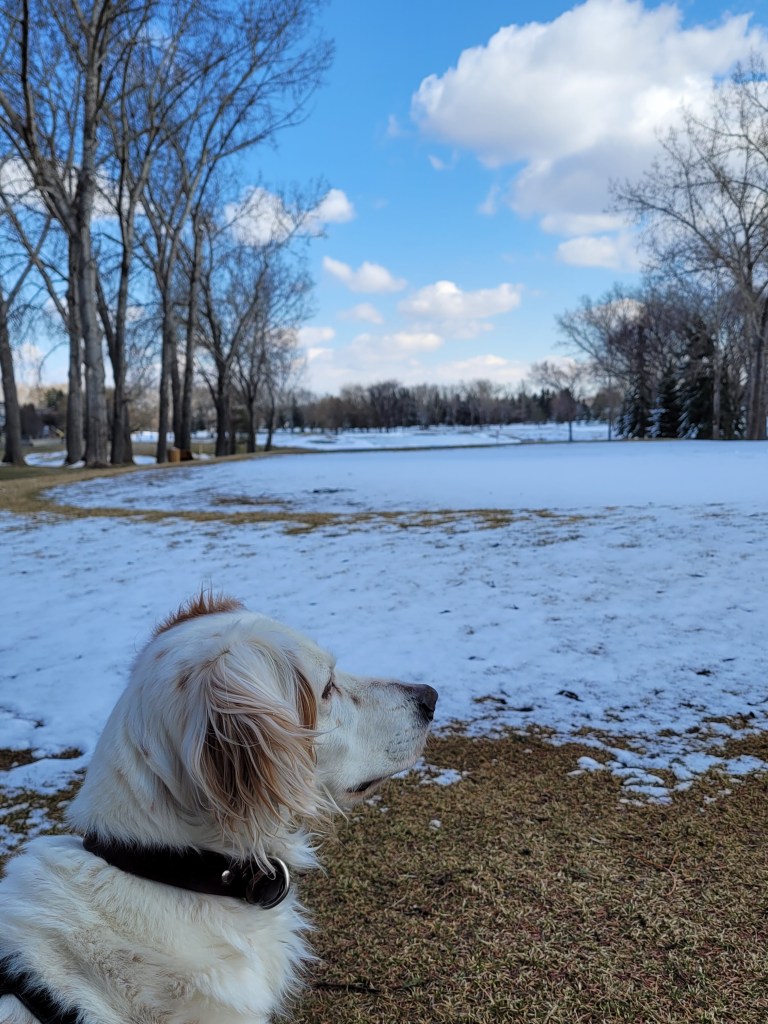
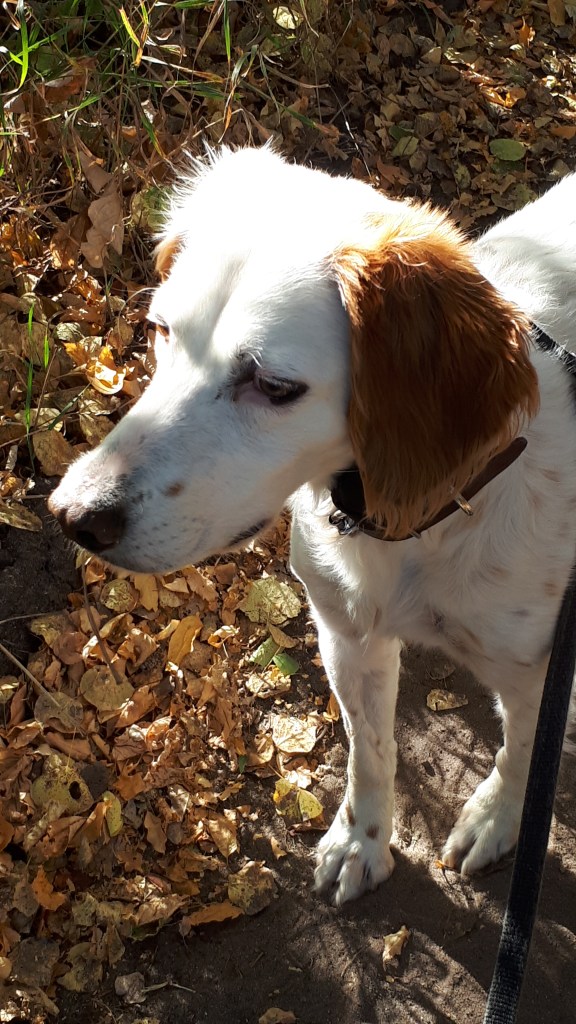
Over the past year at least, I’ve been saying that walking Annie is no longer exercise. It’s fresh air, the gift of being outside noticing life around us. That I may walk 10,000 steps, but certainly not aerobically. And I’ve long known for a dog, walking is “scent shopping,” so I best be prepared for meandering. But in the last two weeks, the gift of this oh-so-perfectly-timed poem, could not be truer. Some of you might know that two weeks ago yesterday – after our morning walk, treats in the kitchen, sleeping…errrr…supervising our work in the office, and then going outside to her kennel when the house cleaners arrived – Annie suddenly was not ok. Disoriented, barely able to walk let alone stand upright, shallow breathing, drooling, incontinent – the ER vet clinic gave us a diagnosis of THC poisoning, an increasingly common incident given our carelessness with roaches and edibles. We were given a prognosis, took her in to see our vet the following morning, who confirmed the diagnosis, but by Sunday her condition was not improving. No appetite nor eating, so we bought electrolytes for her water (on the suggestion from a Facebook friend who saw my posting). Her walk had not improved, in fact we were seeing more weakening. But of most concern was seeing her paw at her right eye, and when I did the reflex test I’d seen the vets do, she didn’t blink, leading us to believe she’d suffered vision loss. A return visit to the vet on Monday morning confirmed my first, and our worst suspicions: she’d most likely had a stroke. “She’ll not live to 17,” the vet said, referring to Annie’s predecessor, Peggy, who died late into her 17th year. And with further examination, and seeing Annie’s lethargy, I wondered if she’d last the week.
After deliberation, we decided to pass on the neuro consult, not wanting to add further distress to Annie with the battery of tests required pre-exam. We know she is happiest with us, and so we’d keep her home, tend to her best we could, hope for the best, and pray for a miracle.
This is my “Lazarus” story, because with every passing day, Annie has returned to herself, engaging in all the patterns and endearing ways she is who she is, with us. Looking eagerly for me to get her leash to walk, barking at the neighbors (fulfilling her job as guard dog), finally eating regularly with creative concoctions of smelly canned fish to pique her interest, remembering to remind us to fetch her favourite dessert of dentistix, and following me down into the office where she takes her place on her supervisor’s cushion. The big right front paw she would persistently, heavily place on my keyboard at noon to signal lunch and a walk…the one I would curse for interrupting my work…that has been slow to return being the side that became weakened. But tonight, she placed it on me as I napped, reminding me of dinner time. It comes. I pray it comes in the office, on my keyboard, and I will kiss and welcome it back.
Annie is a bird dog, smelling her particular stock in trade. We think her loss of vision and diminished sense of smell have been the most disorienting for her, with her hearing less for the past couple of years. Sleeping more than usual with the trauma of it all, and the neurological stress has been exhausting. At yesterday’s chiropractic session, we learned that dogs have the ability to reroute blood to injured areas of the brain. We’re hopeful that as we see her eating and sniffing with more precision and focus outside and during our walks, coming into the kitchen while we cook and eat dinner, her scenting is returning. We pray, too, that her eyesight might improve as pressure comes off the optic nerve, because the eye itself is in good health.
In the last week, I’ve read of several friends having to say goodbye to their beloved fur companions. Each time I feel my heart squeeze. With Annie being our sixth dog, this is a heartbreak I know too well, yet wouldn’t trade for the joy each brings, the love I feel, that grows with each one, in return. Lynn Ungar writes it one way. Mary Oliver in her volume Dog Songs, writes it another: “We would do anything to keep them with us and to keep them young”[1].
At thirteen years, walking slower, needing my help to be lifted onto the bed, and now ensuring she makes it up and down the stairs safely, with this health crisis, I know Annie isn’t young, and that I can’t keep her forever. I am simply so thankful to have her with us now, for as long as now is.
Much love and kindest regards, dear friends. And deep gratitude to you who replied to my posting on Facebook. Your love, thoughts and prayers have helped immeasurably.




















 A Wabi Sabi Life