Rest

Walker… we all fall into bed after a full day

In yesterday’s inbox, I received two emails that struck me as contrasting approaches to coping with the current global state of affairs. In one, subject line: Sanity Repair Kit, its author listed thirteen personal strategies to help her stay above despair. The second, the weekly love note from Christine Valters Paintner, abbess of the online contemplative-creative community Abbey of the Arts, opened with the 6th principle of its Monk Manifesto:

“I commit to rhythms of rest and renewal through the regular practice of Sabbath and resist a culture of busyness that measures my worth by what I do.”

Deep, holy breath in and out…I could feel my body relax into the truth of rest being, as Tricia Hersey, founder of The Nap Ministry, writes: an act of resistance in a culture that wants to exploit and deplete our labor so others can profit. Could this be more on point at this time when we’re told that empathy is the fundamental weakness of Western civilization?

While the first email’s list included practices I know I could be doing, should be doing, and am doing – more or less – mostly, I felt overwhelmed and out of breath …except for the invitation to stare off into the sky for several seconds or minutes. Something I do quite regularly, sitting in my living room, often with Walker sleeping there in the sunshine. I understand “different strokes for different folks,” yet I want to uplift here an appreciation for and the wisdom in doing no-thing.

Suddenly, I am remembering with a smile the story I used to read during staff inservices, written by Robert Fulghum of the All I Really Need to Know I Learned in Kindergarten fame. I no longer have that well-marked, tabbed, and dog-eared copy, but it was his experience of taking a pair of favorite leather shoes to the shoemaker for resoling that captures the essence of doing no-thing. He writes:

“The shoe repair guy returned with my shoes in a stapled brown bag. For carrying, I thought. When I opened the bag at home that evening, I found two gifts and a note. In each shoe, a chocolate-chip cookie wrapped in waxed paper. And these words in the note: ‘Anything not worth doing is worth not doing well. Think about it. Elias Schwartz.’”

“Sabbath is not a doing, but a way of being in the world… In those spaces of rest comes renewal, with dreams for new possibilities. As a culture we face so many issues that feel impossible to tackle in meaningful ways. One way to begin is to allow enough space for visions to enter, to step back and see what happens when we slow down our pace first. . . .” 

Christine Valters Paintner

Part of my Sabbath often includes cooking a good, ample meal giving us leftovers to get through the beginning of the week. With classical music or relaxing jazz streaming in the background and an occasional glass of wine, I’m in my element. Too, writing my Monday blog, warmly ensconced in my studio, surrounded by my various creative endeavors, inspiring images, vision boards and books, I sink into the wellspring of potential beneath the heartlessly cruel rhetoric filling so much airspace today.

Years ago, before The Abbey of the Arts, or The Nap Ministry, my friend Christina Baldwin penned the exquisite Seven Whispers (2002). “Move at the pace of guidance,” is the second whisper, combining two instructions: to re-humanize our speed of life, and to use a slower pace to actively listen for spiritual guidance.

“The pace of guidance, like peace of mind, begins internally – in me. Even though all my conditioning teaches me to accommodate speed, I am responsible for the pace I bring to the moment, just as I am responsible for the peace I bring to the moment.”

Christina Baldwin

What chocolate chip cookies might we find as we allow and settle into a slower pace and use this overwhelming and despairing time to do no-thing? What visions of possibility and inner wisdom might we access by resting and resetting our overwrought nervous systems? What might be the outcome of such a bold, strategic act of resistance?

“We must hang onto our humanity, it is why we’re in the world.”

Christina Baldwin

Much love, kindest regards, and moments of deep and abiding rest, dear friends.

Each moment of rest, of doing no-thing, of being our own Sabbath matters.
Each word, each photograph, each email matters.
Each kind word, each warm embrace matters.

It’s what we have which I have to believe can turn the tide,
perhaps first within the unseen, liminal spaces.

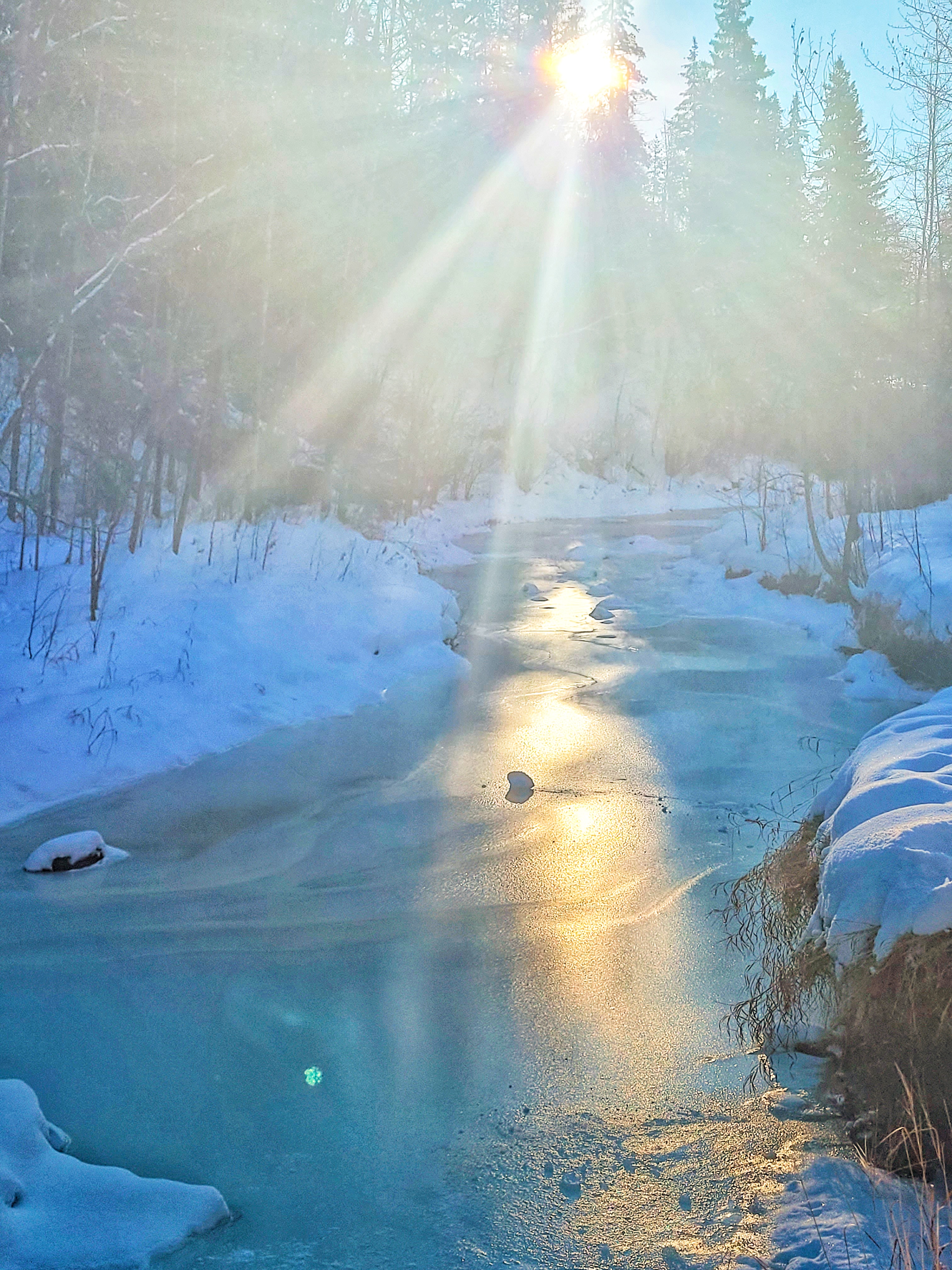
Still Wrapped

“But I don’t look like a sun,”
a young star still wrapped in swaddling
veils said.


To which I replied,
“But you will, my dear. You will, mashuq.
So don’t worry. Don’t fret.”

Daniel Ladinsky, A Year with Hafiz (2011), December 22

My day began before dawn, quiet and dark, lighting the final candle of the Advent wreath. Curious, Walker stood close, watched the flare of the match, the flickering of the four candles, and then left to keep silent vigil sleeping in his bed. I thought of family and friends, the passing of time, the moments of melancholy with the missing…thresholds crossed and yet to be.

It’s now Sunday evening, quiet and dark. I have just listened to poet Elizabeth Alexander read the final chapters from her memoir, The Light of the World. Recommended in Allison Wearing’s online memoir writing course, it’s the lyrical account of the sudden death of her beloved husband…beautiful, poignant, poetic.

A deep breath, a pause to reflect, and to register the sanctity of her story and the liminality of these holy days.

Then, I turned to the book beside me: The Dreaming Way, Toko-pa Turner’s brilliant invitation to the practice of dreamwork. The chapter, “Wisdom of Sophia.” Its essence, as the embodiment of paradox and the continuous chaotic cycle of creation and destruction, leads us to a refinement of our life force aligned with nature.

“Not only is there more to your story beyond this anguish, but one day you story will be the starlight for another to follow out of their own darkness.”

Toko-pa Turner, The Dreaming Way (2024)

Another deep breath and pause to let Toko-pa’s words land. And just before I turned off the floor lamp, I fetched from my box of sacred books and journals, Hafiz by way of Ladinksy to read today’s contemplation.

There’s a thread running through this day…revealed in the elements described here. And a blessing for you, dear friends, that you may trust in your own, perhaps still wrapped, starlight.

Much love and kindest regards.

Rest, My Friend

wintering in dawn’s stillness

Arriving at my desk to write this blog, I opened an email to learn of the sudden passing of my first professional friend. With his wife and young son, they became our first “couple-family” friends when Sig and I made our first home together in small town Ontario. They hosted us for our final nights in Ontario nearly forty-four years ago before we packed up our first dog, Beckey, a few plants (a hosta that still blooms in our dining room window), and some luggage to make the trek across Canada in our little white VW Scirocco sportscar to our new home in Alberta. The vague sadness that has hovered around me for much of this grey, cold and damp day has now found a foothold.

Earlier today, I attended the 4th annual Poets Corner “Reading Rilke,” with Rilke translator-poet Mark S. Burrows in conversation with Padraig O’Tuama and Krista Tippett. Among my notes, the following bore my highlighted underlining:

“I believe in everything that has never been said.”
– Rilke

“We are here to listen the world into being
and then to share its stories.”
– Mark S. Burrows

Consistent among each of them was that much of Rilke’s writing was an embodiment of his famous directive to live into the questions.

Despite my cup feeling full, I don’t have much to write this evening. Questions tinged with sadness. So much that has never been said. Listening into silences. Trusting the infinite possibilities to be found in the unknown.

Remembering how my friend tempered my youthful naievety with his experience and wisdom. For years, throughout every career move, I pinned his handwritten note in front of me to remember: “The world is perfect, including my efforts to change it.” A bit like Rilke.

Rest, my friend.

Much love and kindest regards, dear friends.

Geese Sense

…”the greatest gift you could give a child — or the eternal child in you — is ‘a sense of wonder so indestructible that it would last throughout life, as an unfailing antidote against the boredom and disenchantments… the sterile preoccupation with things that are artificial, the alienation from the sources of our strength.'”

– Maria Popova citing Rachel Carson, The Marginalian

Musing on what I’d write for today’s post, my direction shifted after reading Sunday’s issue of The Marginalian. The above quote and story that followed stirred a memory of responses I’d had during recent walks, during these past weeks fraught with global disenchantments. The unmistakeable sound of Canada geese – flying overhead, landing in the nearby pond, or in formation ready to make their annual southern migration, honking to announce their presence. Whatever I had been thinking up until that point quickly gave way to awe as I gazed up in admiration and remembered the once popular story I’d often read to groups I’d facilitated.

The Sense of a Goose described the group and leadership dynamics of a flock of geese flying south, and how their innate wisdom could be applied to us building teams and making communities. Reading aloud that story, how many times I’d almost be moved to tears. Even recalling it during my recent walks, watching those geese overhead, I had the same visceral, poignant response.

Delving into its edges and source, I realized I had been feeling the longing – that often barely acknowledged human condition – for the deeply rooted sense of wonder as an indefatiguable source of strength; for the feeling of inner safety and outer belonging; for trusting in the reliable support of others. In that story, among the people with whom I worked, and watching overhead now, I felt what the geese and their flying physics illustrated:

…”the physics of any healthy community, any healthy relationship — the physics of vulnerability and trust. Because life always exerts different pressures on each person at different times, internal or external, thriving together is not a matter of always pulling equal weight but of accommodating the ebb and flow of one another’s vulnerability, each trusting the other to shield them in times of depletion, then doing the shielding when replenished. One measure of love may be the willingness to be the lead bird shielding someone dear in their time of struggle, lifting up their wings with your stubborn presence.”

– Maria Popova citing Rachel Carson, The Marginalian

As the story goes, may we all learn from and practice the sense of geese. Goodness knows, we and our precious world are in its need.

Much love and kindest regards, dear friends.

How is Your Haal (Heart)?

“In many Muslim cultures, when you want to ask them how they’re doing, you ask: in Arabic, Kayf haal-ik? or, in Persian, Haal-e shomaa chetoreh? How is your haal?

What is this haal that you inquire about? It is the transient state of one’s heart. In reality, we ask, ‘How is your heart doing at this very moment, at this breath?’ When I ask, ‘How are you?’ that is really what I want to know.

I am not asking how many items are on your to-do list, nor asking how many items are in your inbox. I want to know how your heart is doing, at this very moment. Tell me. Tell me your heart is joyous, tell me your heart is aching, tell me your heart is sad, tell me your heart craves a human touch. Examine your own heart, explore your soul, and then tell me something about your heart and your soul.

Tell me you remember you are still a human being, not just a human doing. Tell me you’re more than just a machine, checking off items from your to-do list. Have that conversation, that glance, that touch. Be a healing conversation, one filled with grace and presence.

Put your hand on my arm, look me in the eye, and connect with me for one second. Tell me something about your heart and awaken my heart. Help me remember that I, too, am a full and complete human being, a human being who also craves a human touch.”

— Omid Safi, from The Disease of Being Busy

heartful distractions on my writing desk

My friend Sally, who I met last year walking the Via di Francesco, shared this post from our mutual friend, Omid Safi. I first “met” Omid when he was one of a cadre of regular bloggers/columnists posting in an early iteration of On Being. It was in the aftermath of 9-11 when tensions, animosities, and cultural misunderstandings were high, particularly in the US. What always touched me was how Omid, who is a professor of Asian and Middle Eastern Studies at Duke University, always wrote with an open-hearted clarity, generously giving space for multiple perspectives and opinions, all the while sharing his culture by way of story. In my experience of Omid, his writing and online presence are an embodiment of his love and reverence for his teacher, Rumi, founder of the Sufi order of whirling dervishes.

On a day when I read that over 40,000 lives have been lost to the conflict in Gaza, with thousands more unaccounted for, Omid’s message of heartful connection and healing conversation lands deep within my heart and soul.

Ours has been a virtual friendship. One day I hope to meet Omid in person, perhaps on one of his Illuminated Tours to Turkey or Morocco. One day I hope to put my hand on his arm, look him in the eye, tell him something about the state of my heart, and listen to him tell me about his. And together remember we are each and all human beings, craving human touch, connection, and peace.

Much love and kindest regards, dear friends.

Beauty Comes From Loss

Some say you’re lucky
If nothing shatters it.

But then you wouldn’t
Understand poems or songs.
You’d never know
Beauty comes from loss.

It’s deep inside every person:
A tear tinier
Than a pearl or thorn.

It’s one of the places
Where the beloved is born.

~ Gregory Orr, Concerning The Book That Is the Body Of The Beloved

One from my “saved poem” file from a poet who writes from knowing deep loss and nearly unbearable grief.

A poem that touches on the essence of my writing and my wabi sabi life. That beauty is found in life’s imperfections and comes from its losses. That with time, in a life sometimes broken, but mostly well-lived and much loved, such beauty becomes polished, like the grain of sand that becomes the pearl, rubbed inside the oyster’s shell. It’s like that for all of us – deep inside every person – if we choose to look at life this way

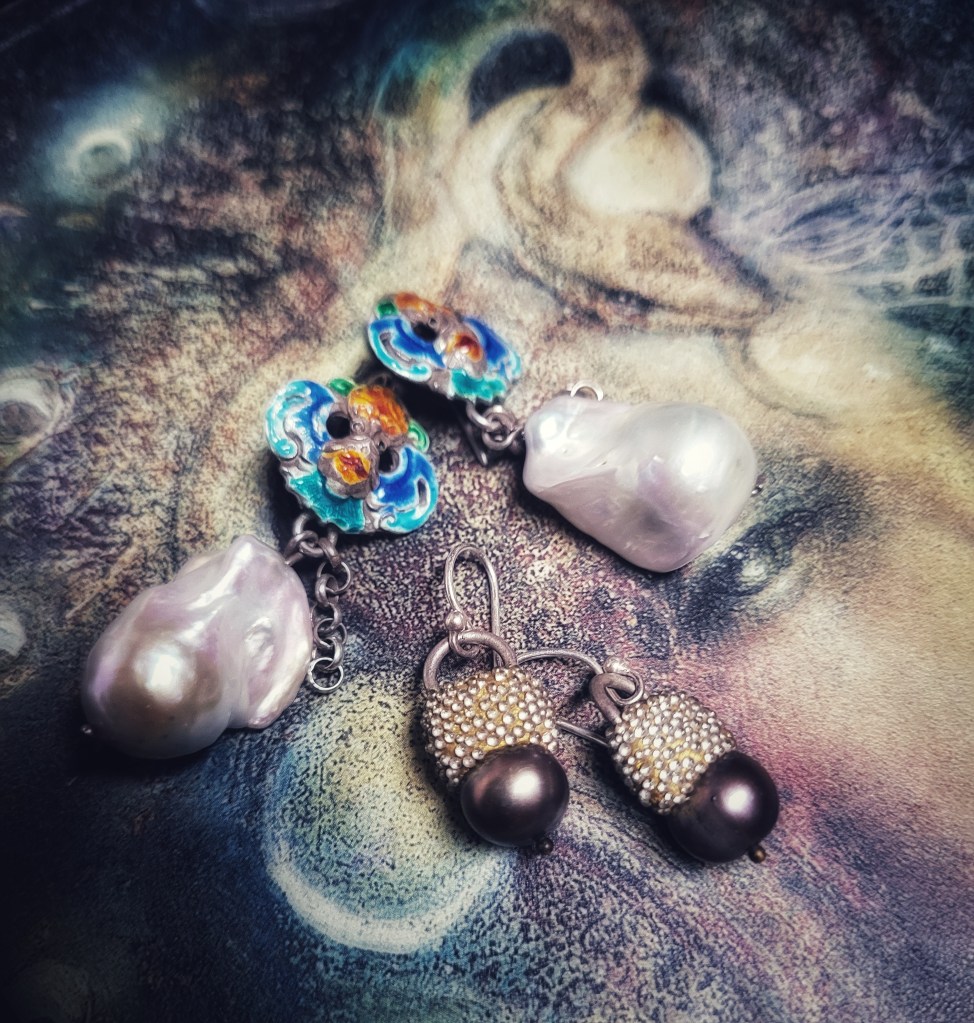
For the past many years my earrings of choice have been silver-grey freshwater pearls, embellished with tiny sterling silver beads, a signature design from Canadian jeweler, Effie Baker. They’re an interesting juxtaposition to the simple diamond studs that I always wear, my birthstone, and a Christmas gift many years ago from my husband. Last summer, after a long wait and good fortune, I gifted myself with a pair of baroque pearl earrings hung from antique Chinese silver and enamel made by another Canadian designer Soma Mo, first seen during covid and for many months sold out. In recent months, I’ve taken to wearing hers every day.

There’s something about pearls that speak to me of the feminine…originating from the watery realm of feelings and intuition…their voluptuous shape and subtle luster…how they become warm with wearing. These pearls remind me of the love in which these two women artists create…a love then gifted to me when I was attracted and responded by allowing myself to purchase them.

The beauty found in, and from loss, that when rubbed up against, as in life, becomes transformed. The beloved born in that.

What a poem and pearl earrings can evoke.
Much love and kindest regards, dear friends.

Our Joined Sorrows

LANGUAGE OF LIGHT
Next to the garden beds I wait
while summer’s profusion wanes

the sycamores stand in unity rows
guarding a path for the recently dead

arboreal complexion of limbs and trunk
sentient camouflage in pale olive and tan

trees older than first-born stars
leaves shimmering in the language of light.

Diana Hayes, Language of Light, 2023

I’ve started my preparation for another autumn long walk in Italy. This time, a small women’s group walking a small portion of the ancient Via Francigena from San Miniato, Tuscany to Rome. No doubt obvious to you who follow me here and on social media, I am smitten with Italy, and am borrowing a page from a once friend who said there was something about returning repeatedly to the same place, to venture deeper in.

I feel good going into this summer’s training. Last year’s foot injury has healed. So, too, my heart – mostly – from Annie’s year-ago passing. Following the same program developed by my friend, I’m starting a month earlier and so feel an ease and confidence I didn’t last summer. Every other day, alternating with pickleball, and a rest day, my chiropractor approves.

Today it rained. I opted for a slow start hoping for the forecasted three-hour break in the showers. Eventually I decided to dress for the weather and set out with my new floral knee-length rain poncho. I “ruck,” meaning when I walk, I carry at least ten pounds of weight in my pack, use my poles and wear my hiking boots, and made of today an experiment in waterproofing and breathability. Better to test here than thousands of miles and another continent away.

Last year, my friend accompanied me on many walks. This year, plagued by her own chronic foot injury, I’ll be walking alone most days. And I’m quite OK with that, given my proven way, even in groups, of often walking solo, in silence, with my camera ever ready. And so it was, Tuesday and today (Thursday), I resumed my lapsed practice of listening to podcasts. Several On Being with Krista Tippett episodes, the last one featuring a conversation with poet, essayist, teacher, and community gardener Ross Gay on The Insistence of Joy. His closing words struck deep:

Is sorrow the true wild?
And if it is — and if we join them — your wild to mine —
what’s that?
For joining, too, is a kind of annihilation.
What if we joined our sorrows, I’m saying.
I’m saying: What if that is joy?

Step by step, mulling his concluding words, that powerful question, as light showers grew heavier, I switched over to another of my favourite podcasts, Ellipsis Thinking, created and hosted by my dear friend, Greg Dowler-Coltman. In this episode a conversation with Saltspring Island poet Diana Hayes, the author of today’s chosen poem. Greg had gifted me with Diana’s chapbook, Language of Light, an exquisite collection borne of her near inconsolable grief for her mother’s too-soon death from breast cancer, the same cancer she suffered at the same time. As I listened, struck again by Greg’s talent for deep listening and thoughtful questions emerging from his innate and kind curiosity, I felt a kindredness with Diana’s way of being in the world and as a poet.

Bittersweet is what comes to mind. Knowing oneself and another when we are vulnerable in disclosing and joining our sorrows. The poignant, piercing joy that can result when we do.

Much love and kindest regards, dear friends.

Aftermath Inventory

famed Polish sculptor Igor Mitoraj’s winged Ikaria on exhibition at il Castello Maniace, Siracusa, Sicilia
May 2024


Aftermath Inventory

Shattered? Of course,
That matters.
But
What comes next
Is all
I can hope to master.

Knowing, deep in my
Bones,
Not all hurt harms.

My wounds?
If
Somehow, I
Grow through them,
Aren’t they also a boon?

My scars?
Someday,
They might shine
Brighter than stars.

Gregory Orr, The Last Love Poem I Will Ever Write, W.W. Norton & Co., 2019

One from the draft folder. For a morning when the night before, after my monthly Zoom with a friend, I opted for time with Walker rather than sitting at my desk, searching for a poem that might fit the week.

Maybe not exactly relevant, but eventually it comes around to this. The shattering. The reflection on hurts – given and received. Remembering that not all hurt harms. That it could be an invitation to lean in. Get real. Remember who and what matters most in the moment. At the time. Take the step, say the word to let them know.

My wounds. Your wounds. Our wounds. That when we grow through them, use them as compost for this day and the next, we might discover we’ve grown a well-lived and much-loved life.

My scars. Your scars. Our scars. Inevitable, too. Mark us among the living. The loving. Hearts broken by griefs shared, untold. Filled with gold, may they shine brighter than stars.

May we.

Much love and kindest regards, dear friends.

Rembrandt’s Late Self Portraits

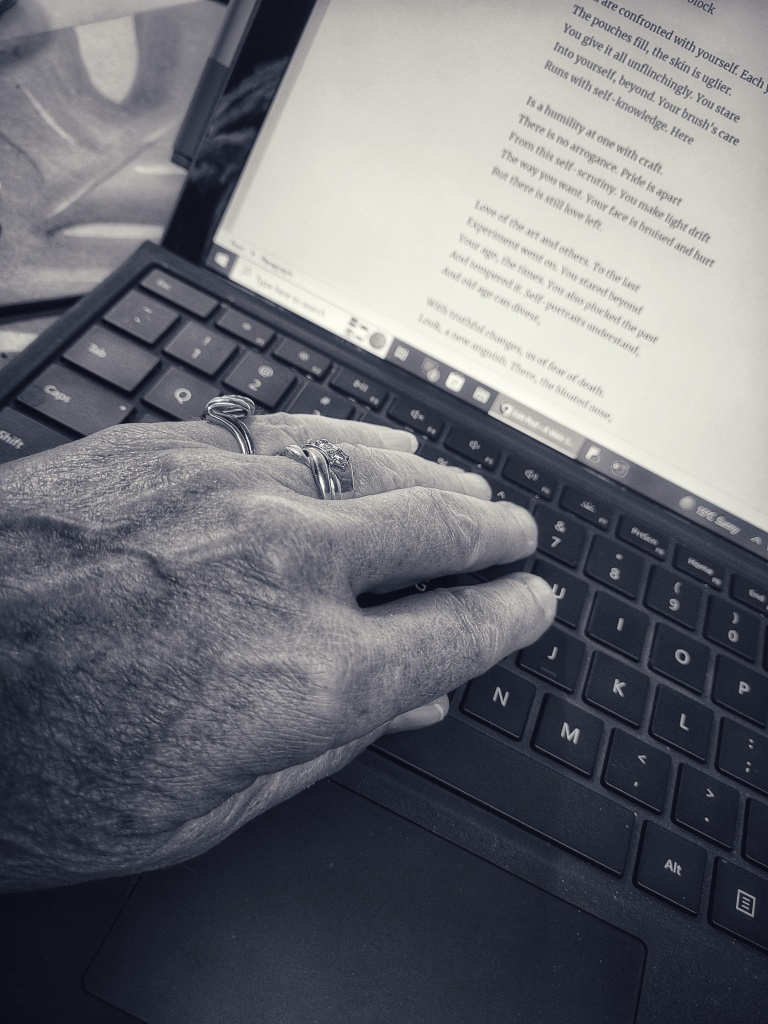
this aging hand of mine…

Rembrandt’s Late Self Portraits

You are confronted with yourself. Each year
The pouches fill, the skin is uglier.
You give it all unflinchingly. You stare
Into yourself, beyond. Your brush’s care
Runs with self-knowledge. Here

Is a humility at one with craft.
There is no arrogance. Pride is apart
From this self-scrutiny. You make light drift
The way you want. Your face is bruised and hurt
But there is still love left.

Love of the art and others. To the last
Experiment went on. You stared beyond
Your age, the times. You also plucked the past
And tempered it. Self-portraits understand,
And old age can divest,

With truthful changes, us of fear of death.
Look, a new anguish. There, the bloated nose,
The sadness and the joy. To paints, to breathe,
And all the darknesses are dared. You chose
What each must reckon with.

– Elizabeth Jennings, ‘Collected Poems’ Carcanet, 1987

First post in a month, and this poem fits the bill. To be confronted with one’s aging self – the fatigue that lingers from almost two weeks of jetlag; stiff and aching knees upon waking, and after playing pickleball; vision that increasingly, more often than not, needs the assistance of my glasses; hearing that fades in noisy spaces; crepey skin and protruding veins on my suntanned hands – I could go on, but suffice to say, with truthful changes and a new anguish, there is still love left.

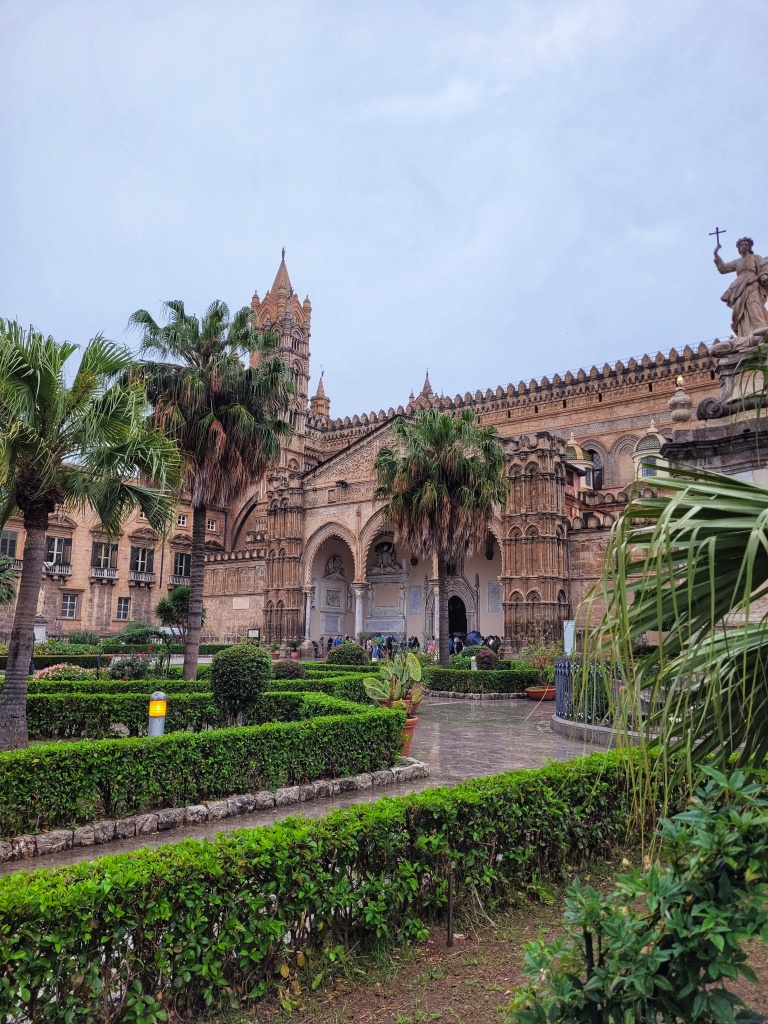
Italy was terrific. She never disappoints, even though it was quite cool for a few days in Taormina, Sicily. The Fairweather Goddess made her presence known, only giving us showers when indoors at a cooking class, touring Palermo, driving in a small touring to a vineyard luncheon on Mount Vesuvius, and full out sunshine when it mattered most – during our drive along the Amalfi Coast on, what locals call, the “Via Mama Mia.” Having arranged this trip, I was pleased that all our plans came together, with the only travel delay back in Canada, where we sat for over an hour on the tarmac during our final leg home from Calgary. I had no idea, as I was sound asleep.

Home less than a week, Sig drove to Kamloops to fetch Walker, our sixth English Setter. Not a year old, he’s playful, eager to please, a quick learner and from one side, looks so much like Annie that I occasionally lapse and call him by her name. It will be quite some time before he becomes the walking companion I had in her, but we’re both amazed at how much he’s settled in six days. Too, we’ve concluded, given our fatigue with the full-out attention required (managed in part by putting a bell on his collar, silence signaling we might need to check out what he’s up to), this will be our last dog, a reckoning as we stare beyond our age, the times.

Walker… we all fall into bed after a full day

At the beginning of this year, I wrote here about “an eldering landscape,” that inevitable next threshold that defines this age and stage of life. Balancing the sadness and the joy, in this stage, in this poem, I think back to one of our seven touring companions in Sicily. Patricia, an eighty-five-year-old American who, with her sixty something daughter, climbed every stair, walked every cobblestone path, sipped every taste of Sicilian wine, cooked with us savoring every morsel. Late self-portrait, hardly! I’ll take a page from her album any day.

I’m happy to be home, and back here on the page with you, dear friends.
Much love and kindest regards.

A Curious Resonance

on the altar of life’s elements

I
Perhaps everything that frightens us is, in its deepest
essence, something helpless that wants our love.

So you must not be frightened if a sadness rises in
front of you, larger than any you have ever seen;
if an anxiety, like light and cloud-shadows,
moves over your hands and over everything you do.

You must think that something is happening with you,
that life has not forgotten you,
that it holds you in its hand; it will not let you fall.
Rainer Maria Rilke

II
the places in our heart
where the world took bites
out of us

may never fully heal
and will likely become
wide open spaces

~ be careful to not fill them
with just anything or anyone

your wounds aren’t supposed
to become attics for you to hoard
unnecessary junk

these holes in our hearts
are holy sites

and we should treat
them as such

so when visiting your old wounds
make sure to take your shoes off
and turn off your cellphone

sit by candlelight
and watch how the shadows
tell the story how brave you are

~ to survive
John Roedel

III
“When a lot of things start going wrong, all at once, it is to protect something big and lovely that is trying to get itself born – and that this something needs for your to be distracted so that it can be born as perfectly as possible.”
Anne Lamott

IV
“Even a wounded world is feeding us. Even a wounded world holds us, giving us moments of wonder and joy. I choose joy over despair. Not because I have my head in the sand, but because joy is what the Earth gives me daily and I must return the gift. “
Robin Wall Kimmerer

I collect poems and quotes for my weekly Friday photo and poem feature. As I scrolled for today’s post, these four came together for me with a curious resonance, echoing from writ small to large, scaling from an individual’s questioning and suffering to Earth’s magnificent mystery.

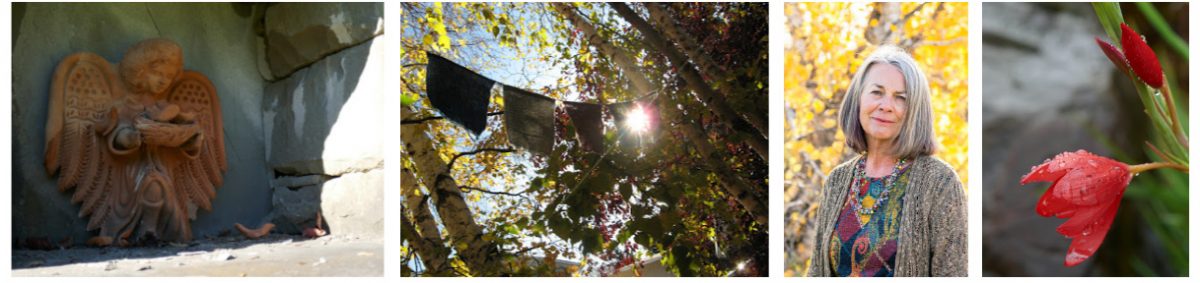
I offer these selections as a reminder that there are forces seen and unseeen, angels, ancients and ancestors working on our behalf in ways we have little, if any way, of registering. I offer these up to salute the turning of the season, life’s cycles being just one of those vast and wondrous mysteries.

Much love and kindest regards, dear friends, and blessings for the arrival of the Equinox, spring and autumn.