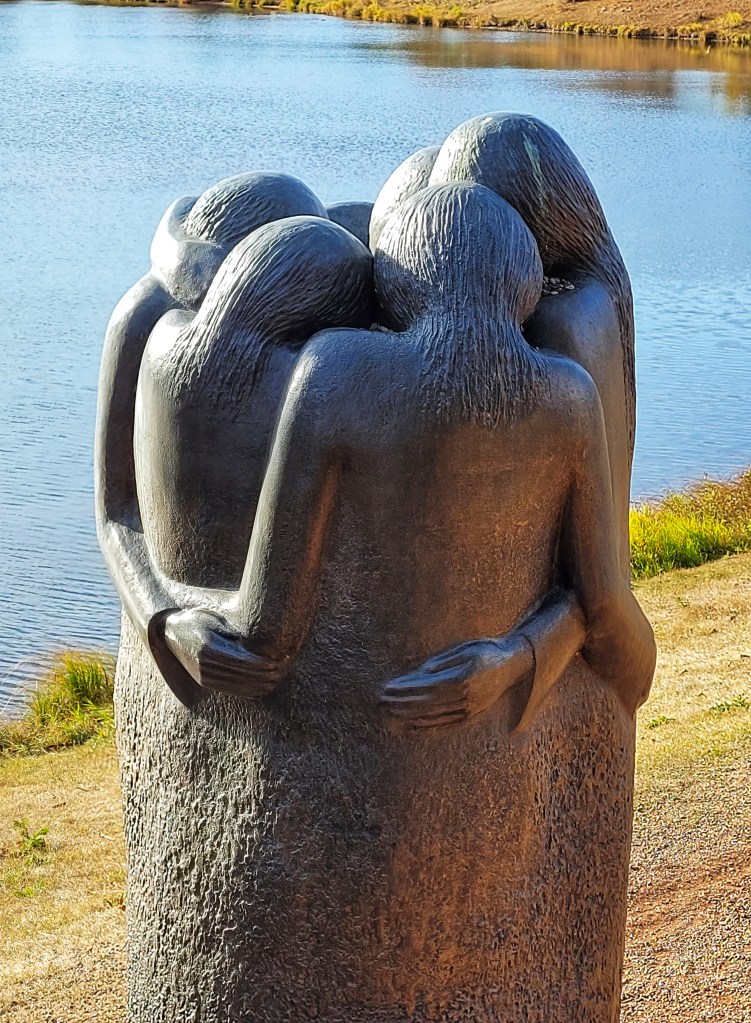
Unison Benediction

UNISON BENEDICTION

Return to the most human,
nothing less will nourish the torn spirit,
the bewildered heart,
the angry mind:
and from the ultimate duress,
pierced with the breath of anguish,
speak of love.

Return, return to the deep sources,
nothing less will teach the stiff hands a new way to serve,
to carve into our lives the forms of tenderness
and still that ancient necessary pain preserve.

Return to the most human,
nothing less will teach the angry spirit,
the bewildered heart;
the torn mind,
to accept the whole of its duress,
and pierced with anguish…
at last, act for love.

May Sarton, Collected Poems 1930-1993


I think recent events south of the border prompted the posting of this poem on social media this week. It’s a time fraught…again…continuously… with uncertainty and anxiety. The polarizing fight for power, opinions weighing heavier than truth…torn spirits, angry minds. Tonight, in this house, tempers flared at dinner as days of heat warnings and insomnia-induced fatigue made patience a precious thing.

Driving to the start of this morning’s training walk, I heard a brief interview with one of the members of DahkaBrakha, a Ukrainian band who combines “traditional folk and punk, drawing inspiration from their Ukrainian homeland with a global sensibility. Melodies from the ancient past collide with future sounds…their style ‘ethno-chaos.'” Marko said the point of their music is to declare to the world that, despite what their invading neighbor says, Ukrainian culture and language exist…and to remind people everywhere in the democratic world, that their problem is not only their problem, but also a big problem for all democratic countries. The truth of his words stung. And as I set out, I was struck with how news cycles now make almost obsolete, or at least only mid-section coverage of Ukraine’s plight, and how much duress, at every scale, many of us hold.

“Return to the most human,” Sarton’s benevolent instruction.

“The dark thought, the shame, the malice/meet them at the door laughing, /
and invite them in,” admonishes Rumi.

“Act for love,” always a way through.

Much love and kindest regards, dear friends.

Morning

“Morning!” we call out in passing –
the dog walkers, the bicyclists,
the ambitious lady with her water bottles
and her sports bra, all out
unfortunately early to avoid the heat.
“Morning!” Not even
“Good morning,” which
could be an overstatement,
given the hour and the fact
that the world is on fire. It’s what
we have to offer. We have the gift
of a couple fresh hours,
the fact that we are out
moving through it,
a whiff of possibility, the reality
that our lives keep on
touching one another’s in the
tiniest of ways. Morning
is as good as word for it as any.

Lynn Ungar, July 8, 2024

…Morgen…Dia…Giornata…
On a German markplatz filling with farmers’ stalls for market day…mumbled by an elderly man in the small coastal fishing village on the Portuguese Camino…nodding to locals and those few fellow tourists at dawn on Florentine cobblestone streets.

This week a heat dome descended on my province. Sig was up early training Walker to become his name through neighborhood streets, quiet yet surprisingly busy with others intent to spare their dogs from the rising heat. I’d set out early one morning to climb stairs and hills in preparation for September’s long walk (sports bra left at home, water bladder instead of bottles in my pack). Cyclists early for the workouts or commutes. Our lives touching each other with a nod, a smile, a mumbled “morning,” and then each of us on our respective ways into days that held possibility and for some, or many, grief.

A world on fire. With suffering and love.

Beauty in passing.

Morning, friends. Much love and kindest regards.

If You Are

from Facebook, December 22, 2023

If You Are
If you are angry, let your anger be fire
So it can warm someone chilly.
If you are grieving, let your grief be a river
So someone thirsty can drink.
If you are numb, let your numbness give you capacity
To walk in hard places and not feel hurt.
If you are broken, let your brokenness
Be what makes space for a new thing to enter.
If you are fearful, let your fear be a warning signal
That others may look up.
If you are lost, let your being lost
Make a new place and call it home.
However you are,
Keep going.
However you are,
Keep going.

– Laura Martin –

I’m partial to poems that invite us to hold it all…the bitter and the sweet. To see the light in our dark places. To have faith that there is a pony hidden in all the muck, and gold to be mined from the dross of our mistakes.

Like my perennial favourite, Rumi’s “The Guest House,” to welcome all that we’d prefer to turn away from and “be grateful for whoever comes/because each has been sent/as a guide from beyond.”

The power of alchemy where we take ourselves to the fires of our grief and numbness, our brokeness and fears, our uncertainties and feeling lost. To be burned away and hollowed out.

To talk about the condition of our hearts, instead of the weather.

To keep going.

Of all of this I need to be reminded. Again, and again.

Much love and kindest regards, dear friends.
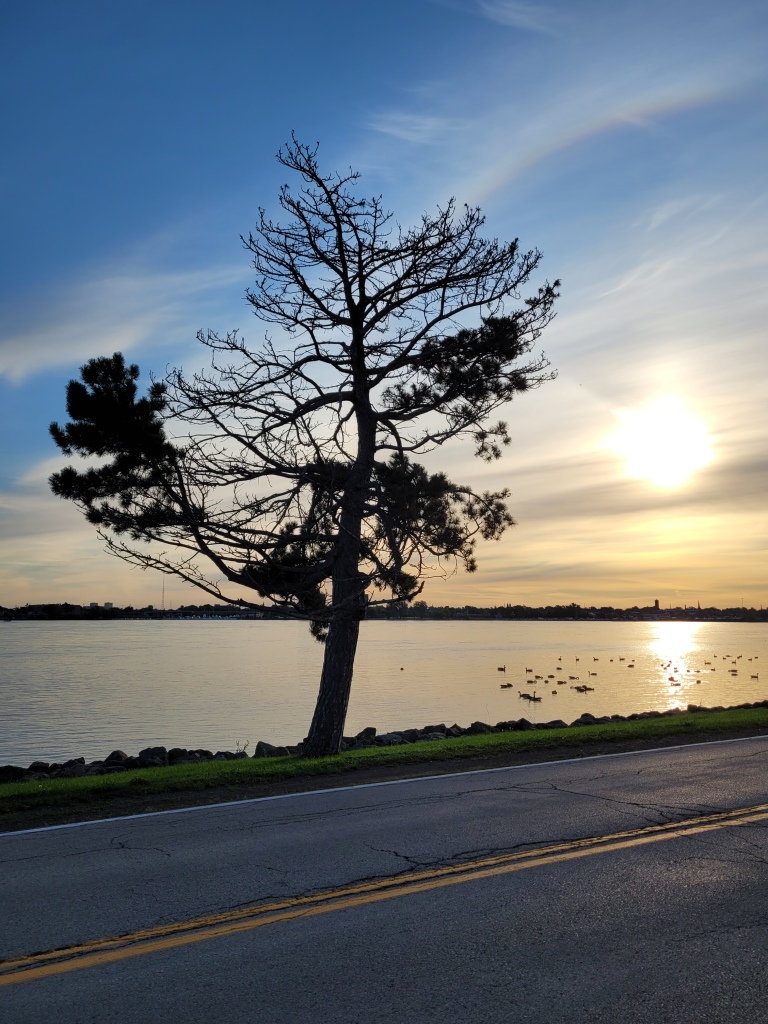
Our Joined Sorrows

LANGUAGE OF LIGHT
Next to the garden beds I wait
while summer’s profusion wanes

the sycamores stand in unity rows
guarding a path for the recently dead

arboreal complexion of limbs and trunk
sentient camouflage in pale olive and tan

trees older than first-born stars
leaves shimmering in the language of light.

Diana Hayes, Language of Light, 2023

I’ve started my preparation for another autumn long walk in Italy. This time, a small women’s group walking a small portion of the ancient Via Francigena from San Miniato, Tuscany to Rome. No doubt obvious to you who follow me here and on social media, I am smitten with Italy, and am borrowing a page from a once friend who said there was something about returning repeatedly to the same place, to venture deeper in.

I feel good going into this summer’s training. Last year’s foot injury has healed. So, too, my heart – mostly – from Annie’s year-ago passing. Following the same program developed by my friend, I’m starting a month earlier and so feel an ease and confidence I didn’t last summer. Every other day, alternating with pickleball, and a rest day, my chiropractor approves.

Today it rained. I opted for a slow start hoping for the forecasted three-hour break in the showers. Eventually I decided to dress for the weather and set out with my new floral knee-length rain poncho. I “ruck,” meaning when I walk, I carry at least ten pounds of weight in my pack, use my poles and wear my hiking boots, and made of today an experiment in waterproofing and breathability. Better to test here than thousands of miles and another continent away.

Last year, my friend accompanied me on many walks. This year, plagued by her own chronic foot injury, I’ll be walking alone most days. And I’m quite OK with that, given my proven way, even in groups, of often walking solo, in silence, with my camera ever ready. And so it was, Tuesday and today (Thursday), I resumed my lapsed practice of listening to podcasts. Several On Being with Krista Tippett episodes, the last one featuring a conversation with poet, essayist, teacher, and community gardener Ross Gay on The Insistence of Joy. His closing words struck deep:

Is sorrow the true wild?
And if it is — and if we join them — your wild to mine —
what’s that?
For joining, too, is a kind of annihilation.
What if we joined our sorrows, I’m saying.
I’m saying: What if that is joy?

Step by step, mulling his concluding words, that powerful question, as light showers grew heavier, I switched over to another of my favourite podcasts, Ellipsis Thinking, created and hosted by my dear friend, Greg Dowler-Coltman. In this episode a conversation with Saltspring Island poet Diana Hayes, the author of today’s chosen poem. Greg had gifted me with Diana’s chapbook, Language of Light, an exquisite collection borne of her near inconsolable grief for her mother’s too-soon death from breast cancer, the same cancer she suffered at the same time. As I listened, struck again by Greg’s talent for deep listening and thoughtful questions emerging from his innate and kind curiosity, I felt a kindredness with Diana’s way of being in the world and as a poet.

Bittersweet is what comes to mind. Knowing oneself and another when we are vulnerable in disclosing and joining our sorrows. The poignant, piercing joy that can result when we do.

Much love and kindest regards, dear friends.

More Awake in Dreams


More Awake in Dreams

for June 20th

Many are more awake, with greater
abilities in dreams, than in daylight.

I walked through a world last night of
such exquisite intricacies…in my sleep
some might say.

But no, it was not really like that. It
was surely as real as any place you ever
visited.

Whatever the hand can shape and make
last…the advanced mind can do a
millionfold.

And love, there too while I slept so alert
with perceptions keen and powerful,

did I know you, love, and could more
bear your fire.

In dream, in spirit, are we not closer to
Her likeness?

– Daniel Ladinsky, A Year with Hafiz, 2011

It had been ages since I’d picked up this book, one sitting in my basket with others contemplative and poetic, and with my journal (ages, too, since I’d picked up a pen to write). But this morning – sitting in the solstice summer sunshine, cool and fresh breeze whispering through the open window, green grass and willow leaves glistening, after several minutes of quiet, reflecting on yesterday’s events, today’s to-dos, Walker occasionally peeking over the pet gate preventing his entry, wishing he could – I did.

Allowing the book to open in its way didn’t reveal an oracular resonance. Turning pages with intention to today, June 21, not quite. Yesterday, yes. That reading, today’s featured poem – Ladinsky’s rendering of Hafiz – its title struck the right chord. One amplified when I read a friend’s early morning post describing a vivid dream with her long-lost sister. (Beautifully written, dear one.)

Like many of you here, I pay attention to my dreams, having learned the value of doing so when I was in analytic therapy. I can recall ones from decades’ past, still pondering them, intuiting they continue to have richness and relevance for my life now. Again Hafiz, via Ladinsky:

“There are so many gifts
still unopened from your birthday,
there are so many hand-crafted
presents that have been sent to you by God.”

This week, two dreamt in the same night with similar “main characters,” continue to nudge my consciousness. Last year, a recurrent dream of urgently needing to catch a flight and not having packed. And over the decades, one of houses I find myself inhabiting, unique and magnificent in potential and needing a lot of work. (Your interpretations are welcome in the comments!)

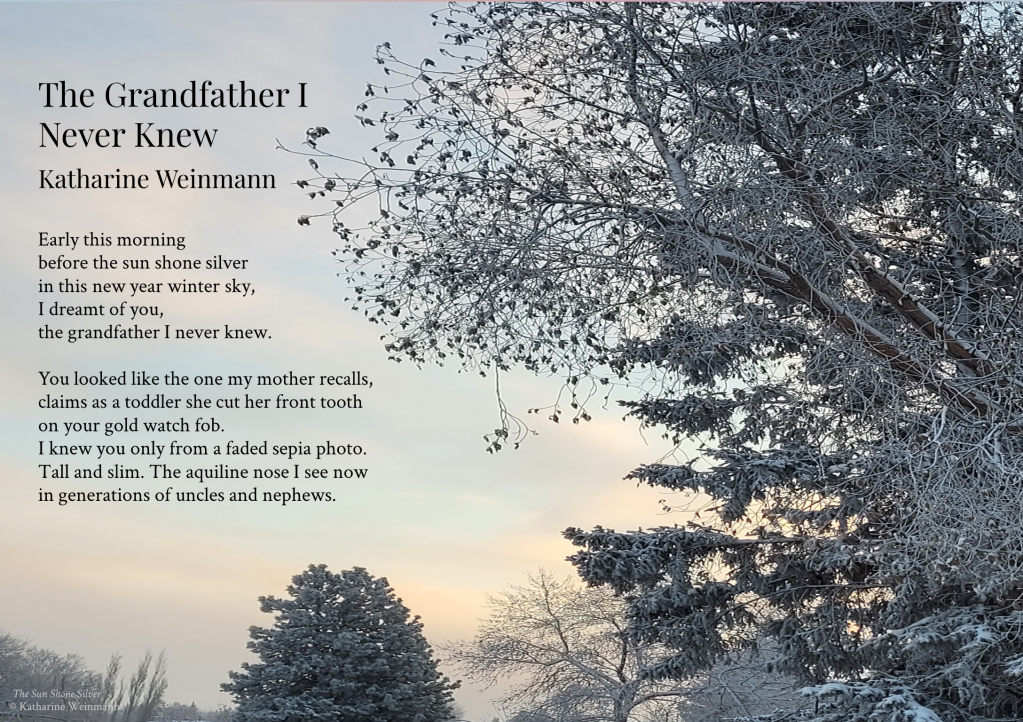
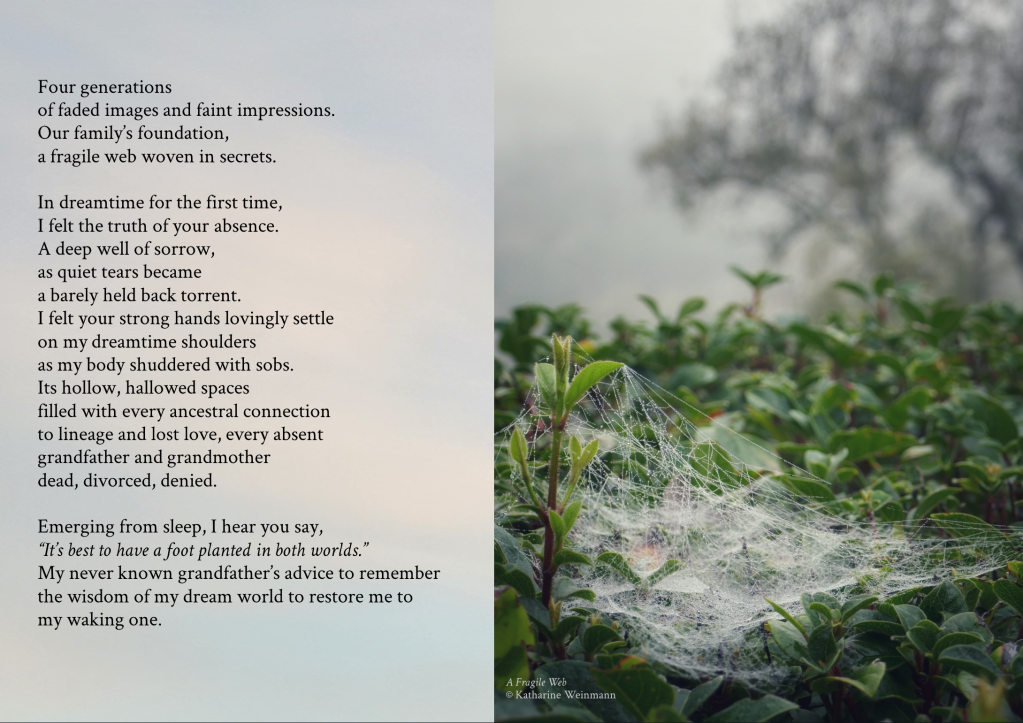
My dreams both inform and have become poems. One, “The Grandfather I Never Knew,” has been recently published, along with my photography, by the beautifully curated Synkroniciti Magazine in Volume 6, Number 1, Katherine McDaniel, editor.

And those dreams where I have greater abilities than in daylight with the associated visceral feelings of exhilaration, satisfaction, freedom?  I’ve wondered how to bring forth that dream-time mastery into my day-time life. I realize how increasingly my poetry, photography, this blog, and even my personal conversations and correspondence have become the bridge across and into my eldering landscape. Heeding my dream-time grandfather’s advice.

Closing this post – one more typical of my Monday missives – as I did my early morning text to another of my dear friends:

“I’ll sign of with love for you and this summer day, for friendships near and far, those waxing and waning…the new beings who bring joy and love, and those steadfast in theirs.”

Kindest regards, dear friends.

Aftermath Inventory

famed Polish sculptor Igor Mitoraj’s winged Ikaria on exhibition at il Castello Maniace, Siracusa, Sicilia
May 2024


Aftermath Inventory

Shattered? Of course,
That matters.
But
What comes next
Is all
I can hope to master.

Knowing, deep in my
Bones,
Not all hurt harms.

My wounds?
If
Somehow, I
Grow through them,
Aren’t they also a boon?

My scars?
Someday,
They might shine
Brighter than stars.

Gregory Orr, The Last Love Poem I Will Ever Write, W.W. Norton & Co., 2019

One from the draft folder. For a morning when the night before, after my monthly Zoom with a friend, I opted for time with Walker rather than sitting at my desk, searching for a poem that might fit the week.

Maybe not exactly relevant, but eventually it comes around to this. The shattering. The reflection on hurts – given and received. Remembering that not all hurt harms. That it could be an invitation to lean in. Get real. Remember who and what matters most in the moment. At the time. Take the step, say the word to let them know.

My wounds. Your wounds. Our wounds. That when we grow through them, use them as compost for this day and the next, we might discover we’ve grown a well-lived and much-loved life.

My scars. Your scars. Our scars. Inevitable, too. Mark us among the living. The loving. Hearts broken by griefs shared, untold. Filled with gold, may they shine brighter than stars.

May we.

Much love and kindest regards, dear friends.

Komorebi

Flying home two weeks ago, with no foreknowledge, simply intrigued by the two-line description, I watched Perfect Days, a 2023 Japanese film written and directed by Wim Wenders. After three weeks of slow travel, designed with time to stay put and settle into the experiences of southern Italy, it was a soothing transition back into our quiet life at home. Clocking in at two hours, the film is described by The Criterion Collection as:

“A perfect song that hits at just the right moment, the play of sunlight through leaves, a fleeting moment of human connection in a vast metropolis: the wonders of everyday life come into breath­taking focus in this profoundly moving film by Wim Wenders. In a radiant, Cannes-award-winning performance of few words but extraordinary expressiveness, Koji Yakusho plays a public-toilet cleaner in Tokyo whose rich inner world is gradually revealed through his small exchanges with those around him and with the city itself. Channeling his idol Yasujiro Ozu, Wenders crafts a serenely minimalist ode to the miracle that is the here and now.

The main character seldom speaks. Day in, day out, his routine is the same – thoughtful, simple, purposeful marked with moments of gratitude for the sky, trees, and the light shimmering among the leaves.

The film’s final frame, shown above, defines the central principle grounding the story, and served as its working title. Reading, I smiled with recognition and appreciation, and sighed knowing its essence, as I am one whose first memory is of komorebi.

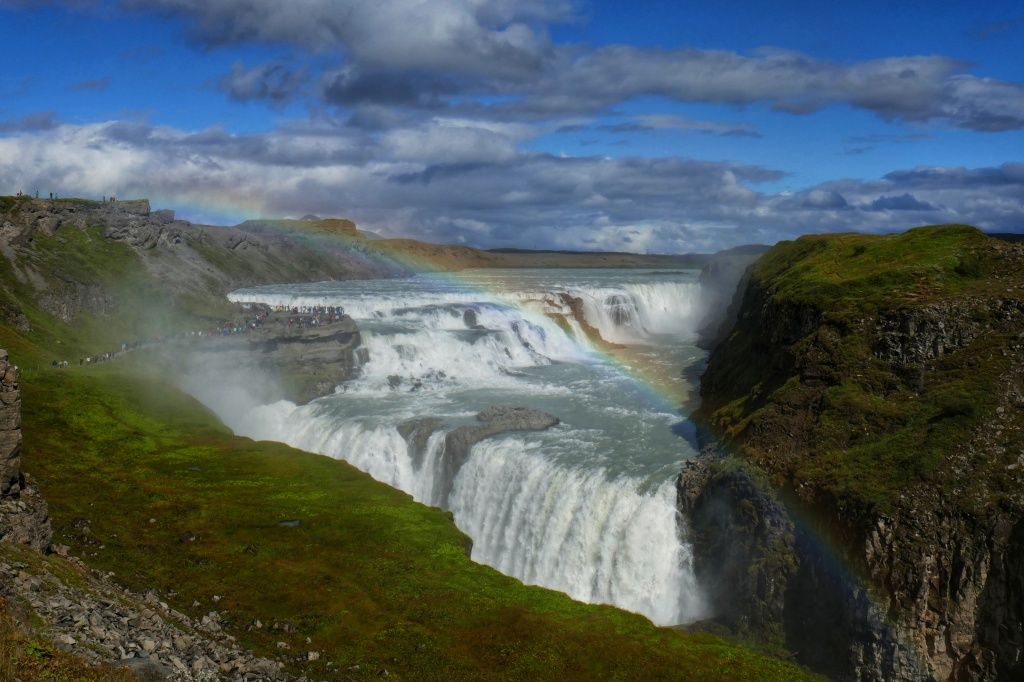
A few years ago, I wrote here about my love affair with trees, then inspired by a Sunday reading of The Marginalian and quote by Maria Popova, “A tree is a light-catcher that grows life from air.” My love affair with skies became conscious when I travelled to Iceland in 2018. While I fully anticipated the landscapes would tug on my heart, I had no idea how indelible the impact of those skies.

But back to trees and some of those that caught my attention in Italy last month. Some captured with komorebi:

Borrowing from my earlier post on trees, I’ll conclude in the same way, with a poem by Mary Oliver, in gratitude for the trees I gaze upon in my yard, and in vistas miles and oceans away, and for my friends who share a special kinship with them:

WHEN I AM AMONG THE TREES
When I am among the trees,
especially the willows and the honey locust,
equally the beech, the oaks and the pines,
they give off such hints of gladness.
I would almost say that they save me, and daily.
I am so distant from the hope of myself,
in which I have goodness, and discernment,
and never hurry through the world
but walk slowly, and bow often.
Around me the trees stir in their leaves
and call out, “Stay awhile.”
The light flows from their branches.
And they call again, “It’s simple,” they say,
“and you too have come
into the world to do this, to go easy, to be filled
with light, and to shine.”

Much love and kindest regards, dear friends.

Rembrandt’s Late Self Portraits

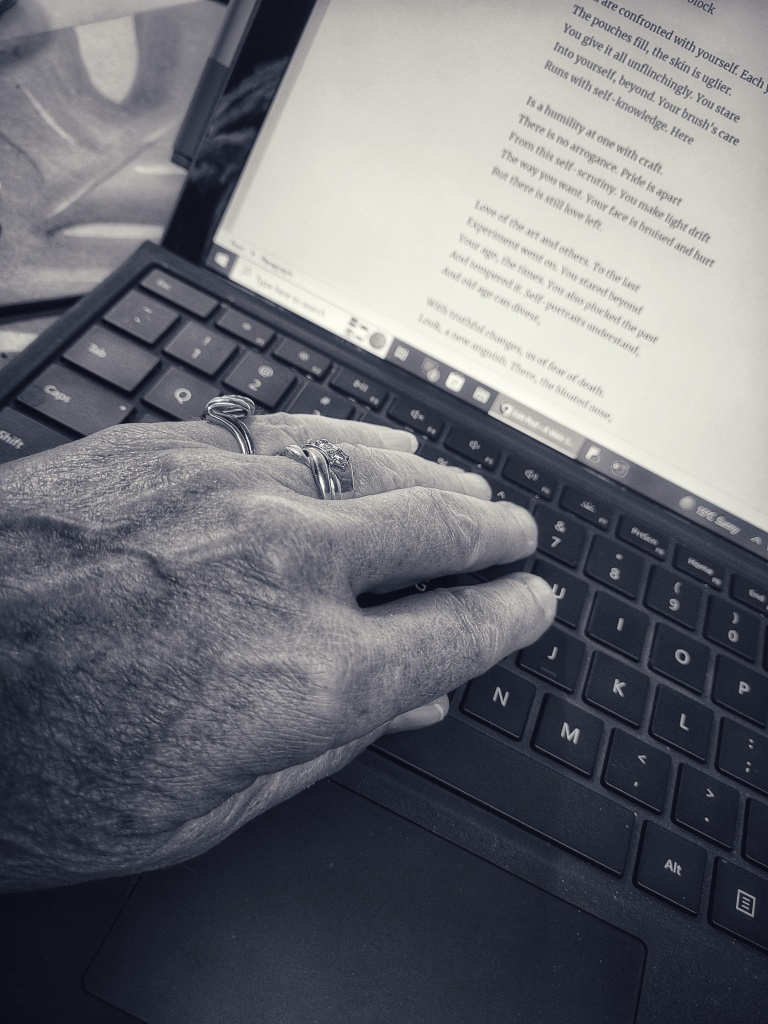
this aging hand of mine…

Rembrandt’s Late Self Portraits

You are confronted with yourself. Each year
The pouches fill, the skin is uglier.
You give it all unflinchingly. You stare
Into yourself, beyond. Your brush’s care
Runs with self-knowledge. Here

Is a humility at one with craft.
There is no arrogance. Pride is apart
From this self-scrutiny. You make light drift
The way you want. Your face is bruised and hurt
But there is still love left.

Love of the art and others. To the last
Experiment went on. You stared beyond
Your age, the times. You also plucked the past
And tempered it. Self-portraits understand,
And old age can divest,

With truthful changes, us of fear of death.
Look, a new anguish. There, the bloated nose,
The sadness and the joy. To paints, to breathe,
And all the darknesses are dared. You chose
What each must reckon with.

– Elizabeth Jennings, ‘Collected Poems’ Carcanet, 1987

First post in a month, and this poem fits the bill. To be confronted with one’s aging self – the fatigue that lingers from almost two weeks of jetlag; stiff and aching knees upon waking, and after playing pickleball; vision that increasingly, more often than not, needs the assistance of my glasses; hearing that fades in noisy spaces; crepey skin and protruding veins on my suntanned hands – I could go on, but suffice to say, with truthful changes and a new anguish, there is still love left.

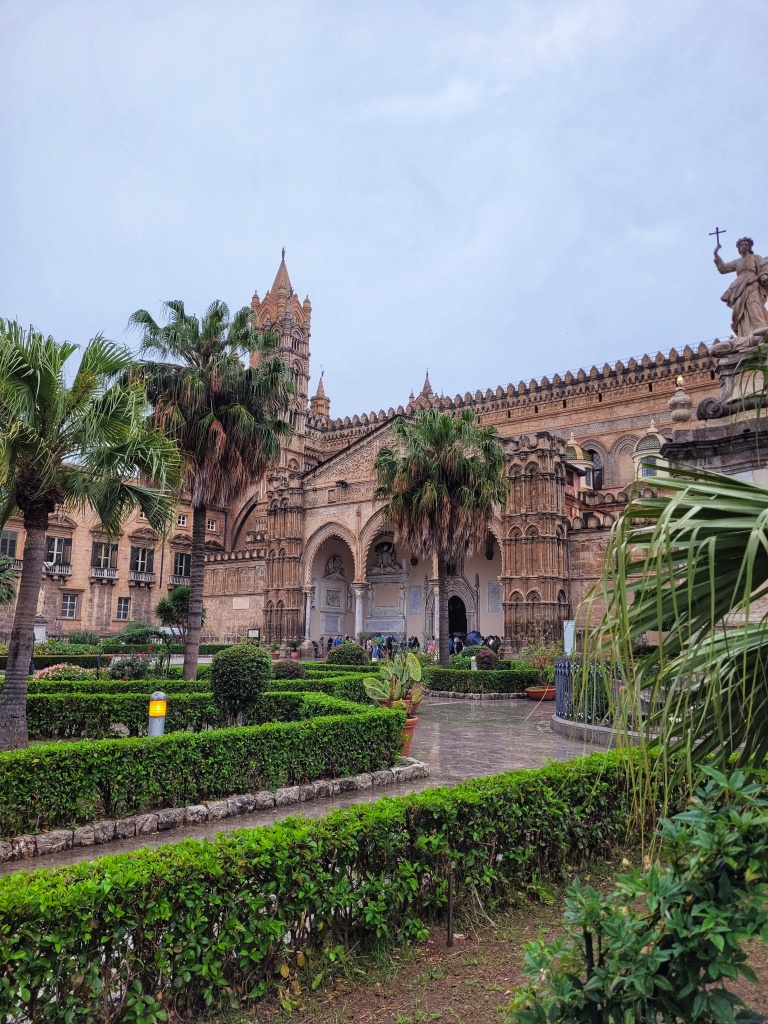
Italy was terrific. She never disappoints, even though it was quite cool for a few days in Taormina, Sicily. The Fairweather Goddess made her presence known, only giving us showers when indoors at a cooking class, touring Palermo, driving in a small touring to a vineyard luncheon on Mount Vesuvius, and full out sunshine when it mattered most – during our drive along the Amalfi Coast on, what locals call, the “Via Mama Mia.” Having arranged this trip, I was pleased that all our plans came together, with the only travel delay back in Canada, where we sat for over an hour on the tarmac during our final leg home from Calgary. I had no idea, as I was sound asleep.

Home less than a week, Sig drove to Kamloops to fetch Walker, our sixth English Setter. Not a year old, he’s playful, eager to please, a quick learner and from one side, looks so much like Annie that I occasionally lapse and call him by her name. It will be quite some time before he becomes the walking companion I had in her, but we’re both amazed at how much he’s settled in six days. Too, we’ve concluded, given our fatigue with the full-out attention required (managed in part by putting a bell on his collar, silence signaling we might need to check out what he’s up to), this will be our last dog, a reckoning as we stare beyond our age, the times.

Walker… we all fall into bed after a full day

At the beginning of this year, I wrote here about “an eldering landscape,” that inevitable next threshold that defines this age and stage of life. Balancing the sadness and the joy, in this stage, in this poem, I think back to one of our seven touring companions in Sicily. Patricia, an eighty-five-year-old American who, with her sixty something daughter, climbed every stair, walked every cobblestone path, sipped every taste of Sicilian wine, cooked with us savoring every morsel. Late self-portrait, hardly! I’ll take a page from her album any day.

I’m happy to be home, and back here on the page with you, dear friends.
Much love and kindest regards.

To Say Nothing But Thank You

TO SAY NOTHING BUT THANK YOU

All day I try to say nothing but thank you,
breathe the syllables in and out with every step I
take through the rooms of my house and outside into
a profusion of shaggy-headed dandelions in the garden
where the tulips’ black stamens shake in their crimson cups.

I am saying thank you, yes, to this burgeoning spring
and to the cold wind of its changes. Gratitude comes easy
after a hot shower, when my loosened muscles work,
when eyes and mind begin to clear and even unruly
hair combs into place.

Dialogue with the invisible can go on every minute,
and with surprising gaiety I am saying thank you as I
remember who I am, a woman learning to praise
something as small as dandelion petals floating on the
steaming surface of this bowl of vegetable soup,
my happy, savoring tongue.

– Jeanne Lohmann –

Whew! I’m glad I’d clipped and saved this poem, shared on social media last week by Parker Palmer. Despite sitting here for a couple of hours writing, and up most weekday mornings to log onto a 7:00 am Zoom writers’ circle, I was ready to power off when I remembered today’s photo and poem feature. This one feels perfect, as it no doubt did for Parker when he posted it.

“I am saying thank you, yes, to this burgeoning spring/and to the cold wind of its changes.” Alberta springs are notorious for their capricious nature: warm one day, snow the next; north winds blowing strong and cold, drying puddles, and disappearing shady pockets of crusty snow. Depending on the location, here you can ski in the morning and golf in the afternoon. Maybe because we had an exceptionally mild winter, thanks to El Nino, most of us have felt more bewildered than usual by spring’s ambivalent arrival. Toss in a solar eclipse, a new moon, and now a full moon, and yesterday’s collective lack of focus on the pickleball courts – wearing toques and gloves after two preceding days of short sleeves and shorts – might indicate our resiliency, or discombobulation! And that’s not writing a word about everything else going amuck in the world. “Weather and world weary,” would suffice.

So yes, I say “thank you” as I remember I am a woman praising something small…like the three browning hares who’ve taken to nestling under the spruce bough, or up against its trunk, the ones I call “honey bunnies,” happy to see them as they bring back memories of Annie fixated on them as she’d stand at the front window. As I do now.

Thank you to the sun that rises earlier and sets later, every day, now necessitating wearing an eye mask to fall asleep. To the robins I’m just beginning to hear singing their mating song. To the geese honking as they fly in pairs or in V formation. The murder of crows nest-making. Catkins and ice pads.

spring’s juxtaposition

And to you, dear friends, thank you for being here.
Much love and kindest regards.

River

In celebration of Earth Day, today its 54th anniversary, my community hosted a free showing of the 2021 documentary, River, produced in Australia, narrated by actor Willem Dafoe, and described as “a stunning exploration of the timeless relationship between human civilization and Earth’s rivers, in all their majesty and fragility.”

Writing in earlier posts that I call myself a “daughter of Niagara,” having been conceived, born, and raised in the land bordered by that mighty river, this film, with its breath-taking photography, orchestral score, and poetic narration, touched that place deep within me where river resides.

“…Our early destiny was shaped
by the will of rivers.
We both feared and revered
them as forces of life,
and of death.
We worshiped them as Gods.

Rivers inspired us as a species,
allowing us to thrive.
Over time, they became the
highways by which trade,
and technology spread inland,
and along them also flowed poetry,
stories and religions,
politics and conflict…”


– Willem Dafoe, River, 2021

For the last forty-five years, I’ve made home near another mighty river, the North Saskatchewan. While not in my sightline every day, and in only a few ways resembling my river from home, at least once a week, as I drive into Edmonton or walk along its valley with my Saturday morning Camino group, I feel deep pleasure and appreciation for its presence in my life, for how it invites, metaphorically and in an embodied reflection, wise action for living.

By flowing with the power of its current; recognizing the value of being contained by its banks; attending to its shallows, hidden depths, and eddies, its seasonal highs and lows influenced by rainfall, snowpack, heat and cold – in sum, recognizing its innate alive wildness as mirror of possibility for my own.

“…For eons, running water
obeyed only its own laws.
Patient and persistent,
it wore mountains away.
It looped and meandered
laying down great plains
of lush, rich silt.
Where rivers wandered,
life could flourish.
For rivers are world-makers.
They have shaped the Earth,
and they have shaped us as a species.
For thousands of years
we worshiped rivers,
as the arteries of the planet,
the givers of gifts,
the well-springs of wonder…”


– Willem Dafoe, River, 2021

Like a sonnet’s volta, or a river’s ninety-degree turn, the film shifted perspective to show the impact on rivers of our interventions and interference in their natural flow, albeit while acknowledging their unpredictable, destructive capacities:

“…we devised extraordinary
means of controlling them,
of harnessing their force
and taming their wildness.
We discovered how to
regulate and manage them,
how to run them like machines.
We shifted from seeing
rivers as living beings
to seeing them as resources.
Our gods
had become our subjects…”


– Willem Dafoe, River, 2021

Repeatedly, I was held in awe by the film’s aerial photography showing the shape and flow of rivers and their profound resemblance to trees. Staggering to learn was that the amount of water in the hydrosphere, the Earth’s original water account, hasn’t changed since the beginning of time, while our numbers, in contrast, have grown beyond comprehension. Too, that worldwide, there is hardly a river unspanned, undammed or undiverted, and that the largest dams have held back so much water, they’ve slowed the Earth’s rotation.

“…The mystery and beauty
of a wild river is beyond our ability to comprehend
but within our capacity to destroy.
Rivers that have flowed for eons
have been cut off in decades.

Time and again,
upstream need and upstream greed
have led to downstream disaster.

We have become Titans,
capable of shaping our world
in ways that will endure for
millions of years to come…”


– Willem Dafoe, River, 2021

Throughout, I kept thinking back to John O’Donohue, and his poem, Fluent:

I would love to live
Like a river flows,
Carried by the surprise
Of its own unfolding.

Such simple eloquence that holds reverence for – not interference with – river’s sovereignty.

If you, too, are enamored of rivers, I encourage you to find the film and take the 90 minutes to watch it. For Earth Day…which, IMHO, should be every day.

Much love and kindest regards, dear friends.