THESE DAYS Anyone who tells you not to be afraid should have their head examined. Cities are burning, hillsides are ablaze. and the dumpster fire of our common life is out of control. I wish I could tell you when it was going to get better. I wish I could promise that better was anywhere down this road. I miss dancing, bodies in something between conversation and flight. I miss singing, the way we trusted the air that moved between us. I miss the casual assumption that everything would be alright in the morning. These days I am trying to be buoyed by the smallest things – a ripe tomato, a smattering of rain. These days I am trying to remember that songs of lamentation are still songs.
Lynn Ungar, These Days: Poetry of the Pandemic Age, 2020
There is so much about this poem – found searching my bookshelf for one to frame my day, this week, my life, LIFE – that is in perfect alignment, despite it being written four years ago with its context the pandemic.
Today, I did a Medicine Walk along my favourite river valley route. Despite training for my long walk in September, this walk was not about distance, elevation, or pace. In honor of the feast day of Saint James – Sant Iago, as in Santiago, as in the Camino – it would be a walking prayer for the health and well-being, for a miracle, for a friend… for several friends… each besieged by life-threatening illness. Itbecame, too, a prayer for all beings displaced,distraught, and destroyed by the wildfires.
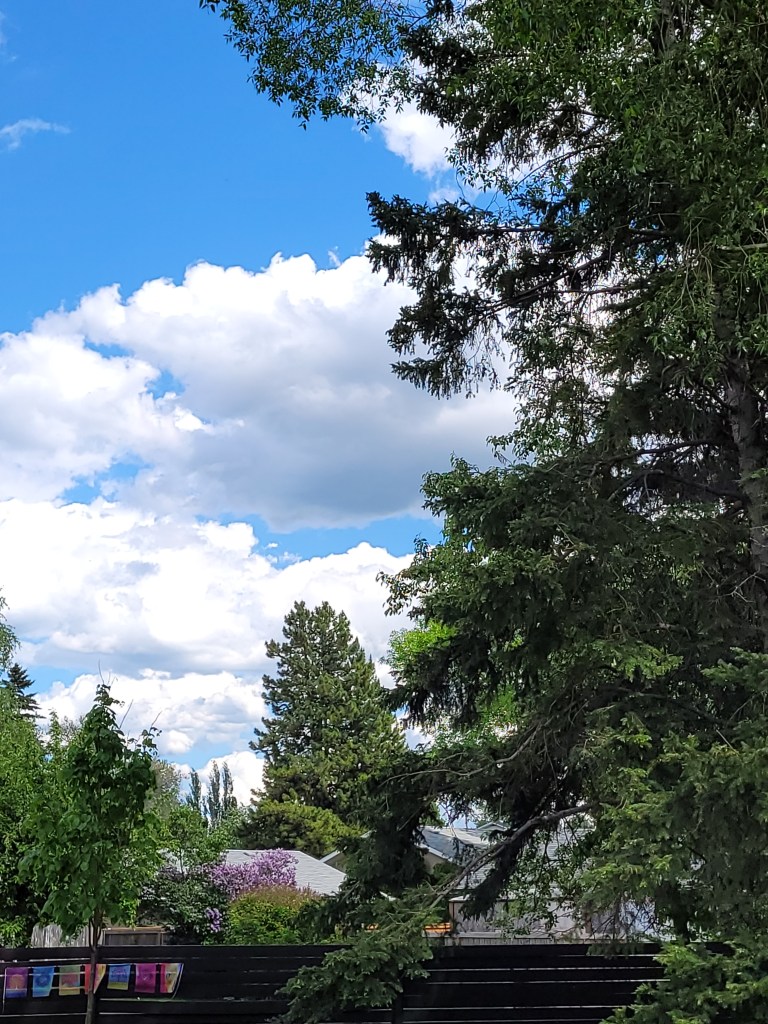
Despite an almost twenty-degree drop in temperature, with the morning overcast, thick with smoke from wildfires that last night ravaged one of Alberta’s beloved treasures, Jasper National Park, and its century old townsite, and heavy with rain that eventually, blessedly fell, I dressed for weather and set out. I chose as my audio companion the exquisitely composed “Camino” by the late Canadian violinist, Oliver Schroer. The first notes of the first track, “Field of Stars,” are a haunting homage to Santiago de Compostela (field of stars). The ambient tracks blended with birdsong on my path such that I felt surrounded and held by the morning’s poignant beauty. A perfect reflection of my interior landscape and the devastated one to the west.
Where a few weeks ago pink wild roses bloomed thick and heady with perfume, today’s bushes were laden with ripe purple saskatoon berries and blood-red wild raspberries.Golden yarrow and wild sage filled river banks. To my way of thinking, tasting those berries was my holy communion, the real “body of Christ.”
As steam rose from the placid river, a lone pelican glided above on its huge, outstretched wings. I lost sight of it, and then looking up, there he was again, effortless in his flight. I wondered about the significance of his appearance as I’d never seen one before on this stretch. Once home, I consulted Ted Andrews’ classic Animal Speak to learn they represent renewed buoyancy, unselfishness, and the need to not be weighed down by emotion. Wise medicine for these days.
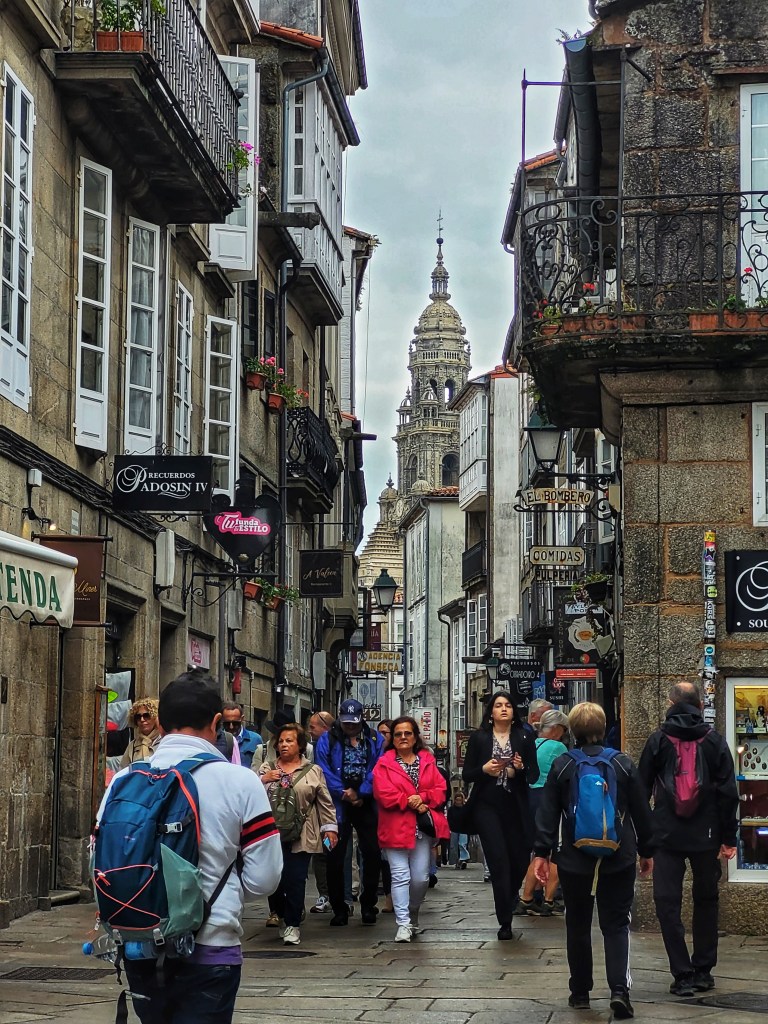
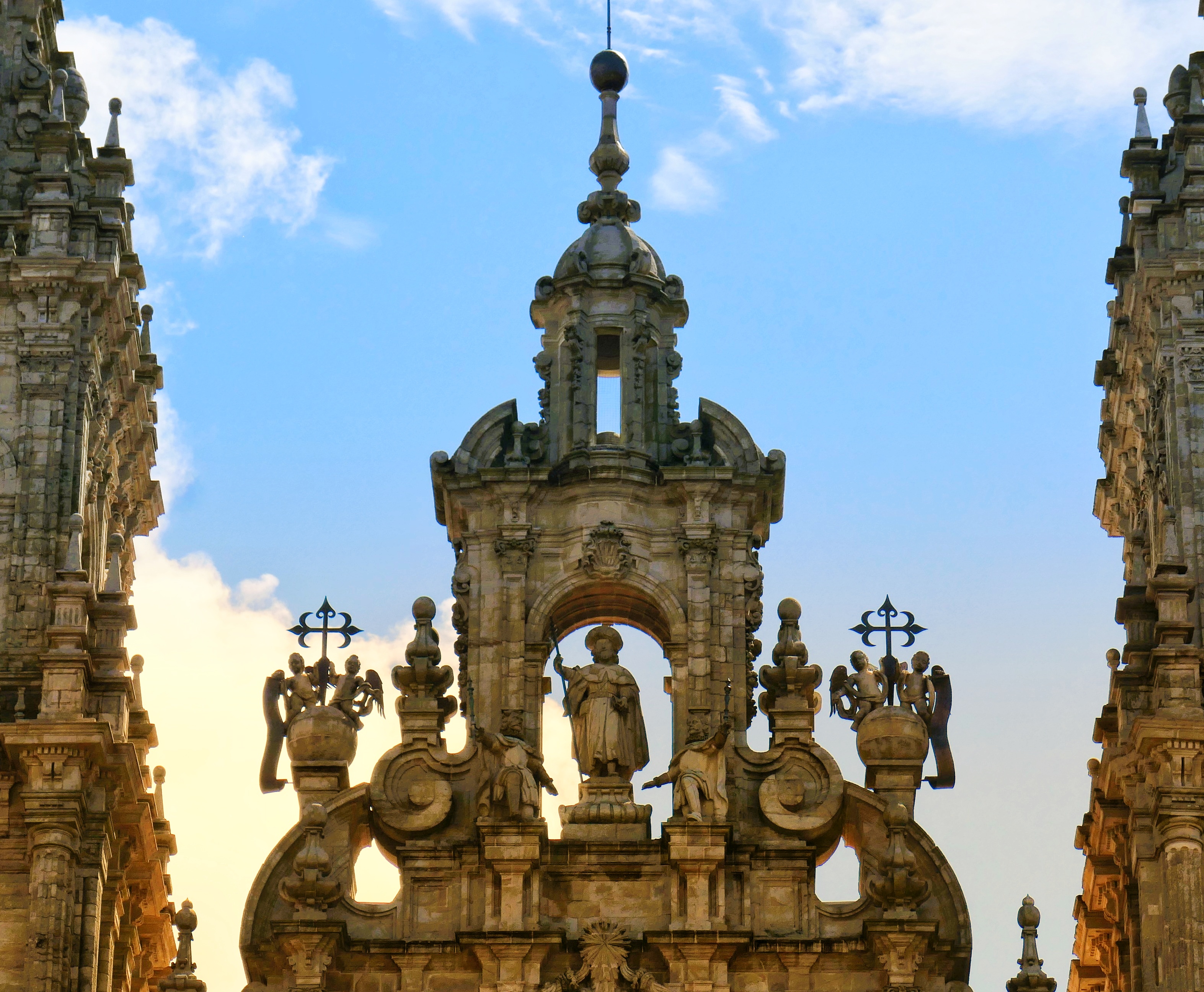
my first glimpse of the Cathedral de Santiagospire
“There is a great moment, when you see, however distant, the goal of your wandering. The thing which has been living in your imagination suddenly becomes a part of the tangible world.”
Freya Stark in The Art of Pilgrimage, 1998
Waking at dawn to the sound of pilgrims’ footsteps passing by my open window, I’d prayed to the Fair Weather Goddess to hold off on the forecasted rain until our arrival in Santiago. I would, but knew walking in more rain, given my fatigue and cough would take more out of me. Despite heavy clouds during this three hour final stage, she had heard and thankfully granted my request.
It was a curious stage, through parkland and woods, meanderng into the thick urban commercial centre of the Santiago suburb, Milladoiro, where we stopped for coffee at the crowded cultural centre, then back into more eucalyptus groves. Climbing and descending, we finally reached the proverbial fork in the road with two Camino markers, each pointing the way to Santiago. Conferring in broken English with another walker, consulting the GPS and guidebook, we opted for the one pointing right. Described as the new “official” route via another suburb, A Conxo, it would be less congested and longer, but avoided a steep climb. We continued to walk in relative solitude. Crossing motorways, moving now into a consistent urban vibe, with markers few and far between, and only the occasional peregrino, identifiable with backpack and scallop shell, I was surprised by the lack of Camino energy and convergence of pilgrims I’d read about as the hard-earned destination drew nearer.
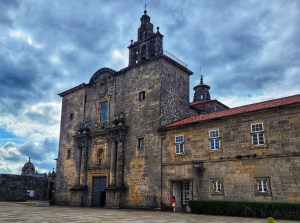
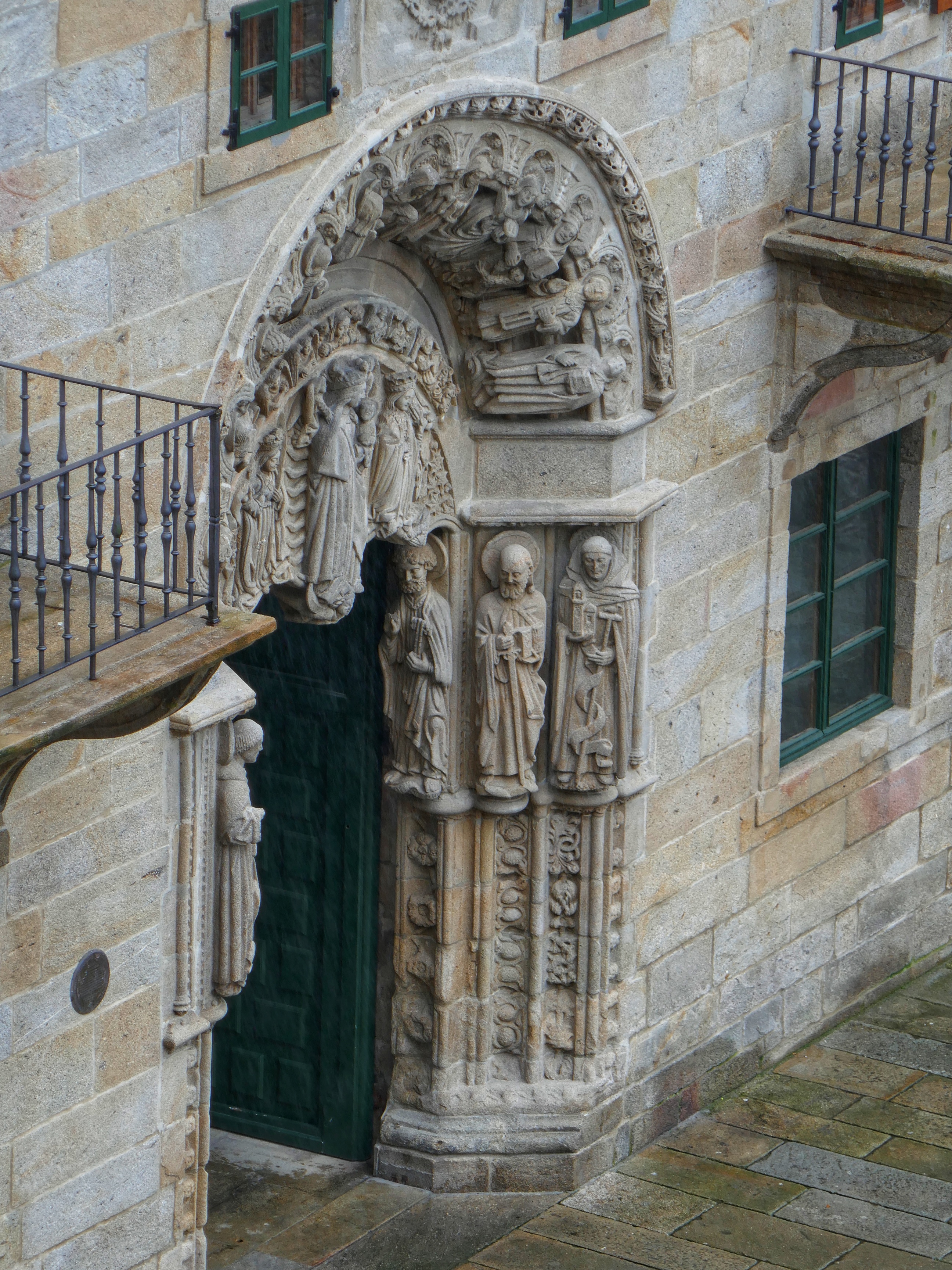
Nuestra Señora De La Merced De Conxo
“Things are always different from what they might be.”
Henry James in The Art of Pilgrimage, 1998
From my journal: “Three hours of walking, not many pilgrims on the Way. At the crossroads we headed right to AConxo and saw no one. Arrived at Prazo do Obradoiro in time to hear the cathedral’s 12:00 pm bells and struck by how few people were gathered here in front of the cathedral. As we stood side by side, I wasn’t overtaken with feeling…instead I felt subdued, relieved to have arrived safely, and tired. Observing myself, I was surprised at my response…perhaps because I had realized a 20 year dream and now is the time to lay it down. I walk my Camino every day and now I have the stamp and certificate, so be it. But when I called home after settling in at the Parador, I cried deeply…”
It would take several weeks to unpack those tears.
this is, in part, whyan iconic photo of arrival
that sky
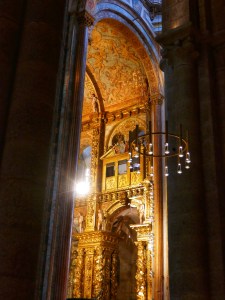
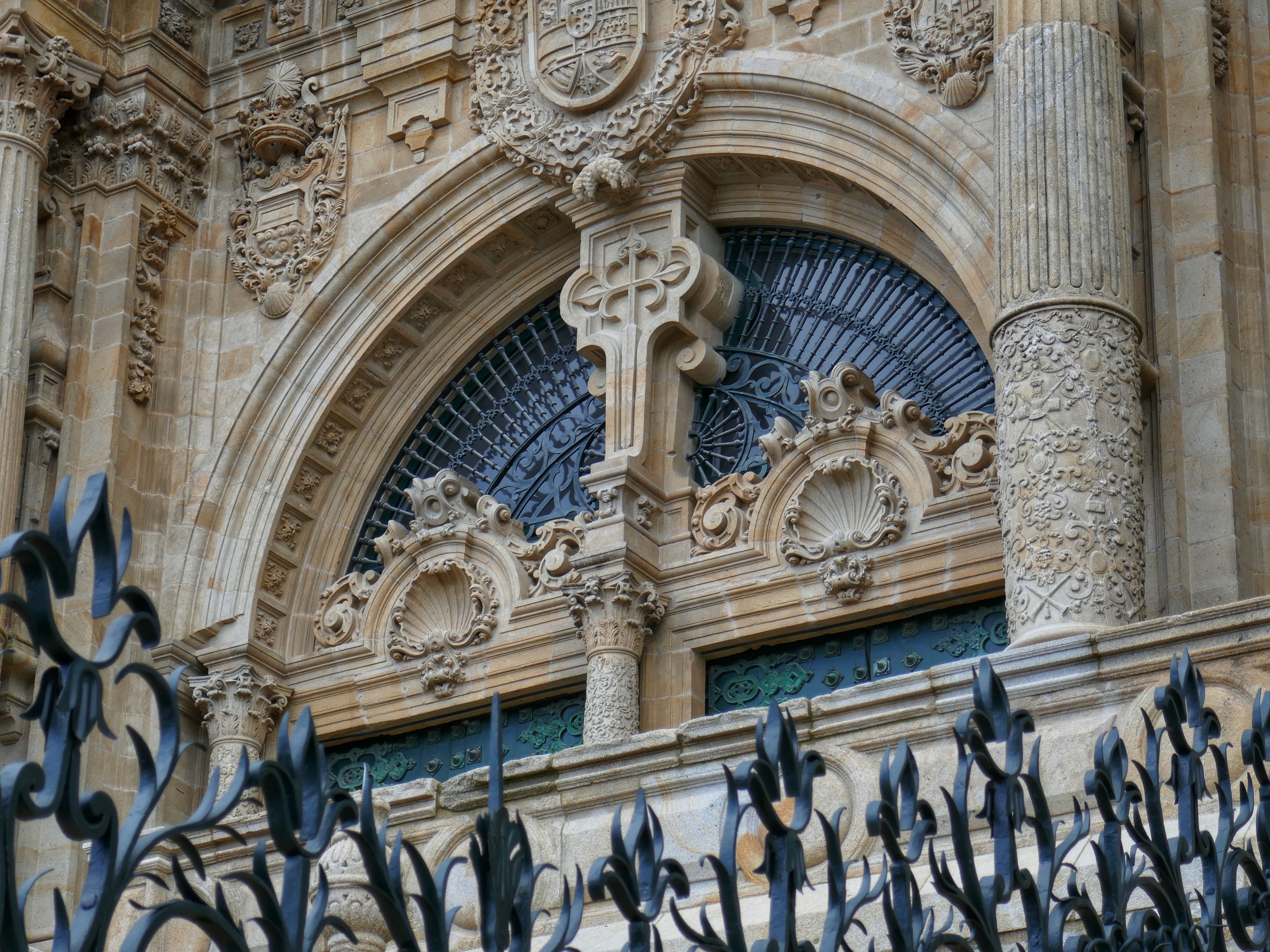
At the outset of planning this walk, and for long before, I had been clear within myself about the importance of holding both the deep value of the journey, walking every day, and the significance of the destination, arriving at the plaza in front of that magnificent structure, as had thousands of pilgrims for the thousand years before me. A few years ago, when I had last given serious thought to walking, I suddenly cancelled, heeding one of those hardly articulated hunches. A few months later, it would be confirmed when I discovered that the cathedral would be closed and hidden by extensive scaffolding to undergo a multi-year restoration. I knew that if and when I ever walked, I would need, as Bettina Selby describes in The Art of Pilgrimage (1998), “what the newly arrived pilgrims see, exalted as they are at the end of the trek, and by all the magnificence and beauty they have already seen in the approach to their goal, the pool of warm golden light drawing them on.”
altar and botofumeiroSt. James’ crypt – la raison d’etre for somethatwarm golden light
So yes, as I observed myself standing in front of the cathedral, taking in the final stage of arriving at my long held dream, I was surprised with my response. Where was the feeling of exaltation? Where the feeling of jubilation and accomplishment I had seen in the hundreds of photos posted by women on the Facebook site I’d followed for years? Was I subdued because I’d already been here, albeit virtually in several livestream tours a couple of years ago? Or was it a visitation by “the dragons of disappointment”? Citing from The Art of Pilgrimage (1998) archeology scholar Michael Guillen’s experience at the palace of Knossos on Crete: “I felt very little at the site itself because of all the crowds and the meddling that had been done with the restoration; the only real power I felt was in the surrounding land. I felt that the site had been transmogrified, and that the only spirits left were in the objects in the museum. I suppose this is the danger of mass pilgrimage, the loss of spirit at the site, especially when the gods flee to higher and higher places.”
In a recent chance reading of a blog by a fellow who, walking the Portuguese route had taken the right turn at the fork, passing by the historic building at A Conxo, providing the name for my photo above, he, too, wrote about being struck by his own “let down” anti-climatic response to arriving. Not at all what he had anticipated. Hmmm, I wasn’t alone, and imagine there are countless others who have felt similarly.
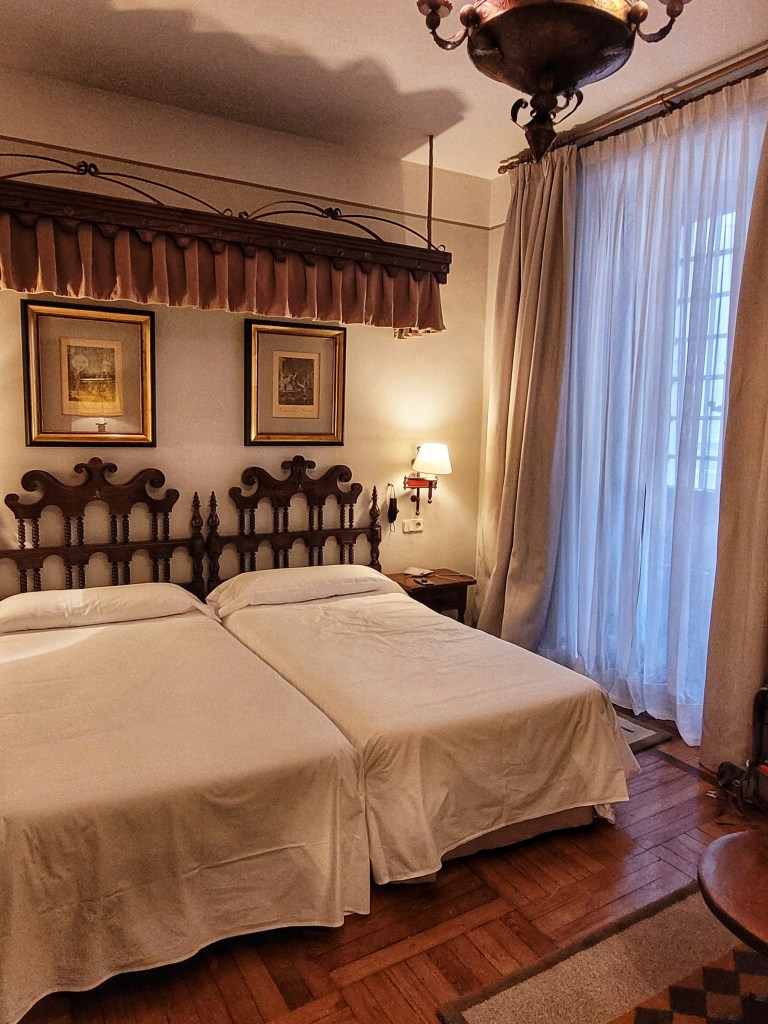
When I designed this walk with Paola at Portugal Green Walks, I determined it would be prudent to stay 72 hours in Santiago in compliance with the then known Covid-19 travel requirements, something that would become moot when we actually departed Canada. The same friend who had recommended PGW said in hindsight, she wished she’d stayed at the Parador in Santiago, the beautiful hotel bordering the plaza, beside the cathedral. “In for a penny, in for a pound, ” my companion agreed and so we partook of its sumptuous surroundings and the best breakfasts.
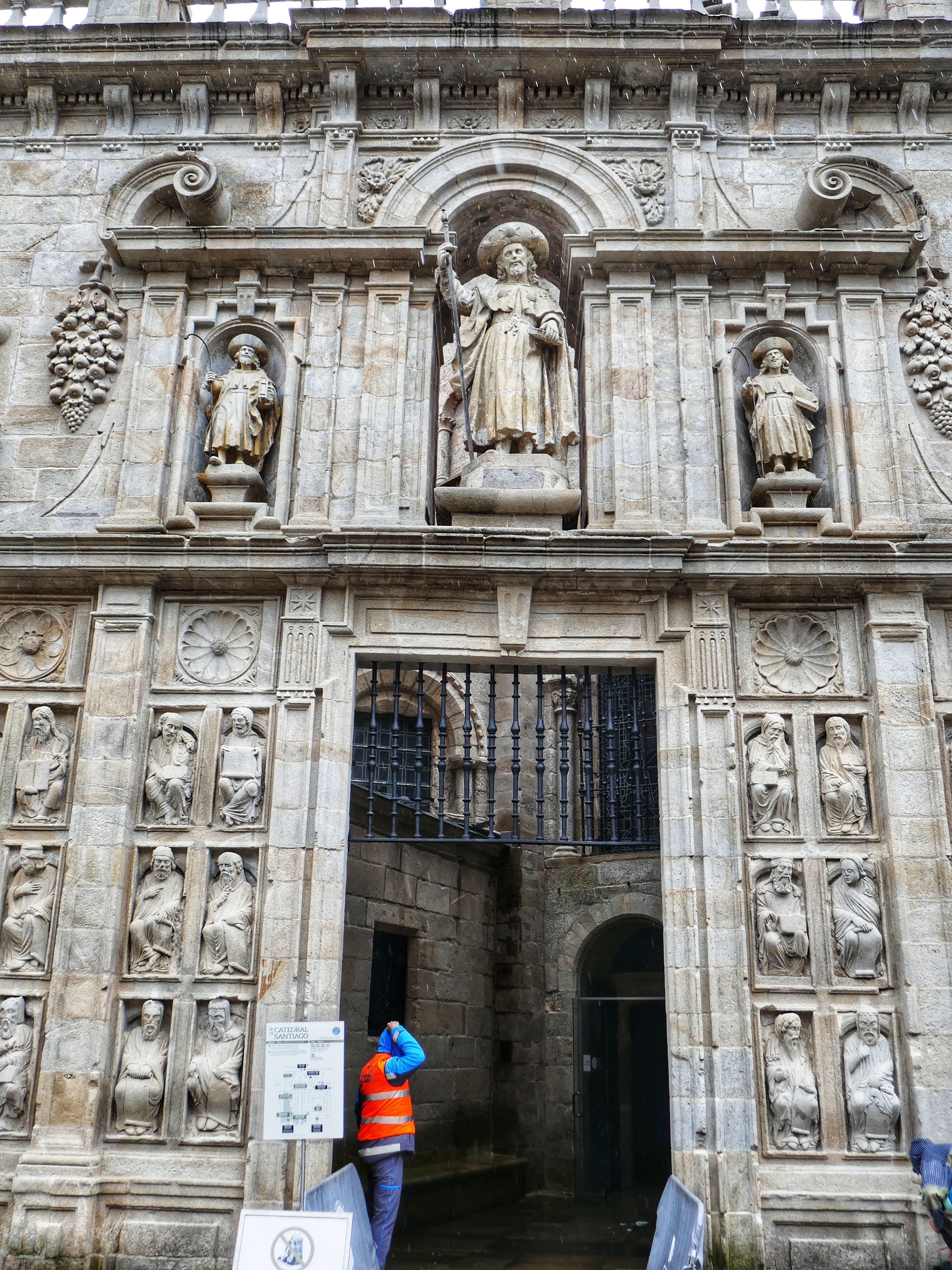
Rain finally came later that afternoon, and poured the next day, making for a perfect time to explore the historic centre, the Cathedral museum, and as luck would have it, attend the daily pilgrims’ mass. As it was Tuesday, and no one had paid the required 400 Euros, we didn’t have the experience of witnessing the famous swinging of the incense filled botofumeiro, so a view of it from the cathedral and its solid silver counterpart in the museum would have to suffice.
Despite my initial “flat” response – let’s mark it down to being sick and tired and relieved – I was enthralled with the cathedral, catching it from different perspectives at different times of day during my time in Santiago. As if to confirm and assure myself that yes, I had arrived.
That despite it having been a dream to walk the Camino, it was now very much part of my lived and waking reality, of who I now am, in the cells and fibre of my being.
That upon returning home, and devoting these past two months to its reliving, reflecting, re-imagining, and writing, I bring back the boon of some insight and self awareness, and much gratitude.
“The story that we bring back from our journeys is the boon. It is the gift of grace that was passed to us in the heart of our journey. Perhaps it was in the form of an insight into our spiritual life, a glimpse of the wisdom traditions of a radically different culture, a shiver of compassion, an increment of knowledge. All these must now be passed on. The boon…is a presence in the soul of the world that can be sensed and honored and carried home in your heart.”
Phil Cousineau, The Art of Pilgrimage, 1998
Dear readers, thank you for walking with me these several weeks. I’ve appreciated hearing from those of you who commented here and on social media, helping me to remember that while we are often walking alone together, ultimately we are all, as Ram Dass famously said, walking each other home.
Much love and kindest regards, dear friends. And to read about my walk in sequence, I’ve created a new page with all the posts titled and stages named. Buen Camino!
Home is where I want to be Pick me up and turn me round I feel numb, born with a weak heart I guess I must be having fun The less we say about it the better Make it up as we go along Feet on the ground Head in the sky It’s ok I know nothing’s wrong… nothing
Hi yo I got plenty of time Hi yo you got light in your eyes And you’re standing here beside me I love the passing of time Never for money Always for love Cover up and say goodnight… say goodnight
Home is where I want to be But I guess I’m already there I come home, she lifted up her wings Guess that this must be the place I can’t tell one from the other Did I find you, or you find me? There was a time before we were born If someone asks, this is where I’ll be, where I’ll be
Hi yo we drift in and out Hi yo sing into my mouth Out of all those kinds of people You’ve got a face with a view I’m just an animal looking for a home And share the same space for a minute or two
You love me till my heart stops Love me till I’m dead Eyes that light up, eyes look through you Cover up the blank spots Hit me on the head ah ooh
Talking Heads: C. Frantz / T. Weymouth / D. Byrne / J. Harrison
“Home is where I want to be,” and now I am. After nearly five weeks away, realizing that 20+ year dream of walking a camino to Santiago de Compostela, I arrived home last Friday after seeing the sun travel full circle, rising in Madrid and setting in Edmonton. Two noneventful flights, albeit with significant delays, but a remarkably quick passage through Toronto, our Canadian port of entry, where within thirty minutes we had disembarked, cleared customs, walked the length of the terminal to be sitting at our gate for the final leg.
During May’s last Sunday afternoon, wafting through the open window of the guest house in Rua de Francos, Galacia, Spain – the resting spot for our “penultimate stage” to Santiago (quoting from Portugal Green Walk’s guidebook ) – I heard a woman’s beautiful voice singing this Talking Head’s classic accompanied by light acoustic strumming. Straining to hear, I rose from the bed where I’d been dozing, and pressed the voice recorder on my phone hoping to include it in the soundscapes I had been creating along the Way.
A gift of prescience, I thought, as a few years ago for my birthday, my husband created a playlist featuring this song, saying for him I’ve always had “a face with a view.” Later I dressed and went to sit in the yard, to warm myself from the chest and head cold that had walked with me the last couple of stages. There, I met Heidi from Portland, Oregon who with her “guitalele” – a slightly larger, more resonant version of a ukelele – was the source of my “homecoming gift.”
“And you’re standing here beside me I love the passing of time…”
There are things you can’t reach. But you can reach out to them, and all day long.
The wind, the bird flying away. The idea of God.
And it can keep you as busy as anything else, and happier.
The snake slides away; the fish jumps, like a little lily, out of the water and back in; the goldfinches sing from the unreachable top of the tree.
I look; morning to night I am never done with looking.
Looking I mean not just standing around, but standing around as though with your arms open.
And thinking: maybe something will come, some shining coil of wind, or a few leaves from any old tree– they are all in this too.
And now I will tell you the truth. Everything in the world comes.
At least, closer.
And, cordially.
Like the nibbling, tinsel-eyed fish; the unlooping snake. Like goldfinches, little dolls of goldfluttering around the corner of the sky
of God, the blue air.
– Mary Oliver –
Today, within a few days of reaching my destination, Santiago de Compostela, I am reminded by Mary Oliver’s words that there are things I cannot reach. During an earlier waxing iteration of my dream to walk a Camino, within a few months I suddenly, inexplicably knew the timing, a year hence, would not work. Not until the beginning of that year, when I discovered that the cathedral would be closed for extensive renovations, and that all pilgrims’ services would be shunted off to other local parishes, did I have my explanation. While the journey would be significant so, too, for me, would be the destination, standing inside the cathedral, where thousands of pilgrims have gathered for hundreds of years, marking their arrival in ceremony and ritual.
Where does the temple begin? Where does it end? How is the ancient cathedral in that ancient square the metaphor for the one residing inside me?
The answers to these questions and more -yet unknown, unspoken – will come…closer…cordially. Or perhaps they are never to be reached.














 A Wabi Sabi Life