“In many Muslim cultures, when you want to ask them how they’re doing, you ask: in Arabic, Kayf haal-ik? or, in Persian, Haal-e shomaa chetoreh? How is your haal?
What is this haal that you inquire about? It is the transient state of one’s heart. In reality, we ask, ‘How is your heart doing at this very moment, at this breath?’ When I ask, ‘How are you?’ that is really what I want to know.
I am not asking how many items are on your to-do list, nor asking how many items are in your inbox. I want to know how your heart is doing, at this very moment. Tell me. Tell me your heart is joyous, tell me your heart is aching, tell me your heart is sad, tell me your heart craves a human touch. Examine your own heart, explore your soul, and then tell me something about your heart and your soul.
Tell me you remember you are still a human being, not just a human doing. Tell me you’re more than just a machine, checking off items from your to-do list. Have that conversation, that glance, that touch. Be a healing conversation, one filled with grace and presence.
Put your hand on my arm, look me in the eye, and connect with me for one second. Tell me something about your heart and awaken my heart. Help me remember that I, too, am a full and complete human being, a human being who also craves a human touch.”
— Omid Safi, from The Disease of Being Busy
heartful distractions on my writing desk
My friend Sally, who I met last year walking the Via di Francesco, shared this post from our mutual friend, Omid Safi. I first “met” Omid when he was one of a cadre of regular bloggers/columnists posting in an early iteration of On Being. It was in the aftermath of 9-11 when tensions, animosities, and cultural misunderstandings were high, particularly in the US. What always touched me was how Omid, who is a professor of Asian and Middle Eastern Studies at Duke University, always wrote with an open-hearted clarity, generously giving space for multiple perspectives and opinions, all the while sharing his culture by way of story. In my experience of Omid, his writing and online presence are an embodiment of his love and reverence for his teacher, Rumi, founder of the Sufi order of whirling dervishes.
On a day when I read that over 40,000 lives have been lost to the conflict in Gaza, with thousands more unaccounted for, Omid’s message of heartful connection and healing conversation lands deep within my heart and soul.
Ours has been a virtual friendship. One day I hope to meet Omid in person, perhaps on one of his Illuminated Tours to Turkey or Morocco. One day I hope to put my hand on his arm, look him in the eye, tell him something about the state of my heart, and listen to him tell me about his. And together remember we are each and all human beings, craving human touch, connection, and peace.
Dr. Clarissa Pinkola Estes, Women Who Run with the Wolves”
“I haven’t seen anything from A Wabi Sabi Life lately,” remarked my friend in our long overdue, much awaited Zoom call. A myriad of reasons, excuses even, offered. And as I sit down in my studio Sunday night after dinner, my typical time to craft a post, what thread to pull from the dark interior knot in hopes of loosening its vague, inarticulate, persistent grip?
“A brave woman, a wisening woman, will develop the poorest psychic land, for if she builds only on the best land of her psyche, she will have for a view the least of what she is.”
Dr. Clarissa Pinkola Estes, Women Who Run with the Wolves”
Do I write again about friendship? How my initial post rang true for so many women, coincidentally finding several at the time questioning their own friendships? How its precipitant, a letter written to a friend, sank like a stone? Its “no response” response – a risk I weighed yet chose to take – now a knot in my heart tied tight with other friendships that have waned or ended this year.
“So do not be afraid to investigate the worst. It only guarantees increase of soul power through fresh insights and opportunities for re-visioning one’s life and self anew.”
Dr. Clarissa Pinkola Estes, Women Who Run with the Wolves”
Do I wonder how I’ll work with feedback given to me from a publisher considering my chapbook submission and why it was refused? Feedback that when taken into consultation with a writer I hold in high regard, she immediately understood and pointed to numerous examples where I hadn’t written myself into my poems. Another risk I had to take: to submit those poems and then to ask for help to understand. Profound and vulnerable, I sense this is as much about my poetry as it is about allowing myself to fully show up – on the page, in my poems, in my life.
“It is in this psychic kind of land development that Wild Woman shines.”
Dr. Clarissa Pinkola Estes, Women Who Run with the Wolves”
Do I wax majestic on the memories of my solo month in Italy, fresh with every step I take walking, especially on Saturdays with my Camino group? Poles in hand, boots on feet, pack on back. Or every Italian inspired meal made, Moka pot Americano sipped? It all comes back viscerally even though the skyline is urban, there’s ice in the river, and I don’t hear much Italian spoken anywhere. I finished my photo journal last week, reveling in my photos and extracting from the posts I’d fortuitously written every day on Facebook. And just today I returned to the pages of my Morocco photo journal. Reading my travel diary and selecting photos, I felt a much-needed surge in love for my intrepid self. And now considering my writing, with several poems the result of my journeys, there’s a question I hold even closer, “How far do I have to travel to find myself?”
women on the wild edge
There’s the ever present, though softened ache in missing Annie, five months passed. Woven in now with the passing last week of my mother-in-law. Anticipated at ninety-eight years, to her family she had been lost twice due to Alzheimer’s attacking her memory and ability to communicate over the past several years, and now finally her body. I’ll make the trip this week to attend her funeral as Sig is tending to health issues that, while thankfully being resolved, have wearied, and episodically worried us since August. Grief weighs. I feel its silent tension in my body.
And then there’s the grief and trauma in the world “writ large,” unleashed again with manmade and natural upheaval and destruction (maybe they are one in the same?) taking up a lot of my “mind space,” to quote a friend. To quote another, in the title of a talk he gave last week, “What does love have to say at a time of war?”, I ponder this deeply. With beloved Muslim friends with Arabic backgrounds, and beloved Jewish friends, all of whom are reeling with the daily horrors of it all…and too, in my city with its significant Ukrainian demographic, again dear friends, people who now feel they are being forgotten by the world while their own horrors persist, I try to find and walk the middle way. I think of Rumi – “beyond right doing and wrongdoing there is a field and I will meet you there.” Or as my friend recommends, a higher field to see with depth and breadth a way through the entrenched complexities. It feels like the only way, and yet how? Who takes the first step walking into that dark field? Does it matter who, simply that it be?
“She is not afraid of the darkest dark, in fact, she can see in the dark.”
Dr. Clarissa Pinkola Estes, Women Who Run with the Wolves”
Finally, enough space to for some words to emerge from that place “before, beneath and beyond” to find their way to the surface and onto this page.
Finally, enough that has been in process for summer’s duration now settling.
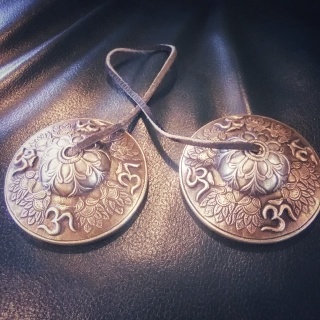
Finally, like my practice’s bell that signals the need for a pause with a breath in between, embodying and enlivening that breath here.
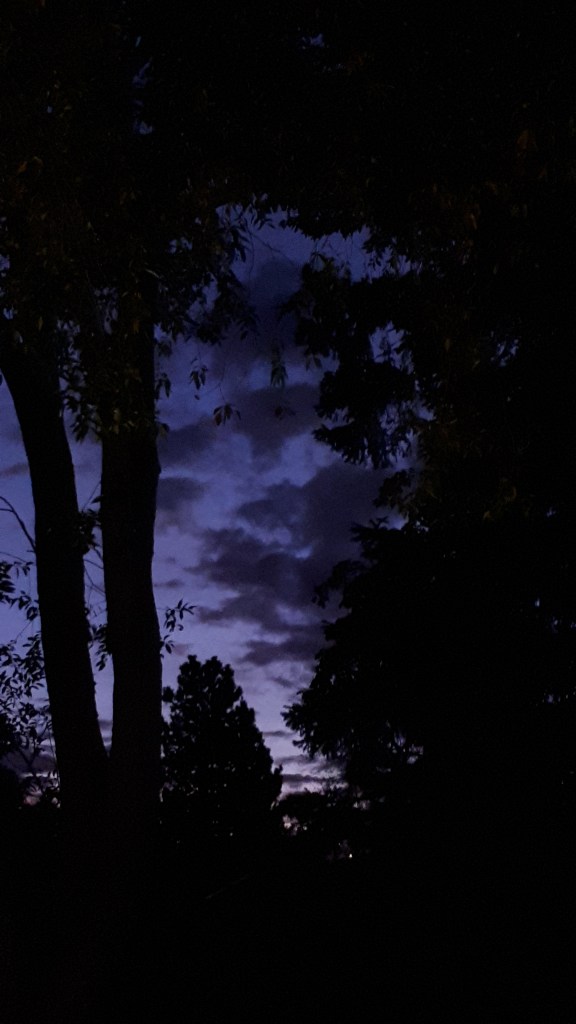
tingshas for ringing in a pause
FRIENDSHIP My last post almost two months ago was an opening into the seldom talked about territory of the distress with broken friendships. As I’d anticipated, my exploration evoked comments from many readers, mostly women. Ranging from encouragement for naming truth, to reframing as peace-making the individual acts of courageously and vulnerably stepping in to invite conversation and clarification, to women sharing related stories of long-standing friendships suddenly going awry, to others feeling the best friendships should be the easiest to maintain (an opinion I countered). If I were to edit that post, I’d clarify that while the opening quote was ample context for both my letter to my friend, and the post, I wouldn’t “walk away in disgust” but rather in sorrow. As has been the case.
Since then, longtime friend Tracy shared a book title that I promptly borrowed from the library. Platonic: How the Science of Attachment Can Help You Make and Keep Friends by Maria Franco (2022) provides an accessible frame for understanding the complexities of early attachment wounding in adult friendships. Suffice to say that John Bowlby’s seminal work on attachment theory, now decades old, is thankfully again seeing the light of day, helping us understand the tricky ground of relationships. Add in the impacts of generational trauma, its impacts on the body-mind, and coping strategies of addiction and we have more than enough reason to find compassion for ourselves and others.
While I’d thought I might have more to write on the subject, my attention has shifted though the questions I hold and the sorrow I feel continue ebb and flow.
MEMORIES At some point during the day, as any of you who store your photos on the cloud know, photo memories appear. Sometimes it’s a past post on social media that I check for relevancy before sharing again. Always it’s the photos I’ve made and stored in the cloud over the years. For the past few days, it’s been photos of my first visit to Morocco in 2019. How utterly poignant to see over and over the beauty of her land, culture and people that captivated me then, that enticed me to return this past March, now in the aftermath of the weekend’s catastrophic earthquake. Writing today to a friend who shares my awe and appreciation for Morocco:“my return to Morocco was most satisfying…my love for her only deepened…my desire to spend more time there was only stoked, not sated.”
To others I acknowledged the bittersweet gift of travel: that with each journey taken, the world becomes smaller, more intimate with each connection made, each friendship forged. So that when such devastating events occur, I cannot help but feel a heart stopping immediacy, a bone resounding impact and meaning. Then anonymous concern gives way to personalized shock and grief.
My dear friend, Omid Safi, an acknowledged scholar of Islamic studies and Rumi, hosts regular “illuminated tours” of Morocco. Evidence of our small world when in March he was with his group in Marrakech as I was with mine in Casablanca. When he saw that I’d attended a cooking class at Marrakesh’s AMAL Women’s Training Center and Moroccan Restaurant, he wrote that its founder was a dear friend. Today he posted their efforts to gather and directly forward donations to families left bereft in the mountain villages hardest hit by the earthquake. I appreciated Omid’s post, resonant with the message I’d heard repeatedly while touring the country, reminding me of those most basic values shared among Abrahamic faith traditions: “send thoughts and prayers, please. Also send aid. Remember that our beloved Prophet says to change things first with your hands, then your tongue, and lastly by the heart. We begin by doing something.”
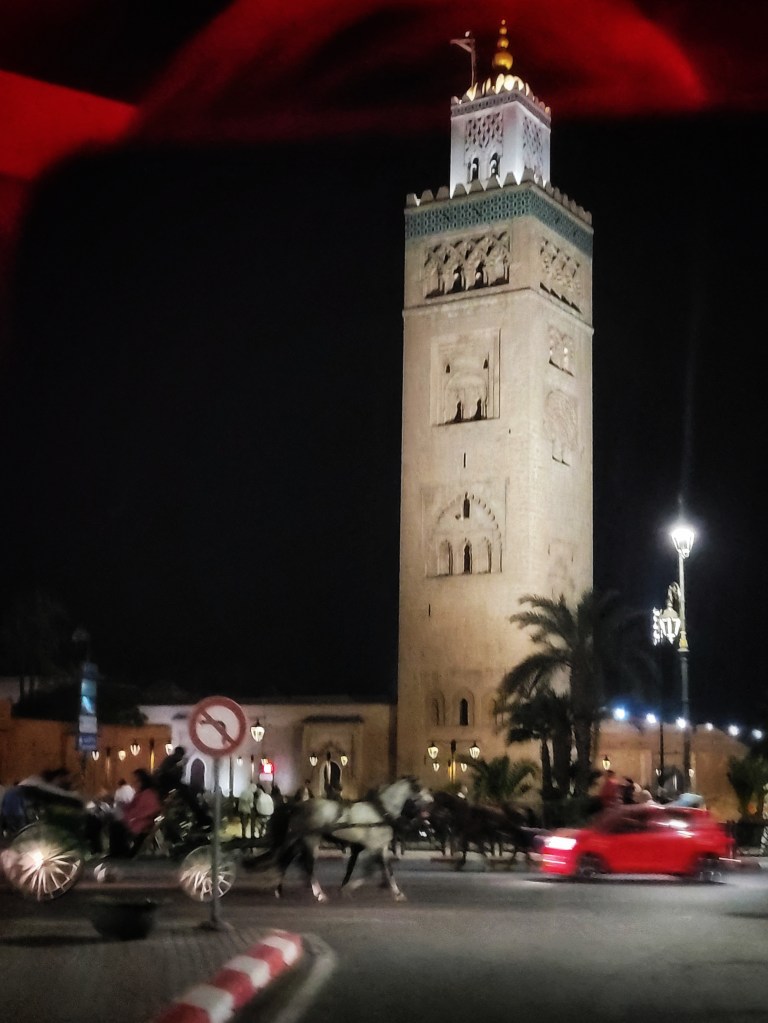
Marrakech’s Koutoubia Mosque, March 2023 September 8, 2023- it shook and swayed, yet stands still erect
ANNIE Among those photo memories are countless ones of Annie. Today a favourite taken a year ago.
It’s been three months since we had to say goodbye to our beloved fur companion. Striking for me has been the coincidence (?) of weather. On both the first- and second-month anniversaries of her passing, the day was exactly as it had been for those initial three days in June: leaden gray skies and steady soaking rain. And like those first three days, each month since I’ve felt held by the sheltering sky, in my grief, my love, my missing, my appreciation for this beautiful being called Annie.
I haven’t yet been able to return to our favourite bench overlooking the pond, nor walk our familiar neighbourhood routes. But in the meantime, I have walked. Close to 320 kms since the end of July. Up and down and through our river valley. Initially with great trepidation, now with confidence that I am as ready as I can be to walk the 16-day, 260 km Via de Francesco from Assisi to Rome. I tended to a collapsed metatarsal of my left foot for most of the spring and summer, the onset of which occurred during that day in March when walking on cobblestone through the labyrinthine medina of Fez. Finally surrendered to giving up pickleball in early June, the activity I’d counted on both to healthfully distract me from grief and to build my cardio fitness, I turned to deep water aqua fitness three times a week. Then my dear friend and former marathoner Thais, created a month-long training program wherein I’d gradually increase the distance and backpack weight to 20+ km and 13+pounds, some of the longest days walked during the highest temperatures of the summer with the greatest weight.
THREE COINS IN THE FOUNTAIN In a week’s time I’ll be settled in Florence for several days, about to meet up with my morning food tour in Otranto. On Tuesday, an early spot at the Uffizi to once again revel in the masters. Another day a city bus up to Fiesole. Then later in the week, a train to Assisi to wander solo and adjust to the first of many hill towns I’ll encounter walking. There I’ll meet with the small group of fellow walkers and pilgrims escorted by our Italian guide, and tour company host, Sandy Brown, writer of several Italian “camino” guidebooks. We’ll conclude our via at the Vatican, giving me several more solo days to decompress in Rome’s Trastevere neighborhood. That coin tossed over my shoulder into the Trevi Fountain last October, now my third, has returned me yet again to another country of my heart.
third coin tossed at the Trevi Fountain, October 2022
“MOVING AT THE PACE OF GUIDANCE” (coined by my friend Christina Baldwin in The Seven Whispers) Walking one day on my own a few weeks ago, I realized how different my preparation for this long-distance trek compared to last year’s Portuguese Coastal Camino. Both then and now booked early in the new year, as I waxed and waned in the early weeks of summer, wondering if I was up to the challenge due to grief and injury, I realized I didn’t know WHY I was making this journey. Last year I had been so clear that I was responding to a decades’ held dream. Such clarity of purpose and my reading of Phil Cousineau’s The Art of Pilgrimage shaped so much of my planning and preparation. Now except for my lists, and clothing and supplies laid out on a bed for weeks, my dedication to my training, I began to wonder about the presence of grace in all of this.
One night trying to sleep after long, hot rugged day of walking, I wept…with exhaustion, with missing Annie, with fear I’d not be up to making the trek, with worry for my husband and a sudden health complication (resolving), and with realizing that with Annie’s passing, my words had died. I did not have the energy to find a word to write. I did manage to polish up a few poems to meet some submission deadlines. And while I trusted this was a temporary state, simply my fallow not a harvest season, I felt sorrow and disappointment that I’d been unable to use my writing to heal my grief, as I’d known other writers to do, published collections being an added result. I felt especially vulnerable as in June I had asked for and received the gift of a weekly writer’s circle with the group of remarkably kind and talented and generous women writers with whom I’d just completed an online course. How could I be in a writer’s circle and not be writing?
Come a week, those four weeks in Italy I will be moving at the pace of guidance. Beyond a food tour and gallery ticket I have nothing booked. Having visited Florence and Rome several times, I feel comfortable wandering, sitting at cafes, watching people, noticing, making photos, and taking a note or many to seed future writing. Walking every day for sixteen, I know from experience there is a simplicity and rhythm that invites heeding guidance, feeling grace.
Realizing the extent to which this summer I have been holding – grief, uncertainty, worry, pain – I feel myself exhaling.
Thank you, dear friends, for your patience as I find my words and my breath. Much love and kindest regards.
“Women are spinners and weavers; we are the ones who spin the threads and weave them into meaning and pattern. Like silkworms, we create those threads out of our own substance, pulling the strong fine fibres, out of our own hearts and wombs.”
Sharon Blackie, If Women Rose Rooted, 2016
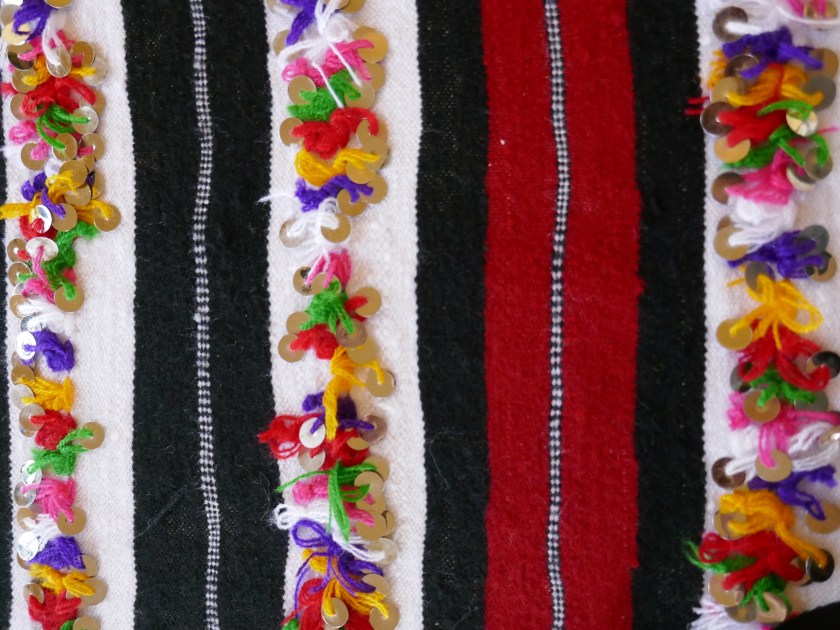
sisters weaving in Errachidia, Morocco, 2019
Gently teasing threads to weave together this week’s post, most vivid are my impressions from the deeply soulful virtual spaces in which I’ve been sitting this month. To name a few:
The monthly Poets Corner Sunday gathering featured Ellen Goldsmith and Lynne Ellis reading several of their poems for healing;
A brief exploration of the wisdom of Mary and the sacred feminine presented by a favourite teacher-writer, Christine Valters Paintner, over at the Wild Luminaries series from Seminary of the Wild.
silk and wool threads and pattern for carpets in Kusadasi, Turkey, 2014
Spinning together these threads, the pattern emerging is my noticing how, in each gathering, women figured predominantly as sources of inspiration and wisdom – either in founding and-or hosting the groups and conversations, or in presenting, writing, teaching, sharing. Noticing how they, their process, and their offerings to the world, reflect and embody qualities of the sacred feminine as described by Christine Valters Paintner:
following intuition
attending to synchronicity
listening deeply to the natural world
surrendering striving
trusting the wisdom of underworld of shadow
honouring vulnerability as strength
embracing slowness and spaciousness
valuing being over doing
Struck by the conversation between Sue Monk Kidd and Terry Helwig – long-time friends and supports to each other’s writing – each described how shedding what no longer matters, simplicity, and literally driving in the slow lane to avoid the felt obligation of rush, make it easier to see, hear and embrace what matters now. How women make each other braver to follow their intuition, honour their vulnerability, do their inner shadow work.
“I think midlife is when the universe gently places her hands upon your shoulders, pulls you close, and whispers in your ear:
‘I’m not screwing around. It’s time. All of this pretending and performing – these coping mechanisms that you’ve developed to protect yourself from feeling inadequate and getting hurt – has to go.’
Time is growing short. There are unexplored adventures ahead of you. You can’t live the rest of your life worried about what other people think.”
Brene Brown
In her words written and spoken, Robin Wall Kimmerer poetically teaches students and her readers how to listen deeply to the natural world, to appreciate indigenous world views and the truth in “all my relations.” Echoed in our book salon conversation, rich in individual perspectives, impressions, and associations, I came away with deepened regard and much deeper regret for all that had been taken away and lost through the colonization and residential schooling of our First Peoples.
“It’s time to make some new threads; time to strengthen the frayed wild edges of our own being, and then weave ourselves back into the fabric of our culture. Once we knew the patterns for weaving the world; we can piece them together again.”
Sharon Blackie, If Women Rose Rooted, 2016
fabric woven in Errachidia, Morocco, 2019
On Saturday I woke to an email announcing that my ekphrastic poem written in response to a track from an electronic music album had been accepted for its anthology. For payment! With a contract coming! The feedback and edits from my writer-in-residence were terrific, just what I need to help this self-taught poet-in-process develop, and realize my innovative contribution to the leadership anthology: “poetic” process observation-recordings of our meetings, and synthesizing chapters into poetic “pauses” to introduce or close chapter sections.
Right about now, two years ago, we were getting ready to leave for a winter sojourn in southern Spain. A couple of weeks, mid to late February, travelling by bus and train through Andalusia – Sevilla, Aracena, Cordoba, Granada, Malaga and then back to Sevilla. And then upon our return home, the world would change. Today, nearly two years later, unprecedented impacts from the pandemic continue to roll out like an endless line of falling dominoes.
In response to a friend’s blog last week, I wrote “this seems to be the time and the place where the art, the poem, the story, the prayer, the silence, the conversation, the thank you, the kiss, the embrace may comfort, soothe, sustain and help us find our way.”
“Women can heal the Wasteland. We can remake the world. This is what women do. This is our work.”
There is nothing I can write today that isn’t already being penned by those more astute, more qualified and more proximate to the rioting south of me in the United States, this time catalyzed by the murder of George Floyd, a black man, by a white police officer in Minneapolis. To say the collective outrage is palpable would be a gross understatement. As I write, headlines appear on my screen reporting increased aggression and violence from police towards protesters. And all the while, the nation’s “leader” resorting to his m.o. – ironically one he tried to shut down this week – tweets with the effect of throwing gasoline on fire. To say these already volatile scenarios in American cities are being intentionally and strategically inflamed by bands of out-of-state Neo Nazis and white supremacists, taking their lead from the one in charge, might be speculation bordering on truth.
So I borrow from the words of others to help me find my own.
And a perspective I heard yesterday in a zoom conversation.
“We need to connect the demand for justice – which is an outpouring of love – with tenderness.”
Omid Safi Islamic scholar and teacher of The Heart of Rumi, May 30, 2020
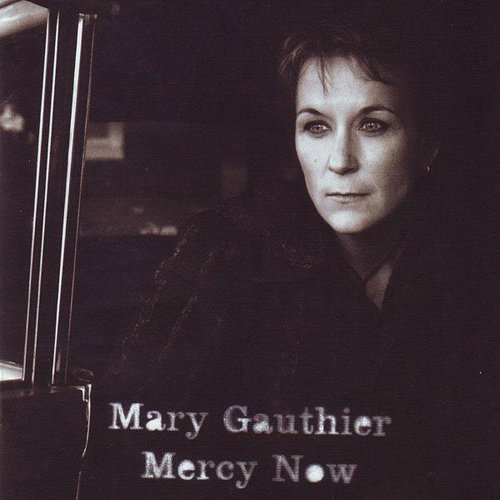
Over the years at summer folk festivals across my province, I’ve heard American songwriter Mary Gauthier sing one of her most memorable songs, Mercy Now. Released in 2005, its relevancy persists as a poignant anthem for these times. Reading the lyrics over at her website for an excerpt here, I realized, with a heavy heart, that every word is as pertinent today as then. Maybe because her gift is to write with a sparse honesty about our human condition.
“…My brother could use a little mercy now He’s a stranger to freedom He’s shackled to his fears and doubts The pain that he lives in is Almost more than living will allow I love my brother, and he could use some mercy now
…Yea, we all could use a little mercy now I know we don’t deserve it But we need it anyhow We hang in the balance Dangle ‘tween hell and hallowed ground Every single one of us could use some mercy now…”
Mary Gauthier, Mercy Now, 2005
I’ve completed the seventh week in The Soul of a Pilgrim with its practice of “embracing the unknown.” This, too, a reality of the human condition, despite our best efforts and delusions to think we know one moment beyond this one. An early morning practicing the art of contemplative photography, framed by this theme, bore these ephemeral gifts of tender mercy in image and word.
Please, can I have a God who within me beyond me enboldens, encourages, enthuses me and we
to be better to do better
for self and kin of every tribe and colour every love and gender
so that me and we may always love, live and breathe
free.
(inspired by “Please, Can I Have a God,” by Christine Valters Paintner, in The Soul of a Pilgrim, 2015)










 A Wabi Sabi Life