Joy and Sadness

…At the same moment, I experienced exactly the opposite emotion. The tears were at the same time tears of an immense sadness—a sadness at what we’re doing to the earth, sadness about the people whom I had hurt in my life, and sadness too at my own mixed motives and selfishness. I hadn’t known that two such contrary feelings (joy and sadness) could coexist. I was truly experiencing the nondual mind of contemplation.

Richard Rohr, Daily Meditation, Tears of Joy and Sadness, 2025

A “better late than never” post, I knew when I’d read Rohr’s meditation yesterday that it would be good grist for my writing mill, but I’ve been struggling to find the words.

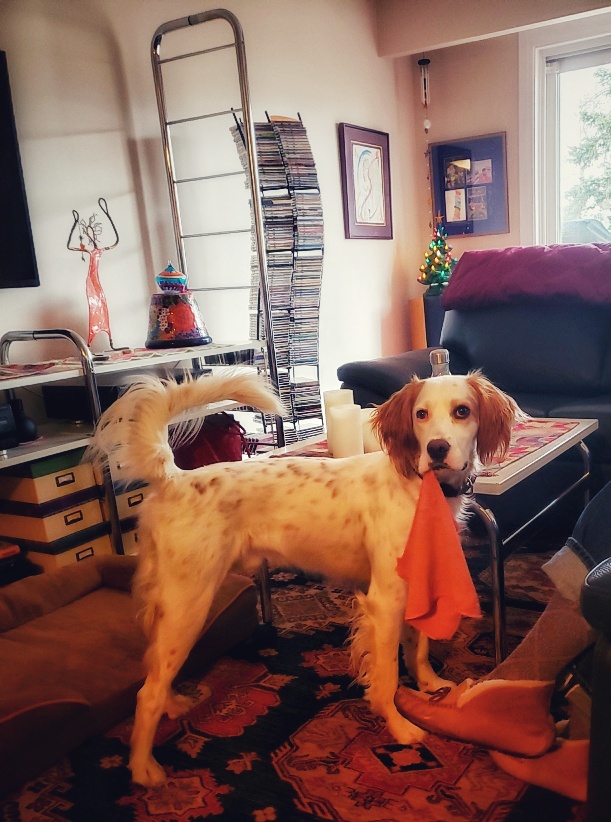
Yesterday, when I’d read another email with the invitation to share a favourite dog poem, I suddenly realized it had been two years to the day (not date) when we’d said our final “good-byes” to Annie. Reading and recalling, at the same time I was hearing Walker the Joy Boy, bounding up the stairs to watch squirrels with a second floor advantage. His version of screen time, says Sig, as he can spend hours glued to those floor to ceiling windows.

Bittersweet.

There’s the world close up, across the border, and oceans away…the new e-bike I bought last week…the need to find the perfect buyer for its predecessor, my Danish cruiser…the hail that for two nights shattered blossoms and shredded leaves giving a poor prognosis for some harvests…the rain that finally fell for hours and hours soaking the parched earth…a lingering sadness from my birthday…the delight with my new decade new haircut.

Bittersweet. The co-existence of two contrary feelings.

Still at a loss for this blog, I turned to editing some poems. Trying to track down a reference to one, I opened Breathe, a collection from Lynn Ungar. I know it’s not Friday when I typically post a poem, a photo, and a reflection, but this is it. With better words that I can muster at the moment to acknowledge life’s bitter and its sweet, and unabashed joy that comes from living with dogs – Beckey, Sassy, Torch, Peggy, Lady, Annie, and Walker.

JOY

I don’t need to tell you this world
is hard, and getting harder.
We thought it would be better than this-
more sensible, more neatly worked out,
more righteous, according to our impeccable
analysis of what righteousness should look like.
And yet, here we are. No good pretending
it isn’t both a slog and a crisis,
which is to say, wearing on every last nerve.
And still, when you least expect it,
you find yourself ambushed by Joy, who,
tail whipping and ears slicked back to her head,
launches herself into your lap,
leaving you breathless
and covered in kisses.

Much love and kindest regards, dear friends.

Our Joined Sorrows

LANGUAGE OF LIGHT
Next to the garden beds I wait
while summer’s profusion wanes

the sycamores stand in unity rows
guarding a path for the recently dead

arboreal complexion of limbs and trunk
sentient camouflage in pale olive and tan

trees older than first-born stars
leaves shimmering in the language of light.

Diana Hayes, Language of Light, 2023

I’ve started my preparation for another autumn long walk in Italy. This time, a small women’s group walking a small portion of the ancient Via Francigena from San Miniato, Tuscany to Rome. No doubt obvious to you who follow me here and on social media, I am smitten with Italy, and am borrowing a page from a once friend who said there was something about returning repeatedly to the same place, to venture deeper in.

I feel good going into this summer’s training. Last year’s foot injury has healed. So, too, my heart – mostly – from Annie’s year-ago passing. Following the same program developed by my friend, I’m starting a month earlier and so feel an ease and confidence I didn’t last summer. Every other day, alternating with pickleball, and a rest day, my chiropractor approves.

Today it rained. I opted for a slow start hoping for the forecasted three-hour break in the showers. Eventually I decided to dress for the weather and set out with my new floral knee-length rain poncho. I “ruck,” meaning when I walk, I carry at least ten pounds of weight in my pack, use my poles and wear my hiking boots, and made of today an experiment in waterproofing and breathability. Better to test here than thousands of miles and another continent away.

Last year, my friend accompanied me on many walks. This year, plagued by her own chronic foot injury, I’ll be walking alone most days. And I’m quite OK with that, given my proven way, even in groups, of often walking solo, in silence, with my camera ever ready. And so it was, Tuesday and today (Thursday), I resumed my lapsed practice of listening to podcasts. Several On Being with Krista Tippett episodes, the last one featuring a conversation with poet, essayist, teacher, and community gardener Ross Gay on The Insistence of Joy. His closing words struck deep:

Is sorrow the true wild?
And if it is — and if we join them — your wild to mine —
what’s that?
For joining, too, is a kind of annihilation.
What if we joined our sorrows, I’m saying.
I’m saying: What if that is joy?

Step by step, mulling his concluding words, that powerful question, as light showers grew heavier, I switched over to another of my favourite podcasts, Ellipsis Thinking, created and hosted by my dear friend, Greg Dowler-Coltman. In this episode a conversation with Saltspring Island poet Diana Hayes, the author of today’s chosen poem. Greg had gifted me with Diana’s chapbook, Language of Light, an exquisite collection borne of her near inconsolable grief for her mother’s too-soon death from breast cancer, the same cancer she suffered at the same time. As I listened, struck again by Greg’s talent for deep listening and thoughtful questions emerging from his innate and kind curiosity, I felt a kindredness with Diana’s way of being in the world and as a poet.

Bittersweet is what comes to mind. Knowing oneself and another when we are vulnerable in disclosing and joining our sorrows. The poignant, piercing joy that can result when we do.

Much love and kindest regards, dear friends.

Joy and Lament

I’ve been thinking about joy and lament for the past few days. How – as poet Christine Valters Paintner described them – as “sisters,” who make space for one another, even, I’d say, needing one another for a purer expression of each. I had logged onto a live Zoom call with Christine and a couple of hundred others from around the world for this year’s Novena for Times of Unravelling, another soulful offering from the Abbey of the Arts, this time oriented around the principles of their Monk’s Manifesto.

This day’s theme was cultivating creative joy by letting body and “heart overflow with the inexpressible delights of love.” Christine was clear to say this joy “isn’t about happiness, but something deeper…an opening to the capacity to taste paradise…and that this capacity for joy is in proportion to our capacity for grief.”

we’re back

A few days earlier, I sent a “thank you” email off to another favourite poet, Samantha Reynolds, who writes under the pen name of “bentlily.” I think I’ve mentioned here that every Monday I’m greeted with her past week’s offering of daily poems, her practice for eleven years of musing on life’s daily moments. Included that week was her “17 flavours of joy”, evoking my memory of the “visceral experience of joy hurting a bit, being like an arrow that pierces my heart…unlike happiness, which is lovely, but not nearly as deep, as profound, as indelible.”

Today, a full moon, and in the Christian tradition, Palm Sunday, the beginning of Holy Week. Too, the beginning of Jewish Passover. And in a couple of weeks, Ramadan. A “trifecta” of high holy days among the Abrahamic religions. I always intuit a certain potency of energy and possibility during such synchronicities. Maybe even a thinning of the veil. Certainly, an opening to the range of feelings and memories evoked. Life’s joys and laments.

Before I sat down here to write, Annie and I walked to beat the forecast spring thunder showers. Of all the choices, I plugged into the just “dropped” On Being re-broadcast of Krista’s 2016 conversation with Northern Irish “Troubles” poet, Michael Longley. Called “The Vitality of Ordinary Things,” they explored the range of Longley’s poetry – his adoration, celebration and worship of wildflowers, birds, his ordinary and real life.

“I want the beauty, the psychedelic wildflowers, the call of the wild birds. I want all of that shimmering beauty to illuminate the northern darkness. We have peace of a kind, but no cultural resolution — the tensions which produced the Troubles are still there. It is important for me to see beautiful Carrigskeewaun as part of the same island as Belfast.”

Michael Longley in On Being with Krista Tippett, March 25, 2021

I like how he describes what being a poet and writing poetry mean for him.

“…good art, good poems, is making people more human, making them more intelligent, making them more sensitive and emotionally pure than they might otherwise be.”

Michael Longley in On Being with Krista Tippett, March 25, 2021

For me, the capacity to hold joy and lament…in one’s life, in situ.

Much love and kindest regards, dear friends.