In the Days That Follow

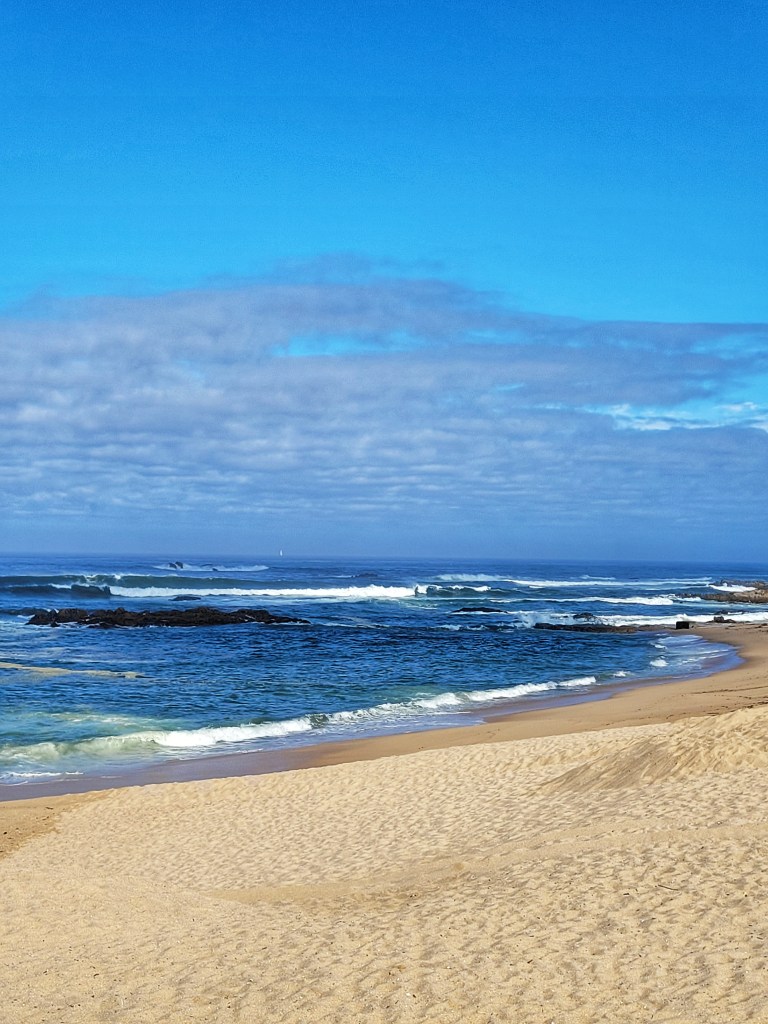
walking the Portuguese Coastal Camino, May 2022

In the Days That Follow

Imagine the wrongs made right, the crooked made straight
the middle way the means to hold the center strong
the point to rise again to choose again
to act with love, to be kind.

Invoke the wisdom of ancients, angels, and ancestors
with wild words of song, and prayers whispered
over a cauldron wrought of shadowed griefs
fired by our righteous rage.

Mix equal parts beauty, truth, and justice into
an elixir made in paradox, luminescent in the dark
heaven sent on the more-than-human breath
earth bound on waves of sand and water.

Elemental formula with sacred geometry
to bravely mend and steadfastly restore
our broken hearts, a torn country,
the exhausted planet.

A work in progress, this poem coalesced the day following the US election. Like many around the world, I awoke to the news I’d hoped and prayed would be different. A brief scroll though social media and a friend’s post of an image – no words – of a tear falling down a woman’s cheek said it all.

Last night, I began reading The Dreaming Way: Courting the Wisdom of Dreams (2024), the latest book by Toko-pa Turner. An internationally recognized dreamworker and one with whom I have personally studied, Toko-pa writes, “As our dreams nudge us in step with the larger intent of nature, we grow to see how necessary we are to these troubled times.”

Describing the Dreaming Way as the practice of choosing to live in reciprocity with the inner and outer worlds, she encourages us to regularly shift our attention away from our modern, external life of reason and rationale to take seriously the imaginal world and dreaming. By doing so, we are contributing to the shifting power in the world and enacting a revolution from within.

My poem, sourced from and steeped in the richness of the imaginal world, is a homage to knowing, trusting, and valuing the necessity of walking in both worlds, my long-time way of being. Now, I recommit to paying more and regular attention to my inner life, a takeaway from my most recent long walk, and the boon of living in my eldering landscape. My life and our world depend on it.

Much love and kindest regards, dear friends.

Clouds

CLOUDS
All afternoon, Sir,
your ambassadors have been turning
into lakes and rivers.
At first they were just clouds, like any other.
Then they broke open. This is, I suppose,
just one of the common miracles,
a transformation, not a vision,
not an answer, not a proof, but I put it
there, close against my heart, where the need is, and it serves

the purpose. I go on, soaked through, my hair
slicked back;
like corn, or wheat, shining and useful.

Mary Oliver, in Why I Wake Early, 2004

Oh, the clouds.

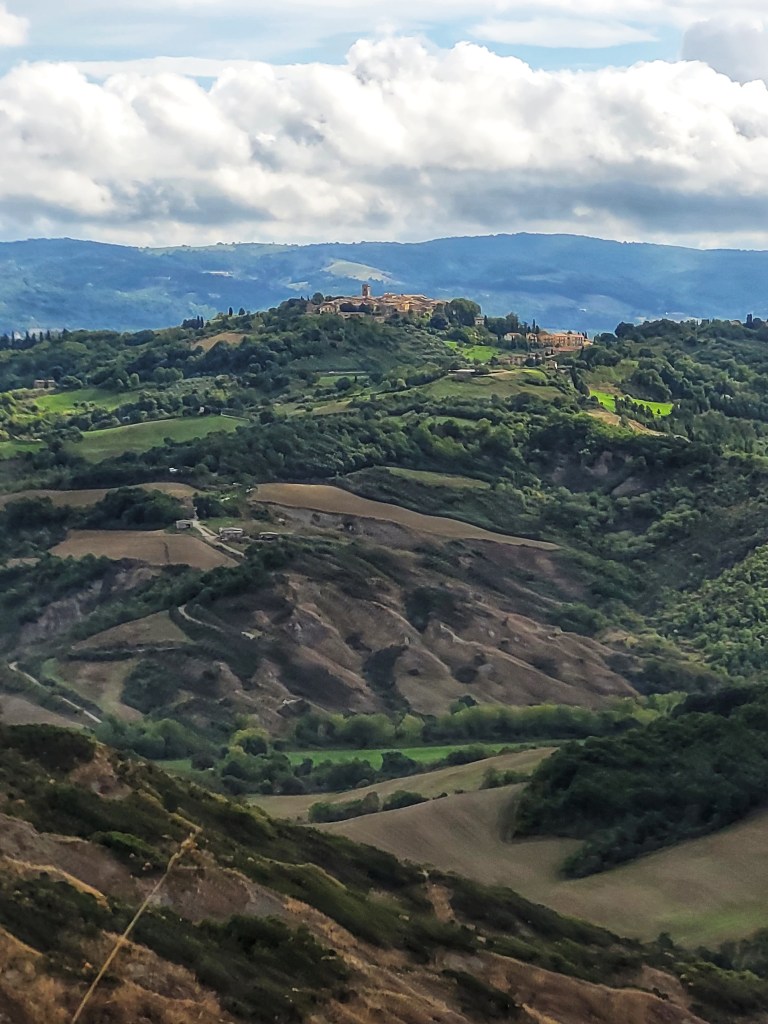
Walking most of the eighteen days in Italy on la Via Francigena – up and down Tuscan hills, across the wide expanses of freshly tilled farmland, in forests dappled with light or dark and sodden with rain – those heavenly ambassadors companioned us, occasionally letting loose their heavy load. A common miracle turned potentially disastrous, depending on the day, the colour of the weather alert (yellow, orange or red) and location in the country, or continent. (In Morocco last week, rain turned years’ dry lakes and rivers into muddy flows.) We were always safe, with our technical guides, Ambra and then Laura, always checking on their various weather and trail apps.

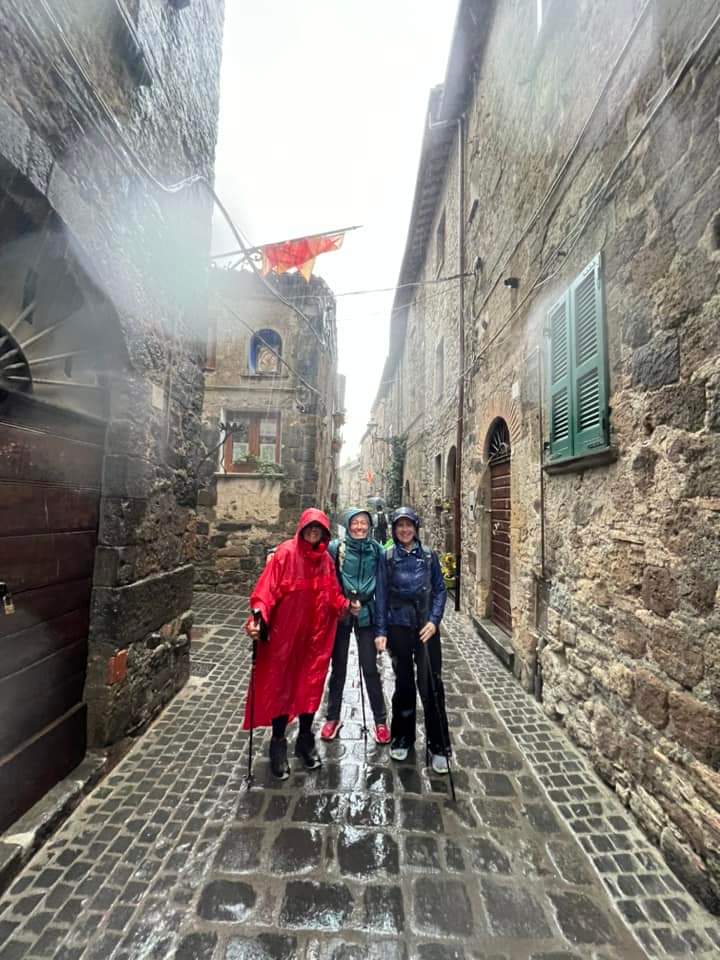
One day, I accepted the invitation to make the memories that come from braving the elements, and walked with three of my companions the distance to Bolsena- every step in the persistent rain and wind. Twenty-six kilometers from early morning to late afternoon through acres of dying sunflowers, village streets, forest paths, up into the medieval town and then down its treacherously steep and slippery cobblestone to the lakeside town’s more contemporary hotels. Clouds so thick the spectacular views obscured until the next day.

Soaked but warm. No waterproofing enough to withstand the deluge.
Shining and smiling. Proud of our accomplishment.

Memories made.

Much love and kindest regards, dear friends.

memories made in medieval Bolsena, Italy (me in red)
photo credit: Laura Harris

Sleeping in the Forest

I thought the earth
remembered me, she
took me back so tenderly, arranging
her dark skirts, her pockets
full of lichens and seeds. I slept
as never before, a stone
on the riverbed, nothing
between me and the white fire of the stars
but my thoughts, and they floated
light as moths among the branches
of the perfect trees. All night
I heard the small kingdoms breathing
around me, the insects, and the birds
who do their work in the darkness. All night
I rose and fell, as if in water, grappling
with a luminous doom. By morning
I had vanished at least a dozen times
into something better.

– Mary Oliver –

This poem arrived shortly after I had posted Monday’s blog, Love Letters to Life. Its imagery brings to life what I could only hope to have conveyed. That by walking alone along the same river routes for weeks, I began to know and feel my relationship with earth, with life, and its relationship with me. That as I re-remembered this, so, too, was I being remembered, taken in, and held by earth.

A few minutes ago, I wished my friend “buona notte” as we concluded our monthly Zoom call. Held within our mutual love and respect for each other, our conversations always bring gifts – an insight, deeper clarity, more to ponder. Knowing that in a week’s time I’ll be in Italy, feeling its imminent “realness” and growing excitement and curiosity, with her invitation I was able to speak my intention for walking, alone-together with women, currently strangers, but soon to be walking mates.

May we feel remembered by the earth.
May we “sleep as never before,” rising each morning rested, refreshed, and ready for the day’s stage.
May our thoughts “float as light as moths among the branches of perfect trees,” and not weigh heavy as stones in our packs.
May we feel the presence, support, and joy of being with each other, inviting each other and ourselves into “something better.”

This will be my last Friday photo and poem feature until my return in mid-October. I expect to post “love letters” on Facebook if you’d like to follow along. Until then, much love and kindest regards, dear friends.


Love Letters to Life

“We were lovers who … decided to make the world a better place by slowing down long enough to pay for its improvement—by paying attention, the reverent, even holy attention of love.”

Brian McLaren, The Galápagos Islands 

My understanding of “paying attention” as a form of gratitude and reciprocity for the abundance we receive from the natural world first came to my awareness when I read Robin Wall Kimmerer’s Braiding Sweetgrass. A couple of years ago, I wrote here about its impact on me. Now, reading last week’s daily meditations from Father Richard Rohr’s Center for Action and Contemplation, with the theme “Befriending Nature,” and listening to podcasts wherein the notion of “anima mundi” had been mentioned, I re-remembered a gift of walking alone, or with another but silently: the slowing down to notice… to really take in… to pay with my attention.

Since July, I have walked over 400 km solo, accompanied by the soft tapping of my poles on dirt and pavement paths; voices heard through my earbuds narrating novels and poetry, or in podcast conversations; urban infrastructure; people and their dogs and babies. During every outing, along routes that have become like familiar friends, I’d stop several times to simply breathe deeper and take in my surroundings: the unusual birdsong; the season’s changing colours; temperatures warmed or cooled by a sudden breeze; the river’s surface. During every outing, always an image or several made with my phone to reflect some essence of that day’s beauty. And after every walk, I’d record the steps, kilometers, and time walked and post it together with my photos and a brief description of my experience. The longer I did this, the more I realized that what I was really doing was composing love letters to life. By showing up on those paths every other day for weeks and noticing and recording, I was saying:

I am here to be with you, to walk in, and among, and on you.
I am here to notice you, to be in relation with you, to be moved, and changed by you.
I am here to say thank you for always, unfailingly, uplifting me – turning my fatigue into curiosity, my sour mood into a smile or a tear.

When I walked the Portuguese Coastal Camino, most of that distance solo and unplugged, I composed a chant from words I’d read by Thich Nhat Hahn and Rumi, to help maintain my rhythm and bring some ease and pleasure to the long distances:

With every step I kiss the Earth.
With every step I make a prayer.
The Soul comes for its own joy.
Dance on, dance on, dance on.

This time, while I’d only remembered the first line, whisper-singing it in a new iteration as I walked, I was mindful of making prayers for friends unwell and suffering. This summer, and in a few weeks’ time in a country I deeply love, walking a section of the Via Francigena, I slow down long enough to pay my attention…my reverent, holy attention of love.

Much love, kindest regards, and many thanks for your support and encouragement during my preparation.


So Much Happiness

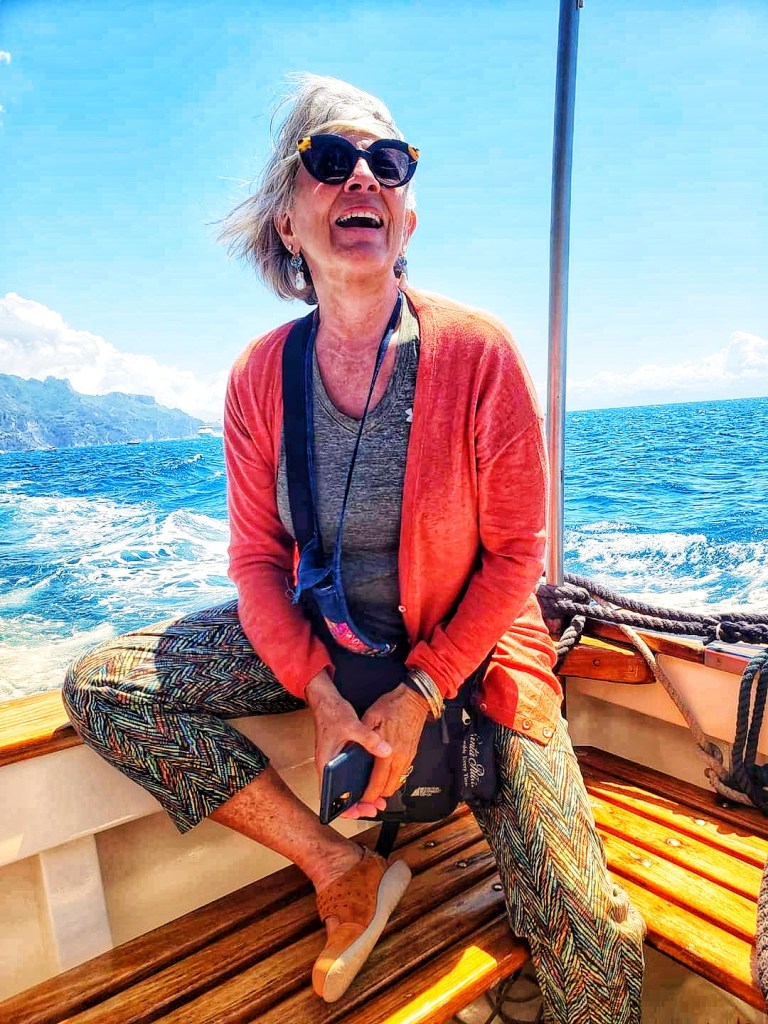
so much happiness…in a boat by the Amalfi Coast

SO MUCH HAPPINESS

It is difficult to know what to do with so much happiness.
With sadness there is something to rub against,
A wound to tend with lotion and cloth.
When the world falls in around you, you have pieces to
pick up,
Something to hold in your hands, like ticket stubs
or change.

But happiness floats.
It doesn’t need you to hold it down.
It doesn’t need anything.
Happiness lands on the roof of the next house, singing,
And disappears when it wants to.
You are happy either way.
Even the fact that you once lived in a peaceful tree house
And now live over a quarry of noise and dust
Cannot make you unhappy.
Everything has a life of its own,
It too could wake up filled with possibilities
Of coffee cake and ripe peaches,
And love even the floor which needs to be swept,
The soiled linens and scratched records….

Since there is no place large enough
To contain so much happiness,
You shrug, you raise your hands, and it flows out of you
Into everything you touch. You are not responsible.
You take no credit, as the night sky takes no credit
For the moon, but continues to hold it, and to share it,
And in that way, be known.

~ Naomi Shihab Nye ~

I’ve been absent from this space for a few weeks. I’ve been preoccupied with walking in preparation for another long walk in Italy. This time, a section of the Via Francigena, one of the oldest of Europe’s many pilgrimages. In three weeks, I’ll be bound for Rome where, the Fairweather and Travel gods willing, I’ll land, secure my train ticket at the airport, and continue to one of Tuscany’s famous hill towns, San Miniato. There, I’ll stay in a bright, spacious apartment with a view onto vineyards and hills, to rest, recalibrate and meet my walking mates four days later.

This summer, I’ve walked close to four hundred kilometers in our river valley, rain or mostly shine, and mostly alone. When I’m not listening to podcasts or audio books, I’m aware of my shifting moods. Those uninvited guests – the sadness or irritation, self-doubt, and even anger – most often at the beginning of a walk when fatigue and loneliness weigh, when I’ve yet to find my stride, or my place within the nature that is surrounding me. When I stop to notice the beauty holding me, to breathe, to give myself a few words of encouragement for persevering, then happiness and gratitude arrive.

While this wasn’t the year for peaches here – cold froze the Okanagan orchards – we did have a bumper crop of raspberries with many eaten fresh and many more frozen for winter muffins, galettes, and smoothies. And that errant red currant seed dropped by a bird a couple of years ago bore just enough berries to make my first ever two small jars of glistening garnet-coloured jelly. So much happiness in a spoon, spread on sourdough seedy rye toast.

Much love and kindest regards, dear friends.
Beauty Comes From Loss

Some say you’re lucky
If nothing shatters it.

But then you wouldn’t
Understand poems or songs.
You’d never know
Beauty comes from loss.

It’s deep inside every person:
A tear tinier
Than a pearl or thorn.

It’s one of the places
Where the beloved is born.

~ Gregory Orr, Concerning The Book That Is the Body Of The Beloved

One from my “saved poem” file from a poet who writes from knowing deep loss and nearly unbearable grief.

A poem that touches on the essence of my writing and my wabi sabi life. That beauty is found in life’s imperfections and comes from its losses. That with time, in a life sometimes broken, but mostly well-lived and much loved, such beauty becomes polished, like the grain of sand that becomes the pearl, rubbed inside the oyster’s shell. It’s like that for all of us – deep inside every person – if we choose to look at life this way

For the past many years my earrings of choice have been silver-grey freshwater pearls, embellished with tiny sterling silver beads, a signature design from Canadian jeweler, Effie Baker. They’re an interesting juxtaposition to the simple diamond studs that I always wear, my birthstone, and a Christmas gift many years ago from my husband. Last summer, after a long wait and good fortune, I gifted myself with a pair of baroque pearl earrings hung from antique Chinese silver and enamel made by another Canadian designer Soma Mo, first seen during covid and for many months sold out. In recent months, I’ve taken to wearing hers every day.

There’s something about pearls that speak to me of the feminine…originating from the watery realm of feelings and intuition…their voluptuous shape and subtle luster…how they become warm with wearing. These pearls remind me of the love in which these two women artists create…a love then gifted to me when I was attracted and responded by allowing myself to purchase them.

The beauty found in, and from loss, that when rubbed up against, as in life, becomes transformed. The beloved born in that.

What a poem and pearl earrings can evoke.
Much love and kindest regards, dear friends.
Consider the Life of Trees

Consider the life of trees.
Aside from the axe, what trees acquire from man is inconsiderable.
From their mute forms there flows a poise, in silence;
a lovely sound and motion in response to wind.
What peace comes to those aware of the voice and bearing of
trees!
Trees do not scream for attention.
A tree, a rock, has no pretense, only a real growth out of itself
in close communion with the universal spirit.
A tree remains in deep serenity.
It establishes in the earth not only its root system but also
those roots of its beauty and its unknown consciousness.
Sometimes one may sense a glisten of that consciousness, and with
such perspective, feel that man is not necessarily the highest form of life.

Cedric Wright in Earth Prayers From Around the World, 1991

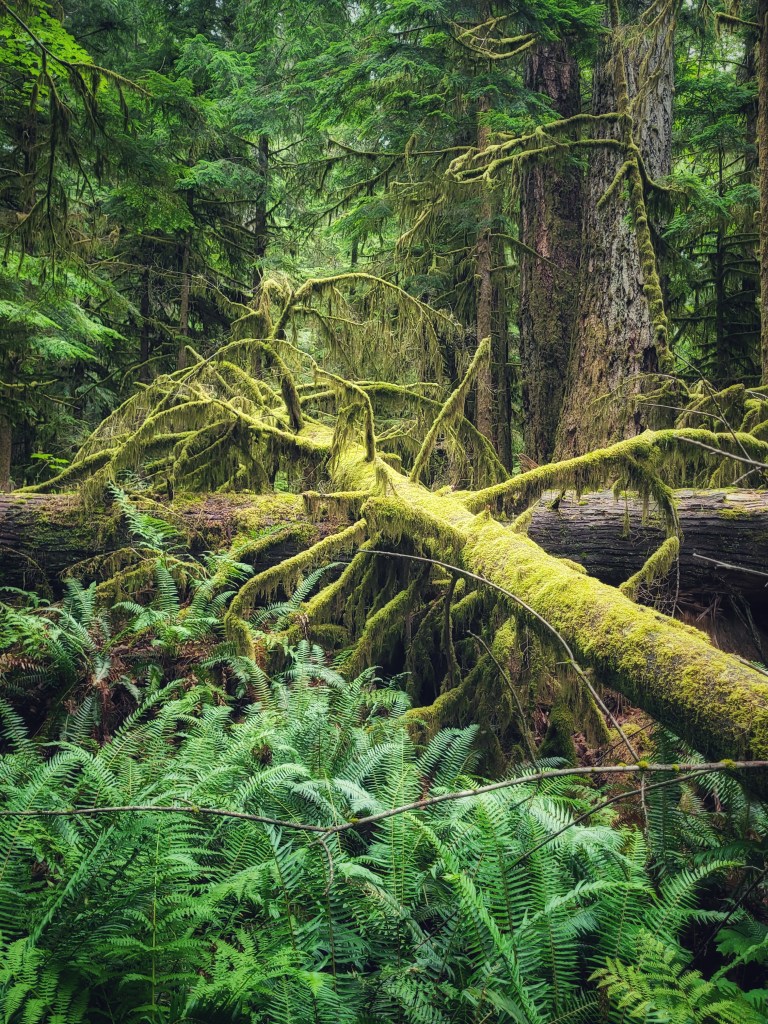
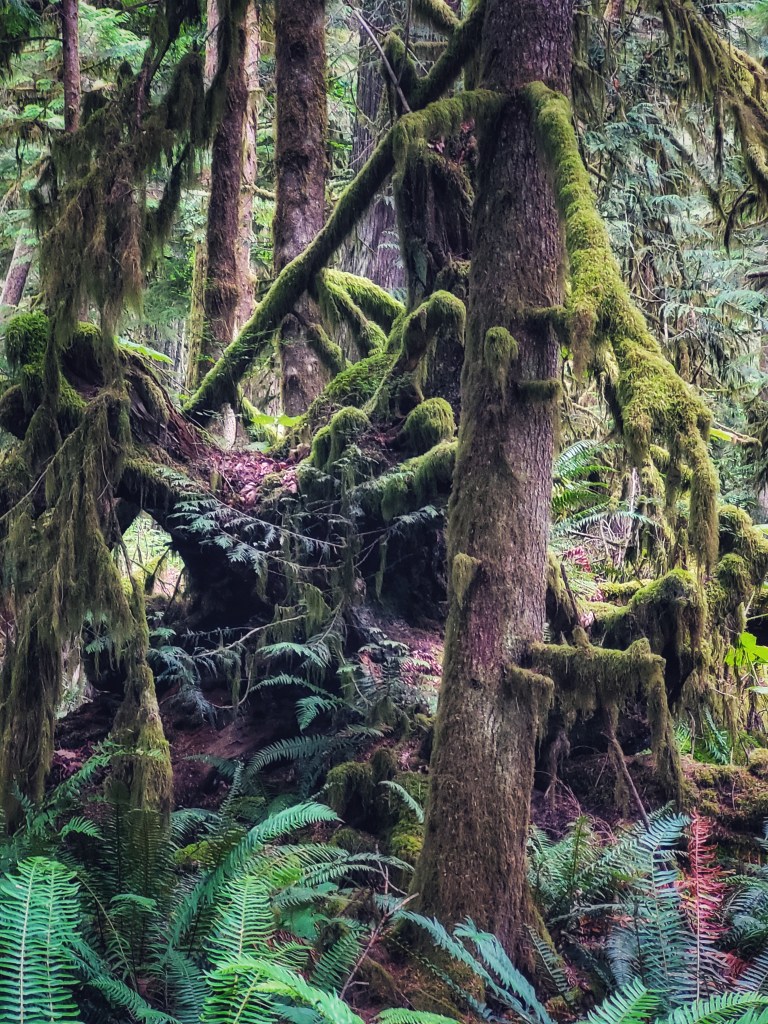
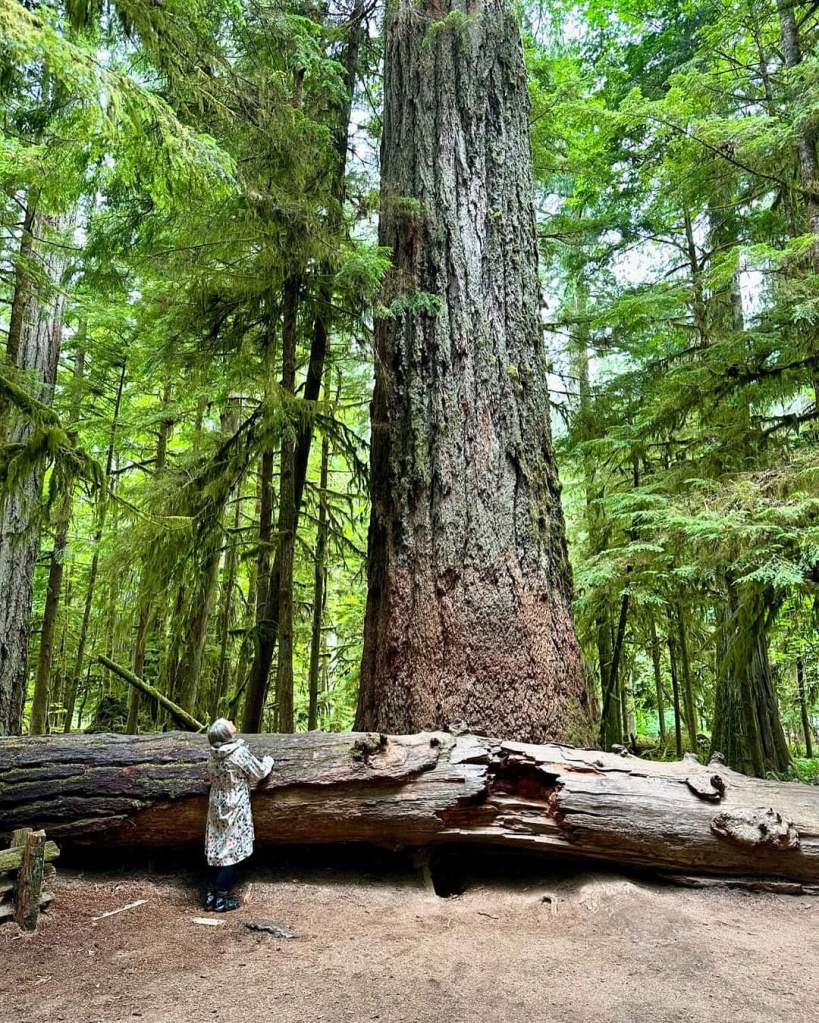
I returned home last night from four days on Vancouver Island, visiting dear friends whose home and hospitality make for a soul-restoring haven. They graciously show me their favourite sights, trusting I’ll delight in what they’ve discovered since relocating there a few years ago. This year, the weather was more in keeping with a Pacific Northwest autumn: cool, overcast, misty with showers, giving us plenty of conversation time in the warm glow of their indoor and outdoor fireplaces. Tuesday, we drove to Cathedral Grove, a popular tourist site along the Tofino highway, graced by a stand of giant, ancient Douglas Firs. It was my first time encountering these enormous stately sentinels. I was rendered awestruck and silent in their presence, taken to the place I have named “before, beneath and beyond words.” One hundred photos later, my friend’s one of me standing in that awe in front of the grove’s largest tree, one estimated to be over 800 years old, and taller than Italy’s Leaning Tower of Pisa, confirmed the perspective that neither man nor woman are the highest form of life.

perspective

Much love and kindest regards, dear friends. And a heart full of gratitude to my friends for the unforgettable experience.

These Days

Medicine Walking

THESE DAYS
Anyone who tells you not to be afraid
should have their head examined.
Cities are burning, hillsides are ablaze.
and the dumpster fire of our common life
is out of control. I wish I could tell you
when it was going to get better.
I wish I could promise that better
was anywhere down this road.
I miss dancing, bodies in something
between conversation and flight.
I miss singing, the way we trusted
the air that moved between us. I miss
the casual assumption that everything
would be alright in the morning.
These days I am trying to be buoyed
by the smallest things –
a ripe tomato, a smattering of rain.
These days I am trying to remember
that songs of lamentation
are still songs.

Lynn Ungar, These Days: Poetry of the Pandemic Age, 2020

There is so much about this poem – found searching my bookshelf for one to frame my day, this week, my life, LIFE – that is in perfect alignment, despite it being written four years ago with its context the pandemic.

Today, I did a Medicine Walk along my favourite river valley route. Despite training for my long walk in September, this walk was not about distance, elevation, or pace. In honor of the feast day of Saint James – Sant Iago, as in Santiago, as in the Camino – it would be a walking prayer for the health and well-being, for a miracle, for a friend… for several friends… each besieged by life-threatening illness. It became, too, a prayer for all beings displaced, distraught, and destroyed by the wildfires.

Despite an almost twenty-degree drop in temperature, with the morning overcast, thick with smoke from wildfires that last night ravaged one of Alberta’s beloved treasures, Jasper National Park, and its century old townsite, and heavy with rain that eventually, blessedly fell, I dressed for weather and set out. I chose as my audio companion the exquisitely composed “Camino” by the late Canadian violinist, Oliver Schroer. The first notes of the first track, “Field of Stars,” are a haunting homage to Santiago de Compostela (field of stars). The ambient tracks blended with birdsong on my path such that I felt surrounded and held by the morning’s poignant beauty. A perfect reflection of my interior landscape and the devastated one to the west.

Where a few weeks ago pink wild roses bloomed thick and heady with perfume, today’s bushes were laden with ripe purple saskatoon berries and blood-red wild raspberries. Golden yarrow and wild sage filled river banks. To my way of thinking, tasting those berries was my holy communion, the real “body of Christ.”

As steam rose from the placid river, a lone pelican glided above on its huge, outstretched wings. I lost sight of it, and then looking up, there he was again, effortless in his flight. I wondered about the significance of his appearance as I’d never seen one before on this stretch. Once home, I consulted Ted Andrews’ classic Animal Speak to learn they represent renewed buoyancy, unselfishness, and the need to not be weighed down by emotion. Wise medicine for these days.

Much love and kindest regards, dear friends.
Our Joined Sorrows

LANGUAGE OF LIGHT
Next to the garden beds I wait
while summer’s profusion wanes

the sycamores stand in unity rows
guarding a path for the recently dead

arboreal complexion of limbs and trunk
sentient camouflage in pale olive and tan

trees older than first-born stars
leaves shimmering in the language of light.

Diana Hayes, Language of Light, 2023

I’ve started my preparation for another autumn long walk in Italy. This time, a small women’s group walking a small portion of the ancient Via Francigena from San Miniato, Tuscany to Rome. No doubt obvious to you who follow me here and on social media, I am smitten with Italy, and am borrowing a page from a once friend who said there was something about returning repeatedly to the same place, to venture deeper in.

I feel good going into this summer’s training. Last year’s foot injury has healed. So, too, my heart – mostly – from Annie’s year-ago passing. Following the same program developed by my friend, I’m starting a month earlier and so feel an ease and confidence I didn’t last summer. Every other day, alternating with pickleball, and a rest day, my chiropractor approves.

Today it rained. I opted for a slow start hoping for the forecasted three-hour break in the showers. Eventually I decided to dress for the weather and set out with my new floral knee-length rain poncho. I “ruck,” meaning when I walk, I carry at least ten pounds of weight in my pack, use my poles and wear my hiking boots, and made of today an experiment in waterproofing and breathability. Better to test here than thousands of miles and another continent away.

Last year, my friend accompanied me on many walks. This year, plagued by her own chronic foot injury, I’ll be walking alone most days. And I’m quite OK with that, given my proven way, even in groups, of often walking solo, in silence, with my camera ever ready. And so it was, Tuesday and today (Thursday), I resumed my lapsed practice of listening to podcasts. Several On Being with Krista Tippett episodes, the last one featuring a conversation with poet, essayist, teacher, and community gardener Ross Gay on The Insistence of Joy. His closing words struck deep:

Is sorrow the true wild?
And if it is — and if we join them — your wild to mine —
what’s that?
For joining, too, is a kind of annihilation.
What if we joined our sorrows, I’m saying.
I’m saying: What if that is joy?

Step by step, mulling his concluding words, that powerful question, as light showers grew heavier, I switched over to another of my favourite podcasts, Ellipsis Thinking, created and hosted by my dear friend, Greg Dowler-Coltman. In this episode a conversation with Saltspring Island poet Diana Hayes, the author of today’s chosen poem. Greg had gifted me with Diana’s chapbook, Language of Light, an exquisite collection borne of her near inconsolable grief for her mother’s too-soon death from breast cancer, the same cancer she suffered at the same time. As I listened, struck again by Greg’s talent for deep listening and thoughtful questions emerging from his innate and kind curiosity, I felt a kindredness with Diana’s way of being in the world and as a poet.

Bittersweet is what comes to mind. Knowing oneself and another when we are vulnerable in disclosing and joining our sorrows. The poignant, piercing joy that can result when we do.

Much love and kindest regards, dear friends.
Komorebi

Flying home two weeks ago, with no foreknowledge, simply intrigued by the two-line description, I watched Perfect Days, a 2023 Japanese film written and directed by Wim Wenders. After three weeks of slow travel, designed with time to stay put and settle into the experiences of southern Italy, it was a soothing transition back into our quiet life at home. Clocking in at two hours, the film is described by The Criterion Collection as:
“A perfect song that hits at just the right moment, the play of sunlight through leaves, a fleeting moment of human connection in a vast metropolis: the wonders of everyday life come into breath­taking focus in this profoundly moving film by Wim Wenders. In a radiant, Cannes-award-winning performance of few words but extraordinary expressiveness, Koji Yakusho plays a public-toilet cleaner in Tokyo whose rich inner world is gradually revealed through his small exchanges with those around him and with the city itself. Channeling his idol Yasujiro Ozu, Wenders crafts a serenely minimalist ode to the miracle that is the here and now.

The main character seldom speaks. Day in, day out, his routine is the same – thoughtful, simple, purposeful marked with moments of gratitude for the sky, trees, and the light shimmering among the leaves.

The film’s final frame, shown above, defines the central principle grounding the story, and served as its working title. Reading, I smiled with recognition and appreciation, and sighed knowing its essence, as I am one whose first memory is of komorebi.

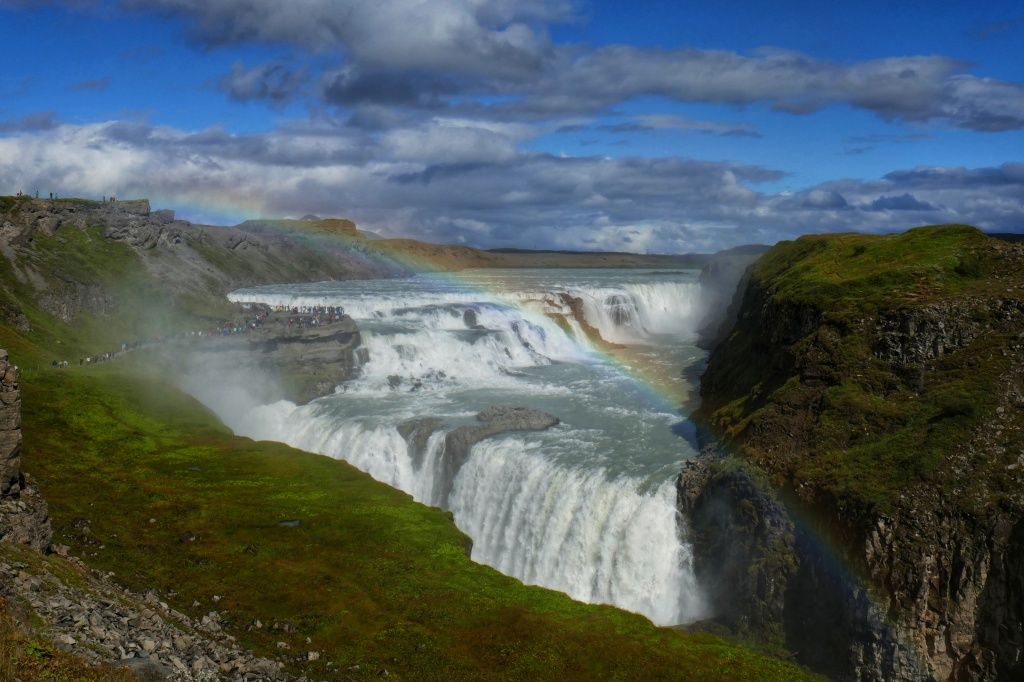
A few years ago, I wrote here about my love affair with trees, then inspired by a Sunday reading of The Marginalian and quote by Maria Popova, “A tree is a light-catcher that grows life from air.” My love affair with skies became conscious when I travelled to Iceland in 2018. While I fully anticipated the landscapes would tug on my heart, I had no idea how indelible the impact of those skies.

But back to trees and some of those that caught my attention in Italy last month. Some captured with komorebi:

Borrowing from my earlier post on trees, I’ll conclude in the same way, with a poem by Mary Oliver, in gratitude for the trees I gaze upon in my yard, and in vistas miles and oceans away, and for my friends who share a special kinship with them:

WHEN I AM AMONG THE TREES
When I am among the trees,
especially the willows and the honey locust,
equally the beech, the oaks and the pines,
they give off such hints of gladness.
I would almost say that they save me, and daily.
I am so distant from the hope of myself,
in which I have goodness, and discernment,
and never hurry through the world
but walk slowly, and bow often.
Around me the trees stir in their leaves
and call out, “Stay awhile.”
The light flows from their branches.
And they call again, “It’s simple,” they say,
“and you too have come
into the world to do this, to go easy, to be filled
with light, and to shine.”

Much love and kindest regards, dear friends.