An Elder Woman’s Words

“As I grow older, I realize that my own writing is very much more than just a pleasurable form of self-expresssion – at its heart, it’s a way of trying to change the story, of weaving the possibility of a better world into being through the power of words.”

Sharon Blackie, Hagitude, 2022
space and a horizon from which to consider

I’ve been walking alot these days and keeping me company has been the wonderful voice of Sharon Blackie reading her words in Hagitude: Reimagining the Second Half of Life. She offers in the chapter “The Creatrix,” one of featured archetypes, that the creative work of elder women is about making art that matters, showing others the way, transcending, and transforming our limiting and dysfunctional cultural narratives. Quoting Betty Friedan’s The Fountain of Age (1993):

“‘late-style’ artists and scientists, creators and great thinkers seem to move beyond tumult and discord, distracting details and seemingly irreconcilable differences, to unifying principles that give new meaning to what has gone before and presage the agenda for the next generation.”

While not as articulate, I’ve held the hope that my writing, here in this blog, and in my poetry, offers a new perspective or amplifies and uplifts a current one. I wish for my writing to create and invite readers into a space of contemplation and affirmation, a heart and mind space from which to know and claim their personal power to make a difference.

Since January, I’ve continued to submit my poetry and photography to literary journals and magazines. Once again, where poems have been rejected, often a photo or several have been accepted. This year, two of my photos were first and second choice for the cover of the 2024 Edmonton Stroll of Poets Anthology. After a winter’s worth of rejections, I received word that my poem, “Contemplating the Cherry Tree,” had won first place in the 3rd annual Carmen Ziolkowski Poetry Prize, hosted by Ontario’s Lawrence House Centre for the Arts. And I’m happy to have found some global homes for my work: in Katherine McDaniel’s beautifully curated Synkroniciti, the German-English Amaranth Journal of Food Writing, Art & Design, and Greece’s Raw Lit.

the cherry tree

A month ago, I sent to a publisher twenty pages of my fifty-eight-poem collection, Skyborne Insight. My winter-spring labour of love, working with my skilful editor, essayist-poet Jenna Butler, this manuscript is distilled from noticing and naming the grief and the beauty in life’s imperfections, and the sacred in the mundane moments at home, and those extraordinary ones when travelling abroad. In the final editing, heeding Jenna’s advice, I printed and posted each poem on the wall, read aloud, changed a word, added a comma or new line break, re-ordered, and finally realized, as I read the totality, that I had created a wise and vulnerable collection, one of which I am deeply proud. Now I wait and see…and as Jenna wisely advised, celebrate this significant accomplishment: my manuscript.

A couple of weeks ago, I wrote here about the memories evoked by a poem sent to me in celebration of a previous significant accomplishment: my retirement. Every summer, by habit, I compose a to-do list of activities. “Shred files” was this summer’s prompt to review, shred, and recycle the last of my professional files. Drawers and shelves emptied, bags and boxes filled, my heart heeded me to hold on to the folders on facilitation, The Circle Way, the Art of Hosting, and bits from coaching – the mainstays of the career I loved, the career that was my love made visible. I now look forward to re-configuring how to use both the physical and energetic space that’s now been opened for my writing, to more fully nurture its potential to weave into being, with words and photographs, a better world…to presage by continuing to notice and name the nuances of what is asking to be born, of what the world is asking of me.

“…the role of the elder woman as visionary isn’t always an active, ‘out there’ role; sometimes it’s associated with a quieter, more inward-looking aspect of elderhood – perhaps a later life stage, in which she has withdrawn to the solitude and darkness of her symbolic cave…

These old women have left their strivings behind, and in the clarity of all that not-doing, they’ve made room for the space in which to cultivate deep vision, insight, and wisdom.”

Sharon Blackie, Hagitude, 2022

Exploring further and deeper the terrain that is my eldering landscape.

Much love and kindest regards, dear friends.

Questions of Midlife and Eldering

Over the years I’ve blogged some of my responses to entering the eldering stage of life, with one of my earliest references in 2016, when I cited the transition from ambition to meaning in Angeles Arrien’s The Second Half of Life. Searching this current blog, A Wabi Sabi Life, I again referenced Arrien in February 2020, mere weeks before the world was stopped by covid-19. In Threshold of Uncertainty, my first post of 2022, I described my experience standing on the threshold of a new year. Recently the gift of a question to a friend who has just crossed into his 7th decade – What joys and challenges will wearing the mantle of early eldering bring?… Last week’s wistful musings prompted by my short visit with my parents and to attend my mother-in-law’s funeral…Yesterday, an excerpt from Dr. Sharon Blackie’s Hagitude, cited in her weekly Art of Enchantment Substack…like a bell thrice rung:

In the last part of our life, focus is everything. The years when we imagined we needed to be all things to all people are long gone, along with our dilettante days: the days of experimenting with this and that, of adopting and discarding different personas, of reinventing ourselves for every season of the year. Now, it’s time to get serious. To let the inessential fall away and focus on the essence of who we are. What is it that is left of us when Old Bone Mother comes along and strips that old, decaying flesh from our bones? Who is it that we are; what is it that we feel we are here to do? What do we imagine these final years of our lives are really for?

Dr. Sharon Blackie

Like Blackie, who says she asks herself these questions every year at this time, when the dark grows long, and she grows older, I’m feeling a similar urgency with similar questions. I realize typing now, this is part of the root of that knot I mentioned a couple of weeks ago and wondered what thread I needed to pull to loosen its persistent grip.

For me, the urgency is more in asking the questions with an open heart and mind, rather than anticipating a set of simple answers. As in the old stories of the Grail, the Question That Must Be Asked is always more important than the answer it provokes.

Dr. Sharon Blackie

Akin to Rilke reminding us to love the questions:

…be patient toward all that is unsolved in your heart
and to try to love the questions themselves like locked rooms
and like books that are written in a very foreign tongue.
Do not now seek the answers, which cannot be given you
because you would not be able to live them.
And the point is, to live everything. Live the questions now.
Perhaps you will then gradually, without noticing it,
live along some distant day into the answer.

Who is it that we are, or think we are?
What is it that we feel we are here to do?
What is the world asking of us now?
What do we imagine these final years of our lives are really for?
What joys and challenges will wearing the mantle of eldering bring?
What thread(s) do I pull in hopes of loosening the interior knot’s persistent grip?

Sitting with, in the growing dark,
growing patient with uncertainty.
Light a candle in this season of light,
advent of a holy reminder,
a mystery we learn to trust.

Much love and kindest regards, dear friends.


Stitches Through Time

Last month I started a hand-making project I’d envisioned for over a year: to interpret a series of mandalas I’d drawn and painted by tracing their designs onto linen and embroidering with wool crewel yarn. That had been the original plan. But when it took many months for the yarn to arrive from England and to secure the right colour and weave of linen – all ordered online as this was in the thick of lockdowns and I’d seen how website color charts don’t translate well – a chance walk down an aisle at Michael’s (the national chain craft store) where I saw a wall full of cotton embroidery thread in a rainbow of colours, resulted in its rethinking to ‘plan B.’

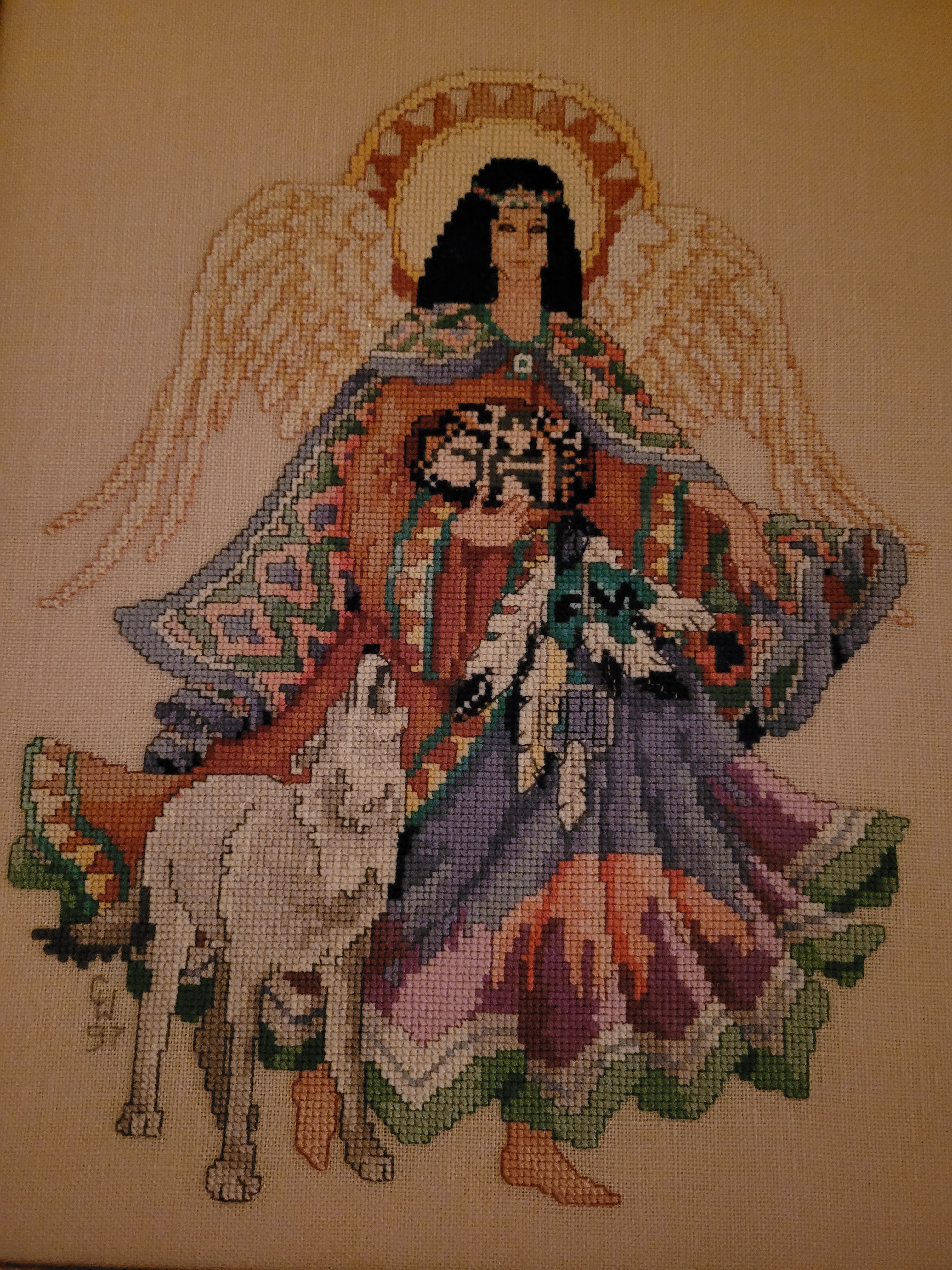
Then a comment to my mother, when we finally visited in September – she remarkably skilled in high counted cross stitch, our home graced by several of her creations – led to her gladly gifting me with her supply of needles, hoops, scissors, specially made wooden boxes, beads, and ‘signature’ well-organized collection of threads – hundreds of colours in a multitude of hues and metallics. For me who was enthralled with my childhood Christmas gift box of 64 Crayola crayons, I was in that same colour-smitten heaven. I paid an extra baggage fee to bring the entire collection safely home, spent an evening going through it all to understand Mom’s ‘system,’ finally broke the seal on the new tracing light board I’d purchased a year ago in anticipation, and began.

Initially, I thought I’d follow closely the colours in the original watercolour, but I soon realized that working with needle, thread and yarn, despite being close in colour, is not the same as brush and paint. So, I began to improvise within the spaces, using a variety of shades and stitch patterns. I discovered that “split stitch” is pleasing in its coverage, texture, ability to move back and forth between thread and yarn, and in actually making each stitch. It simply feels good to make that stitch.

I also discovered that where I began – sitting quietly in our living room after dinner, everything spread around me – I missed my ‘pack,’ and knew Annie missed me. She has her routine. Once we finish dinner and clean up the kitchen, it’s ‘pack time.’ She settles on ‘her’ love seat in the family room and waits for us to join her. Sometimes when we’re lingering over dinner, she can become quite impatient, pacing back and forth, showing her teeth in that non-aggressive, trying to talk to us way. It’s just not the same if I’m sitting in the living room, even when I cajole her into laying down on the carpet beside me. So I’ve shifted to where the light and companionship are better, often plugging in my earbuds to listen to a podcast as I stitch, while Sig watches a hockey game or an investing or horse training video, and Annie, utterly content on the sofa in between, soundly sleeps.

But the biggest discovery has been how soothing I find this act of handmaking. It goes slowly. Gradually I see the colours and textures resemble the painting that inspired the plan. Not an evening goes by when I don’t silently grok and or remark how soothed I feel doing this work. In part I know it comes from the deep appreciation I feel using my mother’s materials and supplies, that my hands are using what her hands had used for years to make beauty. And that given the amount of thread she’s given me, I will most likely have many more years than my mother life to bask in this gratitude.

“There is a juiciness to creativity, a succulence, or a sensuality which both produces and is soothed by creating something. I think that creativity is pleasing to women on a very deep level, whatever form it might take – whether it’s the feel of clay in our hands, the colours that work on us as we knit, the meaning that we find in the words that we write, or the energizing feel of movement as we dance and the music moves through our bodies.”

Lucy Pearce in Sharon Blackie, If Women Rose Rooted, 2019
quoted in “When Women Create,” A Wabi Sabi Life

As I look over my life, my mother always did handwork, as did many women of her generation and those before her. I remember many of the clothes she made for my sister and me until I began sewing my own in my early teens. After living in an apartment for my first thirteen years, my parents built their home and Mom poured herself into its decorating, needlepointing the backgrounds of eight dining room chairs – a meditation in monotony, same stitch, same colour for many months. From there she mastered every style of needlework, again gifting me with cushions, purses, and such. She knit beautifully, always challenging herself in ways I didn’t quite get nor fully appreciate. A brief foray into crewel work and then counted cross-stitch and cutaway, the finer and more intricate, the better. In the last few years, she’s found the strain on her eyes too much, regrettably as she has several half-finished projects and wishes to make each of her grandchildren and great grandchildren keepsakes. So she’s gone back to occasionally knitting, and now spends more time reading. It’s a pastime I’m happy she enjoys, as when younger she never did, believing herself to be a poor reader. So utterly untrue when I think about what she’s created with her hands – the patterns she had to read and interpret, the recipes she improvised, the books she kept for the business. A legacy of the hurtful, limiting stories we’re told, or tell ourselves.

“When you learn to make things with your hands, you begin to awaken an awareness of the beauty and value of things in your life. Handmaking teaches us about slowness: the antidote to brevity and efficiency. It shows us, through the patience of our own hands, what goes into a thing. When we put those long efforts into bringing beauty into the world, we are honouring that which made us by creating as we have been created. We are taught to respect the slow, attentive piecing together of the life we yearn for.”

Toko-pa Turner, Belonging, 2017
quoted in “A Homemade, Handmade Life,” A Wabi Sabi Life

And looking further back, her grandmother, my Gramma, was always sewing – spectacular fashions inspired by the turn of the century Edwardian era. Plumed and netted hats, velvet coats. No wonder I was so taken by Downton Abbey for its costume design, as I have old sepia tint photos of Gramma looking just like those women. Too, I have one hundred year old samples of her silk embroidery, and I wore for my wedding the white cotton lawn embroidered dress she’d made for her own – fine hand sewn tucked bodice, tiny mother of pearl buttons.

My paternal grandmother, Oma, too, was a very skillful seamstress, though in the pre and post world war periods of Germany, her talents were out of necessity directed to the functional, utilitarian, to get more wear from what was worn. Emigrating to North America in the 1950s, she became a pieceworker on the assembly line making glass cases for Bausch and Lomb. An accident on the sewing machine nearly severed her middle finger, left its nail permanently clawed over. Her dowager’s hump the price for countless hours bent over those grinding machines.

Before my mother’s second birthday, her mother died. Eleanor, my grandmother, was adopted as a young child. Family dynamics and bureaucratic policy were such that we grew up knowing very little about her. Did she like to sew? Was she a hand maker? Did she embroider or like cooking? We don’t know. We have very few pictures of her, but one as a young girl shocked us all in the resemblance I share with her.

Early this morning I woke having dreamt of her. A young boy hand-delivered a painting or photograph of a young girl child, now restored and framed. Stretching, I had to reach up high and retrieve the parcel from its precarious perch. I unwrapped its golden Klimt-like heavy wrapping paper to see a little girl at sitting at a table outside, surrounded by little glass pots of paint, flowering bushes beside her, blue sky above. I knew immediately it was Eleanor. I felt a whisper in my heart murmuring that this is how I am connected to my grandmother, in little paint pots of colour – the timeless iteration of the 64 box of crayons – in a yard warm with flowers and a blue sky.

“…I needed that bond to feel whole, competent and grounded, connected to my heart and soul, to my community, to my ancestors, and to the natural world around me…”

Melanie Falick, Making a Life, 2019,
quoted in “Joie de Faire,” A Wabi Sabi Life

In the still dark this morning, I sensed this is how I am connected to the lineage of women – through the shimmering cotton threads, warm hued woolen yarns, fabrics woven on looms and sewn into garments and furnishings. That my ancestors whisper to me in dreams and in the stitches we make through time.

Much love and kindest regards, dear friends.