“But I don’t look like a sun,” a young star still wrapped in swaddling veils said.
To which I replied, “But you will, my dear. You will, mashuq. So don’t worry. Don’t fret.”
Daniel Ladinsky, A Year with Hafiz (2011), December 22
My day began before dawn, quiet and dark, lighting the final candle of the Advent wreath. Curious, Walker stood close, watched the flare of the match, the flickering of the four candles, and then left to keep silent vigil sleeping in his bed. I thought of family and friends, the passing of time, the moments of melancholy with the missing…thresholds crossed and yet to be.
It’s now Sunday evening, quiet and dark. I have just listened to poet Elizabeth Alexander read the final chapters from her memoir, The Light of the World. Recommended in Allison Wearing’s online memoir writing course, it’s the lyrical account of the sudden death of her beloved husband…beautiful, poignant, poetic.
A deep breath, a pause to reflect, and to register the sanctity of her story and the liminality of these holy days.
Then, I turned to the book beside me: The Dreaming Way, Toko-pa Turner’s brilliant invitation to the practice of dreamwork. The chapter, “Wisdom of Sophia.” Its essence, as the embodiment of paradox and the continuous chaotic cycle of creation and destruction, leads us to a refinement of our life force aligned with nature.
“Not only is there more to your story beyond this anguish, but one day you story will be the starlight for another to follow out of their own darkness.”
Toko-pa Turner, The Dreaming Way (2024)
Another deep breath and pause to let Toko-pa’s words land. And just before I turned off the floor lamp, I fetched from my box of sacred books and journals, Hafiz by way of Ladinksy to read today’s contemplation.
There’s a thread running through this day…revealed in the elements described here. And a blessing for you, dear friends, that you may trust in your own, perhaps still wrapped, starlight.
“One of the qualities that you can develop, particularly in your older years, is a sense of great compassion for yourself.”
John O’Donohue, Anam Cara, 2023
I’ve been feeling blah. It’s more a low grade anxious irritation. Reluctant to self diagnose seasonal affective disorder, I’ll call it the “Christmas cranks.” I’m quick to snark at my husband, impatient with the world around me, bewildered with the heartless rationales lobbed back and forth attempting to justify the ongoing carnage in the Middle East, and lest we forget, Ukraine. I’m worried about family and friends struggling with serious health conditions, and in awe of those soldiering on despite. My kitchen candle and morning prayers mere to the weight they shoulder. I’m sad about the turn in friendships, this year counting several who may be no longer, one I dreamt of last night. I miss Annie, not as acutely, but this morning, where was she to hand off a favourite, a crunchy piece of burnt toast? I dreamt of her this week, and when I do, which isn’t often, I’m always aware that she has died. My new-to-me-car’s battery died on Wednesday (thankfully a mild morning for the AMA to test and replace it in my driveway), and while an expense in a month of many, I know it’s but a fraction of the tight belts many are suffering. Some days I feel tired despite being able to sleep deeper and longer, maybe even replenishing stores from summer when ambient light and worry about my trek created many short nights. I’m thinking given the season and that we have friends we haven’t seen in ages, I should invite them for some Christmas cheer, or at least a dinner. But being in low supply, I don’t have the gumption.
Once a wise man suggested this low-grade irritation is a symptom of my care for the world. What a tender reframing for an emotion I’d been feeling ashamed for having, a reframing especially necessary to remember during a season when we may feel worse for not feeling merry.
“Anger is the part of yourself that loves you the most. It knows when you are being mistreated, neglected, disrespected. It signals that you have to take a step out of a place that doesn’t do you justice. It makes you aware that you need to leave a room, a job, a relationship, old patterns that don’t work for you anymore.“
Unknown source
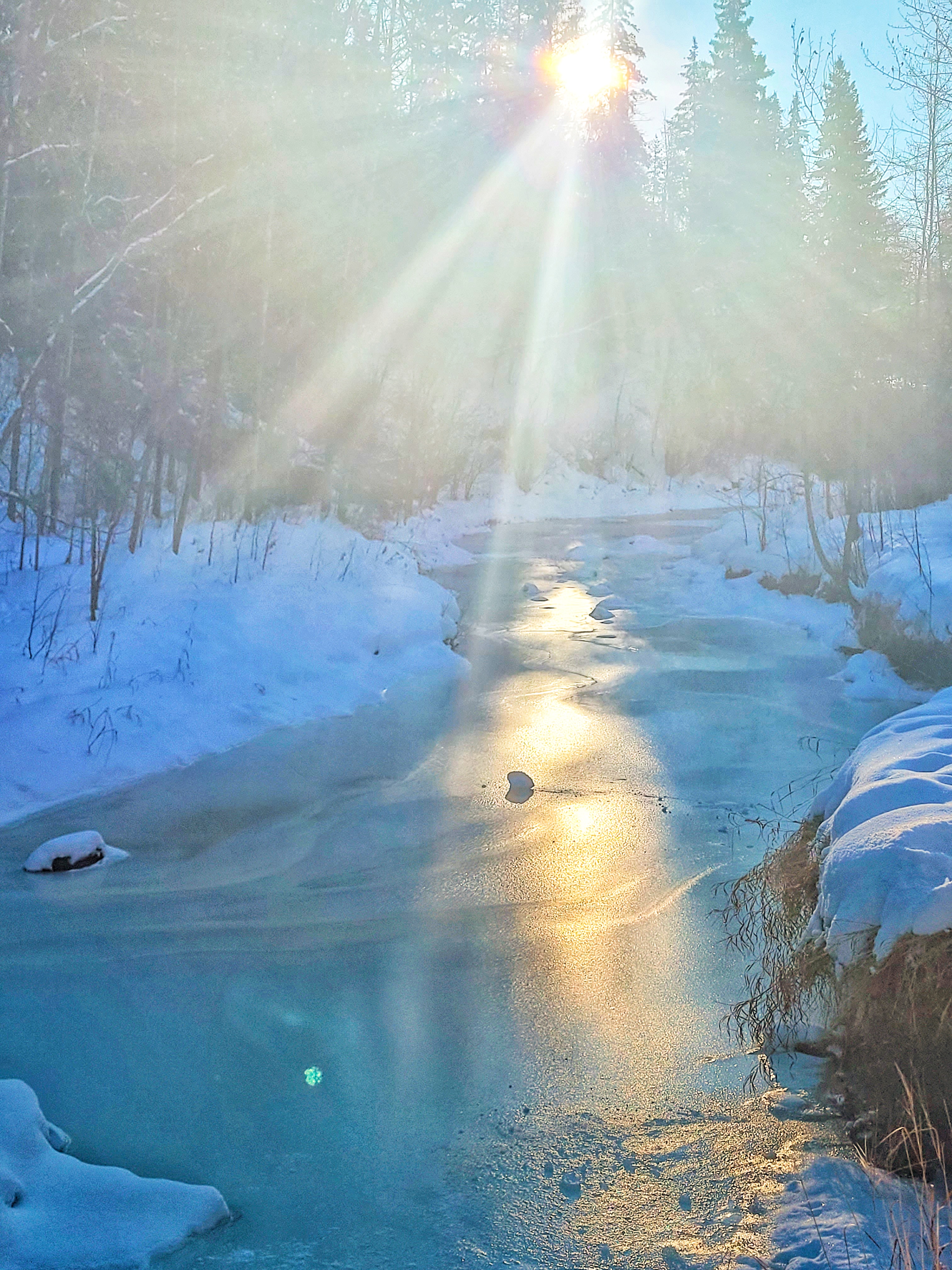
Snow fell midweek, muffling city sounds and bringing a holy softness and silence, making it easier for our neighborhood now white hares to stay hidden, and for me to find moments of inner quiet. Baking muffins and cooking dinner yesterday afternoon, I listened to a beautifully curated winter solstice program hosted by Paolo Piertopauolo on CBC. The song, “The Difficult Season,” from the Music on Main 2017 Winter Solstice concert caught my ear for its truth-telling lyrics and the reminder of a more prevalent intentional making space for the counter-cultural story that invites and acknowledges a myriad of emotions, feelings and responses to this season. One that welcomes and honours grief’s persistent, though at times subdued, presence in our lives. Like this balm from the late John O’Donohue, in yesterday’s Marginalian from Maria Popova:
“There is a quiet light that shines in every heart. It draws no attention to itself, though it is always secretly there. It is what illuminates our minds to see beauty, our desire to seek possibility, and our hearts to love life. Without this subtle quickening our days would be empty and wearisome, and no horizon would ever awaken our longing. Our passion for life is quietly sustained from somewhere in us that is wedded to the energy and excitement of life. This shy inner light is what enables us to recognize and receive our very presence here as blessing.”
John O’Donohue, To Bless the Space Between Us
And this:
“The light of love is always within us, no matter how cold the flame. It is always present, waiting for the spark to ignite, waiting for the heart to awaken.”
bell hooks
Wooooooosh….. blowing on the spark from my heart to yours, igniting much love and kindest regards, dear friends. Let us be tender with ourselves and each other.
I notice that when the angel spoke to Mary she got news that God was pleased with her, and that she would bear a son destined for greatness, but no mention was made of torture and early death and the way her heart would break completely and irrevocably. The angel told her not to be afraid, but didn’t mention the need to take the baby and run from Herod or even giving birth in a stable. If the heavenly being hinted at a future seated at the right hand of God, it never acknowledged how different that feels than having him seated at the family table for supper, and the ache of an empty chair. Maybe she knew, and said yes anyway. Maybe the big ask is to open the door to suffering, which is the door marked Love.
– Lynn Ungar – December 16, 2021
Since returning to Italy in October, truly my heart’s home, or at least one of them, I splurged on a subscription to the weekly ITALY Magazine and follow its daily posts on language, culture, food – with beautiful photos – on Facebook and IG. Yesterday reading the current issue, I was reminded that December 8 is “la Festa dell’Immacolata Concezione,” the Feast of the Immaculate Conception when the Angel visited Mary, the day in many parts of Italy where trees are festooned with lights marking the beginning of the Christmas season. So this poem from Lynn Ungar, stored in the dark of my virtual file since last year, fit the bill for today’s post.
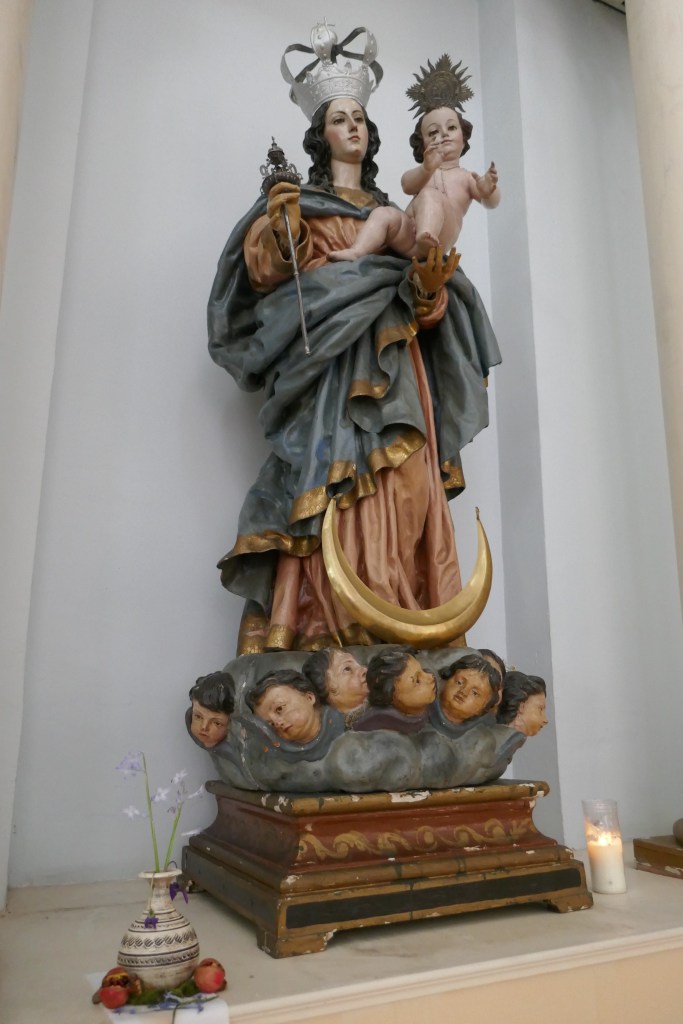
Earlier this week, I read an essay by Perdita Finn, wherein she gave an alternate interpretation to the feast day: that of Mary being immaculate, born without sin, free from karma. That she symbolizes the universe’s womb, the dark matter out of which all life emerges on earth. “This is why so many of the old Madonnas were depicted as black, as black as the original mothers, as the soil, as the space between the stars.”
Aligning with the Celtic celebration of Solstice and its honouring of the wisdom of the dark, when what is planted, resting fallow hidden in the depths, can decay or gestate, renew, transform. Mary becomes the the earthly embodiment of the divine feminine and its creative-destructive cycles of life and death.
Or as Lynn offers, the suffering that is Love.
Much love and kindest regards dear friends as you enter the ever growing darkness of December.
“Look how calmly the trees abandon their autumn leaves, scattering jewels on the ground, soon to become mulch. These serene beings are apt teachers for us. Just see how they send their life-essence down into their roots as the days shorten and darken.”
Pir Zia Inayat Khan, The Zephyr Newsletter, December 2020
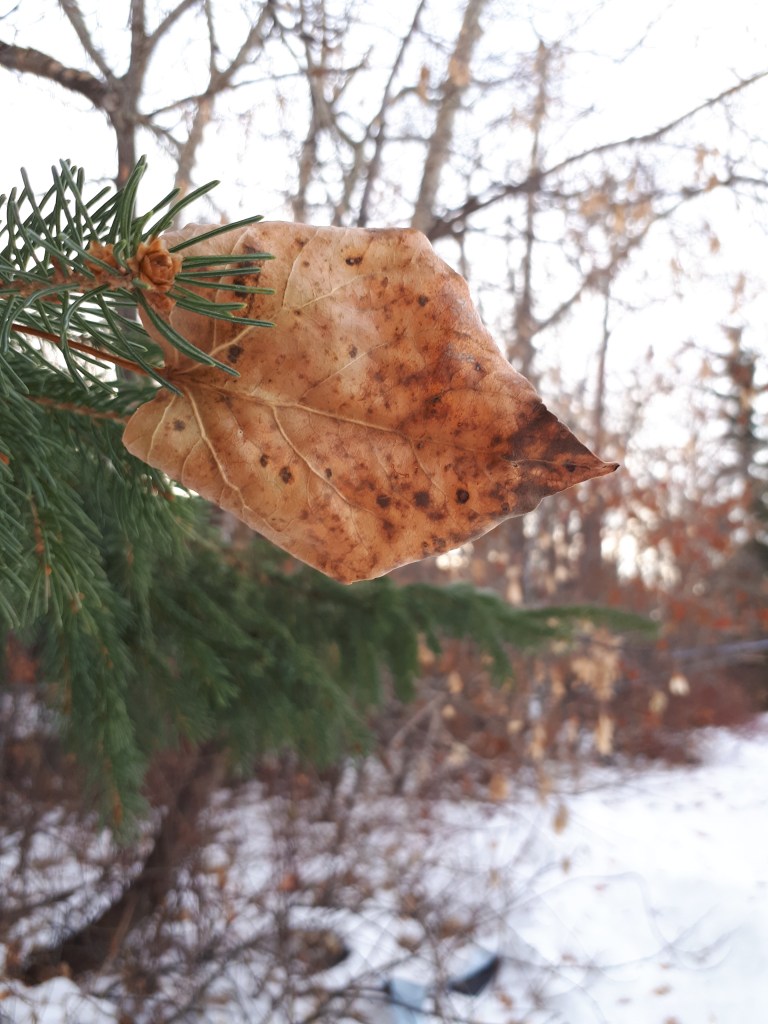
Last Monday, when I walked with Annie to centre myself and find my words, when I listened to the poem that released the floodgate of tears and cleared the way for the inchoate to become articulate, I found myself attracted to Nature’s images that evoked a “hanging on.” Despite all that gives way to a northern winter – daylight and warmth, green grass and foliage, garden fresh vegetables, robin song – still there is much that persists.
And I thought, how fitting a metaphor for this year’s Advent. Now in the third week, the one characterized by the rose-pink candle of joy, I wondered how do we hold the tension, no, how do we live and be in the tension of hanging on expectantly, when so much has let go? How do we negotiate our familiar and counted upon traditions of joy and celebration, in the face of myriad losses and uncertainties, persistent isolation and loneliness? How do we wait in joy for the promise inherent in this season, given so many shattering impacts of 2020? Not an intended pun, but truly a pandemic paradox, of pandemic proportion.
While I don’t have answers to my own questions, let alone any “sage” advice, I am reminded of Rilke’s wisdom to not strive for answers…to live the questions for now…though admittedly, not quite able to love them. But perhaps there are some hints from others, whose words have shimmered as they’ve crossed my screen this week, in remarkable resonance and synchronicity.
“I’m feeling a bone deep exhaustion now, yet I’m also feeling a resistance to the softness and rest that this season urges. There is too much to do to rest. And to be soft in the face of all that has happened in 2020 — that is a world of hurt I’m not sure I can bear. My experience of this season’s impulse to look back and take stock has a new intensity too. There is a great deal I long to recover about pre-pandemic life. But I don’t want to go back to a “normal” that would lose all that this year taught and gave us to live into.”
Krista Tippett, The Pause, December 15, 2020
In the past few days, I walked and listened to another of my favorite podcasts, Brené Brown’s Unlocking Us. In the most recent episode, she looked back over all she had learned from reading and prepping for two seasons worth of interviews, to more fully understand her very first episode on “FFT’s” (friggin’ first times) dropped in the early days of Covid-19. Her recent neuroscience “expert,” David Eagleman, confirmed Brené’s emergent hypothesis that our brains – and we – are exhausted with mapping so many new responses to this year’s unprecedented number of FFTs. The antidote to so much changing so fast is our attention, our acknowledgement, and rest, plenty of rest that restores us, and our brains. The image that comes to mind after today’s snow showers: clearing the walks and roads of snow that keeps falling. No sooner do you get it clear, then you need to do it again, and again, and again.
In this same episode, Brené shared a quote that succinctly sums up life as we know it now:
“‘History is the study of surprises.’ This line captures the world in which we live, we’re living history, surprise after surprise after surprise. And just when we think, we’ve had all the big surprises for a while, along comes another one. If the first two decades of the 21st century have taught us anything, it’s that uncertainty is chronic; instability is permanent; disruption is common; and we can neither predict nor govern events. There will be no ‘new normal’; there will only be a continuous series of ‘not normal’ episodes, defying prediction and unforeseen by most of us until they happen.”
Jim Collins, Beyond Entrepreneurship 2.0, 2020
Hmmm…grim news of foreboding, or the sudden, fresh wakening from somnambulant dis-illusion? Another paradox and invitation to find a middle way, perhaps?
I’ve lost track of the number of times this past year I’ve heard myself say aloud or think the wise words from a past, wise teacher: the trick to living paradox is knowing “it’s all true.” That both sides of the coin are the same coin. That 180 degrees is a straight line connecting what appear to be opposites. That the yin always contains a bit of yang and vice versa. And that there is a field between right doing and wrong doing where I will meet you.
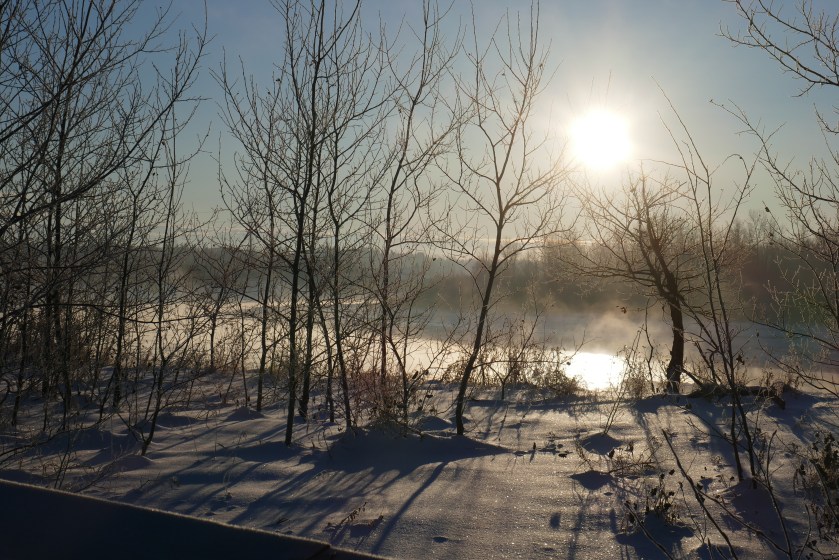
“There is a time for stillness and empty-handedness, a time for holding vigil in the darkness. Winter keeps a secret that is vital to our soul’s knowledge of itself. Before long, the days will lengthen again. But now is the time to be rooted in the silent, patient earth as the planet heaves through the ebon emptiness of space.”
Pir Zia Inayat Khan, The Zephyr Newsletter, December 2020
Yes. This is so very true. And so too, for so many of us right now, is the isolation and loneliness that fills us with sorrow, worry, grief. That keeps us sleepless when we need rest for our bodies and brains and hearts, and to recover our resilience.
Last week, once again in my favorite Italian grocery store, as I maneuvered my cart into the checkout line, I looked up to see our dear friends. The last I saw them was a year ago, sitting at our cozy round table, enjoying a kitchen supper. Nothing fancy. Just simple Tuscan cooking, fine wine, and edifying conversation. It was a delicious evening, one we anticipated repeating sooner than later, upon our return from Andalusia last February. Sure, now we talk on the phone, exchange “love notes” in the mail or via text, but to lay eyes on each other, bundled and masked, brought tears to our eyes. There we stood, huddled among the pasta and olive oil – probably closer than two meters – impelled to express our love, our gratitude, the miraculous of our chance meeting, the angels that must have conspired for us then and there.
“…we need to accompany each other right now and beyond this season, in what none of us is called to bear and do alone. To honor the many losses we scarcely know what to do with. To dwell with reverence before our exhaustion and our resilience. To cultivate the expectant waiting that is the spirit of Advent. To ponder how we want to live once the virus releases us back to each other. “
Krista Tippett, The Pause, December 15, 2020
Since I last wrote, Covid-19 vaccinations are now being administered around the world. Here in Canada, the first to be inoculated was an elderly woman from Quebec. Here in Alberta, our health care workers are to be first in line. Touted as the light at the end of a long dark tunnel, it’s not lost on me that this hoped for miracle comes during our darkest hours, both literally and figuratively. Personally, I sit in another paradox: knowing it will be many months before I have access to this anticipated release from the virus’ silent, deadly grip and can let go of extraordinary vigilance and precaution, countered by the desire to hang on to the many subtle gifts of this time – a slowing down to savour simplicity and deepening stillness, noticing inner shifts and outer expressions, renewed appreciation and gratitude, a growing and steady contentment. Just as my love of winter’s darkness has grown over time, and I wince knowing that come next week, we’ll once again be on the upswing to more daylight, I hear a whisper of caution to not squander what has been so hard won, an invitation to make anew.
“We will not go back to normal, normal never was. Our pre-Corona existence was not normal, other than we normalized greed, inequity, exhaustion, depletion, extraction, disconnection, confusion, rage, hoarding, hate, and lack. We should not long to return, my friends, we are being given the opportunity to stitch a new garment, one that fits all of humanity and nature.”
Sonya Renee Taylor
Now, I literally wait for the linen and yarn and needles to arrive to start stitching.
Yesterday, I woke before dawn to make preparation for the ritual of Advent. Journeying on the “road home,” I’ve become comfortable visiting different spiritual traditions, some for extended stays. So it is, drawing from my Lutheran childhood and early adult years, I made ready my altar to light the first of four weekly candles.
“lighting our way to Christmas…the shared ritual of symbolizing joining my light to another, to another, and so growing our light in connection and caring…”
Nancy Steeves, Minister Southminster-Steinhauer United Church, Streamed Service, November 29, 2020
The German embroidered cloth, a gift from my chosen namesake aunt…the trio of tiny angels, delicate with age, from my Oma… the whimsical magi… a Celtic inspired Father Christmas… a “glassy baby” candle from my circle sister, Sarah…the arrangement of “ice wine” grapes, crystals and gold leaf I created years ago because it all caught my eye. Everything in its place, the same place over the years. My German heritage shimmers.
“The Advent wreath first appeared in Germany in 1839. A Lutheran minister working at a mission for children created a wreath out of the wheel of a cart…Eventually, the wreath was created out of evergreens, symbolizing everlasting life in the midst of winter, while the circle reminds us of God’s unending love and eternal life .”
Within months of marriage, my husband and I, with our first English Setter, Beckey, packed up our VW Scirocco and drove west from Ontario in early January to make our home in Alberta. We consciously chose that next Christmas to not fly back to Ontario, but to learn how to make our own traditions. It’s been an evolving journey. Over the forty years there have been trips back east, joyous celebrations with friends made here, and years being on our own, alone.
A few years after our first Alberta Christmas, now settled into our own home, I purchased the white ceramic Advent wreath I’ve been using ever since. Its simplicity and safety appealed. Growing up, I was most familiar with white candles, though upon reading learned and now use purple candles on the first, second, and fourth Sundays, and a rose pink on the third. In some traditions, the candles are all red, or blue. Too, I didn’t recall qualities being attributed to each of the four Sundays, but was reminded when my friend posted a note yesterday:
The first candle symbolizes hope and is called the “Prophet’s Candle.” The prophets of the Old Testament, especially Isaiah, waited in hope for the Messiah’s arrival.
The second candle represents faith and is called “Bethlehem’s Candle.” Micah had foretold that the Messiah would be born in Bethlehem.
The third candle symbolizes joy and is called the “Shepherd’s Candle.” To the shepherd’s great joy, the angels announced that Jesus came for humble, unimportant people like them, too. In liturgy, the color rose signifies joy.
The fourth candle represents peace and is called the “Angel’s Candle.” The angels announced that Jesus came to bring peace–He came to bring people close to God and to each other again.
The fifth candle (optional) placed in the wreath’s centre, and lit n Christmas Day, represents light and purity and is called “Christ’s Candle.”
“Hope shines as a solitary star; love is the inner light. You and I together mirror the light of lights and illumine the pathway home.”
Catherine Faith MacLean
Yesterday in still dark dawn, that first purple candle flickering, I sat with letting go, letting be, laying down what no longer serves nor is. Deaths and endings. Literal and otherwise. Not with hope, but not without it either. Just that soft quiet space of allowing, with grace and gratitude.
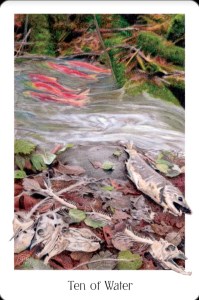
Later, in a Sunday practice learned a couple of years ago when visiting my elder heart sisters, I shuffled the Gaian Tarot deck four times, cut it three, and felt moved to draw the top card, not one from a fanned spread. The Ten of Water – with its five salmon carcasses on the shore of the stream in which five more were swimming upstream for their lives for life – and immediately I recognized its timely portent: the cycle of descent and return, transitions and endings but within which are encoded beginnings.
Advent. Four Sundays to pause, prepare, and anticipate. The birth of the son. Here in the northern hemisphere, in the ever darkening, deepening winter. The return of the sun. From the dark, the light. From the endings, beginnings.
“Watching morning break, I realize again that darkness doesn’t kill the light – it defines it. I believe that now. For years, I didn’t. I believed I was my failures, mistakes, midjudgments, shortcomings and wrongs. But I’m not those things. I am the light that shines from my faith, my courage, my willingness to be vulnerable and to be responsible and accountable.”
Richard Wagamese, Embers, 2016
And so are you, dear friends. With much love and kindest regards.









 A Wabi Sabi Life