Do not try to save the whole world or do anything grandiose. Instead, create a clearing in the dense forest of your life and wait there patiently until the song that is your life falls into your own cupped hands And you recognize it and greet it. Only then will you know how to give yourself to this world so worthy of rescue.
It’s early morning, still dark, cold, snowy, and winter. When this gets posted, hopefully winter will be the only carry forward for us as we’ll be en route to Spain. Reading last July, a solo traveler’s post on spending a couple of weeks last January in Andalusia got me thinking. Last winter, having bailed on Mexico, we stayed put and endured the coldest February in forty years. Not complaining, as making home in Alberta comes with making peace with winter. And while my tolerance for cold has lessened after a thyroidectomy in 2017, I’ve come to love the soft, enveloping quiet of falling snow, the invitation to turn inward during the long dark, the slow, the still. But I wondered aloud about shifting direction this winter. A quick email to Sam, who with his wife and sons host an exquisite b’n’b in the mountains west of Sevilla, confirmed winter can be a lovely, low season time to visit. Confirmation from husband that yes, Spain would meet his destination criteria of tasty food and wine, gave me the go ahead to don my travel consultant hat and design our itinerary. Barcelona and Madrid would give way to a more focused, yet leisurely experience of Andalusia. A circuit starting quickly but ending slowly in Sevilla, with an easy few days Finca Buenvino in Aracena, then onto Cordoba, Granada, Malaga.
“Every time you leave home, Another road takes you Into a world you were never in.”
John O’Donohue, “For The Traveler,” in To Bless the Space Between Us, 2008
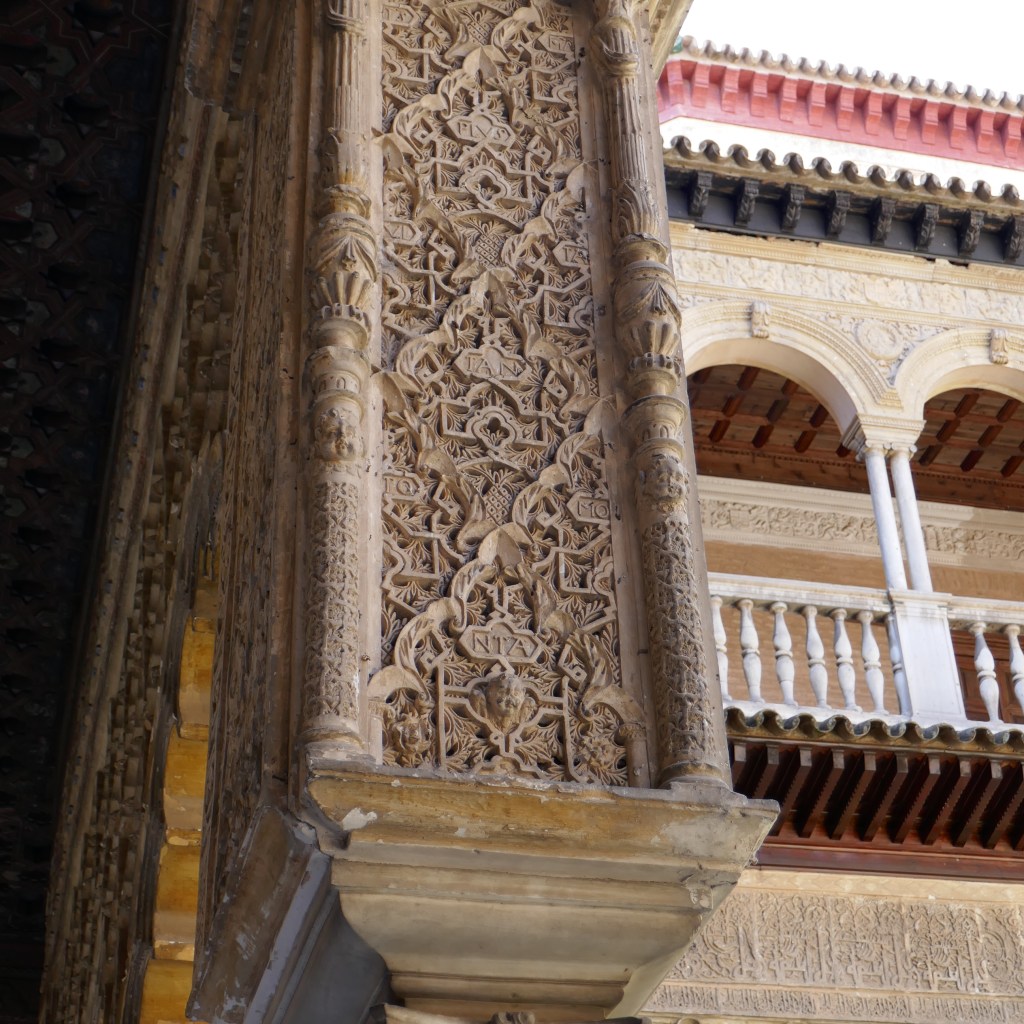
I’d already visited some of the region. September 2017 I was scheduled to co-host a circle gathering in Germany when a friend suggested we travel to her favourite part of Spain, an area she was certain I’d become as enamored of as had she. Rather magically, the email invitation to attend a writer’s retreat at Finca Buenvino a few weeks’ preceding. Afterwards, five days soaking up elements of Sevilla – hot sunshine, cold manzanilla sherry, tapas and flamenco, Mudejar architecture, colourful tiles and gardens – and a day in Cordoba. As the scout for some of the travelling I do with my husband, I’m delighted to be stepping back into the familiar, while anticipating the fresh and new with him.
“Old places that know you well Will pretend nothing Changed since your last visit.”
John O’Donohue, “For The Traveler,” in To Bless the Space Between Us, 2008
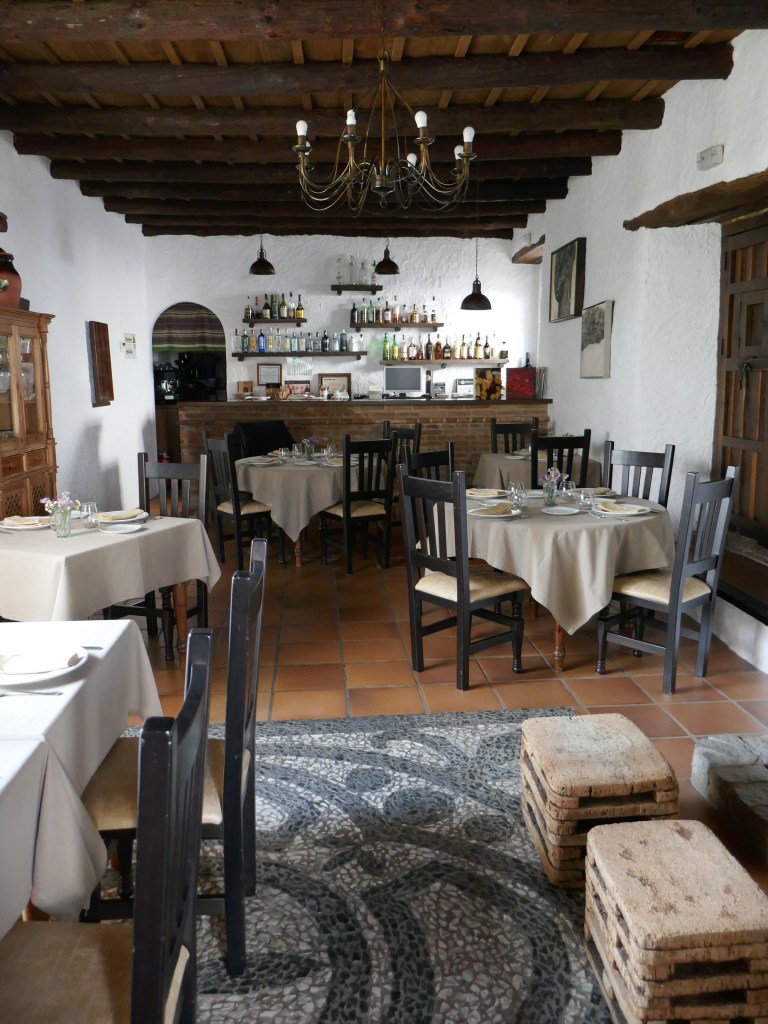
I know we’ll be beautifully hosted in Aracena. Sam and Jeannie, British expats, built their pink villa decades ago as a guest house and cooking school. Specializing in fresh, local Andalusian inspired cuisine complemented by sherries, vermouths, and wines, I knew this would be an effortless way to my man’s heart. I’ve reserved a luncheon in Linares, a nearby hill town, at Arrieros, the Michelin recommended café I’d walked by that September where the owner invited me in for gazpacho, which I had to regretfully decline due to the day’s writing retreat schedule. Another luncheon booked at Sevilla’s ConTenedor, returning to that terrific slow food restaurant featuring a pastiche of local flavor and colour. We’ll see flamenco, compare the vast beauty of Al Hambra with the more accessible Real Alcazar, sip and savour at tapas bars. I’ll visit the art galleries I missed the first time.
“When you travel, A new silence Goes with you, And if you listen, You will hear What your heart would Love to say.”
John O’Donohue, “For The Traveler,” in To Bless the Space Between Us, 2008
I’ve been living a slower spaciousness. I completed a contract in January, filed the report a couple of weeks ago. Intentionally set timelines to have time to prepare.
The practical. After the brilliant, brittle cold last month, how will long-range forecasts of mid teen and low twenties temperatures feel? Which layers to stay warm at night, at elevation? What are the best footwear options to safeguard against a flareup of the plantar fasciitis I’ve been tending for the month? Which medicinals to shore up and stay healthy? The corkscrew and sharp knife for the impromptu. The swimsuit for the hammam.
The heart. Travel lighter. Make time and space for writing and painting. Bring the journal from last time, the new notebook that matches. Paints and brushes. The camera. Receive what the heart would love to say, to see. Maybe the gift of my sore foot, “to move at the pace of guidance.”
“May you travel in an awakened way, Gathered wisely into your inner ground; That you may not waste the invitations Which wait along the way to transform you.”
John O’Donohue, “For The Traveler,” in To Bless the Space Between Us, 2008
Often, I travel solo. Typically, an “alone, together” small group experience where I can immerse in the moment to moment unfolding, nurturing impressions in the quiet of my own creative process; then coming out to engage with those around me. Travelling with my husband is markedly different. The focus and energy shifts to us, together, to us, alone, in new spaces, and made new by our travelling them together. I wonder what invitations wait along the way for us, for me?
“May you travel safely, arrive refreshed, And live your time away to its fullest; Return home more enriched, and free To balance the gift of days which call you.”
John O’Donohue, “For The Traveler,” in To Bless the Space Between Us, 2008
Seven months since the idea to go to Spain this winter. Almost here, and soon enough home again.
When despair for the world grows in me and I wake in the night at the least sound in fear of what my life and my childrens’ lives may be, I go and lie down where the wood drake rests in his beauty on the water, and the great heron feeds. I come into the peace of wild things who do not tax their lives with forethought of grief. I come into the presence of still water. And I feel above me the day-blind stars waiting with their light. For a time I rest in the grace of the world, and am free.
…May the nourishment of the earth by yours,
May the clarity of the light be yours,
May the fluency of the ocean be yours,
May the protection of the ancestors be yours.
And so may a slow
Wind work these words
Of love around you,
An invisible cloak
To mind your life.
– John O’Donohue –
To Bless the Space Between Us, 2008
Not chosen but invited, it arrived early into a simple, elegant process offered by Abbey of the Arts, called “2020, Give Me a Word.” Developed for the twelve days of Christmas, but available in early December, I’d receive an email invitation to “create some space each day to listen and see what word comes shimmering forth from the dailiness of my experience.”
At first, “at home,” which evoked being home and staying put. Perhaps wise counsel given I’d had another autumn full of travel. This time I’d become quite ill during my last trip in early December, a visit with a friend I’d not seen since the passing of her husband. A disappointment for us both when first, our great plans for trekking in the desert mountains became dashed by my excruciating case of plantar fasciitis. Then, a viral infection contracted days before departure had me reach for the emergency cipro to be well enough to get home without an ear-blocked, cough-racked flight. Just recovered and now into a serious grip of Arctic winter cold, staying put, at home, has been the order of the day.
But as the twelve days passed, with a new practice offered to evoke or ripen – a contemplative walk in nature, writing a poem, illustrating the word visually, attending to my dreams, consulting a soul friend – “at home” became distilled to “home.” Still that comfort with being at home (the best place to be when you’re sick and it’s ridiculously cold outside), but now with a spaciousness that allows mystery to unfold, shadow and surprise to emerge, dreams to awaken.
Last week, browsing somewhere, I came across these wondrous words in an essay, “To Find Your True Home Within Your Life.” Home came knocking.
The mystic Thomas a Kempis said that when you go out into the world, you return having lost some of yourself. Until you learn to inhabit your aloneness, the lonely distraction and noise of society will seduce you into false belonging, with which you will only become empty and weary. When you face your aloneness, something begins to happen. Gradually, the sense of bleakness changes into a sense of true belonging. This is a slow and open-ended transition but is utterly vital in order to come into rhythm with your own individuality. In a sense this is the endless task of finding your true home within your life. It is not narcissistic, for as soon as you rest in the house of your own heart, doors and windows begin to open outwards to the world.
John O’Donohue, Eternal Echoes (1999), 93.
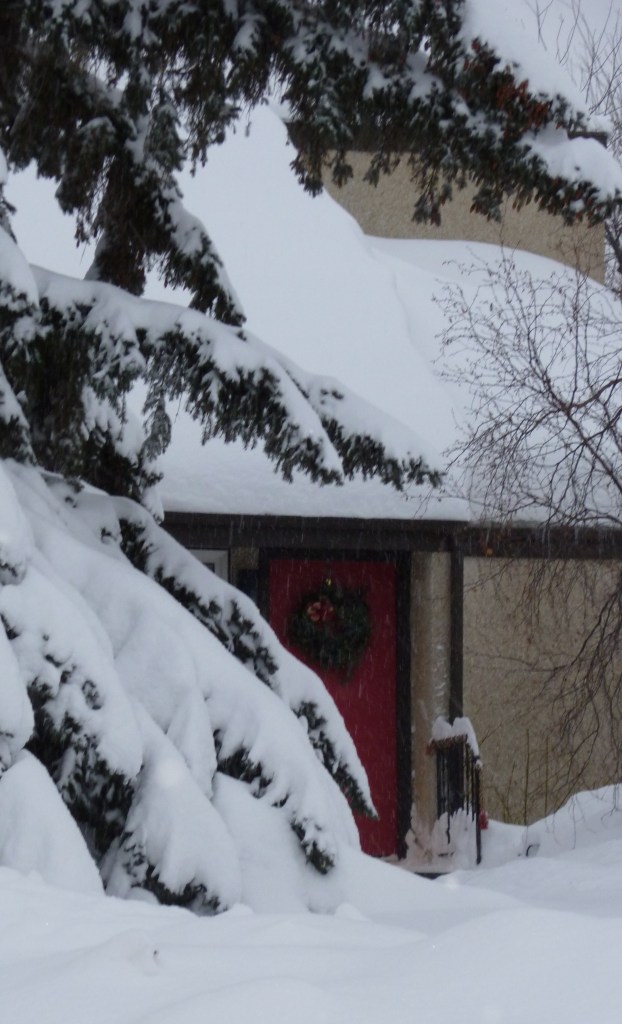
Home with her heart red door, a few years ago…same season with a bit more snow
“And” teaches us to say yes
“And” allows us to be both/and “And” teaches us to be patient and long suffering
“And” is willing to wait for insight and integration
“And” does not divide the field of the moment
“And” helps us to live in the always-imperfect now
“And” keeps us inclusive and compassionate towards everything
“And” demands that our contemplation become action
“And” insists that our actions is also contemplative
“And” is the mystery of paradox in all things
“And” is the way of mercy
“And” makes daily, practical love possible
A long time friend and follower of each of my blogs* asked upon this current one’s launch two weeks ago, “What is wabi sabi?” to which I rather cryptically replied, “the tagline.”
Wabi Sabi is the most conspicuous and characteristic feature of what we think of as traditional Japanese beauty. It occupies roughly the same position in the Japanese pantheon of aesthetic values as do the Greek ideals of beauty and perfection in the West. Wabi Sabi can in its fullest expression be a way of life. At the very least, it is a particular type of beauty.
Leonard Koren, Wabi-Sabi for Artists, Designers, Poets & Philosophers, 1994
Koren writes that wabi sabi is a beauty of things imperfect, impermanent and incomplete…of things modest and humble…of things unconventional.
I first heard the phrase in 2013, when a friend used it to describe my life with Bells Palsy. A few years later, to the day of its sudden, inexplicable onset, I wrote a poem essay, using a word play of wabi sabi and wasabi – that Japanese horseradish served with sushi – to describe that experience. Since then, this notion of wabi sabi has become a way of being in and making sense of life that has persisted, just like the Bells Palsy.
Last winter I had it permanently inked on my forearm, an embodied mantra and talisman to remind me of its persistent truth.
To remind me to be kinder, and more patient, allowing, and more gracious in the face of all that is imperfect, impermanent, and incomplete.
In this sometimes broken and mostly well-lived life.
In the usual iconography of the temple or the local Wok you would never see him doing such a thing, tossing the dry snow over a mountain of his bare, round shoulder, his hair tied in a knot, a model of concentration.
Sitting is more his speed, if that is the word for what he does, or does not do.
Even the season is wrong for him. In all his manifestations, is it not warm or slightly humid? Is this not implied by his serene expression, that smile so wide it wraps itself around the waist of the universe?
But here we are, working our way down the driveway, one shovelful at a time. We toss the light powder into the clear air. We feel the cold mist on our faces. And with every heave we disappear and become lost to each other in these sudden clouds of our own making, these fountain-bursts of snow.
This is so much better than a sermon in church, I say out loud, but Buddha keeps on shoveling. This is the true religion, the religion of snow, and sunlight and winter geese barking in the sky, I say, but he is too busy to hear me.
He has thrown himself into shoveling snow as if it were the purpose of existence, as if the sign of a perfect life were a clear driveway you could back the car down easily and drive off into the vanities of the world with a broken heater fan and a song on the radio.
All morning long we work side by side, me with my commentary and he inside his generous pocket of silence, until the hour is nearly noon and the snow is piled high all around us; then, I hear him speak.
After this, he asks, can we go inside and play cards?
Certainly, I reply, and I will heat some milk and bring cups of hot chocolate to the table while you shuffle the deck. and our boots stand dripping by the door.
Aaah, says the Buddha, lifting his eyes and leaning for a moment on his shovel before he drives the thin blade again deep into the glittering white snow.
– Billy Collins –
Click here to hear Billy Collins read with pianist George Winston.
Almost half way into this first month of this new year and how easy it’s been to riff on the “perfect vision” metaphor of 2020: clarity, focus, vision, insight, foresight, hindsight.
Lately though, I’ve been struck that this is a year where “forty” (20+20), with its symbolic significance across spiritual traditions, holds potential for deep personal growth.
“In spiritual literature, ‘forty’ is often used to indicate a term of learning or change, such as the ‘forty days and forty nights’ of Noah’s Flood. Forty is called ‘the number of perseverance,’ marking a period of growth through testing, trial and purification. After the exodus from Egypt, the Israelites endured ‘forty days of wandering’ in the wilderness before they were ready to enter the Promised Land. Jesus, following the ancient practice of the prophets, went into the desert for a great seclusion of forty days, which he described as a period of purification and preparation for the next stage of his work. The Buddha attained final enlightenment after forty days of continuous meditation.”
Henry S. Mindlin, “The Life and Work of Hafiz” in I Heard God Laughing: Renderings of Hafiz by Daniel Ladinsky, 1996.
Thinking to when I turned forty, it was ripe with finding meaning and making ritual to acknowledge a coming of age. Looking back at the months preceding that birthday, it certainly was a time of learning and change, of perseverance and growth. One of those “dark night of the soul” times where, following what could only be intuition, I went through a process that included finding a sacred space into which I would eventually co-create and re-enact the ancient ceremony of baptism and name change to formally honour my mothering ancestors.
These past weeks of Solstice, Advent, Christmas, Epiphany, and New Year reflection, with the interior image of dark desert lit only by moon and star, shine luminous with promise. Friday’s full moon eclipse and subsequent planetary alignments foreshadow powerful opportunities for tending to the inner work of one’s sovereignty. I feel the pull of “magic and dreams and good madness.”
“May your coming year be filled with magic and dreams and good madness. I hope you read some fine books and kiss someone who thinks you’re wonderful. And don’t forget to make some art, or write, draw, build, sing, or live only as you can. And I hope in the next year, you surprise yourself.”
No one but me by the fire, my hands burning red in the palms while the night wind carries everything away outside.
All this petty worry while the great cloak of the sky grows dark and intense round every living thing.
What is precious inside us does not care to be known by the mind in ways that diminish its presence.
What we strive for in perfection is not what turns us into the lit angel we desire,
what disturbs and then nourishes has everything we need.
What we hate in ourselves is what we cannot know in ourselves but what is true to the pattern does not need to be explained.
Inside everyone is a great shout of joy waiting to be born.
Even with the summer so far off I feel it grown in me now and ready to arrive in the world.
All those years listening to those who had nothing to say.
All those years forgetting how everything has its own voice to make itself heard.
All those years forgetting how easily you can belong to everything simply by listening.
And the slow difficulty of remembering how everything is born from an opposite and miraculous otherness. Silence and winter has led me to that otherness.
So let this winter of listening be enough for the new life I must call my own.










 A Wabi Sabi Life