You start dying slowly if you do not travel, if you do not read, if you do not listen to the sounds of life, if you do not appreciate yourself.
You start dying slowly When you kill your self-esteem; When you do not let others help you. You start dying slowly If you become a slave of your habits, Walking everyday on the same paths… If you do not change your routine, If you do not wear different colors Or you do not speak to those you don’t know.
You start dying slowly If you avoid to feel passion And their turbulent emotions; Those which make your eyes glisten And your heart beat fast.
You start dying slowly If you do not change your life when you are not satisfied with your job, or with your love, If you do not risk what is safe for the uncertain, If you do not go after a dream, If you do not allow yourself, At least once in your lifetime, To run away from sensible advice.
– Martha Medeiros –
This says it all. Why I took five weeks to walk everyday on different paths. To travel, and be enthralled with the sounds of life. To remember, to embody, that life is short, energy is precious, and that it is up to me to go after my dream, and appreciate myself. To feel turbulent emotions which make my eyes glisten and break my heart. To ask for help and let others help me.
Not to delude myself that I won’t die, but to live my life well. And in this way, to prepare for a good death.
Home is where I want to be Pick me up and turn me round I feel numb, born with a weak heart I guess I must be having fun The less we say about it the better Make it up as we go along Feet on the ground Head in the sky It’s ok I know nothing’s wrong… nothing
Hi yo I got plenty of time Hi yo you got light in your eyes And you’re standing here beside me I love the passing of time Never for money Always for love Cover up and say goodnight… say goodnight
Home is where I want to be But I guess I’m already there I come home, she lifted up her wings Guess that this must be the place I can’t tell one from the other Did I find you, or you find me? There was a time before we were born If someone asks, this is where I’ll be, where I’ll be
Hi yo we drift in and out Hi yo sing into my mouth Out of all those kinds of people You’ve got a face with a view I’m just an animal looking for a home And share the same space for a minute or two
You love me till my heart stops Love me till I’m dead Eyes that light up, eyes look through you Cover up the blank spots Hit me on the head ah ooh
Talking Heads: C. Frantz / T. Weymouth / D. Byrne / J. Harrison
“Home is where I want to be,” and now I am. After nearly five weeks away, realizing that 20+ year dream of walking a camino to Santiago de Compostela, I arrived home last Friday after seeing the sun travel full circle, rising in Madrid and setting in Edmonton. Two noneventful flights, albeit with significant delays, but a remarkably quick passage through Toronto, our Canadian port of entry, where within thirty minutes we had disembarked, cleared customs, walked the length of the terminal to be sitting at our gate for the final leg.
During May’s last Sunday afternoon, wafting through the open window of the guest house in Rua de Francos, Galacia, Spain – the resting spot for our “penultimate stage” to Santiago (quoting from Portugal Green Walk’s guidebook ) – I heard a woman’s beautiful voice singing this Talking Head’s classic accompanied by light acoustic strumming. Straining to hear, I rose from the bed where I’d been dozing, and pressed the voice recorder on my phone hoping to include it in the soundscapes I had been creating along the Way.
A gift of prescience, I thought, as a few years ago for my birthday, my husband created a playlist featuring this song, saying for him I’ve always had “a face with a view.” Later I dressed and went to sit in the yard, to warm myself from the chest and head cold that had walked with me the last couple of stages. There, I met Heidi from Portland, Oregon who with her “guitalele” – a slightly larger, more resonant version of a ukelele – was the source of my “homecoming gift.”
“And you’re standing here beside me I love the passing of time…”
“I suspect that the mind, like the feet, works at about three miles an hour. If this is so, then modern life is moving faster than the speed of thought, or thoughtfulness.”
Rebecca Solnit, Wanderlust, 2001
Text on Friday night from my friend:Are you planning on walking tomorrow? It’s supposed to be raining all day.
Me:Yes, I saw the forecast, and yes, I plan to walk. I made the commitment to myself to walk every stage, come rain, sun, sleet or snow. So, yes, I’ll be walking.
Friend: Thumbs up emoji
Text on Saturday morning – well before dawn – to my friend:Hmmmm, I’m reconsidering walking. It’s been raining all night, the forecast is for rain all day. I don’t want to get chilled and cold and sick. What about you?
Friend:I’m up and already dressed.
Me:Well, then…
Friend:We can always go, see if anyone else comes, and what’s happening.
Me:Good idea. Thumbs up emoji
“Go out and walk. That is the glory of life.”
Maira Kalman, My Favorite Things, 2014
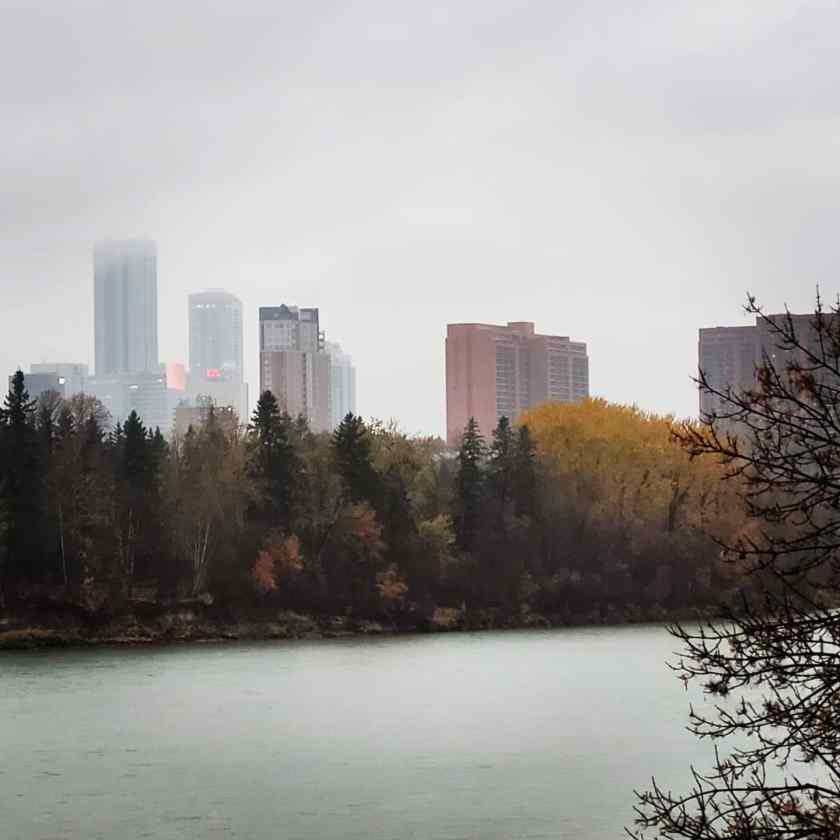
So at 7:35 am I drove the short distance to the park for the 8:00 am rendezvous for Stage 7 of the local Camino de Edmonton, amazed at how much darker it was from a week ago, due to heavy cloud cover and the shortened days. We’re now past the midway point, with twelve stages in total, ending the last Saturday in November at the city’s west end of the river valley, when my drive will be much further. A repeat of last year’s camino, now with the stages in reverse order, we’ve had glorious fall weather every weekend until now.
And there we were, ten of us hardy “peregrinos” ready to embrace the day, stepping through puddles, agreeing it would be a good day to test our gears’ waterproofness. Mine – boots, pants and jacket – failed miserably by the end of the 13.5 km circuit, my feet and quads wet to the skin. Once home, showered and dried, wet clothes laundered, boots aired, I began researching remedies and replacements. Several pairs of boots ordered, a couple of jacket styles eyed and waiting, hopefully, for a Black Friday sale (yup, those Arc’teryx jackets are an “investment” to quote my friend ), and waterproofing wash and spray purchased to renew the life of my pants.
“The pieces that I chose were based on one thing only — a gasp of DELIGHT. Isn’t that the only way to curate a life? To live among things that make you gasp with delight?”
Maira Kalman, My Favorite Things, 2014
Every week I post pictures of the week’s walk on social media. Last week in response, another friend asked if I ever wrote about my “camino” experience, relaying how my posts brought to her mind the hauntingly beautiful composition, “camino,” by the late Canadian violinist, Oliver Schroer, created in May and June, 2004, as he walked one thousand kilometers of the Camino Frances, with his partner Elena, and two friends, Peter Coffman and Diane Laundy.
“In my back pack, I carried my violin like a wooden chalice, like my own precious relic, carefully packed in its reliquary of socks and underwear and waiting to work a miracle. My pack also contained a portable recording studio. When I found a church or cathedral that was acoustically enticing…and open…I played my violin and recorded in those spaces. I played some of my older fractal and spiritual pieces. I improvised a lot. Walking for weeks, new pieces came to me – one hill, one valley at a time. In two months, I played and recorded in twenty-five different churches…
…The music still sings on these recordings. The sense of place is strong here – pilgrims praying, children playing, birds, bells, footsteps, passing snatches of conversation, the sounds of the buildings themselves. Each space has it sown distinct character and resonance.”
Oliver Schroer, “camino” journal notes, 2005
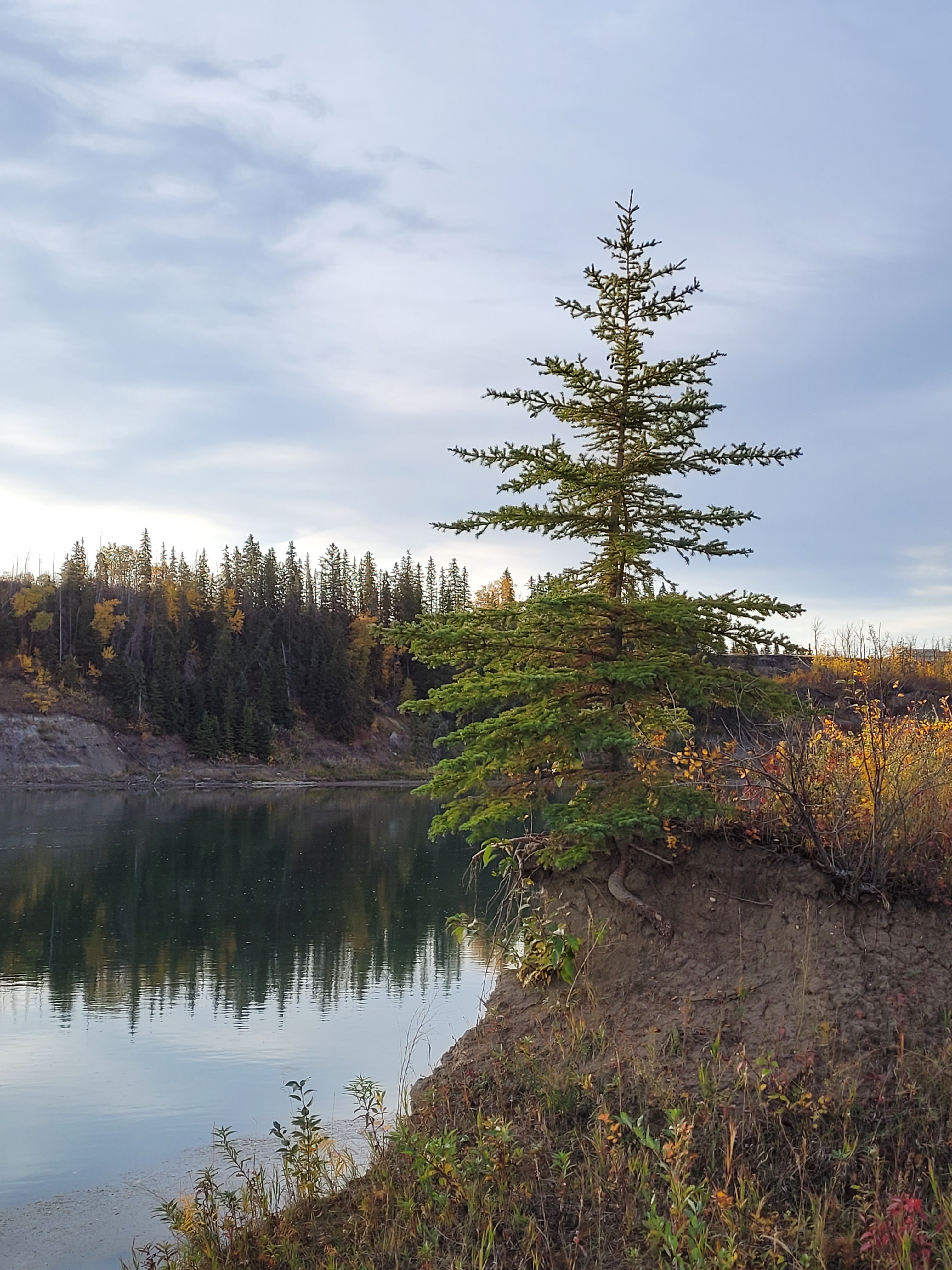
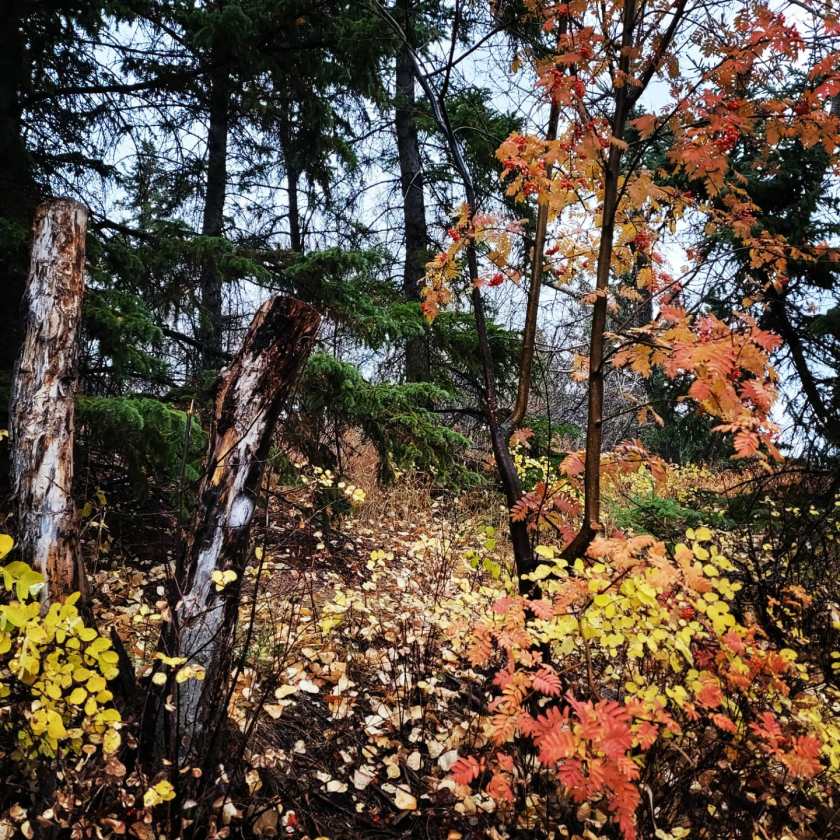
My photographs are glimpses into the sense of place I encounter as I walk – “that magical stuff of ‘the moments inside the moments inside the moments.’” (Maira Kalman). What shimmers – audaciously or subtly – and has me gasp with delight, or stop and turn around to really take in the moment? What is different or the same this year, from when I walked the same stage last year? What memories are evoked, impressions stirred, conversations silently replayed, or spoken anew now?
“With the utmost love and attention the person who walks must study and observe every smallest living thing, be it a child, a dog, a fly, a butterfly, a sparrow, a worm, a flower, a man, a house, a tree, a hedge, a snail, a mouse, a cloud, a hill, a leaf, or no more than a poor discarded scrap of paper on which, perhaps, a dear good child at school has written his first clumsy letters.”
Henry Thoreau, The Walk, 1861
Last year walking, it was a friend’s question about what I did with my photos – having watched me pause many times that glorious Saturday, to frame the image and focus my camera, fall behind the group and then catch up – that planted the seed for creating a photo journal of how I experienced my life during the pandemic. The first volume of one hundred pages, from March to December, 2020, and now a second volume almost at capacity with three months of this year still to enter. Too, my husband suggested I make a photo book exclusively of my Camino photos in appreciation for the co-ordinator’s efforts in planning and hosting all thirteen stages last year. As our host didn’t follow along on social media, it was the first time he saw in its entirety the beauty of what he had envisioned and coordinated for us, through the beauty I had captured and created for him.
“…the genius of walking lies not in mechanically putting one foot in front of the other en route to a destination but in mastering the art of sauntering – which word is beautifully derived “from idle people who roved about the country, in the Middle Ages, and asked charity, under pretense of going a la Sainte Terre, to the Holy Land, till the children exclaimed, “There goes a Sainte-Terrer,” a Saunterer, a Holy-Lander. “
Henry Thoreau, The Walk, 1861
Since 2000 I’ve waxed and waned with the dream of walking a camino, ever since I read Shirley MacLaine’s memoir. She brought to mainstream consciousness the ancient pilgrimage through France and northern Spain to Santiago de Compostela, today known as The Way, or Camino Frances, the same one walked by Oliver Schroer. There are many camino routes, ending at Santiago, or Italy’s Vatican, or through the forests and shrines of Japan. Last year, walking the Camino de Edmonton I learned that my way of walking is to saunter. I need to take my time to notice, to observe, to photograph, to hum a tune, sing a made-in-the-moment, soon-to-be-forgotten lyric. I enjoy conversation, and have had some delightful, edifying ones. And then what I notice – the shiny and the shimmer, the magic that suddenly catches my eye and speaks to my heart – shifts my attention.
And so, thinking more intentionally about a long distance “saunter” to Santiago, through Portugal, next year, the “easy walk” – taking several more days than the typical two week allocation – with ample time to rest and appreciate the ambiance of local villages, having my accommodations with breakfasts pre-booked, and luggage transferred, viscerally has me gasp with delight and settle my covid concerns. New impressions…the moments inside the moments…the magical stuff…the glory of life.
And hearing inside my heart, Oliver Schroer’s homage to the Camino de Santiago, “Field of Stars.” (Click the link to listen.)
“I went because I knew others who had gone, and the experience filled them with wonder.”







 A Wabi Sabi Life